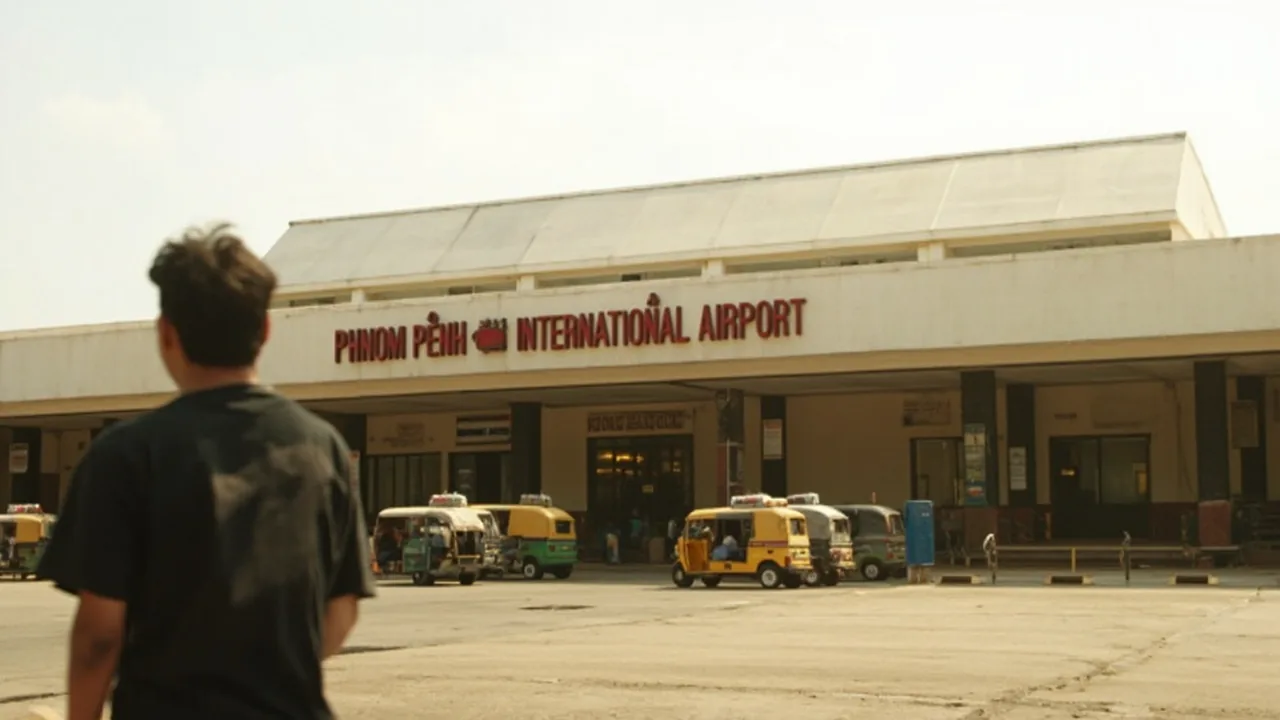
Phnom Penh PNH Airport Guide: Terminals, Transit Visa, Immigration & Arrival Tips
Subodh’s Pro Tip: Have two recent passport-sized photos and crisp US dollars ready in your hand before you reach the visa counter. Without photos, the officials add a surcharge and won’t have change for a large bill.
Phnom Penh PNH airport (officially Pochentong International, code: PNH) is Cambodia’s main international gateway, a single mid-sized terminal serving everything from Bangkok shuttles to Siem Reap layovers. For Indian backpackers looping through the Thailand-Vietnam-Laos-Cambodia route, PNH is often where you cross from Bangkok or Saigon into the Kingdom of Wonder. Arrival here is manageable once you know the layout: one terminal, three zones (landside for transit, airside for connecting flights, and arrivals for entry), a visa-on-arrival counter before immigration, and a short ride into the city afterward. Visa fees and terminal flow were cross-checked against the official Cambodia immigration website and verified against current traveller reports.
Quick Answers
| What | Answer | Price (INR) |
|---|---|---|
| Airport code | PNH (officially Pochentong International) | Free |
| Do Indians need a visa? | Yes, visa on arrival or e-visa required | ₹2,892 (~30 USD) |
| Transit visa needed? | Only if leaving the airport during a layover (tourist visa required) | ₹2,892 (~30 USD) |
| Immigration time | Usually 15-40 mins depending on flight cluster | Free |
| Distance to city centre | ~8-10 km to Riverside / BKK1 area | Free |
Safety Alert: PNH airport has historical reports of aggressive taxi touts and overpriced SIM stalls inside the terminal. Walk past the taxi desk, ignore SIM vendors with no price boards, and use only the official Grab pickup zone on the ground floor outside.
Phnom Penh Airport (PNH) Layout: One Terminal, Clear Flow
Unlike Bangkok’s BKK or Saigon with multiple terminals, Phnom Penh operates out of a single terminal. This makes connections short and walking distances minimal. The terminal has two main public levels for arriving international passengers:
- Ground floor (Arrivals): visa-on-arrival counters, immigration booths, baggage claim, customs exit.
- First floor (Departures): check-in desks, duty-free, airside transit corridor, food court.
For transit passengers staying airside (without clearing immigration), the layout is even simpler: walk straight from the gate down the central corridor to your next departure gate. Arrivals and departures are stacked across two main public levels of the terminal.
For Indian backpackers entering Cambodia for the first time, the “Visa on Arrival” section immediately follows immigration control, so once the plane lands, you queue first at visa, then at passport control, then at baggage claim, then at customs. Signs are bilingual (Khmer and English); Hindi is not posted, but the process is straightforward and officers speak enough English to handle routine questions. For a broader look at Cambodia travel, check our Southeast Asia Backpacking Hub.
Visa on Arrival for Indian Passport Holders (2026)
Indians need a valid visa to enter Cambodia, and PNH is one of the country’s two main entry points where you can sort it on the spot. Two options exist:
Option 1: Visa on Arrival (VOA). Walk up to the dedicated counter before passport control, fill a quick form, hand over your documents, wait 10-20 minutes. You will need:
- Two passport-sized photos (Indian photo spec works fine).
- ₹2,892 (~30 USD) cash for the tourist visa fee.
- Valid passport with at least 6 months validity and 1 blank page.
The official fee is ₹2,892 (~30 USD). Some officers bundle a processing charge into “₹3,374 (~35 USD) total” and some quote the base fee separately. Travellers report the cleanest transactions when you hand over the passport with photos already attached and the combined amount ready.
Option 2: Cambodia e-Visa. Apply online via the official Cambodia e-visa portal before flying. Cost is ₹3,471 (~36 USD) total, which includes the visa fee and processing. Processing normally takes 3 business days. E-visa lets you skip the visa counter and head straight to immigration at PNH.
Both visa classes grant a 30-day stay, with one standard extension available for ₹4,338 (~45 USD) from the immigration office in Phnom Penh or Siem Reap.
Subodh’s Pro Tip: The e-visa is cleaner and removes the photo-haggling risk, but it locks you to specific entry ports (Phnom Penh, Siem Reap, Sihanoukville, and a few land crossings). If you’re entering overland from Bangkok via Poipet, you must use a visa on arrival at the border, not an e-visa.
Transit Visa: Do You Need One?
For backpackers with a stopover at PNH on the way to Siem Reap or Bangkok, the answer depends on whether you stay airside or go landside. If you’re flying onward to Siem Reap, check our Siem Reap Airport Guide for arrival tips there.
Same-airline domestic connection (e.g. Bangkok → PNH → Siem Reap): No transit visa, you stay in the secured transit corridor between international and domestic gates and never clear immigration. Bags transfer on certain airlines but not all, check with the carrier before flying.
Airside transit only (e.g. Bangkok → PNH → Saigon, same booking): No transit visa needed. You stay airside and pass through transit security. PNH handles this efficiently because the terminal is small.
If you want to leave the airport during a long layover (common on overnight Bangkok-PNH routes with morning departures): You need a standard tourist visa on arrival (₹2,892 (~30 USD)) or a pre-approved e-visa (₹3,471 (~36 USD)). Cambodia does not issue a separate transit visa — if you exit the terminal, you enter the country and need the same visa as any other visitor.
For most Indian backpackers doing the standard Vietnam-Cambodia-Thailand loop, you enter Cambodia once, spend a few days in Phnom Penh, then fly out to Bangkok or Saigon on the same booking or a separate one. If you only have a short airside layover and stay in the transit corridor, no visa is needed at all.
Immigration Process: What to Expect at PNH
Once you have your visa stamp in hand (or e-visa printed), the immigration queue is your next stop. In 2026, average wait times at PNH during peak morning arrivals (Bangkok, Saigon, Singapore flights) run 20-40 minutes, while midday arrivals from China/Korea clear in 10-15 minutes.
Officers ask routine questions:
- Purpose of visit? Tourism.
- Where are you staying? Name your hostel or guesthouse.
- How long? State your planned nights.
- Return ticket? Yes, show your onward flight printout.
Have a printed hotel/hostel confirmation and your onward flight ticket ready. Many officers won’t ask for them, but having them on your phone or printed saves time if they’re being thorough.
After passport control, you pass through customs (green channel for “nothing to declare,” red for goods above the duty-free allowance) and exit into the arrivals hall. This is where touts and taxi drivers line up aggressively. Once you’re in the city, check our Cheap Things to Do in Phnom Penh for budget-friendly activities.
Currency Exchange at PNH
The official rate at Phnom Penh Airport is slightly worse than in the city, but the airport counters let you skip the ATM hunt on day one.
- 1 USD ≈ ₹96.3294 at current rates (verified 2026-07-17 against ExchangeRate-API).
- Airport money changers give around ₹95-₹97 (~4,000-4,050 KHR or ~$0.99-$1) per ₹96 (~1 USD).
- ATMs from Canadia Bank and ABA accept international cards (Mastercard, Visa, UnionPay); Indian Rupee cards (HDFC, ICICI, SBI) generally work but with a ₹482-₹675 (~5-7 USD) withdrawal fee per transaction.
For Indian travelers carrying forex cards (HDFC, Niyo, or Thomas Cook), the ₹482 (~5 USD) ATM fee often makes currency exchange more cost-effective. Travellers report that withdrawing from ABA or Sathapana Bank ATMs in the city gives the best rate overall.
Safety Alert: Outside the terminal arrival doors, you will find local drivers offering “500 baht to city, no meter.” Skip them. Use the official Grab pickup zone on the left side of the arrivals curb, or walk 200 meters past the terminal to flag a tuk-tuk or PassApp (Cambodia’s local Grab equivalent) at fair market rates.
Getting From Phnom Penh Airport to the City Centre
The airport sits about 8-10 km west of the city centre (Riverside, BKK1, BKK3 districts where most backpackers stay). If you’re comparing airport transfers across the region, our Ho Chi Minh City Airport Guide covers a similar route on the Vietnam side.
| Mode | Cost (LOCAL) | Time | Note |
|---|---|---|---|
| Grab / PassApp | ₹334-₹477 (~14,000-20,000 KHR or ~$3.46-$4.95) | 25-40 mins | Cleanest option, app-based |
| Airport Taxi (official desk) | ₹868-₹1,157 (~9-12 USD) | 25-30 mins | Fixed price, but inflated |
| Tuk-tuk | ₹596-₹954 (~25,000-40,000 KHR or ~$6.18-$9.89) | 30-50 mins | Negotiable, slower in traffic |
| Shared Shuttle | ₹964 (~10 USD) | 45-60 mins | Booked via hostels |
The Grab app (or local PassApp / WeCambodia app) is the smoothest option for Indian travelers with working data. The fare from PNH to Riverside is usually ₹358-₹429 (~15,000-18,000 KHR or ~$3.71-$4.45). Tuk-tuks outside the terminal will quote in USD or Thai Baht; if they do, walk past the first row of drivers and find one who quotes in riel. The rate will be fairer.
Getting Connected: SIM Cards at PNH
You need working data to use Grab/PassApp and to communicate with hostels. The airport has two options:
Option 1: Physical SIM. Smart, Cellcard, and Metfone have booths inside the arrivals hall. Prices range from ₹482-₹964 (~5-10 USD) for tourist SIMs with 5-15 GB data valid 7-30 days. Smart is the most reliable for travelers.
Option 2: eSIM. If your phone supports eSIM (most Indian phones from the last 3 years do), you can activate before landing and have data the moment you step out.
Where to Stay Near the Airport
Most backpackers head into town, but if you have an early morning flight or overnight layover, these spots work:
| Type | Location | Price (LOCAL) |
|---|---|---|
| Dayuse | Airport lounges | ₹1,928-₹3,856 (~20-40 USD per 3-4 hour block) |
| Transit hotel | Inside terminal | ₹7,712 (~80 USD/night) |
| Riverside hostels | 25-40 mins from PNH | ₹715-₹1,430 (~30,000-60,000 KHR or ~$7.42-$14.84) |
For overnight layovers, the airport transit hotel inside the terminal is clean but overpriced (₹7,712-₹11,568 (~80-120 USD)). Many travelers find it cheaper to clear immigration, take a Grab to town, stay at a proper riverside hostel, and re-enter the airport the next morning. Once in town, eat at Gorkha Palace Phnom Penh Indian and Nepalese Restaurant for Indian/Nepalese dishes (rated 4.8), Phnom Penh Three Rivers Restaurant for riverside Cambodian food (rated 4.9), or CHINGU Cafe Phnom Penh for Korean brunch (rated 4.8).
Connecting Flights: Phnom Penh to Bangkok, Saigon, Siem Reap
Most Indian backpackers fly out of PNH in one of three directions. For the full breakdown of transport options within Cambodia, see our Cambodia Transport Guide. If you’re weighing the flight vs bus to Siem Reap, read our Phnom Penh to Siem Reap Cost Guide for real pricing.
| Route | Duration | Operator | Book |
|---|---|---|---|
| Bangkok ↔ Phnom Penh | ~1h 20m | Thai AirAsia, Bangkok Airways | Book on 12go |
| Phnom Penh ↔ Siem Reap | ~45 mins | Cambodia Angkor Air | Book on 12go |
Domestic flights to Siem Reap are not much faster than the bus (₹1,157 (~12 USD), 6 hours) when you factor in airport time, but they win on comfort. Check whether your ticket is on a single PNR or split booking. Single PNR means your luggage checks through; split booking means you must collect bags and re-check.
Common Mistakes Indians Make at PNH
1. Arriving with a ₹9,640 (~100 USD) bill and no change. Counter officials won’t break it. Bring smaller denominations.
2. Trying to pay the visa fee in Indian Rupees. The official fee is USD only. KHR is technically accepted but you get a bad rate.
3. Skipping photos and paying the “no-photo” surcharge. Always bring two photos. Saves hassle.
4. Using the front-row airport touts. They quote 3x to 4x the local rate and refuse meters. Walk past them.
5. Not downloading offline maps before landing. Grab/PassApp needs data. Have Get Nomad eSIM or buy a SIM at the airport before leaving the terminal.
Subodh’s Take
Phnom Penh Airport is small enough that you can walk it in under five minutes once you know the flow. The biggest hurdle for Indian backpackers isn’t the terminal, it’s the visa-on-arrival haggle. Smooth it out with two photos, a ₹3,374 (~35 USD) bill, and a printout of where you’re staying. Everything after that, the city is calling you. When hunger hits, Gorkha Palace Phnom Penh Indian and Nepalese Restaurant does solid Indian/Nepalese, and Phnom Penh Three Rivers Restaurant is the riverside spot for your first Cambodian meal.
FAQ
Can Indians get a visa on arrival at Phnom Penh Airport? Yes. $30 USD + $5 processing = $35 total. Bring two passport photos and a $35 bill. E-visa (₹3,471 (~36 USD) total) is available online for cleaner entry.
Do I need a transit visa for an overnight layover at PNH? Only if you leave the airport airside. Stay in the transit corridor for free; no visa needed for connections. If you exit the terminal, you need a standard tourist visa (₹2,892 (~30 USD) on arrival) or a pre-approved e-visa (₹3,471 (~36 USD)). Cambodia does not issue a separate transit visa.
How long is the immigration queue at Phnom Penh Airport? 15-40 minutes depending on flight cluster. Morning arrivals from Bangkok, Saigon, and Singapore are the busiest.
Is Grab available at Phnom Penh Airport? Yes. The official Grab pickup zone is on the ground floor, outside the main terminal exit, to the left. Fares to the city centre run ₹334-₹477 (~14,000-20,000 KHR or ~$3.46-$4.95).
Can I pay the visa fee with Indian Rupees or UPI? No. The visa fee must be paid in USD cash. UPI, Indian cards, and riel are not accepted at the visa counter. Have a ₹3,374 (~35 USD) bill ready.
How far is Phnom Penh Airport from the city centre? About 8-10 km. The ride takes 25-40 minutes depending on traffic via Monivong Boulevard.
— Subodh
