Photography Spots Sea of Temples in Bagan (2026)
Bagan is a top bagan niche activity for Indian backpackers, with over 2,000 temples spread across 26 sq km of dry plain. The “sea of temples” effect is real if you stand in the right spot at the right hour. This guide lists the exact sunrise/sunset viewpoints, what each one costs, and where the drone rules bite.
Where to Stay
Backpackers mostly stay in Nyaung U near the market cluster, where guesthouses run 25,000 MMK for a basic double with fan and attached bath. For a quieter base closer to the sunrise temples, Old Bagan has a handful of small hotels at 40,000 to 60,000 MMK. Book the first night in advance during November to February.
Quick Answers
| What | Answer | Price (INR) |
|---|---|---|
| Best sunrise spot | Shwesandaw Paya (south platform, before 5:30 AM) | Free |
| Best sunset spot | Bulethi Paya or Pyathada Paya | Free |
| Drone allowed? | No, tourist drones banned in the Bagan Archaeological Zone | — |
| Photography zone fee | 25,000 MMK (foreigners, per person) | ₹1,675 |
| Hot air balloon ride | From ₹28,439 (~295 USD) per person, sunrise only | ₹28,439+ |
| Best season | November to February (dry, low dust) | — |
| Currency | 1 MMK ≈ ₹0.67 at current rates | — |
Note: Myanmar’s domestic situation is fluid. Check the Indian MEA travel advisory and the Myanmar Ministry of Information before booking flights. Several airlines have reduced Yangon routes through 2026.
What Is the “Sea of Temples” in Bagan?
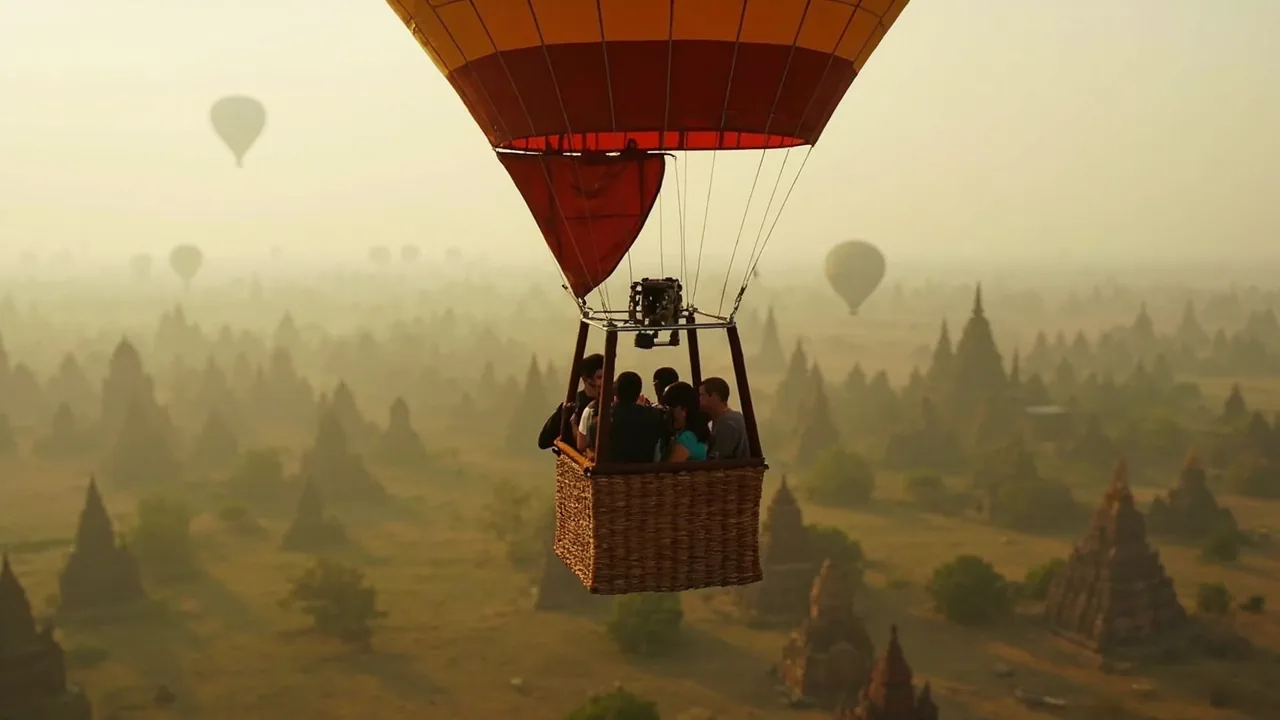
The Bagan Archaeological Zone covers the plain between the Irrawaddy River and the Tuyin Taung hills in central Myanmar. Between the 9th and 13th centuries, Bagan’s kings built over 10,000 Buddhist temples and pagodas here; about 2,200 still stand. From the right vantage point, especially at sunrise or sunset when the brick turns orange and the hot air balloons drift across the horizon, the clustered spires look like a forest or a sea. That visual is what every photographer is chasing when they come to Bagan.
Step-by-Step: Planning Your Bagan Photography Trip
Step 1: Pay the Archaeology Zone Fee
Every foreigner entering the zone pays 25,000 MMK at one of the official counters (Nyaung U, Old Bagan, or the airport). You get a paper pass to keep on you. Travellers report getting checked at random temples, especially the popular sunrise ones, so carry the pass. It is valid for the whole zone for the duration of your stay, not per temple.
Step 2: Pick Your Sunrise Viewpoint
Three options, in order of crowd level:
- Shwesandaw Paya: the classic. Climb the south platform by 5:00 AM in dry season. The view faces east over the plain, balloons rise in front of you, and the sun clears the horizon behind you. Expect 50 to 150 other photographers even in low season. Closed for restoration some years; check locally.
- Taung Bi Ta Paya: a smaller stupa with similar views and one tenth of the crowd. Locals know it; ask your guesthouse.
- Pyathada Paya: better as a sunset spot but works at sunrise too, with the river in the foreground.
Most travellers agree the balloons above Bagan are the headline shot, and Shwesandaw is where you get it. For a full one-day temple-hopping plan with balloon cost breakdowns, see the Bagan sunrise spots and balloon cost guide.
Step 3: Pick Your Sunset Viewpoint
Sunset faces west, so you want a temple on the east side of the zone looking west across the plain. The top picks:
- Bulethi Paya: slightly elevated, fewer crowds than Shwesandaw, good golden-hour light on the brick.
- Pyathada Paya: views down toward the Irrawaddy. Popular with local guides for the river reflection at golden hour.
- Lawkananda Paya: riverside, you get the water in the frame with the sun dropping behind the western hills. Quieter than the inland spots.
Step 4: Shoot the Mid-Morning Temples Without Crowds
Between 9:00 AM and 11:00 AM the tour buses have left and the light is harsh, which helps inside narrow temple corridors. Two temples give you better mid-morning frames than sunrise ones:
- Dhammayangyi Temple: the largest in Bagan, dense brickwork, narrow corridors, moody shadows. No shoes inside, bring socks for the hot stone floor.
- Ananda Temple: gilded spires, four standing Buddhas facing four directions, the gilded hall reads well against blue sky. Entry to the inner chamber sometimes restricted, check at the gate.
- Apalyadana Temple: small, often empty, frescoes inside. Excellent if you want architecture detail shots with no people.
Step 5: Get the Balloon Shot
Balloons over Bagan operates sunrise flights from October to March (weather permitting). Standard flight is ₹28,439-₹40,972 (~295-425 USD) per person depending on basket class. The balloon carries you over the zone at roughly the height of the spires, so you get a top-down sea-of-temples frame that is impossible from the ground. Flights sell out two to four weeks ahead in peak season (December to February).
If you cannot afford the balloon, the second-best frames come from a hired motorbike ride up to one of the small ridges west of Old Bagan around 5:30 AM. Travellers report shooting balloons rising against a low sun from dirt tracks with no one else around.
Step 6: Get Around
Most backpackers rent an e-bike in Nyaung U for 5,000 to 8,000 MMK per day. Fuel up the night before, the stations near the temples close early. Carry a printed map, mobile data is patchy on the plain. Some roads inside the zone are closed to e-bikes past 6:00 PM, so plan the sunset ride back.
The 7 Best Photography Spots in Bagan
- Shwesandaw Paya, south platform (sunrise): the canonical sea-of-temples shot. Climb before 5:00 AM in dry season.
- Bulethi Paya (sunset): west-facing, calmer than Shwesandaw, golden hour on the brick spires.
- Lawkananda Paya, riverbank (sunset): Irrawaddy in the foreground, sky turning pink behind the western hills.
- Dhammayangyi Temple, east corridor (mid-morning): dense brickwork and shadow play, narrow passages work for portrait framing.
- Ananda Temple, north spire (late morning): golden stupa against blue sky, four directional Buddhas inside for symmetrical frames.
- Apalyadana Temple, interior (midday): frescoes, no crowd, fine detail shots with a 35mm or 50mm lens.
- Pyathada Paya (sunset): views across the plain to the river, fewer people than Shwesandaw.
Old Bagan is also worth a half-day walk on its own, even if the famous spires here are smaller than the headline pagodas.
Common Mistakes Indians Make in Bagan
Mistake 1: Bringing a drone
Tourist drones are banned in the Bagan Archaeological Zone. Travellers report customs at Yangon airport flagging drone gear at the baggage scanner, and the zone checkpoints will confiscate drones if you try to fly. The rule has been in place since 2016 and remains enforced in 2026. Leave the DJI at home.
Mistake 2: Wearing wrong shoes for temple interiors
You take shoes and socks off at every temple floor entrance. Stone is 40 to 50 degrees C at midday in dry season. Travellers burn their feet and limp for two days. Carry thick cotton socks in your daypack. See the Southeast Asia packing list for what else to bring.
Mistake 3: Showing up at Shwesandaw for sunrise at 6:15 AM
By 6:15 AM the top is packed and the sun is already up. You need to be at the platform by 4:50 to 5:10 AM in November to February. Set two alarms, walk in the dark with a torch, bring water.
Mistake 4: Spending all three days on the same three temples
Shwesandaw, Dhammayangyi, and Ananda cover 80 percent of the famous photos, but the quieter pagodas (Apalyadana, Sulamani, Nathlaung Kyaung) give you empty frames at golden hour. Hire an e-bike for a half-day loop and stop at whatever catches your eye.
Mistake 5: Paying for the zone fee in USD
The 25,000 MMK is the official rate. Some touts at the airport try to charge ₹1,928-₹2,892 (~20-30 USD) per person for “zone entry plus guide.” The fee is fixed and paid at the official counters only. Politely walk past the touts.
What Most Guides Don’t Tell You
Edge case 1: Shwesandaw closures
The platform has been closed for restoration in past years, sometimes with two days notice. If you arrive at 4:50 AM and the gate is locked, you have maybe 15 minutes to ride to Taung Bi Ta or Bulethi. Travellers report hotel staff knowing the closure status the night before, ask at check-in.
Edge case 2: The “monkey forest” listing
You may see “Sacred Monkey Forest Sanctuary in Bagan” listed on tour platforms. That sanctuary is in Ubud, Bali, not Bagan. The platforms index tours across Southeast Asia under similar keywords. Skip the listing, it is a search artefact.
Edge case 3: Visa and entry changes
Myanmar suspended e-visa issuance to several nationalities in 2024 and 2025 and the policy can change month to month. Indian passport holders currently need to apply through the official Myanmar e-visa portal or collect a visa on arrival at Yangon airport, but verify before you book flights. See the Myanmar visa guide for Indians for current fees and processing times. The Indian MEA page and the Myanmar Ministry of Immigration are the two sources to cross-check.
Edge case 4: Cash only
Most temples, e-bike rentals, and small restaurants in the zone do not take cards or UPI. Carry clean, unmarked USD bills in 20, 50, and 100 denominations for the bigger fees (zone pass, balloon booking, hotel), and break them into MMK at a Nyaung U money changer for daily expenses. Torn or stamped USD bills are often refused. See the best forex card for India guide for the few cases where a card helps in Myanmar.
Where to Eat Between Shoots
After a 4:30 AM sunrise you will want breakfast and coffee. Nyaung U has the densest cluster of cafes near the market. A few specific spots:
- Kyal Sin Thit: Burmese tea-leaf salad (around 3,500 MMK), Mohinga (around 2,500 MMK), the local breakfast soup. Travellers report it being clean and quick.
- Elodie Restaurant: bigger menu, good for a slow lunch with air conditioning when the noon heat hits.
- Top Star Restaurant Bagan: panoramic view across the plain from a rooftop. Order the tea-leaf salad (their signature), Mohinga, and a Mandalay-style rice plate.
- TS Bagan Restaurant: Burmese dishes with a modern presentation. Works for dinner when you are tired of curry.
- Bagan Beach Food Garden: riverside setting on the Irrawaddy, fresh seafood and barbecue in the evening.
For strict-veg days, two options serve plant-based Burmese food without egg or fish sauce:
- The Moon Vegetarian Restaurant: vegetarian Burmese dishes, mild flavours, easy on the stomach after a long day on a bike.
- Khaing Shwe Wha Vegetarian Restaurant: Burmese veg menu in a clean setting, popular with the local Myanmar vegetarian community.
Note: Burmese vegetarian dishes often use fish sauce as a base. If you need strict Jain or no-onion-no-garlic food, ask specifically. Dal-chawal and roti are not on most menus here, unlike Thailand or Vietnam.
Connectivity: SIM and eSIM
Foreign SIMs are sold at Yangon airport and at the official MPT, Ooredoo, and Telenor counters in Nyaung U. For a full comparison of SIM cards across Southeast Asia, MPT tourist SIMs run around 15,000 to 25,000 MMK for 7 to 15 days of data. Coverage on the Bagan plain is weak inside temples (thick brick blocks signal), strong in open areas and on the riverbank.
If you want to skip the airport queue, Get Nomad eSIM covers Myanmar on regional Asia plans, though data speeds on the Bagan plain are similar to local SIMs because the backhaul is the same. Pick eSIM if you are arriving late at Yangon and do not want to queue.
Carry a printed map and offline Google Maps for the zone. The plain looks uniform at 5:30 AM and most dirt tracks between temples are not on the standard map.
Daily Budget (Photography-Focused)
Verified 2026-07-17 at 1 MMK ≈ ₹0.67.
| Item | Cost (MMK) | Cost (₹) |
|---|---|---|
| Zone pass (one-time) | 25,000 | ₹1,675 (~$17.37) |
| E-bike rental per day | 6,000 | ₹400 (~$4.15) |
| Petrol per day | 3,000 | ₹200 (~$2.07) |
| Breakfast (tea + Mohinga) | 2,500 | ₹170 (~$1.76) |
| Lunch at Elodie or TS Bagan | 6,000 | ₹400 (~$4.15) |
| Dinner at Top Star or Bagan Beach | 8,500 | ₹570 (~$5.91) |
| Guesthouse (basic double) | 25,000 | ₹1,675 (~$17.37) |
| Balloon ride (if booked) | 295,000+ | ₹19,750 (~$204.87)+ |
| 3-day total (no balloon) | ~230,000 | ~₹15,400 (~$159.74) |
Add roughly 8,000 to 12,000 MMK per day if you also hire a guide for half-day temple runs. A guide helps with restricted inner chambers and the small temples most tourists miss. For a complete SEA trip budget reference, see the Southeast Asia trip cost from India breakdown.
Best Season and Timing
- November to February: dry, dust-free, balloons fly almost daily. The peak photography window. Temperatures 15 to 30 degrees C. This is when the famous shots get made.
- March to May: hot (40 degrees C plus), dust haze, balloons often grounded. The brickwork reads well at sunrise but midday is brutal.
- June to October: monsoon, green plain, fewer tourists, balloons rarely fly. Photographers who do not mind rain get lush fields and empty temples, but visibility drops.
Sunrise in November is around 6:15 AM, sunset around 5:30 PM. In January sunrise shifts to 6:30 AM. Plan accordingly.
FAQ
Can I fly a drone in Bagan?
No. Tourist drones are banned in the Bagan Archaeological Zone. Customs at Yangon airport will flag them, and zone checkpoints will confiscate them. Leave the drone at home.
Do I need a visa for Myanmar as an Indian citizen?
Indian passport holders need a visa. The official Myanmar e-visa portal processes applications in about 3 to 5 working days. Verify the current rules at the Myanmar Ministry of Immigration and the Indian MEA travel advisory before booking, the policy has changed year to year.
Are the sunrise platforms safe at 5 AM?
Yes, but the brick stairs are uneven and there are no railings at the top. Wear shoes with grip, bring a torch, and watch your step in the dark. Travellers report minor falls every season, usually because of smooth stone worn by foot traffic.
Can I shoot inside the temples with a tripod?
Tripods are technically restricted inside the inner chambers of major temples (Ananda, Thatbyinnyu, Dhammayangyi) to prevent damage to frescoes and floors. Handheld is fine. Outside on the terraces, tripods are tolerated outside prayer hours. Ask at each temple before setting up.
Is it worth hiring a guide for photography?
A guide helps with restricted chambers, frescoes, and the smaller temples you would not find on a map. For pure landscape shots (sunrise/sunset from a known viewpoint) you do not need one. Travellers report paying 15,000 to 25,000 MMK for a half-day guide who knows the quiet photo spots.
Will my Indian debit or credit card work in Bagan?
Most shops, restaurants, and the zone counters in Bagan do not accept foreign cards. Carry clean USD bills and break them into MMK in Nyaung U. See how to carry money from India abroad for the broader Southeast Asia cash strategy.
Are hot air balloon flights running in 2026?
Balloons over Bagan runs sunrise flights from roughly October through March, weather permitting. Book two to four weeks ahead for December and January. See Balloons over Bagan tour for current rates and dates.
Subodh’s Take
The sea-of-temples shot is doable on a backpacker budget if you skip the balloon and ride an e-bike for two mornings. The catch is that everyone else is doing the same thing, so the famous sunrise platforms are crowded by 5:30 AM. What separates a good Bagan photo trip from a generic one is a half-day on the quieter temples (Apalyadana, Sulamani, the ones north of Old Bagan) where you have the frame to yourself. Do one balloon morning if your budget allows, one quiet temple afternoon for the detail shots, and one sunset at Lawkananda for the river. That is enough to come home with a portfolio instead of three photos of the same pagoda.
