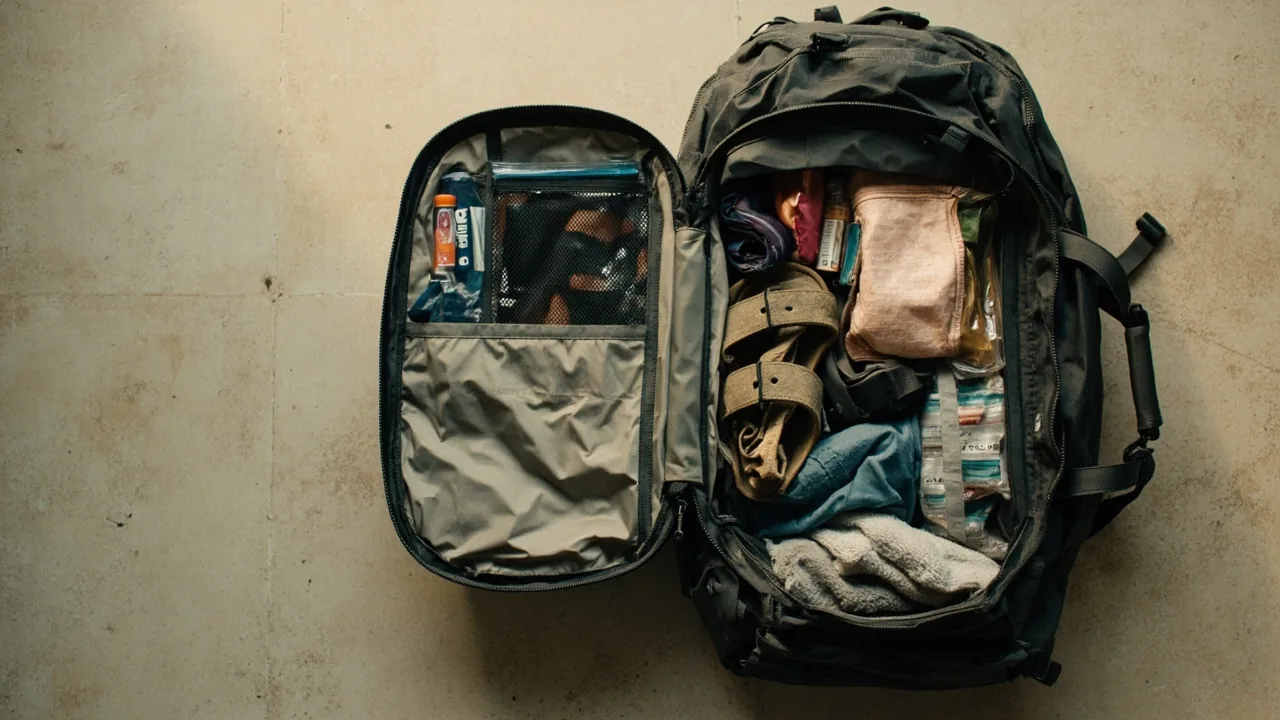
What to Pack for 21 Days in Southeast Asia: The Definitive Backpacker List (2026)
You need a 40 to 50 litre backpack, four or five t-shirts, two pairs of quick-dry pants, one rain jacket, sandals that grip wet tile, and a small lock for hostel lockers. This backpacking packing list southeast asia checklist covers everything for a 21-day loop through Thailand, Vietnam, Laos, and Cambodia. Everything else is noise.
The short version fits in a 50-litre pack weighing under 8 kg. If yours weighs more than 10 kg before you leave home, you’ve packed too much. Every item below earns its weight with a specific job.
Planning your route? Start with our Southeast Asia backpacking hub for country-by-country guides, budgets, and itineraries.
Quick Answers
| What | Answer | Price (INR) |
|---|---|---|
| Backpack size | 40 to 50 litres | |
| Pack weight (empty) | Under 2 kg | |
| Total loaded weight | Under 8 kg | |
| Clothes count | 4 t-shirts, 2 pants, 1 shorts, 5 socks/underwear | |
| Shoes | 1 worn, 1 packable sandal | |
| Toiletries | 100 ml liquids, decanted | |
| Documents | Passport + 4 photos + 2 photocopies | |
| Money | ₹15,000 (~$155.60) cash + forex card | |
| Travel insurance | Mandatory | See below |
The Backpack Itself
A 40 to 50 litre pack with a hip belt, lockable zips, and a rain cover is the sweet spot. Anything bigger invites overpacking. Anything smaller (under 35L) forces uncomfortable compression on a 21-day trip.
Subodh’s Pro Tip: Pick a pack with a front-opening clamshell design, not just top-loading. You will live out of this bag in hostels, and top-loaders become a tangled mess by day three.
Popular choices with Indian backpackers in 2026 (see our full backpack gear guide):
- Decathlon Forclaz Travel 100 (50L), best budget pick, around ₹3,500 (~$36.31) to ₹4,500 (~$46.68) in India.
- Osprey Farpoint 40, the gold standard for hostel travellers, around ₹9,000 (~$93.36) to ₹12,000 (~$124.48).
- Wildcraft Voyager 45L, widely available in Indian stores, around ₹3,000 (~$31.12).
Buy the pack first. Pack everything else around it. If a bag doesn’t fit, the bag is wrong.
Clothes: Less Than You Think
Three weeks of laundry access means you carry roughly one week’s worth of clothes. Hostels and guesthouses offer wash-and-fold for ₹86-₹144 (~30-50 THB or ~$0.89-$1.49), ₹74-₹147 (~20,000-40,000 VND or ~$0.76-$1.53), or ₹96 (~1 USD) per kg in Cambodia. Doing laundry every 4 to 5 days is normal.
Tops (4):
- 3 quick-dry t-shirts or merino-blend tees
- 1 long-sleeve shirt or rashguard for temples and sun
Bottoms (3):
- 2 quick-dry travel pants (zip-off legs are gold for buses)
- 1 pair of shorts (active shorts, not beach shorts)
Underwear and socks (5 each minimum):
- Merino or synthetic only. Cotton stays wet for hours in monsoon humidity.
Layers (2):
- 1 light fleece or hoodie (northern Vietnam and Laos get cold at night, December to February especially)
- 1 packable rain jacket (not a poncho; ponchos tear on day two)
Sleepwear:
- 1 set, or just wear a t-shirt and shorts
Swimwear:
- 1 pair. Trunks for men, any quick-dry set for women.
Subodh’s Pro Tip: Quick-dry fabrics are non-negotiable. Regular cotton jeans take 8+ hours to dry in 80% humidity. You will wear wet jeans on a sleeper bus exactly once before you learn this.
Footwear: Two Pairs, Maximum
Pair 1: Closed-toe shoes you already trust. Trail runners, walking shoes, or broken-in sneakers. These protect your feet on motorbike rides, jungle treks, and temple floors where stray dogs and sharp stones lurk.
Pair 2: Strappy sandals with a heel strap. Tevas, Chacos, or the Decathlon Quechua MH500. Flip-flops break on day three and offer zero grip on wet temple steps. A heel strap keeps them on during stream crossings and boat landings.
Leave hiking boots at home unless you’re doing Sapa or Doi Inthanon treks specifically.
Toiletries: The 100 ml Rule
Carry-on liquids max out at 100 ml per container in a single 1-litre zip bag. Most of what you need comes in sample sizes or solid forms now.
Essentials:
- Toothbrush, small toothpaste tube
- Roll-on deodorant (spray cans get confiscated at security)
- Solid shampoo bar or travel-size bottle
- Sunscreen SPF 50 (reef-safe if you swim)
- Insect repellent with 20 to 30% DEET
- Razor + 2 blades
- Quick-dry towel (Sea to Summit, 200 grams packed)
- Small first-aid kit (see below)
Skincare extras:
- Moisturizer in a contact-lens case (saves 80 ml of space)
- Lip balm with SPF
- Tampons or pads (limited availability outside Bangkok and Singapore)
Skip these:
- Full-size anything
- Hair dryer (hostels have them)
- Makeup beyond one small bag
- Perfume (it leaks and stains everything)
First Aid Kit
A small ziplock with:
- Paracetamol (10 strips)
- Loperamide for traveller’s diarrhoea (Imodium or Econorm)
- Oral rehydration salts (ORS sachets, 5 to 10)
- Ibuprofen for swelling and pain
- Antiseptic cream (Soframycin)
- Band-aids, 10 in mixed sizes
- Gauze and medical tape
- Blister plasters (Compeed)
- Antihistamine (Cetirizine)
- Your personal prescription meds with the prescription stapled to the packet
Safety Alert: Pharmacy access is good in Thailand and Vietnam, patchy in rural Laos and Cambodia. Bring enough of any prescription medication to last the full trip plus one week buffer.
Documents and Money
Passport and copies:
- Passport (6+ months validity beyond your return date; airlines will deny boarding otherwise)
- 4 passport-size photos (2 for visa-on-arrival backups, 2 for permits like the Ha Giang Loop or Angkor Wat passes)
- 2 photocopies of your passport ID page (separate from the originals)
- 1 photocopy of your visa or e-visa printouts
- Printed flight itinerary (immigration asks at land borders)
Money stack:
- ₹15,000 (~$155.60) to ₹20,000 (~$207.46) in USD cash (carry ₹9,640 (~100 USD) bills; torn or marked bills get refused in Cambodia and Laos)
- Forex card loaded with USD, see best forex card for Indians
- A Visa/Mastercard debit card as backup (UPI does not work outside India in 2026)
- Read our Southeast Asia visa guide for country-by-country entry rules
Insurance and bookings:
- Travel insurance policy number saved offline + printed
- Photocopies of insurance card
- Vaccination records if you’ve had Japanese encephalitis or typhoid (some Laos treks ask)
- Hotel/hostel addresses for the first 2 nights (border officials sometimes ask)
- Emergency contacts list (parents, embassy, insurance hotline)
Subodh’s Pro Tip: Email yourself a folder with scans of every document. Cloud access from any hostel Wi-Fi has rescued more than one backpacker who lost a bag in a tuk-tuk.
Tech and Electronics
- Phone (unlocked, dual-SIM slot if possible)
- Universal adapter (Type A, B, C, G across SE Asia; one adapter with USB ports beats a power strip)
- Power bank (10,000 mAh, under 100 Wh to fly legally)
- Earphones (cheap wired ones, they get lost or stolen)
- Headlamp or small flashlight (power cuts in rural areas)
- Quick-dry phone lanyard (insurance against pickpockets)
Charging cables:
- 1 USB-C, 1 Lightning if you use Apple, 1 short backup
- Avoid wireless chargers; they fail in humid climates
Travel Insurance
Non-negotiable for any trip crossing borders. Medical evacuation from Laos or Cambodia to a proper hospital can cost ₹4,820,185 (~50,000 USD)+. Indian travel insurance policies are patchy for motorbike incidents, which is the single most common injury in SE Asia. Compare options in our travel insurance guide.
The standard among Indian backpackers in 2026 is SafetyWing’s Nomad Insurance: $62/month (~₹5,900), covers COVID, trip interruption, and medical evacuation, and works across Thailand, Vietnam, Laos, and Cambodia without a country-by-country list.
What NOT to Pack
This is the section Reddit threads get wrong most often.
Leave at home:
- Towels (hotel towels or a quick-dry travel towel handle this)
- Books (Kindle app on your phone or trade paperbacks at hostels)
- Hair dryer, straightener, curling iron
- Full-size shampoo, conditioner, body wash
- Jeans (heavy, slow to dry, useless in humidity)
- Jewellery beyond one small chain
- Hiking boots unless doing a specific trek
- Drone without checking drone import rules per country
- Too many shoes (two pairs, see above)
Subodh’s Pro Tip: If you’re tempted to bring something, ask: “Can I buy this in Bangkok for under ₹1,436 (~500 THB or ~$14.89) if I need it?” If yes, don’t pack it. Bangkok, Hanoi, and Chiang Mai have Decathlon stores, pharmacies, and 7-Eleven on every block. You’ll replace forgotten items cheaply within 24 hours of landing.
Connectivity: SIM and eSIM
Physical SIMs in Thailand (AIS, dtac) and Vietnam (Viettel, Mobifone) cost ₹574-₹1,436 (~200-500 THB or ~$5.96-$14.89) or VND with 15 to 30 GB data valid 15 to 30 days. You’ll need your passport and the SIM tray tool (a paperclip works in a pinch).
For Laos and Cambodia, local SIMs are cheap (₹193 (~2 USD) to ₹482 (~5 USD)) but slow in rural areas. Many backpackers use an eSIM as backup.
If you’d rather skip the airport SIM counter, Get Nomad eSIM ships a regional Southeast Asia plan (5 GB for 30 days, around ₹868 (~9 USD)) that activates before you land.
Common Mistakes Indians Make
Mistake 1: Packing for every weather scenario. You check four countries, you want four wardrobes. Reality: a single layer system covers 90% of conditions. Add one fleece and one rain jacket. Done.
Mistake 2: Bringing Indian snacks for the whole trip. Maggi and Parle-G weigh 2 kg by themselves. Buy snacks on the road; Indian shops exist in Bangkok, Hanoi, and Phnom Penh.
Mistake 3: Forgetting that hostels have laundry. Travellers report packing 7+ t-shirts “just in case,” then washing one shirt a week. Save the weight.
Mistake 4: Overstuffing the liquids bag. A 100 ml contact lens case holds 30 ml of moisturiser. A 50 ml travel bottle holds shampoo for 10 showers. You don’t need a 200 ml bottle of anything.
Mistake 5: Skipping photocopies of documents. Border crossings in Laos (especially Huay Xai) and Cambodia (Poipet) sometimes want paper copies of your visa. No copy, no entry. Carry two.
What Most Guides Don’t Tell You
Get your vaccinations 6 weeks before flying. Japanese encephalitis, typhoid, hepatitis A, and tetanus boosters aren’t in your childhood shots. The Indian travel clinic in Delhi (and equivalents in Mumbai, Bangalore) does them all in one visit. Last-minute vaccination = no protection = risk on rural treks. See our health and vaccines guide for full details.
Pack a padlock for hostel lockers. Most dorm beds come with under-bed lockers that take a small combination lock or TSA lock. Without one, you’re trusting strangers with your passport and cash. Budget locks: ₹574 (~200 THB or ~$5.96) at any 7-Eleven in Bangkok.
Carry a thin scarf or sarong. It doubles as a temple cover-up (Thai temples require shoulders and knees covered), a pillow on sleeper buses, a towel in a pinch, and a sun shade. Five uses in one 150-gram item.
The 8 kg rule is firm. Every kilo above 8 kg is a kilo your back carries through Chiang Mai’s old city, up Sapa’s rice terraces, and across Angkor Wat’s temple complex in 35°C heat. If your bag hits 12 kg before departure, leave something behind.
Plan to spend on experiences, not gear. A ₹14,358 (~5,000 THB or ~$148.93) cooking class in Chiang Mai, a ₹4,420 (~1,200,000 VND or ~$45.84) Ha Giang Loop motorbike tour, a ₹138 (~32,000 LAK or ~$1.43) Mekong slow boat, these define the trip. A ₹15,000 (~$155.60) bag of “just-in-case” gear you never use doesn’t.
Packing Checklist (Print This)
| Category | Items | Count |
|---|---|---|
| Pack | 40 to 50L backpack with rain cover | 1 |
| Clothes | Quick-dry t-shirts | 4 |
| Travel pants (zip-off ideal) | 2 | |
| Shorts | 1 | |
| Underwear | 5 | |
| Socks | 5 | |
| Light fleece or hoodie | 1 | |
| Rain jacket | 1 | |
| Swimwear | 1 | |
| Shoes | Trail runners or walking shoes | 1 pair |
| Strappy sandals with heel strap | 1 pair | |
| Toiletries | Toothbrush, toothpaste, deodorant, shampoo bar | 1 set |
| Sunscreen SPF 50, insect repellent | 1 each | |
| Quick-dry towel | 1 | |
| First aid | Paracetamol, ibuprofen, ORS, loperamide, antihistamine | 1 set |
| Band-aids, gauze, antiseptic cream | 1 set | |
| Personal prescriptions | As needed | |
| Documents | Passport (6+ months validity) | 1 |
| Passport photos | 4 | |
| Passport photocopies | 2 | |
| Visa/e-visa printouts | As needed | |
| Travel insurance details | 1 set | |
| Printed hotel address (first night) | 1 | |
| Money | USD cash (₹9,640 (~100 USD) bills) | ₹19,281 (~200 USD) to ₹28,921 (~300 USD) |
| Forex card (USD loaded) | 1 | |
| Backup debit card | 1 | |
| Tech | Phone, charger, power bank | 1 set |
| Universal adapter with USB ports | 1 | |
| Earphones | 1 | |
| Headlamp | 1 | |
| Other | Padlock for hostel lockers | 1 |
| Sarong or thin scarf | 1 | |
| Reusable water bottle | 1 | |
| Daypack (collapsible, 15 to 20L) | 1 |
FAQ
How much should my backpack weigh fully packed? Under 8 kg including the pack itself. Indian travellers regularly arrive at 12 kg because they packed for “just in case.” Refuse. Buy on the road if needed.
Do I need a rain cover if my pack is water-resistant? Yes. “Water-resistant” means survives a drizzle. A proper rain cover survives a tropical downpour, which you’ll hit daily between June and October.
Should I bring a laptop? Only if you’re working remotely. Otherwise, your phone handles hostel Wi-Fi, booking confirmations, and the Kindle app. Travellers report tablets as the middle ground: lighter than a laptop, bigger screen than a phone.
Can I buy toiletries in Bangkok cheaply? Yes. Boots and Watsons in Bangkok sell travel-size everything. Decathlon sells replacement gear. Pharmacies sell first-aid supplies. Skip the over-packing.
Do I need 4 passport photos? Yes. Visa-on-arrival in Laos and Cambodia uses one each. The Ha Giang Loop in Vietnam and some Myanmar border permits ask for one. Two photos = buffer for lost or damaged ones.
Is a daypack worth the space? A packable 15 to 20L daypack weighs 100 g, fits in your main bag, and saves you from carrying your full pack on day trips to Angkor Wat, the Mekong slow boat, and Sapa treks. Bring one.
What if I’m going during monsoon season? Add a second pair of quick-dry socks (wet feet cause blisters) and a small microfiber cloth to dry electronics. Otherwise the list is identical. The rain is hourly, not constant.
