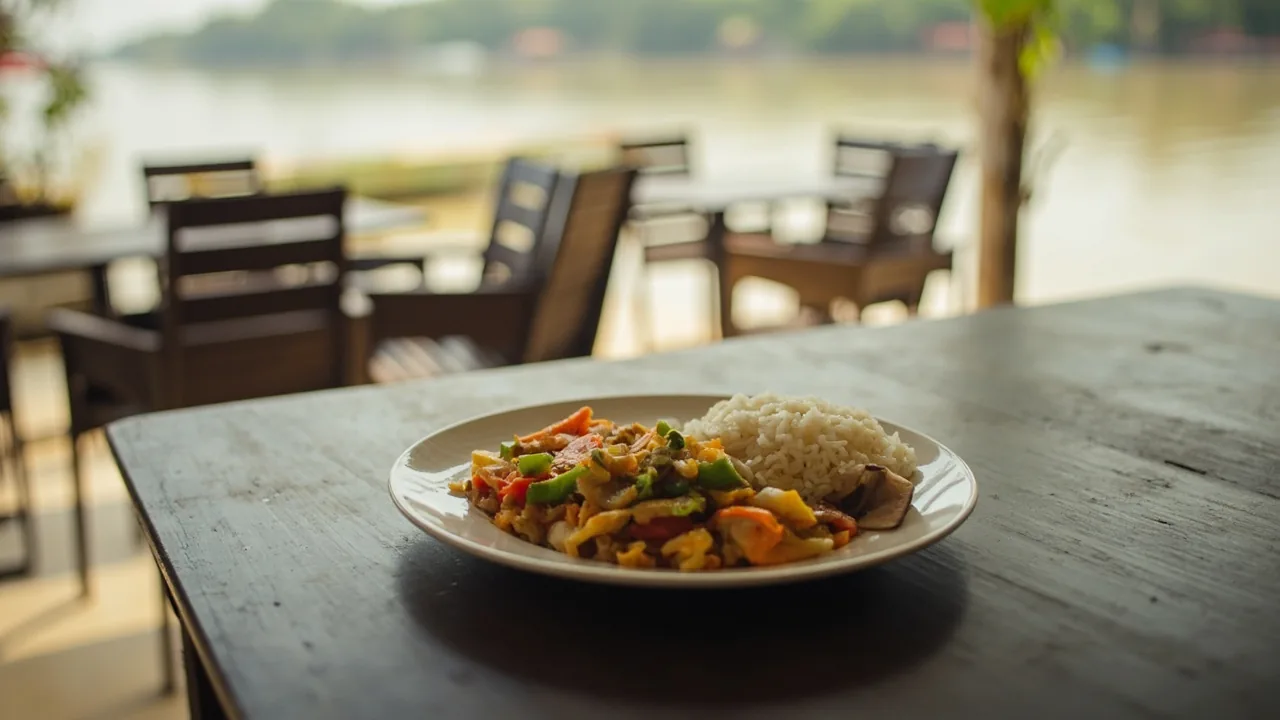
Si Phan Don Vegetarian Food Guide: Where to Find Veg Meals on the 4000 Islands
I’ll be honest with you: Si Phan Don is the most remote stretch of the Thailand-Vietnam-Laos-Cambodia loop, and “remote” used to mean “you’ll be eating rice and fried egg for a week.” That has changed. Don Det’s sunset side, Don Khon’s quieter strip, and a couple of guesthouses on the north end now run reliable vegetarian menus, and there is at least one Indian kitchen that will save you on day four when the herb garden starts to look the same. You will not have Bangkok-level variety, but you will eat well if you know which guesthouses cook and which phrase gets you a clean stir-fry. For related planning, see our guide on Sea Backpacking Hub.
Quick Answers
| What | Answer | Price (INR) |
|---|---|---|
| Cheapest veg meal (fried rice or noodles) | Don Det sunset side guesthouses, ₹65-₹108 (~15,000-25,000 LAK or ~$0.67-$1.12) | ₹65-₹110 (~$0.67-$1.14) |
| Main vegetarian Lao dish at a riverside spot | Rivergarden, Oi ‘s Place, or Herb Garden | ₹151-₹259 (~35,000-60,000 LAK or ~$1.57-$2.69) |
| Indian fallback (dal, paneer, roti) | Hathim Indian Restaurant on Don Det | ₹173-₹345 (~40,000-80,000 LAK or ~$1.79-$3.58) |
| Mango sticky rice (when in season, March-June) | Most sunset-side guesthouses | ₹86-₹129 (~20,000-30,000 LAK or ~$0.90-$1.34) |
| Bottled water (essential on the islands) | Any minimart, expect to drink 3L/day | ₹22 (~5,000 LAK or ~$0.22) |
The Local Culinary Landscape on the 4000 Islands
Lao food in Si Phan Don is built around four ingredients: sticky rice, Mekong river fish, Mekong river weed (pak wan), and freshwater prawns. Two of those four are not vegetarian, and the third is borderline. The good news is that the islands have been on the backpacker route since the late 1990s, so the longer-running guesthouses know what a vegetarian is and will modify dishes without drama. You may also find Mango Sticky Rice Phuket useful for this trip.
The bad news is the hidden stuff. Most Lao stir-fries start with a base of nam pa (fish sauce) or kapi (shrimp paste) before any vegetable touches the wok. If you do not say anything, you will get a “vegetable” dish that smells and tastes like anchovies. Even tom yum soup, when it appears on a guesthouse menu, is almost always made with chicken stock or prawn stock first. Don’t trust the menu, trust the phrase.
Attitudes toward vegetarianism are relaxed. Lao people don’t eat beef much (it’s expensive and culturally rare), but they consider fish, prawn, chicken, and duck to be neutral, not “meat” in the moral sense. So when a Lao aunty hears “vegetarian,” she may serve you fish. You have to be specific: gin jay (vegan / no animal product) or gin phak (vegetable-eater, may include egg). Jay is the strict word, and it works.
Key Phrases in Local Script
These four sentences will feed you for a week. Print them or screenshot them. The Lao script matters less than the pronunciation, but locals appreciate the effort.
| English Phrase | What it Means | Lao Script | Pronunciation |
|---|---|---|---|
| I am vegetarian, no meat or fish | The base request that opens every meal | ຂອ້ອຍກິນເຈ | khoy gin jay |
| No fish sauce | Kills the hidden anchovy taste in stir-fries | ບໍ່ໃສ່ນ້ຳປາ | bo sai nam pa |
| No egg | Important for Jains and vegans | ບໍ່ໃສ່ໄຂ່ | bo sai khai |
| No shrimp paste (kapi) | The other hidden non-veg ingredient | ບໍ່ໃສ່ກະປິ | bo sai kapi |
| Only vegetables, please | Reinforcement when they seem unsure | ກິນຜັກຢ່າງດຽວ | gin phak yang diao |
Subodh’s Pro Tip: Say gin jay first, then bo sai nam pa bo sai kapi. Two short sentences. Every guesthouse cook on Don Det understands this combo.
Safe Local Dishes That Are Vegetarian or Easy to Customize
The 4000 Islands is not Chiang Mai. You won’t find a Jay Market with yellow flags. What you will find is a short list of dishes that the guesthouse cooks can turn into a proper vegetarian meal if you use the phrases above.
Lao Stir-Fried Vegetables (Phak Boon Jay)
This is the workhorse. Morning glory, Chinese broccoli, eggplant, or whatever’s at the market that morning, wok-fried with garlic (if you allow it), soy, and a little chili. Order as phak boon jay. It’s on every guesthouse menu from Don Det’s south to Don Khon’s old French pier, and the price rarely moves: ₹86-₹129 (~20,000-30,000 LAK or ~$0.90-$1.34) for a plate that fills two people. Specify bo sai nam pa or you’ll get a fishy aftertaste.
Fried Rice with Vegetables (Khao Phak Jay)
The universal fallback. Rice, cabbage, carrot, a bit of tomato, sometimes pineapple for sweetness. Travellers report that the version at the family-run guesthouses along Don Det’s sunset side is safer than the riverside tourist spots, because turnover is high and the wok gets cleaned between orders. Expect to pay ₹108-₹151 (~25,000-35,000 LAK or ~$1.12-$1.57).
Sticky Rice and Jeow (Jay)
The most Lao meal you can eat. Plain sticky rice (khao niao) with jeow bor (a roasted tomato-and-eggplant dip) or jeow mak kheua (eggplant dip), no meat version. The jeow is plant-based and Lao cooks understand “no sai moo” (no pork). Some places add dried shrimp to jeow, so ask. This is the cheapest meal on the islands: ₹65-₹108 (~15,000-25,000 LAK or ~$0.67-$1.12).
Mango Sticky Rice (Khao Niao Mamuang)
Seasonal. The mango season in southern Laos runs roughly March through June, peaking in April-May. Outside those months, the mangoes are imported and the dish is mid. When it’s in season, though, every guesthouse on Don Det’s sunset side sells it for ₹86-₹129 (~20,000-30,000 LAK or ~$0.90-$1.34) and it’s one of the best things you’ll eat on this whole loop.
River Weed Stir-Fry (Pak Wan Jay)
A Si Phan Don specialty. The green weed that grows on the Mekong rocks is harvested daily and stir-fried with garlic and egg. Ask for pak wan bo sai khai, no egg, and you get a plate of greens that tastes like the river. ₹108-₹173 (~25,000-40,000 LAK or ~$1.12-$1.79). If the cook has never done a Jay version, point at the dish and say “gin jay, bo sai khai” and they’ll figure it out.
Recommended Places to Eat Vegetarian
You don’t have a hundred options here. You have nine. Here’s how I’d split them across a typical three-day stay on the islands.
Rivergarden Restaurant
A solid all-rounder on the riverside strip. The kitchen understands “gin jay” and the menu has a separate vegetarian section with five or six options including a green curry with tofu and a sticky rice set. Travellers report the green curry is the safest bet, made to order and not pre-mixed with the meat version. Expect ₹173-₹259 (~40,000-60,000 LAK or ~$1.79-$2.69) for a main.
The Herb Garden
The highest-rated restaurant in the shortlist at 4.9, and the one most suited to plant-based eaters. The name says it: the menu leans herb-led, lots of fresh basil, mint, and lemongrass, with stir-fries and curries that can be made Jay with a quick ask. The setting is the draw, garden seating away from the road. ₹151-₹237 (~35,000-55,000 LAK or ~$1.57-$2.46) for a main.
Oi ‘s Place
On Don Det’s sunset side, with Mekong views that justify the slightly higher prices. The Lao dishes here are the genuine article, including laap jay (the Lao minced-meat salad done with tofu or mushrooms instead of meat). Order laap het (mushroom laap) and ask for it without the toasted rice powder, which sometimes carries pork fat. ₹173-₹259 (~40,000-60,000 LAK or ~$1.79-$2.69).
One More Bar and Restaurant
The social spot. Mixed menu, the kitchen handles the basics well, and they have a reliable veg burger if you need a break from rice. ₹129-₹216 (~30,000-50,000 LAK or ~$1.34-$2.24).
Barefoot Island Bar & Restaurant
Beachside seating on the sunset side, more bar than restaurant but the kitchen does a solid Pad Jay (Thai-style noodles, jay version, Lao kitchen will make it if you ask). ₹129-₹216 (~30,000-50,000 LAK or ~$1.34-$2.24).
Hathim Indian Restaurant
The safety net. When day three arrives and you want roti, dal, paneer masala, or biryani, Hathim is your answer. Indian-run, the spices are real (not the tourist-bland version you sometimes get in Thai beach towns), and they understand Jain constraints if you explain. The thali runs ₹216-₹345 (~50,000-80,000 LAK or ~$2.24-$3.58) and a single roti is ₹43 (~10,000 LAK or ~$0.45). Travellers report the paneer butter masala and the dal tadka as the most consistent items.
Mrs Khamla Fish Noodle Soups, Mouy’s, and Adam’s
All three are local spots worth knowing for the off-vegetarian moments. Mrs Khamla is famous for the fish noodle, not veg, but she also does a veg noodle version that travellers report is fine. Mouy’s and Adam’s are general Lao kitchens; if you walk in and use the gin jay phrase, they’ll point you to the veg options. Treat these as backup if your first choice is closed or full.
Fandee Island Restaurant
Heads-up: this one is not on the 4000 Islands. Fandee is on the Bolaven Loop, near Tad Lo waterfalls, and is included here because it’s a common day trip from Pakse and Si Phan Don travellers pass through. The veg Lao dishes are good and the setting is waterfall-front, worth knowing if you loop up that way.
Subodh’s Pro Tip: On Don Det, the sunset side is where the food is, and most guesthouses with kitchens open at 7am for breakfast and stop serving around 9pm. Don Khon is quieter with fewer options, so plan one dinner on Don Det per day and one on Don Khon if you’re staying across.
Food Safety & Hygiene on the Islands
The islands are clean. The water comes from wells and isn’t always safe. The food is generally fine because turnover at the popular guesthouses is high. Three rules:
Bottled water only. Don’t refill from the tap. ₹22 (~5,000 LAK or ~$0.22) per 1.5L bottle at any minimart, expect to drink three a day in the dry season.
Eat where the locals eat. If a guesthouse restaurant is empty at 7pm, walk to the next one. The popular places turn food over fast, which is the single best predictor of food safety anywhere in Southeast Asia. Travellers report that the riverside spots and sunset-side guesthouses have higher turnover than the inland ones.
Skip the river water and ice. Ice in drinks is generally fine (factory-made, hollow tubes), but if a place looks like it’s filling an ice bucket from a backyard freezer, skip the cold drink and order hot tea or a Lao coffee. Lao coffee is local, strong, and worth trying anyway.
For broader Laos-specific health prep, check our Laos vegetarian guide and the related Pakse veg spots at vegetarian restaurants in Pakse.
Getting Connected
A working data connection on the islands is patchy, useful for translating the menu or pulling up this guide when you’re standing in front of a guesthouse kitchen. The local Lao Telecom SIM is fine, but for short stays an eSIM is simpler since you don’t lose your Indian number.
SIM: Lao Telecom or Unitel at Pakse airport or the boat pier, ₹216-₹432 (~50,000-100,000 LAK or ~$2.24-$4.48) for a week of 4G data, signal strong on Don Det, weaker on Don Khon.
eSIM alternative: Get Nomad eSIM works before you fly, activates on landing, and is the cleanest option for a one-week island stay where you don’t want to queue at a SIM kiosk.
Common Food Mistakes Indians Make on the 4000 Islands
Assuming “vegetable stir-fry” is safe. It’s not, by default. Lao stir-fries use fish sauce as the salt. You have to ask. Travellers who skip the bo sai nam pa line report the same metallic, fishy aftertaste in every meal.
Trusting the menu’s green dot or “V” symbol. Most guesthouse menus don’t have these markers. Where they exist, they’re inconsistent, sometimes meaning “vegetable-heavy” rather than “no animal product.” Always say the phrase.
Not telling Hathim about Jain constraints. If you don’t eat onion or garlic, the standard Indian menu still has both. Tell the staff at Hathim when you order, they will adjust, but the default dishes include both.
Skipping sticky rice and jeow. This is the most authentic meal on the islands and it’s already vegetarian. A lot of Indian travellers default to fried rice because it’s familiar, and miss the actual local food.
Trying to do a complete vegan week without the phrasebook. It’s possible, but you’ll eat the same three dishes. With the gin jay / bo sai nam pa combo, you get ten or twelve dishes. Worth the 30 seconds of learning.
FAQ
Can I get Jain food (no onion, no garlic) on the 4000 Islands? Hathim Indian Restaurant can do it if you tell them in advance, specifically when ordering. Outside Hathim, it’s hard, because Lao stir-fries use garlic as a default. Stick to plain steamed vegetables and sticky rice if you need strict Jain.
Is the river fish safe for vegetarians to order around? Yes, you’ll smell it cooking. The smell travels. Just don’t order it. The vegetarian menu at the same guesthouse is usually separate from the fish menu.
Are there any Western veg options like pizza or pasta? A few sunset-side guesthouses do cheese pizza or veg pasta, mostly for the European crowd. Prices are higher (₹216-₹345 (~50,000-80,000 LAK or ~$2.24-$3.58)) and quality varies. Useful as a one-off break, not as a daily staple.
Can I drink the local Lao coffee? Yes, and you should. It’s robusta, served thick and dark, usually with condensed milk for kafoa nom sai. The black version (kafoa dam) is vegan. ₹43-₹65 (~10,000-15,000 LAK or ~$0.45-$0.67) at most guesthouses.
Is there a food tour on the 4000 Islands? Not a dedicated vegetarian food tour. The main loop is Pakse and Bolaven food tours, which can sometimes be customized. For an on-the-ground option, Book a Si Phan Don food experience covers cooking classes and market walks.
What’s the cheapest meal on the islands? A plate of sticky rice with two jeow dips: ₹65-₹86 (~15,000-20,000 LAK or ~$0.67-$0.90), around ₹65-₹90 (~$0.67-$0.93).
Should I bring snacks from Pakse? Yes, especially if you’re Jain or strict-veg. The Pakse morning market has peanuts, dried fruit, and biscuits that hold you between meals. The Don Det minimarts are limited and pricier.
Where to Stay on the Islands (If You Need a Kitchen Nearby)
The two islands have a different food-and-stay pattern: Don Det is where the guesthouses cluster along the sunset side and most have attached restaurants, Don Khon is quieter with fewer food options but cleaner river views. Pick based on whether you want walkable dinners (Don Det) or quiet mornings (Don Khon).
| Guesthouse | Island | Vibe | Book |
|---|---|---|---|
| Mama Leuah’s | Don Det | Family-run, kitchen cooks daily, herb garden out back | Check prices |
| Don Det Hotel | Don Det | Riverside, big kitchen, vegetarian options marked on menu | Check prices |
| Souksan Guesthouse | Don Det | Sunset-side, backpacker classic, good Lao breakfast | Check prices |
| Sala Done Khone | Don Khon | Quiet, fan rooms, attached restaurant with veg menu | Check prices |
| Auberge Sala Inhkong | Don Khon | Old French colonial, set dinners with veg option | Check prices |
Subodh’s Take
Si Phan Don is a slow place and the food matches it. You won’t eat the most varied vegetarian week of your life here, but you’ll eat some of the freshest, because most of what arrives at your guesthouse table was in the ground or in the river that morning. Learn the four phrases, find Hathim on day three or four when you need the comfort food, and stop worrying. The 4000 Islands is one of the gentlest stops on the whole SEA loop for vegetarians, as long as you accept that “gentle” means fewer options, not zero.
