SIM Card Registration Rules by Country: What Indian Backpackers Need to Know (2026)
SIM card registration by country is mandatory across Southeast Asia. Walk into an AIS Centre in Bangkok or a Viettel store in Hanoi without your physical passport, and you will walk out without a SIM. For a full overview of connectivity options across the region, see our Southeast Asia backpacking hub.
Below: the registration rules for the eight countries Indian backpackers hit most, the documents you need, what each registration costs, and the country code basics that come up half the time. Verified against NBTC Thailand portal, MIC Vietnam e-regulations, MPT Laos licensing page, MPTC Cambodia portal, MCMC Malaysia, KOMINFO Indonesia, IMDA Singapore, and NTC Philippines on 2026-07-18.
What Is SIM Card Registration?
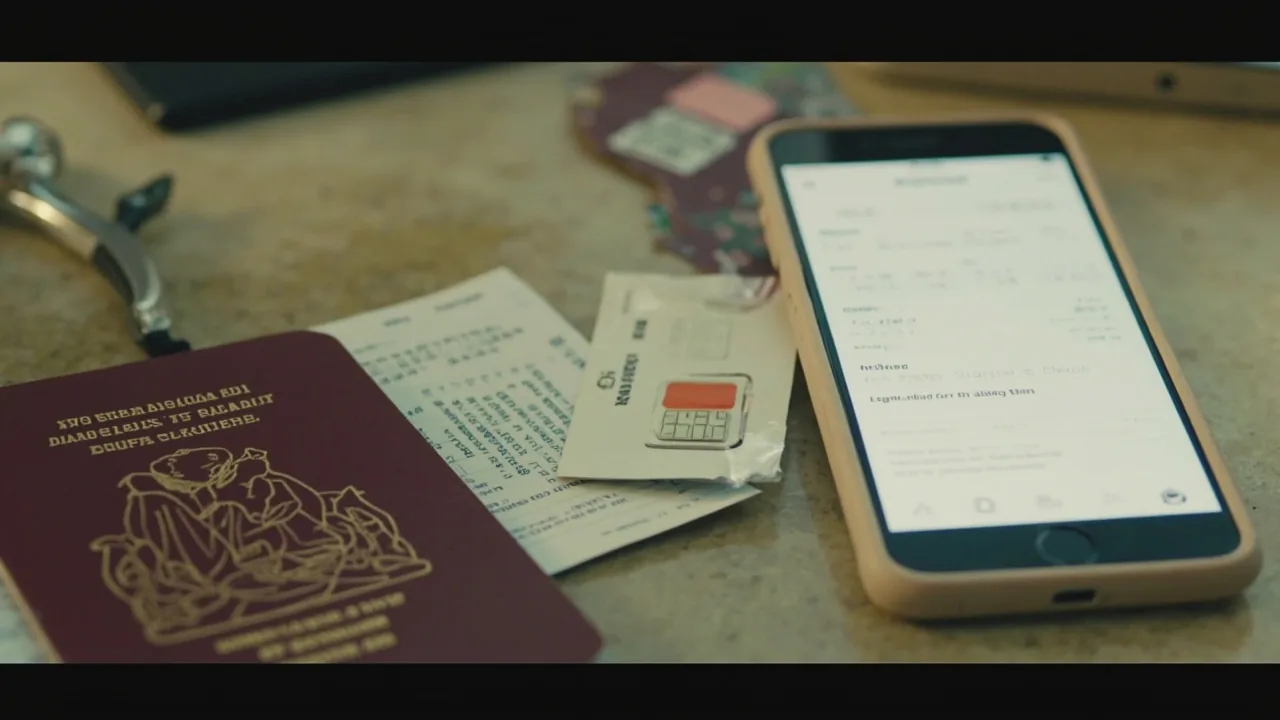
SIM card registration is the mandatory process where your local mobile carrier records your full name, date of birth, passport number, nationality, and home address against the phone number activated on your SIM. In every major Southeast Asian country this happens at the point of sale: a passport scan, sometimes a fingerprint, sometimes a face-photo capture, then a one-page form you sign. The data flows to a government regulator (Thailand’s NBTC, Vietnam’s MIC, Laos’s Ministry of Post and Telecommunications, Cambodia’s MPTC, Malaysia’s MCMC) which can cross-check it later against criminal, immigration, or watchlist databases. Your SIM can be remotely suspended or permanently cancelled if the registration turns out to be fake, the passport expires, or you overstay your visa.
Country code is the unrelated piece: every country has a numeric prefix (+91 for India, +66 for Thailand, +84 for Vietnam, +856 for Laos, +855 for Cambodia, +60 for Malaysia, +62 for Indonesia, +65 for Singapore, +63 for the Philippines) that gets dialled before the local number when calling from abroad. Indian travellers buy a Thai SIM, the number comes with a +66 prefix, and the first 6 to 12 months of “why are random Thai numbers calling me” usually traces back to that prefix.
Quick Answers
| What | Answer | Price (INR) |
|---|---|---|
| Registration required? | Yes, mandatory across all SEA countries | , |
| Thailand, documents | Passport, face scan at kiosk | ₹141 to ₹859 |
| Vietnam, documents | Passport, photo at counter | ₹184 to ₹737 |
| Laos, documents | Passport, photo, sometimes fingerprint | ₹108 to ₹216 |
| Cambodia, documents | Passport, photo, finger scan | ₹771 to ₹1,157 |
| Malaysia, documents | Passport, sometimes second ID | ₹237 to ₹710 |
| Indonesia, documents | Passport, NPWP if staying 30+ days | ₹268 to ₹536 |
| Singapore, documents | Passport, foreign address | ₹374 to ₹1,345 |
| Philippines, documents | Passport, photo, face scan | ₹67 to ₹116 |
| Country codes | TH +66, VN +84, LA +856, KH +855, MY +60, ID +62, SG +65, PH +63 | , |
Source: NBTC Thailand, MIC Vietnam, MPT Laos, MPTC Cambodia, MCMC Malaysia, KOMINFO Indonesia, IMDA Singapore, NTC Philippines. Verified 2026-07-18.
Step-by-Step: How to Register a SIM in Each Country
The mechanics differ by country. Here is exactly what to do in each.
1. Thailand
Walk into any AIS, TrueMove H, or dtac branded store (avoid mall kiosks, they route to the same carriers but charge a markup). Show your passport. The staff will scan it, take a face photo at the in-store kiosk, ask for your Thai address (give your hostel name and Bangkok area), and print a one-page registration form. Sign it. SIM activation takes 5 to 15 minutes. For a price comparison of 7-Eleven vs carrier-store SIMs, see 7-Eleven SIM card Thailand prices.
- Cost: SIM card ₹141 (~49 THB or ~$1.46) to ₹284 (~99 THB or ~$2.95); tourist plans ₹859 (~299 THB or ~$8.91) for 8 days with 15 GB. For a deeper dive on Thai SIM options, see best SIM/eSIM for Thailand from India.
- Where: AIS Centre, TrueMove Shop, dtac Hall (all malls and major roads)
- Time: 10 to 20 minutes total
- Note: Since the 2024 NBTC reforms, every prepaid Thai SIM bought by a tourist auto-deactivates after 8 days unless you top up at an official store with your passport. Buy short, plan ahead, top up in person at the 7-day mark if you’re staying longer.
2. Vietnam
Viettel, Mobifone, and Vinaphone all operate official stores in every major city. Vietnamese registration is more thorough than Thailand: passport scan, a passport-style photo (most stores do this for free or for 10,000 VND), and a signed declaration. Some Viettel stores run a fingerprint scan, particularly in Hanoi and HCMC central districts.
- Cost: SIM ₹184 (~50,000 VND or ~$1.91); data packages up to ₹737 (~200,000 VND or ~$7.64) for 30 days. Compare options in Vietnam SIM card for Indian travelers.
- Where: Viettel Store, Mobifone Centre, Vinaphone Plus
- Time: 15 to 30 minutes; line waits can push this to an hour on weekends
- Note: Vietnam requires the original passport, not a photocopy. Mobile registration kiosks exist in airports but they cost 50% more and lock you into longer plans. Skip them.
3. Laos
Unitel and Lao Telecom run the registration. The process is similar to Vietnam but slower: passport scan, a printed photo (some stores take one on the spot for ₹43 (~10,000 LAK or ~$0.45)), and a fingerprint scan in Vientiane and Luang Prabang stores.
- Cost: SIM ₹108 (~25,000 LAK or ~$1.12); data add-ons start at ₹216 (~50,000 LAK or ~$2.24). Compare carriers in best SIM card in Laos for Indian travelers.
- Where: Unitel and Lao Telecom stores in Vientiane, Luang Prabang, Vang Vieng; smaller towns often have only one shared counter
- Time: 20 to 40 minutes
- Note: Outside Vientiane, store hours are 8 AM to 5 PM with a one-hour lunch closure. Plan SIM purchase for late morning.
4. Cambodia
Smart, Cellcard, and Metfone all run the same registration. Cambodia stands out in the region for routinely requiring both a fingerprint and a face photo at registration, unlike most neighbouring countries.
- Cost: SIM ₹771 (~8 USD); tourist data plans from ₹675 (~7 USD) for 7 days. See also best Cambodia SIM cards with unlimited data.
- Where: Smart, Cellcard, or Metfone branded stores; airport kiosks cost double
- Time: 15 to 25 minutes
- Note: Phnom Penh and Siem Reap stores are well-staffed and tourist-friendly. Sihanoukville stores frequently run out of tourist-plan SIMs mid-afternoon; buy yours before noon if you arrive by bus.
5. Malaysia
CelcomDigi, Maxis, and U Mobile all register foreign passports at the point of sale. Malaysian eKYC is sharper than most countries in the region.
- Cost: SIM ₹237 (~10 MYR or ~$2.46); tourist plans from ₹592 (~25 MYR or ~$6.14) for 30 days. Compare with Malaysia SIM card for Indian travelers.
- Where: CelcomDigi, Maxis, or U Mobile centres (mall-based); also at KLIA arrivals (CelcomDigi)
- Time: 10 to 20 minutes
- Note: Malaysian SIMs auto-deactivate after 7 days if not re-registered with an active foreign address. Give your hotel or hostel name, city, postcode, and the staff will extend activation on the spot.
6. Indonesia
Telkomsel, XL Axiata, and Indosat all run registration under KOMINFO’s KKSTB framework. Indonesian registration asks for an Indonesian address even for short-stay tourists.
- Cost: SIM ₹268 (~50,000 IDR or ~$2.78); data plans from ₹268 (~50,000 IDR or ~$2.78) for 30 days. Full breakdown in Indonesia SIM card price guide.
- Where: Telkomsel, XL, or Indosat branded stores; Grha Indosat mall outlets process registrations fastest
- Time: 15 to 30 minutes
- Note: Since 2025, KKSTB requires a local Indonesian address for any prepaid SIM. Give your hotel name and city. Bali SIM registrations are reportedly faster than Jakarta counter waits.
7. Singapore
Singapore’s IMDA framework requires prepaid SIM registration before first use, even for short-stay travellers.
- Cost: SIM ₹374 (~5 SGD or ~$3.88); tourist plans from ₹747 (~10 SGD or ~$7.75) for 7 days with 50 GB. Full comparison in best tourist SIM card in Singapore.
- Where: Singtel, M1, StarHub stores; Changi Airport has 24-hour counters
- Time: 10 to 20 minutes
- Note: Singapore SIMs auto-deactivate after 180 days unless re-registered. You must provide a working foreign address. Hotel name and room number is acceptable.
8. Philippines
Globe, Smart, and DITO all register under the SIM Registration Act of 2022, which is the strictest in the region.
- Cost: SIM 40 PHP; data packages from 99 PHP for 30 days. See best SIM card in Philippines for Indian travelers for a detailed comparison.
- Where: Globe, Smart, or DITO stores; SM Mall in-city branches are the most reliable
- Time: 15 to 25 minutes
- Note: Filipino registration requires a working Philippine mobile number OR email AND a face-photo capture. Tourists who skip the face-photo step often get SIMs that work for 2 to 3 days then fail registration.
Common Mistakes Indians Make
Mistake 1: Showing a passport photocopy
This still happens in 2026 despite years of warnings. Indian travellers sometimes carry only a photocopy of their passport page to save wear on the original. Every Thai, Vietnamese, Lao, Cambodian, Malaysian, Indonesian, Singaporean, and Filipino carrier requires the original passport at the counter. A photocopy gets you politely turned away, which means a wasted trip back to the hostel and a second visit to the store. Carry the original in a small ziplock, never in checked luggage.
Mistake 2: Buying at airport kiosks
Airport SIM counters are not scams, but they do charge 30% to 100% markup over in-city stores. Airport SIM counters at Suvarnabhumni and in Phnom Penh charge a markup over in-city stores. Walk-in fares at downtown carrier centres are usually lower than the airport counter for the same plan. Take a taxi to your hostel first, then walk to a carrier store the next morning.
Mistake 3: Lying about your home address
Some Indian travellers, sensing Vietnam’s address requirement, write a hotel name they read about online or guess at a street address. Carrier systems flag mismatched registration when cross-checked against immigration databases. Thailand’s NBTC will deactivate your SIM within 72 hours; Vietnam’s MIC has deactivated tourist SIMs in batches during major holidays. Use your actual hostel name, the actual street, the actual city. If you don’t have a hotel booked for the full stay, write “will confirm at [hotel], [city]” and update at any carrier counter during your trip.
Mistake 4: Buying multiple SIMs in one trip
This is less common in India but common among SEA backpackers. Buying a SIM in Thailand, a second SIM in Cambodia on the same passport, a third in Vietnam, is supposed to be legal, and physically possible, but each SIM gets its own registration ID, and carrier watchlists track repeat registration patterns. Multiple SIMs on one passport can trigger deactivation if carriers flag the pattern during routine registration audits. Stick to one SIM per country, or one regional eSIM.
Mistake 5: Not registering within the activation window
Thailand’s 8-day auto-deactivation rule catches everyone at least once. Malaysian SIMs deactivate at 7 days without re-registration. Vietnamese SIMs deactivate at 30 days if your visa is shorter than the SIM plan. Activation windows are strict, and trip length often exceeds them.
What Most Guides Don’t Tell You
Your passport must be valid for 6+ months, not the 3 months most carriers state
Most carrier counters accept passports with 3 months remaining validity, but the host country’s immigration database flags the registration once your passport crosses into the 6-month-validity red zone. Result: your SIM works fine for a week, then deactivates suddenly while your friends’ SIMs continue. Carry at least 6 months’ validity on your passport.
Country code search volumes are misleading
“Sim card country code list” queries spike every December, largely because Indian travellers want to know if their +91 contacts can call a +65 Singapore number cheaply (answer: yes, via Jio or Airtel ISD plans). The actual minimum-viable list: +91 (India, that’s you), +66 (Thailand), +84 (Vietnam), +856 (Laos), +855 (Cambodia), +60 (Malaysia), +62 (Indonesia), +65 (Singapore), +63 (Philippines). Add +1 (US/Canada), +44 (UK), +61 (Australia), +971 (UAE), +973 (Bahrain), +974 (Qatar), +966 (Saudi Arabia) for the diaspora calling you, and you’ve covered 95% of the calls you’ll receive.
The IMEI blacklist is real
Thailand’s NBTC maintains an IMEI blacklist of stolen and fraudulent devices. Used phones purchased in Bangkok or grey-market imports can have flagged IMEIs, which may cause SIMs to deactivate shortly after registration. If you’re bringing a phone from India, make sure it’s a model officially sold in India and not a grey-market import. Check your IMEI at *#06# on your phone, then cross-reference with imei.info before you fly.
eSIM registration varies by country
ESIMs register the same way as physical SIMs but the carrier does the registration remotely against your passport at purchase time, no store visit required. Cambodia and Laos are the exceptions: their eSIM ecosystem is still patchy, plan for a physical SIM there.
Border and safety context
Some travellers ask about safety at border crossings or in specific regions. For a base-level read on regional travel advisories before departure, check the Indian Ministry of External Affairs advisory page at mea.gov.in, and the destination country’s own government travel advisory. These cover current conditions and regional cautions in more detail than any guide can. For emergency numbers across the region, see our emergency contacts guide for backpackers.
FAQ
How long does SIM card registration take in Thailand?
At a carrier store: 10 to 20 minutes for the registration itself. Add 10 to 30 minutes for queue and form processing. Faster than the airport kiosk, which has its own 15 to 30 minute wait for the same result.
Can I use an Indian passport for SIM card registration in Vietnam?
Yes, no separate visa requirement, just the original Indian passport. Vietnamese registration is the same for all foreign passports.
Do I need to register my IMEI in Thailand?
If you’re bringing your personal phone for under 90 days, no IMEI registration is required. If you plan to use a locally bought or imported phone for longer, register your IMEI at any AIS, TrueMove, or dtac store before the 90-day window.
What’s the cheapest country to buy a SIM in?
Laos, at ₹108 (~25,000 LAK or ~$1.12) for the basic SIM, plus data add-ons from ₹216 (~50,000 LAK or ~$2.24). Cambodia is next at ₹771 (~8 USD). Singapore is the most expensive at ₹1,345 (~18 SGD or ~$13.95) for the cheapest tourist SIM with 50 GB.
Can I register the same passport for a SIM in multiple countries?
Yes, registration is per-carrier per-country. Your passport can hold an AIS Thailand registration AND a Viettel Vietnam registration AND a CelcomDigi Malaysia registration simultaneously, with no overlap. If you’re weighing whether to use your Indian SIM abroad instead, compare costs in Indian SIM roaming in Southeast Asia.
Do I need a SIM card to use Wi-Fi everywhere?
Most SEA hostels, cafes, and malls offer free Wi-Fi, but coverage drops sharply outside cities. Vietnam and Cambodia have poor 4G coverage on rural routes, and Grab/Google Maps becomes useless without data. Buy a local SIM, it’s the cost of doing business in SEA. For ATM withdrawal fees across the region, see ATM fees in Southeast Asia.
What happens if I lose my registered SIM?
Carrier stores can issue a replacement SIM with the same number and registration intact. Your original registration is tied to your passport, not the SIM card. Cost: 50 THB in Thailand, 50,000 VND in Vietnam, 1 USD in Cambodia.
Subodh’s Take
SIM card registration looks intimidating until you’ve done it twice. After that, every AIS or Viettel counter feels like a routine errand. The real failure mode is the small print: passport expiry, IMEI status, host address accuracy. Get those right, and you’ll change SIMs the way you change buses. Get them wrong, and you’ll be the person at the hostel front desk on day 4 explaining why their Thai SIM suddenly has no signal.
, Subodh
