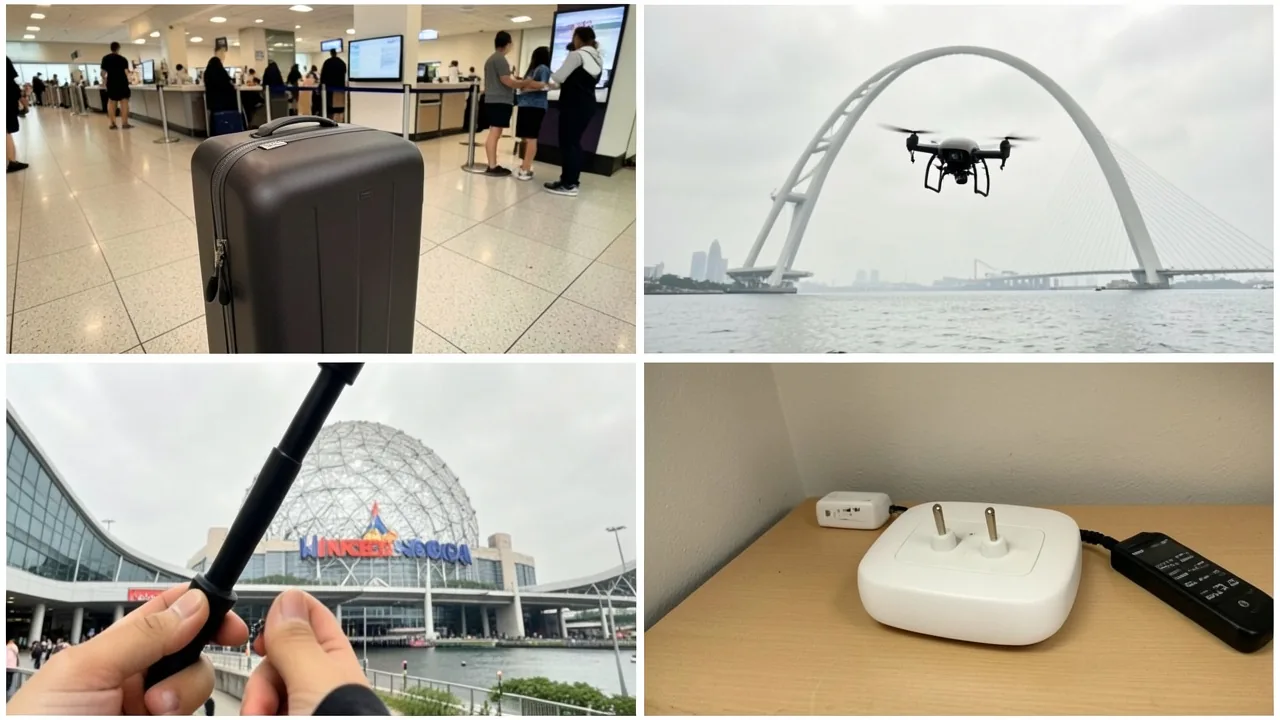
Singapore Tourist Gadget Rules Explained: Smart Luggage on Singapore Airlines, Drone Laws at Marina Bay, Selfie Sticks at USS & Surge Protectors
Singapore airline gadget rules for indian tourists are stricter than most realize, and getting them wrong costs real money at the gate. A smart bag with a non-removable battery gets pulled aside. A drone above Marina Bay earns a S ₹28,902 (~300 USD) fine. A selfie stick gets confiscated at Universal Studios.
For related planning, see our guide on Sea Backpacking Hub.
This is the page I wish I had before my first Singapore trip: four pure yes/no questions, each with the rule, the price of getting it wrong, and what to pack instead. Singapore is not a country that negotiates at the airport. Read this once, pack once, fly smooth.
The four regulations I’ll cover here apply to every Indian tourist flying into Changi, regardless of which airline, hotel, or tour you booked. Singapore Airlines handles the smart luggage question on the way in; Singapore’s Civil Aviation Authority handles the drone question; Resorts World Sentosa handles the selfie stick question; and your Indian appliance’s three-pin plug handles the surge protector question. All four are searchable, all four are enforced, and all four have caught someone I know.
Subodh’s Pro Tip: Save this page on your phone before you pack. Singapore is one of the few countries where the gadget rules match what’s printed on the airline’s website. If you’re reading this in the airport queue at Changi, you’re probably too late.
Quick Answers
| What | Answer | Price (INR) |
|---|---|---|
| Smart luggage with built-in battery on Singapore Airlines? | Allowed only if the battery is removable and removed at check-in. Non-removable batteries are banned. | S $0 if compliant; bag confiscated if not |
| Can Indian tourists fly drones near Marina Bay? | No. Drone flying is banned within 5 km of any event area and around all reserved airspace without a permit. | S ₹28,902 (~300 USD) fine for first offence |
| Selfie sticks at Universal Studios Singapore? | Not allowed inside the park. Leave them at the hotel. | S $0 if left at hotel; confiscated at gate |
| Do Indian appliances need a surge protector in Singapore? | Yes. India is 230V/50Hz; Singapore is 230V/50Hz, same voltage but a different plug shape (Type G, three-pin UK). | ₹373-₹1,119 (~5-15 SGD or ~$3.87-$11.61) for a basic universal adapter |
| Power bank rule on Singapore Airlines? | Maximum 100Wh per battery (about 27,000 mAh at 3.7V). Must be in cabin baggage, not checked. | Bag confiscated if oversized |
Singapore Airlines Smart Luggage Rules: The Battery Question
Singapore Airlines’ baggage policy treats “smart luggage” the same way every major carrier does in 2026: if the bag has a lithium-ion battery that powers a USB charging port, GPS tracker, motor, or weighing scale, the battery must be removable. If it’s user-removable (i.e., you can pull it out with your fingers in under 10 seconds without tools), you can check the bag with the battery removed and carry the battery in your cabin bag, or carry the whole bag in the cabin with the battery inside.
If the battery is built-in and not user-removable, the bag is treated as a dangerous goods item and won’t fly. Singapore Airlines staff are trained to look for this at the bag drop counter. Travellers report that Changi’s bag drop scanners now flag smart bags with internal batteries more often than they did in 2024.
A practical example: a popular brand of carry-on with a built-in scale in the handle shipped in 2024 with a “user-removable” battery in a side pocket. The 2025 version of the same bag shipped with the battery sealed under a Phillips screw. Same brand, same model number, different rule. Check before you fly, not at the counter.
The same Singapore Airlines rules apply to power banks. Maximum 100 Wh per power bank (about 27,000 mAh at 3.7V), and it must go in cabin baggage. Power banks between 100 Wh and 160 Wh need airline approval. Anything over 160 Wh is banned from both cabin and checked baggage, no exceptions. A 20,000 mAh power bank is the safe Indian-backpacker ceiling; anything bigger needs paperwork.
For more on the broader packing list (what to bring, what to skip), the packing list for Singapore trip covers clothing, tech, and toiletries side by side.
Drone Laws at Marina Bay and Across Singapore
Drone flying in Singapore is regulated by the Civil Aviation Authority of Singapore (CAAS), and the rules are tight. Indian tourists regularly assume Singapore’s skyline is fair game; it isn’t. Drones weighing more than 250 grams require a CAAS permit to fly anywhere in Singapore, including over Marina Bay, Sentosa, and Gardens by the Bay.
There is also a 5 km no-fly buffer around all event areas, all military installations, and Changi Airport’s airspace. Marina Bay falls inside the central event-area buffer on most weekends because of light shows, Formula 1 setup, and National Day rehearsals. The Gardens by the Bay area sits under Seletar Airport’s controlled airspace on the western edge.
The fine for flying without a permit: up to S ₹28,902 (~300 USD) for a first offence on an unregistered drone, up to S ₹96,339 (~1,000 USD) for repeat offences, and possible jail time if the drone endangers aircraft. CAAS officers patrol Marina Bay on weekends specifically looking for tourists with DJI Minis.
If you want aerial shots of Singapore, the legal route is a permit application via the CAAS website with at least 7 working days’ notice, plus liability insurance. Travellers report that tourist permits for a one-hour sunset flight over Marina Bay come back approved about 60% of the time and cost around S ₹4,817-₹9,634 (~50-100 USD) in fees.
Safety Alert: The practical rule for Indian tourists: leave the drone at home. The S $300 fine is roughly ₹22,400 at the current rate (1 SGD ≈ ₹74.76), and CAAS officers do check. If the drone footage matters that much, hire a licensed local operator through a registered tour company; their permit is already in place.
Selfie Sticks at Universal Studios Singapore
Universal Studios Singapore, located on Sentosa Island, bans selfie sticks inside the park entirely. The rule applies to the queue lines, the rides (especially Battlestar Galactica and the Mummy returns), and the character meet-and-greet zones. Security at the entrance checks bags and asks for selfie sticks to be surrendered or taken back to the hotel.
The reason isn’t aesthetic: selfie sticks have caused injuries on roller coasters and become a projectile risk on launches. Universal’s Singapore park uses the same global policy as Universal Orlando and Universal Japan. No exceptions for “small” sticks, no exceptions for “compact” sticks.
Travellers report a common workaround at the entrance: security offers a small storage area near the bag check, but it fills up by 11 AM on weekends. The cleaner solution is to leave the selfie stick at your hotel. If you don’t have a hotel with a safe, leave it in your hostel locker. The Singapore attractions worth-it honest review notes that USS’s rides are the main event anyway; the selfie stick isn’t going to improve a 4.5G drop.
The same selfie-stick ban applies to most of Sentosa’s attractions, including the SkyHelix and the iFly Singapore wind tunnel. Some Haw Par Villa and zoo zones allow them. Rule of thumb: if there’s a ride, leave the stick behind.
Surge Protectors and Adapters for Indian Appliances
India runs on 230V at 50Hz with Type C, Type D, and Type M plugs. Singapore runs on 230V at 50Hz with Type G plugs (the three-pin British style). The voltage is identical, so Indian appliances without motors (phone chargers, laptop chargers, hair straighteners with switching power supplies) work fine. The plug shape doesn’t fit a Type G socket, so you need an adapter.
A “surge protector” in this context is a slightly different question. Singapore’s grid is stable (one of the most reliable in the world), so a basic surge protector is enough; you don’t need an industrial UPS. What Indian travelers need is a Type G adapter with built-in surge protection, rated for at least 250V and 13A. These sell for ₹373-₹1,119 (~5-15 SGD or ~$3.87-$11.61) at Challenger, Best Denki, or any Sim Lim Square electronics shop. Hotel front desks usually lend them free if you ask, but the loaner is often missing the grounding pin.
For higher-draw Indian appliances (curling irons, hair dryers, immersion heaters), check the wattage label. A typical Indian hair dryer is 1,000-2,000W, which is fine on Singapore’s grid but can trip a cheap adapter. Use a Singapore-rated adapter and avoid plugging two high-draw devices into one wall socket; Singapore’s older HDB wiring doesn’t always like a stacked load.
The bigger appliance question is the three-pin Indian Type D plug, common on older mixer-grinders and Indian rice cookers. These do not fit any Singapore socket even with an adapter because the pin diameter is too large. Travellers report that the cleanest answer for Indian appliances used long-term is to bring a small Indian-to-Type G adapter, sold at Indian grocery stores in Little India (Tekka Market area). For a one-week trip, leave the Indian appliance at home.
Subodh’s Pro Tip: A universal travel adapter with USB-C PD 65W output replaces four separate Indian chargers. Phones, laptops, and most cameras now charge over USB-C. One adapter, four cables, half the bag weight. This is the single best packing upgrade for Indian travelers going to Singapore.
SIM Cards and Connectivity Gear
Singapore’s tourist SIM market runs on three carriers: Singtel, StarHub, and M1. All three offer a 7-day tourist SIM with around 50GB of data for ₹1,119 (~15 SGD or ~$11.61). The price is identical across all three and the networks are roughly equivalent in central Singapore. You can buy at Changi’s arrival hall (open 24/7), at any 7-Eleven on the island, or pre-order via the Heya app for airport pickup.
A traveller-specific note: Singapore requires SIM card registration by law. You must present your passport at the point of purchase. The registration is logged against your passport number and the SIM’s IMEI. If you skip registration, the SIM auto-deactivates within 3 days. For full details, the Singapore SIM card registration law explainer covers what the form asks for and why your Indian Aadhaar isn’t enough.
The eSIM alternative is simpler for Indian travelers whose phones support dual eSIM (most iPhones from XR onwards, most Samsung Galaxy S series from S21 onwards). Nomad eSIM plans for Singapore start at 1GB/7 days for around ₹482 (~5 USD) and activate by QR code without registration.
Get Nomad eSIM, alternative to a physical SIM, no passport registration needed for most plans.
For the full breakdown of Heya, Pelago, StarHub, and 7-Eleven SIM options, the Singapore SIM cards for Indian travelers page compares all four side by side. If you’re worried about expiry, the Singapore SIM card expiry guide covers what happens at day 8.
Other Gadget Rules That Catch Indian Travelers
Beyond the four headline questions, a few smaller gadget rules bite Indian backpackers regularly.
Power bank rules across all Singapore-bound airlines: under 100Wh (about 27,000 mAh at 3.7V) in cabin baggage only. Power banks in checked bags get pulled at security. Travellers report that Changi’s security scanners at Terminal 3 are stricter than other terminals; they read the printed Wh rating, not the mAh.
E-cigarettes and vapes: banned for personal import into Singapore as of 2024, with possession punishable by fines up to S ₹192,678 (~2,000 USD) for first-time offenders. Don’t pack them, even if you have a prescription. The rule covers disposables, pods, and refill bottles.
Drone batteries and power tool batteries above 100Wh: these fall under the same airline rule as oversized power banks and need prior airline approval. If you’re carrying a drone to film your Singapore trip (with a permit, per the section above), bring only the drone’s standard battery pack and leave the high-capacity spare at home.
Smart watches with cellular (Apple Watch with LTE, Samsung Watch with LTE): these work fine on Singapore networks but require a separate eSIM registration. Most Indian tourists just use them on Bluetooth tethered to their iPhone.
Laptop and tablet chargers: no rule, no problem. The standard 65W USB-C charger works on any Singapore socket with a basic adapter.
Common Mistakes Indian Travelers Make on Singapore Gadget Rules
Mistake 1: Packing a smart suitcase with a non-removable battery and checking it in. The bag gets pulled at the counter. The traveller pays ₹3,729-₹7,459 (~50-100 SGD or ~$38.71-$77.42) to ship the bag home separately or abandons it. Solution: check the battery before you pack.
Mistake 2: Bringing a 30,000 mAh power bank because “more is better.” 30,000 mAh at 3.7V is 111Wh, above the 100Wh limit without airline approval. The bank gets confiscated at security. Solution: stay at or under 20,000 mAh (74Wh), which covers two phone charges and a laptop top-up.
Mistake 3: Trying to fly a drone at Marina Bay for sunset shots. The CAAS fine is S ₹28,902 (~300 USD), and the drone is impounded. The fine has to be paid before the drone is returned. Solution: skip the drone or hire a licensed operator.
Mistake 4: Bringing a selfie stick “just in case” and trying to argue at the USS gate. Universal doesn’t negotiate. The stick goes in storage or back to the hotel. Solution: leave it at the hotel.
Mistake 5: Packing the Indian three-pin plug without an adapter and assuming the hotel will have spares. Budget hotels often don’t. Solution: pack one Type G adapter per person, plus a multi-port USB hub.
Mistake 6: Buying a Singapore SIM card from an unofficial vendor at Lucky Plaza or Peninsula Plaza without registering the passport. The SIM deactivates within 3 days. Solution: buy from Changi, 7-Eleven, or a registered carrier store.
Mistake 7: Assuming Indian hair straighteners need a voltage converter. They don’t; the voltage is identical. They need a plug adapter only. A voltage converter is heavier, more expensive, and unnecessary.
What to Pack: The Gadget Side of Your Singapore Bag
Building on the rules above, here’s a working gadget list for a one-week Singapore trip from India.
One universal adapter with USB-C PD (₹1,119-₹1,865 (~15-25 SGD or ~$11.61-$19.36)). One 20,000 mAh power bank. One short USB-C to USB-C cable. One short USB-C to Lightning cable for older iPhones. One pair of wireless earbuds (the Singapore MRT is loud). One phone mount or pop socket (the MRT doesn’t have grab-rails everywhere).
Skip: a smart suitcase, a drone, a selfie stick, a voltage converter, more than two power banks.
For non-gadget items (clothing, toiletries, monsoon gear), the Singapore packing list for backpackers covers the rest.
Singapore Entry and Visa Reminders for Indian Tourists
Indian passport holders need a Singapore tourist visa. The base fee is ₹2,119 (~22 USD), processing takes 3-5 working days, and you need confirmed onward tickets and hotel bookings. Common rejection reason: insufficient funds shown in the bank statement. Apply through the official ICA portal or an authorised visa agent. Travellers report that applications with hotel bookings inside the visa portal and a clear bank statement get approved within 48 hours.
Singapore Customs allows you to bring personal electronics (laptop, phone, camera) duty-free. There’s no issue with bringing a brand-new iPhone or a MacBook, as long as it’s for personal use. Resale goods get flagged.
Subodh’s Take
Singapore is the easiest country in Southeast Asia to travel through if you respect its rules. The gadget rules are published, enforced consistently, and don’t leave room for negotiation. Pack a smart bag with a removable battery, leave the drone at home, leave the selfie stick at the hotel, and bring one good universal adapter. That’s it. The S ₹28,902 (~300 USD) you save on a CAAS fine pays for a week of MRT rides and a decent chicken rice.
FAQ
Q: Can I bring a smart suitcase on Singapore Airlines if the battery is removable? A: Yes. Singapore Airlines allows smart luggage as long as the lithium-ion battery is user-removable and removed before check-in. The battery must travel in your cabin bag. Non-removable batteries are banned.
Q: What happens if I fly a drone at Marina Bay Sands without a permit? A: CAAS can fine you up to S ₹28,902 (~300 USD) for a first offence and impound the drone. Repeat offences can hit S ₹96,339 (~1,000 USD) and may include a court summons. The drone is returned only after the fine is paid.
Q: Are selfie sticks allowed at Universal Studios Singapore? A: No. Selfie sticks are banned inside the park, including queues, rides, and character zones. Security at the entrance will ask you to surrender it or take it back to your hotel.
Q: Do Indian appliances work in Singapore without a voltage converter? A: Yes, because both countries use 230V/50Hz. You only need a plug adapter (Type G, three-pin UK). A voltage converter is unnecessary and adds weight.
Q: How big can my power bank be on a Singapore Airlines flight? A: Up to 100Wh (about 27,000 mAh at 3.7V) in cabin baggage, no airline approval needed. Between 100-160Wh needs prior approval. Over 160Wh is banned.
Q: Is vaping legal in Singapore for Indian tourists? A: No. Personal import, possession, and use of e-cigarettes and vapes is banned. Fines start at S ₹192,678 (~2,000 USD) for first offenders.
Q: Where can I buy a Type G adapter in Singapore if I forget mine? A: Any 7-Eleven, Challenger store, Best Denki, or Mustafa Centre in Little India. Prices run ₹373-₹1,119 (~5-15 SGD or ~$3.87-$11.61) for a basic adapter with surge protection.
