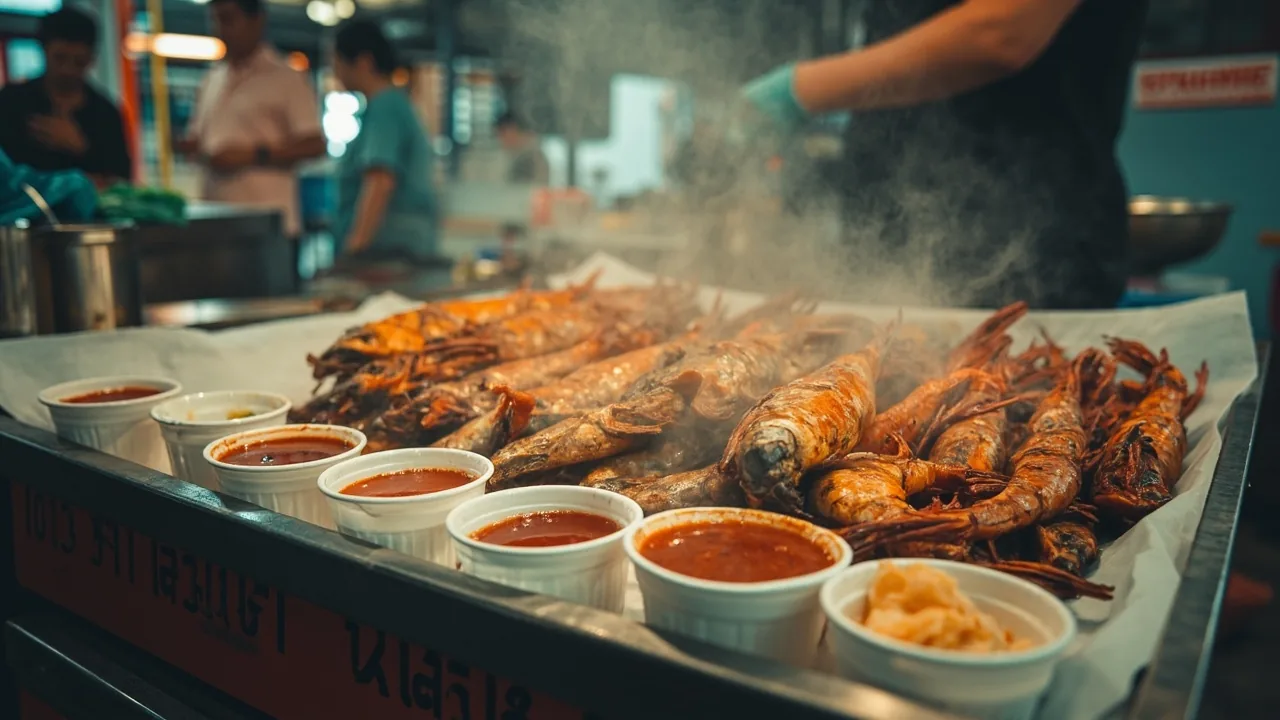
Southeast Asia Food Guide: Complete Regional Guide for Indian Backpackers
Southeast Asian food is one of the cheapest regional cuisines on the planet for Indian backpackers, with most street plates running ₹114-₹229 (~40-80 THB or ~$1.19-$2.37) in Thailand, ₹92-₹184 (~25,000-50,000 VND or ~$0.95-$1.91) in Vietnam, and ₹43-₹81 (~8,000-15,000 IDR or ~$0.45-$0.84) in Indonesia. The catch: it’s built around fish sauce, shrimp paste, pork, and beef, so vegetarians need a strategy beyond just “order something without meat.” This guide walks you through what to eat in each country, what to skip, and where to find Indian or veg food when your stomach needs a break from the unknown. For related planning, see our guides on Sea Backpacking Hub and 7 Days Thailand Tour Package Price.
Subodh’s Pro Tip: Don’t try to eat only “safe” food your first week. Eat one new dish a day at a busy stall, look for turnover, and carry ORS packets from India. Your gut adjusts within five days. Travellers who eat only fried rice and banana pancakes for two weeks miss the entire point of the trip.
Quick Answers
| What | Answer | Price (INR) |
|---|---|---|
| Cheapest meal region | Thailand (Bangkok/Chiang Mai) | ₹114-₹172 (~40-60 THB or ~$1.19-$1.78) |
| Average street meal | Pad thai, pho, nasi goreng | ₹114-₹229 (~40-80 THB or ~$1.19-$2.37) / ₹110-₹220 (~30,000-60,000 VND or ~$1.14-$2.29) / ₹81-₹134 (~15,000-25,000 IDR or ~$0.84-$1.40) |
| Indian meal in SEA | Common in tourist areas | ₹343-₹715 (~120-250 THB or ~$3.56-$7.42) / ₹294-₹551 (~80,000-150,000 VND or ~$3.05-$5.72) |
| Pure veg street food | Rare outside India-dedicated spots | Same as Indian meal range |
| Halal options | Widespread in Malaysia, Indonesia, parts of Thailand | Same as street food range |
| Must-try dish | Pad thai, pho, banh mi, nasi lemak | ₹114-₹229 (~40-80 THB or ~$1.19-$2.37) / ₹110-₹220 (~30,000-60,000 VND or ~$1.14-$2.29) / ₹43-₹81 (~8,000-15,000 IDR or ~$0.45-$0.84) |
What Counts as “Southeast Asian Food”?
Southeast Asian food is a regional grouping, not a single cuisine. Seven countries share a few common threads: rice as the daily starch, fish sauce or shrimp paste as the default savoury base, fresh herbs (Thai basil, cilantro, mint), lime, chilli, and palm sugar for balance. From there the cuisines diverge sharply: Thai food balances sweet-sour-salty-spicy in one bite, Vietnamese food is lighter with broths and herbs, Indonesian and Malaysian food leans on coconut milk and spice pastes, and Cambodian and Laotian food sit somewhere in between, often with French or Khmer influences.
For Indian backpackers, the practical categories that matter are: noodle dishes (pad thai, pho, kway teow), rice dishes (nasi goreng, khao pad, com tam), curries (Thai green curry, massaman, Malaysian curry), grilled meats (satay, gaeng leuk), and soups (tom yum, bun bo Hue). Most are heavily seasoned and not vegetarian by default. Knowing the five or six dishes in each category that you can eat saves hours of menu-staring.
Thailand: The Best Starting Point
Thailand has the most food-friendly infrastructure for Indian backpackers in Southeast Asia. Bangkok, Chiang Mai, and Phuket all have well-organised Indian restaurant districts, and most tourist-area menus are translated into English with photographs.
Pad thai is the entry dish: stir-fried rice noodles with egg, tofu or shrimp, bean sprouts, peanuts, lime, and a tamarind-based sauce. Order it with chicken or tofu if you’re not into shellfish, and ask for “mai phet” (not spicy) if heat isn’t your thing. A plate at a street stall runs ₹143-₹229 (~50-80 THB or ~$1.48-$2.37); sit-down tourist-area restaurants charge ₹343-₹515 (~120-180 THB or ~$3.56-$5.34) for the same dish with air-conditioning.
Tom yum goong is a hot-and-sour shrimp soup with lemongrass, galangal, kaffir lime leaves, and chilli. It’s usually served with prawns and fish sauce. Veg versions exist (tom yum pak, with mushrooms) at places that understand tourists, but the flavour profile is different from anything in Indian cooking. Budget ₹229-₹429 (~80-150 THB or ~$2.37-$4.45) at a street stall, ₹572-₹1,001 (~200-350 THB or ~$5.94-$10.39) at a restaurant.
Khao soi is a Northern Thai coconut curry noodle soup, found mostly in Chiang Mai. It’s egg noodles in a yellow curry broth, topped with crispy noodles, pickled mustard greens, shallots, and usually chicken or beef. Veg versions are common and often better than the meat versions because the broth gets more coconut milk. Expect ₹172-₹286 (~60-100 THB or ~$1.78-$2.97) at a street stall.
Mango sticky rice (khao niao mamuang) is the standard dessert: sweet sticky rice with coconut milk and fresh mango slices. It’s vegetarian, gluten-free, and almost universally available. Budget ₹143-₹229 (~50-80 THB or ~$1.48-$2.37).
For Indian food, Bangkok’s Phahurat area (Little India) and Chiang Mai’s Santitham neighbourhood have multiple Gujarati and Punjabi restaurants. A thali runs ₹429-₹715 (~150-250 THB or ~$4.45-$7.42). Phuket has Indian restaurants in Patong and Phuket Town catering to the large Israeli and Indian tourist crowd. For a daily Indian-food budget, see our Thailand per-day spend guide.
Vietnam: Lighter, Fresher, Harder for Vegetarians
Vietnamese food is built around broths (pho, bun bo Hue), rice paper rolls (goi cuon, cha gio), and baguette sandwiches (banh mi). It’s one of the healthiest regional cuisines but also one of the hardest for vegetarians because fish sauce is in almost everything, including dishes that look safe.
Pho (pronounced “fuh”) is the national dish: rice noodles in a beef or chicken broth, topped with thinly sliced meat, herbs, bean sprouts, lime, and chilli. A bowl at a street stall is ₹110-₹184 (~30,000-50,000 VND or ~$1.14-$1.91); tourist-area pho runs ₹220-₹330 (~60,000-90,000 VND or ~$2.29-$3.43). Veg pho (pho chay) is available in most places catering to tourists and is usually made with a mushroom or vegetable broth, but check that they don’t use fish sauce in the broth. Authentic Vietnamese cooks consider fish sauce non-negotiable.
Banh mi is a French baguette sandwich filled with meat, pâté, pickled vegetables, cilantro, and chilli. It’s street food at its best and cheapest. A banh mi in Hanoi or Ho Chi Minh City runs ₹55-₹92 (~15,000-25,000 VND or ~$0.57-$0.95). Egg banh mi (banh mi trung) is vegetarian-friendly and widely available for around the same price.
Bun cha is a Hanoi specialty: grilled pork patties served over cold rice noodles with a fish-sauce dipping broth, herbs, and pickled vegetables. It’s not a vegetarian dish, but you can find veg versions in tourist areas.
Com tam (broken rice) is a Southern Vietnamese staple, usually served with grilled pork, a fried egg, pickled vegetables, and fish sauce. Veg com tam is rare; you’re better off ordering a plate of broken rice with a fried egg and asking for the meat and fish sauce on the side.
For Indian food, Hanoi has a small Indian restaurant cluster around the Old Quarter, and Ho Chi Minh City has a larger one in District 1. Indian meals here are ₹294-₹551 (~80,000-150,000 VND or ~$3.05-$5.72), which is more expensive than Thai Indian food because the Indian community is smaller. Vegetarian Indian restaurants exist, mostly serving South Indian food.
Indonesia: Halal Default, Spice-Heavy
Indonesian food is the most halal-friendly cuisine in Southeast Asia because the country has the world’s largest Muslim population. Pork is rare outside Bali and Chinese-Indonesian enclaves, and most dishes can be made vegetarian if you skip the meat and ask for no shrimp paste (terasi).
Nasi goreng is the national dish: fried rice with a sweet soy sauce base, egg, and usually chicken or shrimp. A plate at a warung (small local restaurant) runs ₹81-₹134 (~15,000-25,000 IDR or ~$0.84-$1.40); tourist-area versions are ₹215-₹430 (~40,000-80,000 IDR or ~$2.23-$4.47). Veg nasi goreng (nasi goreng sayur) is widely available.
Satay is grilled meat skewers in a peanut sauce, usually served with rice cakes and cucumber. Chicken satay (sate ayam) is the most common. Order without the kecap manis (sweet soy) if you want it less sweet. Budget ₹108-₹215 (~20,000-40,000 IDR or ~$1.12-$2.23) for 10 skewers.
Gado-gado is a boiled-vegetable salad with peanut sauce and rice cakes. It’s one of the few fully vegetarian Indonesian dishes and is genuinely good, not just “vegetarian-friendly.” Expect ₹108-₹188 (~20,000-35,000 IDR or ~$1.12-$1.95).
Rendang is a slow-cooked dry curry from Sumatra, originally made with beef but increasingly available in chicken and veg versions. The spice profile is closer to South Indian than Thai food. A plate at a Padang restaurant (the regional style that dominates Indonesia) is ₹161-₹269 (~30,000-50,000 IDR or ~$1.68-$2.79).
For Indian food, Bali has a large Indian restaurant scene in Kuta and Ubud because of the tourist flow. Jakarta has Indian restaurants in the Kemang and Menteng neighbourhoods. Budget ₹323-₹646 (~60,000-120,000 IDR or ~$3.35-$6.70) for an Indian thali.
Malaysia: The Halal-Vegetable Paradise
Malaysia is the easiest country in Southeast Asia for Indian vegetarian backpackers because of the large Tamil and Chinese-Malaysian populations. Indian restaurants are everywhere, mamak (Indian-Muslim) stalls run 24 hours, and many Chinese-Malaysian dishes are accidentally vegetarian.
Nasi lemak is the national dish: coconut rice served with sambal (spicy paste), anchovies, peanuts, cucumber, and egg. Veg versions with vegetable sambal are common. A packet at a morning stall runs ₹71-₹118 (~3-5 MYR or ~$0.73-$1.22); restaurant versions are ₹188-₹353 (~8-15 MYR or ~$1.96-$3.67).
Roti canai is a flaky flatbread served with dhal or curry dipping sauce. It’s the default breakfast at any mamak stall. A piece of roti canai with dhal is ₹35-₹71 (~1.50-3 MYR or ~$0.37-$0.73). You can eat here twice a day and not spend more than ₹236 (~10 MYR or ~$2.45).
Char kway teow is stir-fried flat rice noodles with soy sauce, egg, prawns, and Chinese sausage. It’s not vegetarian by default but veg versions are available. Expect ₹188-₹353 (~8-15 MYR or ~$1.96-$3.67) at a hawker stall.
Laksa is a coconut-curry noodle soup with a thick, rich broth. Curry laksa and assam laksa are the two main styles. Veg laksa is widely available at Chinese-Malaysian stalls. Budget ₹188-₹283 (~8-12 MYR or ~$1.96-$2.93).
For Indian food, every Malaysian city has a Little India with banana-leaf restaurants, tandoori houses, and South Indian idli-dosa stalls. A banana-leaf meal (unlimited rice with multiple veg curries) is ₹236-₹424 (~10-18 MYR or ~$2.45-$4.40) and is one of the best value meals in Southeast Asia.
Cambodia and Laos: Smaller Scenes, Lower Prices
Cambodia and Laos have smaller Indian communities, so finding Indian food requires more effort. But the local food is good and cheap, and tourist hubs like Siem Reap and Luang Prabang have well-organised veg-friendly menus.
Kuy teav (Cambodia) is a pork-and-seafood noodle soup that’s the breakfast staple in Phnom Penh. A bowl is ₹95-₹190 (~4,000-8,000 KHR or ~$0.99-$1.98) at a local stall, ₹96-₹193 (~1-2 USD) at a tourist place. Veg versions exist but are uncommon.
Amok trey (Cambodia) is a steamed fish curry in coconut milk with kaffir lime, served in a banana leaf. It’s one of the more aromatic regional dishes. Order without fish if you want a veg version; tourist-area restaurants usually accommodate. Budget ₹145-₹289 (~1.50-3 USD).
Larb (Laos) is a minced-meat salad with herbs, lime, chilli, and toasted rice powder. It’s eaten as a main dish or with sticky rice. Veg larb (with mushrooms or tofu) is available in Luang Prabang. Budget ₹107-₹215 (~25,000-50,000 LAK or ~$1.11-$2.23) at a local stall.
Khao niaw (Laos) sticky rice is the daily staple, eaten by hand from a bamboo basket. Pair it with jeow (chilli dips) and grilled meat or veg.
For Indian food, Siem Reap and Phnom Penh have a handful of Indian restaurants catering to tourists; expect to pay ₹96-₹289 (~1-3 USD) for a basic veg thali. Luang Prabang has fewer options but at least one reliable Indian spot near the night market. Vientiane has a small but decent Indian cluster.
What to Eat on a ₹5,000 (~$51.90)-a-Day Budget
If you’re running a standard Southeast Asia budget trip, here’s roughly how your food money breaks down across the four main countries:
| Country | Breakfast | Lunch | Dinner | Daily total |
|---|---|---|---|---|
| Thailand | Roti + chai (₹143-₹229 (~50-80 THB or ~$1.48-$2.37)) | Pad thai or rice plate (₹172-₹286 (~60-100 THB or ~$1.78-$2.97)) | Indian thali or street meal (₹343-₹515 (~120-180 THB or ~$3.56-$5.34)) | ₹715-₹1,144 (~250-400 THB or ~$7.42-$11.87) |
| Vietnam | Banh mi + coffee (₹92-₹147 (~25,000-40,000 VND or ~$0.95-$1.52)) | Pho or com tam (₹147-₹220 (~40,000-60,000 VND or ~$1.52-$2.29)) | Bun cha or Indian meal (₹220-₹441 (~60,000-120,000 VND or ~$2.29-$4.57)) | ₹477-₹808 (~130,000-220,000 VND or ~$4.96-$8.39) |
| Cambodia | Kuy teav or fruit (₹96-₹193 (~1-2 USD)) | Local rice plate (₹193-₹289 (~2-3 USD)) | Indian meal or amok (₹289-₹482 (~3-5 USD)) | ₹578-₹963 (~6-10 USD) |
| Laos | Khao niao + coffee (₹107-₹215 (~25,000-50,000 LAK or ~$1.11-$2.23)) | Larb or noodle soup (₹172-₹344 (~40,000-80,000 LAK or ~$1.78-$3.57)) | Indian or local restaurant (₹344-₹644 (~80,000-150,000 LAK or ~$3.57-$6.69)) | ₹644-₹1,203 (~150,000-280,000 LAK or ~$6.69-$12.48) |
A solo Indian backpacker eating street food three times a day in Thailand can run food costs as low as ₹572 (~200 THB or ~$5.94) per day. Add one Indian meal per day and you’re at ₹1,001-₹1,287 (~350-450 THB or ~$10.39-$13.35). In Vietnam and Cambodia, the equivalent range is ₹367-₹661 (~100,000-180,000 VND or ~$3.81-$6.86) and ₹482-₹771 (~5-8 USD).
Common Mistakes Indians Make With SEA Food
Mistake 1: Assuming “vegetarian” means no meat. Most Thai, Vietnamese, and Indonesian cooks consider fish sauce and shrimp paste as flavouring, not meat. They’ll say a dish is vegetarian because there’s no chicken or pork, but the broth or sauce is still fish-based. Always ask “no fish sauce?” (“mai nam pla” in Thai, “khong nuoc mam” in Vietnamese).
Mistake 2: Eating only at tourist-area restaurants. The pad thai on Khao San Road is three to four times the price of the same dish on a side street. Walk two blocks away from the main tourist strip and you’ll find the same food for half the price. Look for stalls with locals eating and high turnover.
Mistake 3: Drinking tap water and skipping ORS. The ice in most street drinks is safe (commercially produced), but the water in fruit shakes, soups, and freshly cut fruit can vary. Carry ORS packets from India (2 rupees per packet at any chemist) and use them at the first sign of loose motion. It’s cheaper and faster than rehydration salts bought abroad.
Mistake 4: Skipping street food entirely because of hygiene fears. The safest street food is the busiest street food. High turnover means ingredients don’t sit out. The risky stalls are the empty ones with food sitting under a fan for hours.
Mistake 5: Ordering “spicy” without testing the local heat first. Thai chilli is not Indian chilli. A “medium” Thai dish can be eye-watering if you’re not calibrated. Always start with mild (mai phet in Thai, khong cay in Vietnamese) and work up over a few days.
What Most Guides Don’t Tell You
Most “Thai food” isn’t eaten as a single dish. In Thailand, meals are built around a rice or noodle base with multiple small shared dishes: a curry, a stir-fry, a soup, a salad. If you order just one plate of pad thai at a sit-down Thai restaurant, you’re eating like a tourist. Locals order two or three shared dishes and split them. This is also cheaper per dish and gives you variety.
“Indian food” in Southeast Asia often means Punjabi or Gujarati. If you’re from South India, you’ll find the South Indian restaurants, but they’re concentrated in cities with a Tamil diaspora (Malaysia, Singapore, parts of Bangkok, Ho Chi Minh City). Northern Thai and Cambodian Indian restaurants often don’t serve idli, dosa, or sambar. Set expectations accordingly or stick to the universal dishes (dal, rice, naan, paneer).
Fruit shakes are not always safe. The “fresh fruit shake” stall is everywhere, but ice and water quality vary. Stick to stalls where you can see the fruit being cut in front of you and the ice is from a sealed bag (most tourist-area stalls are fine). Avoid pre-mixed shakes and anything with dairy if your stomach is still adjusting.
Tipping isn’t expected but small change helps. Southeast Asia doesn’t have a strong tipping culture at street stalls. At sit-down restaurants, ₹29-₹57 (~10-20 THB or ~$0.30-$0.59) or ₹73-₹184 (~20,000-50,000 VND or ~$0.76-$1.91) is appreciated but not required. Don’t over-tip; it creates awkwardness and isn’t part of the local economy.
FAQ
Is Southeast Asian food safe for Indian vegetarians? Most countries have vegetarian options, but you need to specify “no fish sauce” and “no oyster sauce.” Vietnamese food is the hardest because fish sauce is in almost everything. Malaysian and Indonesian food is the easiest because of the large Muslim and Indian populations.
Where do I find pure vegetarian Indian food? Every country has at least one Indian restaurant district: Bangkok (Phahurat/Silom), Chiang Mai (Santitham), Phuket (Patong), Hanoi (Old Quarter), Ho Chi Minh City (District 1), Kuala Lumpur (Little India), Penang (Little India), Bali (Ubud/Kuta), Siem Reap (Pub Street area), and Luang Prabang (near the night market). Veg thalis cost ₹343-₹715 (~120-250 THB or ~$3.56-$7.42) or equivalent in local currency.
How much should I budget for food per day? Thailand: ₹715-₹1,144 (~250-400 THB or ~$7.42-$11.87). Vietnam: ₹477-₹808 (~130,000-220,000 VND or ~$4.96-$8.39). Cambodia: ₹578-₹963 (~6-10 USD). Laos: ₹644-₹1,203 (~150,000-280,000 LAK or ~$6.69-$12.48). Malaysia and Singapore run higher because the local currency is stronger. See our Southeast Asia daily budget guide for a fuller breakdown.
Can I drink the water? No. Stick to bottled water (sealed, check the cap) and commercially produced ice. Most street drinks use safe ice, but ask if you’re unsure. Carry ORS from India as backup.
What’s the one dish I have to try? Pad thai if it’s your first time in Thailand, pho if it’s your first time in Vietnam, nasi lemak if it’s your first time in Malaysia. Pick one, eat it at a busy local stall, and don’t order “mild” unless you genuinely can’t handle spice.
Is Indian food in Southeast Asia expensive? Yes, typically two to four times the price of local food. Budget for one Indian meal per day as a treat, not three. Street food is the value play, and your body adjusts to local spice faster than you think.
Do I need to carry Indian snacks? Carry a small stash for the first three days: Maggi packets, instant upma, bhujia, and pickle. They’re useful for late-night hunger, when you can’t find veg food, or when your stomach needs a break. Once you’ve calibrated, you’ll rely on them less.
Subodh’s Take
Southeast Asian food is the single biggest reason most Indian backpackers end up extending their trips. The cuisine is varied enough that two months in you still haven’t tried everything, cheap enough that eating well costs less than your daily chai-and-paratha budget back home, and foreign enough that every meal teaches you something new. Eat at busy stalls, order one dish you don’t recognise every day, and keep a stash of Indian snacks for the days your stomach needs a break. If you do that, you’ll come back having eaten better than any previous trip.
