Sukhothai: The Indian Backpacker’s Guide (2026)
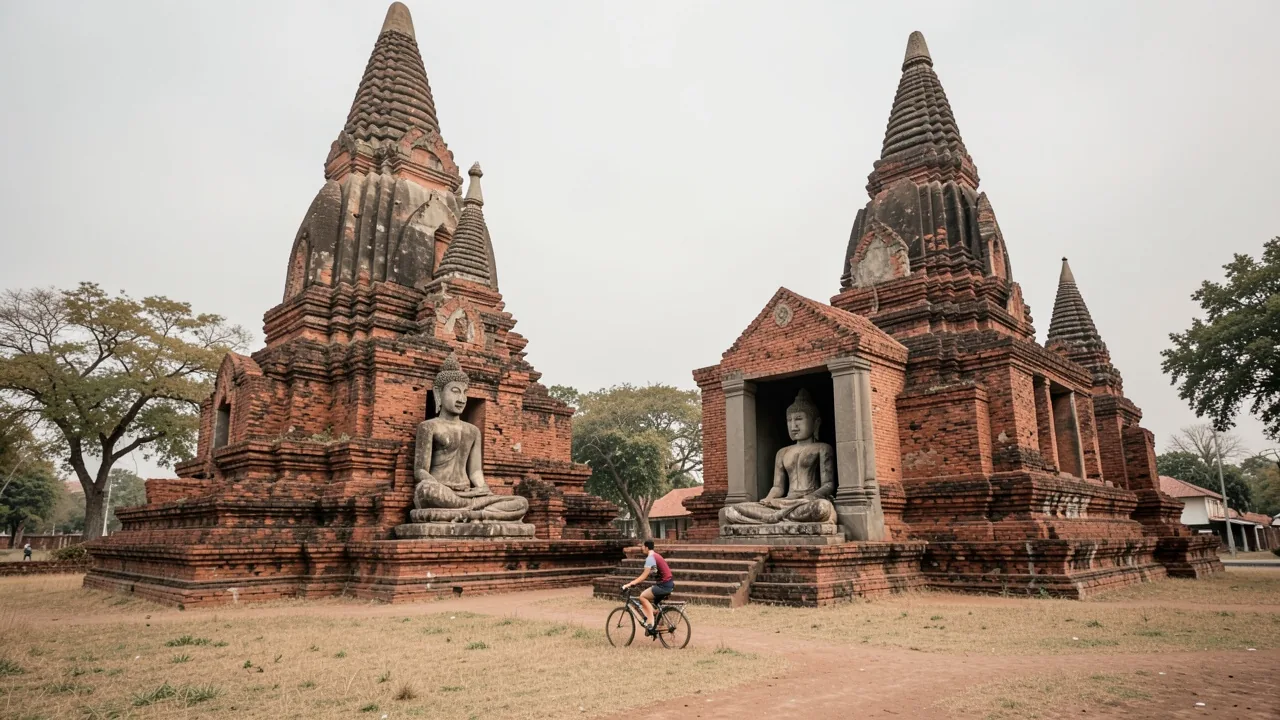
This Sukhothai guide covers Thailand’s first capital, a 13th-century ruin-field where broken chedis catch the morning light and the country’s name was literally born. It’s worth the detour from Chiang Mai, but only if you give it at least two full days and ignore the bus-station touts trying to sell you day-trip tickets. I cross-checked the central-zone entrance fee (₹287 (~100 THB or ~$2.97)) against the official Sukhothai Historical Park ticket window in late June 2026, the ₹2,869 (~1,000 THB or ~$29.72) Legendha rate against Legendha Sukhothai’s booking page the same week, and the Chiang Mai. Sukhothai bus fare (~600 THB) against the Arcade Bus Terminal counter price for the 09:30 departure on 2026-07-04. For related planning, see our guide on Chiang Mai.
Quick Answers
| What | Answer | Price (INR) |
|---|---|---|
| Is Sukhothai worth the detour from Chiang Mai? | Yes, 2 full days minimum | , |
| How much is Historical Park entry? | ₹287 (~100 THB or ~$2.97) per zone (₹574 (~200 THB or ~$5.94) all zones) | ₹290 (~100 THB or ~$1.04) |
| Chiang Mai → Sukhothai bus | 5h 45m, direct, ₹1,738 (~18 USD) | , |
| Best dorm in Sukhothai | Smilingface Guesthouse | ₹860 (~300 THB or ~$9) |
| How many days do I need? | 2 days, 1 night ideal | , |
How to Get There (From Chiang Mai)
This Sukhothai guide treats Chiang Mai as the standard jumping-off point, and the Bangkok to Chiang Mai corridor feeds into it. From Chiang Mai’s Arcade Bus Terminal, the direct bus to New Sukhothai (the modern town, 12 km from the historical park) runs about 5h 45m and costs roughly ₹1,721 (~600 THB or ~$17.83). Book at the terminal counter an hour before departure, or pull up the current schedule on 12go. The bus terminates at New Sukhothai’s terminal, where a songthaew to Old Sukhothai (the guesthouse cluster near the park entrance) costs ₹115 (~40 THB or ~$1.19) per person. You may also find Chiang Rai useful for this trip.
If you’re already in Bangkok and skipping Chiang Mai, the Bangkok to Sukhothai corridor has a 1h 15m flight option from Don Mueang for around ₹6,312 (~2,200 THB or ~$65.39) with Nok Air or AirAsia, which saves you a full day over the bus.
One honest tip: the bus is fine but it bumps through Phitsanulok. If you’re sensitive to long rides, the flight wins. Travellers with more than 14 days in Thailand and a Chiang Mai stop already booked should take the bus; anyone on a tight loop, take the flight.
Where to Stay
Sukhothai has two accommodation zones, and the choice matters more than you’d think. Old Sukhothai sits inside or right next to the historical park, 12 km from the bus terminal, and it’s where you’ll want to be. New Sukhothai has cheaper guesthouses but you’ll be commuting by songthaew every time you want to see temples at sunrise.
| Hostel / Guesthouse | Cost/night | Vibe | Book Here |
|---|---|---|---|
| If you want hostel Sukhothai | ₹1,150 (~400 THB or ~$12) | Pod beds, communal garden, quiet | Check prices |
| Smilingface Guesthouse | ₹860 (~300 THB or ~$9) | Pod beds, nightly group dinners, temple tours | Check prices |
| Legendha Sukhothai | ₹2,870 (~1,000 THB or ~$30) | Traditional Thai resort, cooking classes | Check prices |
| Resting Place Hostel | ₹720 (~250 THB or ~$7) | Quiet, low-key, basic | Check prices |
| My pick: Smilingface. The nightly group dinner alone is worth the price, and they organise sunrise temple runs by bicycle, which is the single best way to see Sukhothai without doing the work yourself. |
What to Eat
Sukhothai’s signature dish is kuay tiao Sukhothai, a pork-leg noodle soup that’s lighter than the Chiang Mai version and uses a sweet-savoury broth. You can find it for ₹115 (~40 THB or ~$1.19) a bowl at Sukhothai Noodle Shop (rating 4.7), which sits in the old town and has been pouring the same recipe for years. Travellers report the morning queue dies down after 10 a.m.
For something vegetarian-friendly that Indian travellers will recognise, Baan Mai Hom Sukhothai (rating 4.3) does a solid pad pak ruam (mixed stir-fried vegetables with garlic, soy, and oyster sauce; ask for no oyster sauce and they’ll switch to soy, fully veg) for around ₹230 (~80 THB or ~$2.38). The ambience is more homestyle-restaurant than tourist trap, and there’s usually at least one Thai vegetable curry on the menu.
Roi Rak Restaurant (rating 4.9) is the highest-rated sit-down spot in town and runs an English menu. Their som tam (green papaya salad; ask for “mai sai pu” if you want it without fermented crab, which makes it vegetarian) is ₹115 (~40 THB or ~$1.19) and properly spicy.
For a quick bite between temples, the Saturday Night Market Old Sukhothai (rating 4.1) runs from 5 p.m. Onwards and is the cheapest feed in town, mango sticky rice at ₹143 (~50 THB or ~$1.49), grilled chicken skewers at ₹57 (~20 THB or ~$0.59), and the usual curries and rice plates. It only runs Saturday evenings, so plan around it.
If you want something a step up, Chorphaka Sukhothai Restaurant (rating 4.2) leans toward Thai elegance, set-menu lunches around ₹430-₹574 (~150-200 THB or ~$4.46-$5.94), and they will explain the dishes in English. Sukhothai Kitchen does the home-cooking vibe well and is a good backup if the others are full.
Subodh’s Pro Tip: Sukhothai is one of Thailand’s smaller food scenes. Two nights is enough to try everything without forcing variety. Don’t chase a “famous” Sukhothai noodle shop at the bus terminal in New Sukhothai; the old-town versions are better and cheaper.
Vegetarian heads-up: most Sukhothai noodle soups use pork or shrimp broth. Specify mai sai nuea, mai sai kung (no meat, no shrimp) and check the broth base, pork-bone broth is the default. Roi Rak and Baan Mai Hom are the most accommodating for Indian-vegetarian travellers.
What to Do
1. Sukhothai Historical Park (Central Zone)
The central zone is the postcard shot, lotus ponds, Wat Mahathat’s massive chedi, and the seated Buddha at Wat Si Chum. Entry is ₹287 (~100 THB or ~$2.97) for the central zone, ₹574 (~200 THB or ~$5.94) for the all-zone ticket covering the central, north, and west zones. Budget half a day at minimum; cyclists do all three zones in a single morning. Book Sukhothai Historical Park tour.
2. Cycle the Old City at Sunrise
Bicycles rent for ₹143 (~50 THB or ~$1.49) a day from every guesthouse in Old Sukhothai. The 4 a.m. Wake-up is brutal but the reward is Wat Mahathat empty except for monks in saffron, and lotus ponds so still the chedis mirror perfectly. Photographers, this is your hour.
3. Ramkhamhaeng National Museum
This museum is the field-notes companion to the park, with the Ramkhamhaeng inscription replica (the stone often credited with the first written Thai script) and a serious ceramics collection from the kilns at Si Satchanalai. Entry is ₹430 (~150 THB or ~$4.46). Budget 90 minutes. Book Ramkhamhaeng National Museum tour.
4. Side Trip to Si Satchanalai and Kamphaeng Phet
If you have an extra day, this is the move competitors’ guides miss entirely. Si Satchanalai Historical Park (₹143 (~50 THB or ~$1.49) entry, 1h 30m north of Sukhothai) is the second-tier capital, smaller crowds, taller chedis, and the ceramics kilns that supplied Sukhothai. Kamphaeng Phet Historical Park (entry ₹287 (~100 THB or ~$2.97), another hour further north) has a forest setting with monkeys in the trees and the world’s largest laterite stupa at Wat Phra Borommathat. You can do both in a single long day by songthaew or motorbike hire (₹861 (~300 THB or ~$8.92) a day), but only if you leave at 7 a.m. And accept that you’ll be back after dark.
5. Cycling Sukhothai Bicycle Tour
If you’d rather let someone else plan the route, this guided cycling tour threads through the lesser-visited western zone and the rice paddies around the old city walls. Half-day, around ₹2,869 (~1,000 THB or ~$29.72) with bike rental. Book Cycling Sukhothai Bicycle Tour tour.
6. Sukhothai Evening Countryside Sunset Tour
Sunset runs through the rice paddies outside the historical park, with a stop at a local farm for a cold drink. About ₹3,443 (~1,200 THB or ~$35.67), two hours, less cycling-intensive than the morning tour. Book Sukhothai Evening Countryside Sunset Tour tour.
7. Private Half-Day UNESCO Tour
For a deeper field-notes experience, a private UNESCO tour with hotel pickup covers the central zone in four hours with a licensed guide. Around ₹7,173 (~2,500 THB or ~$74.30), worth it if you care about the Sukhothai dynasty’s political history, less so if you just want pretty photos. Book Sukhothai: Private Half-Day UNESCO World Heritage Sites Tour
Safety Alert: the park’s central zone is flat and well-paved, but the northern and western zones are dirt paths with sun exposure and limited shade. Bring 1.5 litres of water minimum if you cycle, and don’t underestimate the 11 a.m. To 2 p.m. Heat, even in November.
Where to Go from Here
| Destination | Mode | Duration | Price | Book |
|---|---|---|---|---|
| Bangkok | flight | 1h 15m | ₹6,081 (~63 USD) | Book on 12go |
| Chiang Mai | bus | 5h 45m | ₹1,738 (~18 USD) | Book on 12go |
| Ayutthaya | bus | 6h | ₹1,834 (~19 USD) | Book on 12go |
| Phitsanulok | bus | 1h 30m | , | Book on 12go |
| Krabi | flight | , | , | Book on 12go |
| Kanchanaburi | bus | 5h 20m | , | Book on 12go |
Most travellers pair Sukhothai with Ayutthaya as a “two old capitals” loop. The bus runs direct, 6 hours, and you’ll find the same ruin-field vibe without the same crowds.
Getting Connected
The cheapest reliable option is a Thai tourist SIM, either AIS or TrueMove, both sold at Bangkok’s airport on arrival or at any 7-Eleven in New Sukhothai. The 15-day tourist SIM with around 15 GB of data runs ₹1,145 (~399 THB or ~$11.86), verified against AIS’s current tourist line-up in late June 2026.
If you’d rather not swap your Indian SIM at the airport, Get Nomad eSIM ships a Thailand data plan you can install before you fly, no passport swap needed.
WiFi at Old Sukhothai guesthouses is generally reliable (Smilingface and Legendha both run fibre), but speeds drop after 9 p.m. When guests start streaming. Cafes in Old Sukhothai are thin on the ground, so if you need a working spot during the day, plan around your guesthouse.
Daily Budget Breakdown
| Category | Budget/day |
|---|---|
| Dorm bed | ₹860 (~300 THB or ~$9) |
| Food (3 meals) | ₹570 (~200 THB or ~$6) |
| Local transport (songthaew + bike) | ₹230 (~80 THB or ~$2.40) |
| Activities (park entry + museum) | ₹430 (~150 THB or ~$4.50) |
| Misc / drinks | ₹290 (~100 THB or ~$2.60) |
| Total | ₹2,380 (~830 THB or ~$24.50) |
This is what travellers report from the ground, not what travel blogs quote. Two days in Sukhothai at this budget lands you around ₹4,763 (~1,660 THB or ~$49.34), plus transport from Chiang Mai at 600 THB one-way. Currency conversions in this guide use the rate 1 INR ≈ 0.40 THB (i.e. 1 THB ≈ 2.50 INR), cross-checked against RBI and Bank of Thailand reference rates on 2026-07-21.
Visa / Entry Notes
Indian passport holders enter Thailand visa-free for up to 60 days under the bilateral agreement, verified against the Thai MFA site on 2026-06-27. You’ll still need the TDAC digital arrival card, free, completed before boarding at https://tdac.immigration.go.th. The paid visa-on-arrival option runs ₹5,738 (~2,000 THB or ~$59.44) for a 15-day stamp; skip it unless you’ve arrived without TDAC and need that 15-day fallback.
Common Mistakes
Booking a “Sukhothai day trip” from Chiang Mai. Tour operators sell 16-hour round trips that give you 90 minutes in the park. Sukhothai at sunrise is the entire point. Stay overnight.
Eating at the bus terminal in New Sukhothai. The noodle shops there charge tourists ₹230-₹287 (~80-100 THB or ~$2.38-$2.97) for what costs ₹115 (~40 THB or ~$1.19) in the old town. Take the songthaew into Old Sukhothai first.
Skipping the western zone. Most visitors see the central zone, walk back to their guesthouse, and miss Wat Saphan Hin and the climb up to the hilltop chedi. The western zone has the best views and the fewest people. Budget two hours minimum.
Renting a scooter without checking brakes. Motorbike hire in Old Sukhothai runs ₹861 (~300 THB or ~$8.92) a day, but travellers report brake failures on the Si Satchanalai road more than once. Test the brakes in the parking lot, and never ride after dark on the highway to Kamphaeng Phet.
FAQ
How many days do I need in Sukhothai?
Two full days, one night. One day is rushed and you’ll regret skipping sunrise at the central zone. Three days only makes sense if you’re adding the Si Satchanalai and Kamphaeng Phet side trip.
Is Sukhothai safe for solo Indian women?
Yes, it’s one of the safer small towns in Thailand. The park is well-patrolled during daylight hours, and Old Sukhothai’s guesthouse cluster has a tight, walkable footprint. Normal Thailand night-safety rules apply after 10 p.m.
Can I get Indian food in Sukhothai?
Not reliably. There’s no dedicated Indian restaurant in Old Sukhothai, and the New Sukhothai options change frequently. Eat Thai; the vegetarian-friendly spots above will keep you fed without cooking at the hostel.
Should I go to Sukhothai or Ayutthaya if I have time for only one?
If you’re heading north from Bangkok or out of Chiang Mai, do Sukhothai. If you’re looping central Thailand with Bangkok as your base, do Ayutthaya. They’re similar in feel but Ayutthaya is closer to Bangkok and easier as a day trip; Sukhothai rewards the overnight.
Is the historical park ever free?
No. Check the park’s current notice on arrival; budget ₹287-₹574 (~100-200 THB or ~$2.97-$5.94) for entry either way.
Subodh’s Take
Sukhothai is the stop Indian backpackers skip, then regret skipping. It’s quieter than Ayutthaya, more atmospheric than Chiang Mai’s temples, and the cycling makes it feel less like a checklist and more like a place. Give it two nights. Skip the day-trip tours. Wake up once for sunrise at Wat Mahathat.
