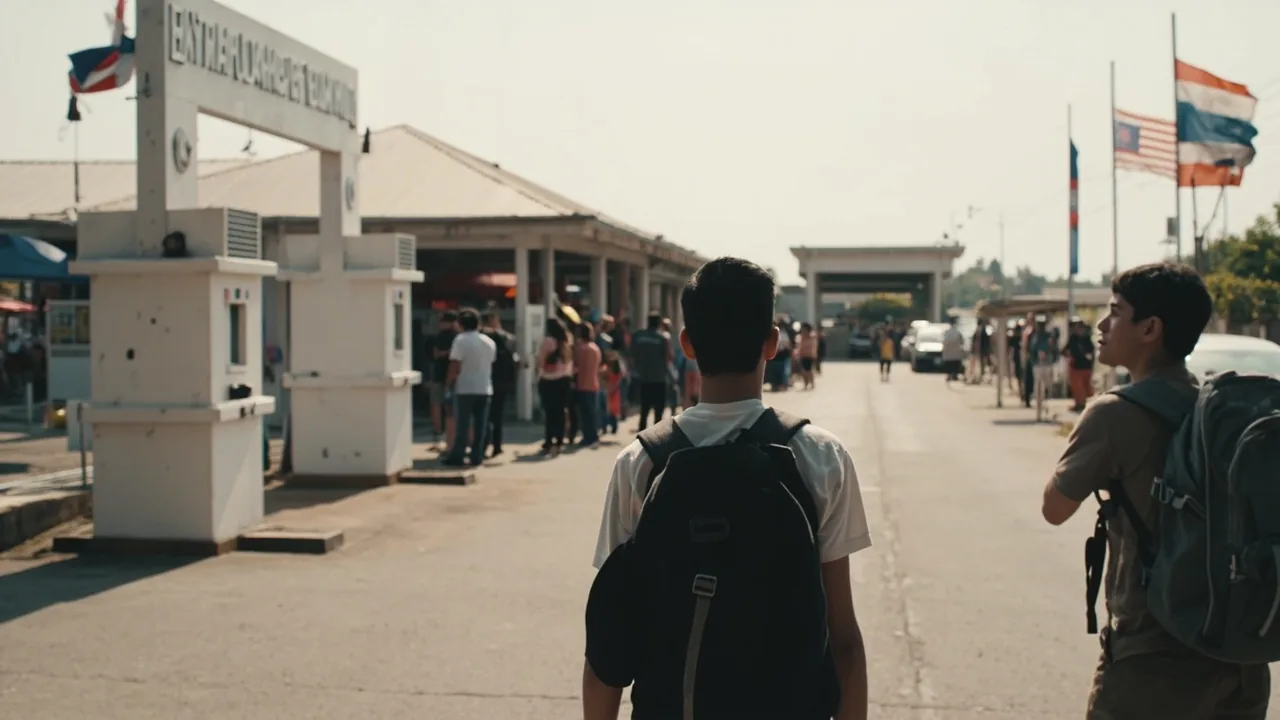
Where Exactly Is the Border Between Thailand and Malaysia? (2026 Indian Traveler’s Guide)
Where is the border between Thailand and Malaysia? It runs roughly 650 km across the Kra Isthmus, separating Thai provinces (Songkhla, Pattani, Yala, Narathiwat) from Malaysian states (Perlis, Kedah, Perak, Kelantan) through 7 official crossings, with Sadao-Bukit Kayu Hitam the busiest and Wang Kelian the most scenic.
Quick Answers
| What | Answer | Price (INR) |
|---|---|---|
| Length of land border | ~650 km across the Malay Peninsula | — |
| Provinces/States it separates | Songkhla, Pattani, Yala, Narathiwat (TH) ↔ Perlis, Kedah, Perak, Kelantan (MY) | — |
| Main Indian-traveler crossings | Sadao-Bukit Kayu Hitam, Wang Kelian, Betong-Wang Kelian, Sungai Golok-Rantau Panjang | — |
| Thai exit fee | per person | ₹57 (~$0.59) |
| Malaysian visa for Indians | e-Visa / MEV (advance required) | ₹1,182 (~$12.27) |
| Visa-free transit zone | Not applicable, full entry required | — |
| Time to cross on foot | 30-90 minutes including queues | — |
| Currency on Thai side | Thai Baht (THB) | 1 THB ≈ ₹2.87 (~$0.03) |
| Currency on Malaysian side | Malaysian Ringgit (RM) | 1 RM ≈ ₹23.64 (~$0.25) |
Note on the exchange rate: Verified 2026-07-17. 1 RM ≈ ₹23.64 (~$0.25) (1 INR ≈ 0.042 RM). Rates shift daily, but the borders of Thailand and Malaysia haven’t moved in centuries.
Where the Thailand-Malaysia Border Runs
If you pull up a Thailand-Malaysia border map, you’ll see it stretches from the Andaman Sea in the west (just south of Satun province) all the way to the Gulf of Thailand in the east (near Narathiwat). It cuts the peninsula roughly in two for its southern stretch, then angles south-east, with the Thai provinces sitting on the eastern, Gulf side and Malaysian states on the western, Andaman side.
The geography:
- Western anchor: Sadao district in Songkhla province (TH) ↔ Bukit Kayu Hitam in Kedah (MY). This is where the main North-South highway (AH2) crosses.
- Eastern anchor: Sungai Golok (TH) ↔ Rantau Panjang (Kelantan, MY). Further east, the Golok River itself forms a natural border for tens of kilometres, separating Narathiwat from Kelantan.
- Middle stretch: Narathiwat (TH) ↔ Perak and Kelantan (MY) through hilly, forested terrain with no major road crossings.
- Northern edge: The border doesn’t run all the way to Bangkok; it starts around 900 km south of the capital, roughly at the latitude of Phuket.
The Thai provinces along this line, specifically Pattani, Yala, and Narathiwat, are sometimes called the “Deep South.” This matters for you, because the security situation there is meaningfully different from the rest of Thailand, and skipping it is the single most common safety mistake Indian backpackers make.
The 7 Official Thailand-Malaysia Border Crossings (North to South)
1. Sadao-Bukit Kayu Hitam (the one 95% of backpackers use)
This is the main crossing. Sadao sits in Songkhla province on the Thai side, 60 km south of Hat Yai. Bukit Kayu Hitam sits across the highway in Kedah, Malaysia. The crossing handles buses, motorbikes, cars, and pedestrians, and it runs 24 hours.
Crossing this one takes 45 to 90 minutes including queueing, depending on the time of day. Avoid Malaysian public holiday eves; the queue can stretch to 3 hours.
- Thai side: Sadao border post, off Highway 4. Buses from Hat Yai drop you here ( from Hat Yai’s main terminal).
- Malaysian side: Bukit Kayu Hitam ICQS (Immigration, Customs, Quarantine and Security Complex). Direct buses to Alor Setar (30 RM), Penang (45-55 RM), and Kuala Lumpur run from here.
2. Wang Kelian-Wang Kelian (scenic, quiet, eastern Perlis)
The Wang Kelian crossing connects Padang Besar in Songkhla with the small Malaysian town of Wang Kelian in Perlis. The road on the Malaysian side climbs through a hill-station-style area near Perlis State Park, which is worth a half-day stop if you like quiet jungle.
- Thai side: Wang Kelian checkpoint, near the village of Wang Prachan. 45 km from Hat Yai.
- Malaysian side: Wang Kelian ICQS, then either Perlis State Park or onward to Kangar and Alor Setar.
This crossing closes at 22:00 Thai time. Don’t plan a late arrival.
3. Padang Besar-Padang Besar (railway crossing)
Padang Besar has a railway station on both sides of the border, which is unusual. Trains from Bangkok to Butterworth (Penang) cross here. The on-foot passenger terminal next to the railway station also handles pedestrians.
This is a faster crossing than Sadao if you arrive by train, because immigration and customs are co-located with the rail terminal.
4. Betong-Wang Kelian (alternative mid-route)
Betong is in Yala province, further east. This crossing is sometimes called the “Betong route” and is used by travellers heading to or from Kota Bharu in Kelantan.
- Thai side: Betong border checkpoint, 200 km southeast of Hat Yai, accessible by minivan from Yala city.
- Malaysian side: Connects to the Malaysian interior road network. Slower, less frequent onward transport.
5. Tak Bai-Pengkalan Kubur (boat crossing)
Tak Bai is a small Thai coastal town in Narathiwat province across from Pengkalan Kubur in Kelantan. The crossing is by boat across the Golok River.
This crossing requires a Thai re-entry permit if you’re just doing a day trip, and it sits in the Deep South security zone (more on that below).
6. Sungai Golok-Rantau Panjang (24-hour, Malay-language friendly)
This is the easternmost main crossing, and it’s busy with cross-border shoppers. Rantau Panjang on the Malaysian side is famous for cheap goods, and many Malaysians cross here to buy Thai petrol and snacks.
- Thai side: Sungai Golok district, Narathiwat province.
- Malaysian side: Rantau Panjang, Kelantan. Direct buses to Kota Bharu (15 RM, 1 hour).
7. Ban Taba-Sungai Padi (remote, mostly for locals)
A small remote crossing in the deep south of Narathiwat province. Only used by local villagers with border passes. If you find yourself here without a pre-arranged permit, you won’t be allowed through.
Step-by-Step: Crossing Sadao-Bukit Kayu Hitam (Most Common)
Step 1: Get to Hat Yai
Hat Yai is the staging town. From Bangkok it’s an overnight train ( for a 2nd-class sleeper, ~14 hours). From Phuket, a bus (, 6 hours). From Krabi, a minivan (, 5 hours).
Step 2: Take a bus or minivan to Sadao border
Minivans to Sadao leave from Hat Yai’s main minivan terminal near the post office. The fare is per person. Trip takes 75 minutes. The driver will drop you at the Thai immigration building.
Step 3: Clear Thai exit immigration
You queue at the Thai immigration hall. Have your passport, the departure card (filled on the flight in or at the immigration counter), and your TM30 (the Thai arrival registration form, if you have one) ready.
Thai exit fee: per person, payable at a separate counter inside the building.
Step 4: Walk across the no-man’s land
It’s a roughly 600-metre stretch of road between the Thai exit building and the Malaysian ICQS. Taxis and motorbikes offer rides, but walking is faster and the road is flat.
Step 5: Clear Malaysian entry immigration
The Malaysian ICQS building is bigger and usually busier. Have your passport, your printed Malaysian eVisa or VOA documents, and your onward bus ticket ready. Indian passport holders need a Malaysian visa in advance for tourism, you cannot get VOA at land crossings (this is critical, see below).
Step 6: Find your onward bus
After immigration, walk straight out of the building to the bus terminal. Some unofficial touts inside the terminal may claim the bus station has “moved” — it hasn’t. Stick to the official terminal.
Step 7: Continue to Alor Setar, Penang, or KL
- Alor Setar: 30 RM, 1 hour
- Penang (Butterworth): 45 RM, 2 hours
- Kuala Lumpur: 70-85 RM, 5-6 hours, often with a bus change in Butterworth
Total Cross-Border Cost
Walking it yourself with public transport:
| Leg | Cost | Price (INR) |
|---|---|---|
| Minivan Hat Yai to Sadao (Thai side) | ₹172 (~$1.79) | |
| Thai exit fee | ₹57 (~$0.59) | |
| Bus Bukit Kayu Hitam to Penang (Malaysian side) | 45 RM | ₹1,064 (~$11.05) |
| Total Hat Yai to Penang | , | ~₹1,293 (~$13.42) |
By comparison, a through-ticket from a Hat Yai travel agency that handles the cross-border handoff end-to-end runs 250 to all-in (₹717-₹1,004 (~$7.44-$10.42)), but you get less flexibility.
Visa Implications for Indian Passport Holders
Thailand: Indian passport holders currently enjoy visa-free entry for up to 60 days when entering by air or land, though the exact duration can vary by entry point — always confirm at the counter. You just get a 60-day stamp on arrival, no fee, no form beyond the standard arrival/departure card. See our Thailand visa guide for Indians for the latest rules.
Malaysia: This is where it gets tricky. Indians need a Malaysian visa in advance. The two main options:
- eVisa (eVISA): Apply online through the official Malaysia eVisa portal. 50 RM per person (~₹1,182 (~$12.27)), processed in 3-5 working days, valid for 30 days single entry. This is what most backpackers use. Our step-by-step Malaysia eVisa guide walks through the exact application.
- Multiple Entry Visa (MEV): 100 RM per person (~₹2,364 (~$24.54)), valid for up to 30 days per entry, multiple entries within validity.
- Visa on Arrival at land crossings: NOT available for Indian passport holders. Only specific nationalities (including most ASEAN, Japan, South Korea, and a handful of others) qualify for VOA. Don’t believe any agent who tells you otherwise.
Apply at: Official Malaysia eVisa portal. The official URL ends in .gov.my. Stay away from any .com site that asks for the same fee, those are processing agencies that add 100-150 RM on top.
Common Mistakes Indians Make at the Thailand-Malaysia Border
1. Believing you can get a Malaysian VOA at land crossings
What people do wrong: Assume the rules are the same as Thailand or Indonesia, where VOA exists.
What happens: The Malaysian immigration officer at Sadao or Wang Kelian sends you back to Bangkok, Hat Yai, or Kuala Lumpur to apply for an eVisa. There is no VOA for Indians at any land crossing.
How to avoid: Apply for your Malaysian eVisa at least 1 week before you cross. Carry the printed approval letter. Don’t rely on the mobile PDF alone, sometimes the signal drops in the border area.
2. Not carrying exact Thai baht for the exit fee
A common mistake is arriving at the Thai exit fee counter with a large note and expecting change. The counter often doesn’t have change for notes.
How to avoid: Bring per person in small notes. Buy a bottle of water at the 7-Eleven opposite Hat Yai station to break the large note.
3. Exchanging all your Thai baht at the border
What people do wrong: See money changers in the no-man’s-land and exchange everything before crossing.
What happens: The rates are 3-5% worse than Hat Yai city rates, and you still need Thai baht for the bus from Hat Yai on your next trip back into Thailand.
How to avoid: Exchange only what you need for the Malaysian bus ticket. Keep a small amount of THB for your next Thai entry.
4. Taking “direct” taxis that aren’t direct
What people do wrong: Hire a “direct taxi to Penang” at the Sadao border for 200-300 RM.
What happens: The driver drops you at Bukit Kayu Hitam immigration and tells you to clear immigration yourself, then a second driver takes over across the border. You paid double the bus fare for a worse experience.
How to avoid: Take the public bus. If your bags are too heavy for the bus, use the official cross-border taxi counter inside the ICQS building, with a fixed-price slip.
5. Not checking the security situation before crossing the Deep South crossings
What people do wrong: Walk into Sungai Golok or Betong based on a friend-of-friend’s blog post from 2018.
What happens: The Thai Deep South (Pattani, Yala, Narathiwat, parts of Songkhla) has seen periodic insurgent activity since 2004. Foreigners are not common targets, but the risk is real and the Thai government regularly issues advisories.
How to avoid: For the standard tourist trail (Hat Yai, Sadao, Wang Kelian), the risk is low and security is visible. For Betong, Sungai Golok, and Tak Bai, check the official Indian Ministry of External Affairs travel advisory at mea.gov.in and the UK FCDO Thailand page before you go. Both are updated quarterly.
What Most Guides Don’t Tell You
1. The “free 60-day Thai entry” is not automatic at all crossings
If you enter Thailand by air, you get 60 days free. If you enter Thailand by land from Malaysia (crossing from Malaysia into Thailand, not the other way around), you may still get 60 days free under the current 2026 rules — but always confirm the exact duration at the immigration counter, as land-crossing rules can differ from air entry.
But: the Thai immigration officer will ask for proof of onward travel, proof of funds (equivalent per person), and a confirmed accommodation address for the first night. Hotel booking, bank statement screenshot, and flight out of Thailand is enough. Don’t be caught without them.
2. The Hat Yai airport immigration does not stamp out after 22:00
If you’re crossing back from Malaysia into Thailand via Sadao late at night, you can still cross. The Sadao border runs 24 hours. But if you’re crossing back via a smaller checkpoint like Wang Kelian (which closes 22:00), you’ll have to detour to Sadao. Plan accordingly.
3. There’s an obscure “immigration processing” surcharge that appears on some receipts
A few Malaysian bus operators include a “processing fee” of 5 RM for the cross-border handoff. This is technically legitimate but feels like a scam. Ask before paying. The official bus tickets from the terminal have a fixed price printed on them.
4. SIM cards are cheaper on the Malaysian side
If you want data coverage across the whole crossing, buy a Malaysian SIM (Hotlink, Celcom, Maxis) at Bukit Kayu Hitam town before you board the onward bus. The Malaysian network catches signal in the border zone, while the Thai AIS/DTAC signal drops sharply once you enter no-man’s-land. A 30-day, 30 GB Malaysian tourist SIM is 30 RM (~₹709 (~$7.36)), versus a 15-day 30 GB Thai SIM at (~₹1,718 (~$17.84)) that won’t work in Malaysia. Our Malaysia SIM card guide and Thailand SIM/eSIM guide compare all the options.
If you want one SIM for both sides, the cheapest option is the Nomad eSIM, which covers both Thailand and Malaysia from one purchase. 5 GB for 30 days is around ₹1,349 (~14 USD), no physical swap needed at the border.
5. The 60-day Thai visa-free entry stamp is on a different page from the visa sticker
Thai immigration stamps in your passport, not on a separate paper. Make sure you get the entry stamp (usually a date stamp with “ADMITTED UNTIL…” written on it) on a blank page. If they stamp over a visa sticker or another country’s stamp, ask them to use a different page. This matters later if you apply for other visas and they see a smudged Thai stamp.
6. The border doesn’t run due north-south
This sounds basic, but the geography matters: Sadao is northwest of Betong, which is northwest of Sungai Golok. If you’re travelling north-to-south along the peninsula, you don’t cross the border “down,” you cross it “south” and the Thai side is to the east, the Malaysian side to the west.
Safety Context for the Southern Thai Border
The Thai Deep South (Pattani, Yala, Narathiwat, and parts of Songkhla south of Hat Yai) has seen an insurgency since 2004. The main crossings used by tourists (Sadao-Bukit Kayu Hitam, Wang Kelian) are far enough from the active zones that security is visible but not disruptive. The Thai military runs checkpoints on the highways, and the border ICQS buildings have additional security.
The eastern crossings (Betong, Sungai Golok, Tak Bai) are closer to the active zones. Travel advisories from the Indian Ministry of External Affairs (mea.gov.in), the UK FCDO, and the Australian Smartraveller all currently advise reconsidering travel to the southernmost districts of Pattani, Yala, and Narathiwat. The Malaysian state of Kelantan, on the other side, is safe.
Before crossing, check:
- India MEA travel advisory
- UK FCDO Thailand travel advice
- The official Malaysian Immigration Department announcement page for any recent rule changes
- Our 7-day Malaysia itinerary for what to do after you cross
If you stick to Sadao-Bukit Kayu Hitam, you’ll be fine. If you’re going to the eastern crossings, check the advisories first.
FAQ
Do Indian passport holders need a Malaysian visa to cross from Thailand?
Yes. Malaysia does not offer visa-on-arrival at land crossings for Indian passport holders. You need an eVisa (50 RM, ~₹1,182 (~$12.27)) or a Multiple Entry Visa applied for in advance through the official Malaysia eVisa portal. Carry the printed approval letter, not just the PDF on your phone.
How long does the Sadao-Bukit Kayu Hitam crossing take?
45 to 90 minutes during normal hours, up to 3 hours on Malaysian public holiday eves (especially the eve of Hari Raya and Chinese New Year). The Thai side is usually faster than the Malaysian side.
Is the Thailand-Malaysia border safe for Indian backpackers?
The main tourist crossings (Sadao, Wang Kelian, Padang Besar) are safe and well-policed. The eastern crossings in Narathiwat province (Sungai Golok, Tak Bai) are in a region with a long-running insurgency. Check the official Indian MEA travel advisory before planning to use those crossings.
Can I get a 60-day Thailand visa at the Sadao border crossing?
Indian passport holders currently enjoy visa-free entry for up to 60 days at official Thai border crossings, though the exact duration can vary — always confirm at the immigration counter. Carry proof of onward travel (flight out of Thailand within your permitted stay) and proof of funds (roughly ₹57,400 (~$595.87) per person).
What is the cheapest way to get from Hat Yai to Penang?
Hat Yai to Sadao minivan (, ~₹172 (~$1.79)), walk across the Sadao-Bukit Kayu Hitam border, then Bukit Kayu Hitam to Penang bus (45 RM, ~₹1,064 (~$11.05)). Total around ₹1,236 (~$12.83) and 4-5 hours including border crossing time.
Can I take a bus directly across the border from Bangkok to Penang?
No through-bus crosses the Sadao-Bukit Kayu Hitam border. All buses drop you at the Thai side, you walk or take a local shuttle across, then board a Malaysian bus on the other side. If you want a single through-ticket, travel agencies in Hat Yai sell them for 250-350 THB (~₹717-₹1,004 (~$7.44-$10.42)), but they’re stitching together the same legs under one price.
Do I need an international driving permit to drive across the border?
If you want to drive your own car or motorbike across, yes. The Malaysian side requires an IDP plus the Malaysian Road Transport Department (JPJ) approval for foreign vehicles, which costs 50 RM (~₹1,182 (~$12.27)). For a motorbike, the fee is 10 RM (~₹236 (~$2.45)). The Thai side requires either an IDP or a Thai-issued foreign driving licence. Most backpackers don’t bother with this and take the bus.
Subodh’s Take
The Thailand-Malaysia border crossing looks intimidating on a map because it runs through politically sensitive territory in the south, but the actual logistics for a backpacker are simple: take a minivan to Sadao, walk across, take a bus onward. The one thing that trips up Indian travellers every single time is assuming Malaysia has visa-on-arrival like Thailand does. It doesn’t, not for Indian passport holders at land crossings. Get the eVisa before you cross and the rest is a half-day adventure.
