Thailand Sleeper Train Guide: Routes, Classes, Prices (2026)
Thailand’s overnight sleeper trains are the cheapest way to move long distances across the country, and the most comfortable for a backpacker doing the Bangkok to Chiang Mai, Bangkok to Surat Thani, or Bangkok to Chiang Rai legs. State Railway of Thailand (SRT) runs them nightly, with air-conditioned first class (two-bed and one-bed compartments), air-conditioned second class (a/c berth and a/c seat), and non-air-conditioned second class fan carriages on a few routes. Tickets open 30 days before departure and sell out on the high-season Bangkok to Chiang Mai trains. For related planning, see our guide on Sea Backpacking Hub.
Quick Answers
| What | Answer | Price (INR) |
|---|---|---|
| Operator | State Railway of Thailand (SRT) | , |
| Booking window | 30 days before departure | , |
| Booking fee (online) | ₹286 (~100 THB or ~$2.97) + 1.5% credit-card fee | ₹372-₹572 (~130-200 THB or ~$3.86-$5.94) |
| Booking fee (station counter) | 0 THB (you just queue) | 0 THB |
| AC first class (two-bed) | 2-berth private cabin, lockable door | ₹3,431-₹6,861 (~1,200-2,400 THB or ~$35.61-$71.22) |
| AC first class (single) | 1-berth private cabin | ₹4,860-₹9,434 (~1,700-3,300 THB or ~$50.45-$97.93) |
| AC second class (berth) | 4 berths per cabin, curtain | ₹2,287-₹4,288 (~800-1,500 THB or ~$23.74-$44.51) |
| AC second class (seat) | Recline-only seat, no berth | ₹1,715-₹3,145 (~600-1,100 THB or ~$17.81-$32.64) |
| Fan second class (berth) | Open windows, no A/C | ₹1,144-₹2,001 (~400-700 THB or ~$11.87-$20.77) |
| Sleeper supplement | Covers pillow, blanket, sheet | Already included |
| Food on board | Trolley sells instant noodles, rice | ₹114-₹286 (~40-100 THB or ~$1.19-$2.97) |
| Bangkok to Chiang Mai (second class a/c berth) | ~13 to 14 hours, runs nightly | ~₹3,145 (~1,100 THB or ~$32.64) |
| Bangkok to Surat Thani (Andaman gateway) | ~9 to 11 hours, runs nightly | ~₹2,287 (~800 THB or ~$23.74) |
| Bangkok to Chiang Rai | change at Den Chai, ~14 hours total | ~₹3,431 (~1,200 THB or ~$35.61) |
Subodh’s Pro Tip: The Bangkok to Chiang Mai “Special Express” train numbers 7, 9, 13, 25 and the “Express” 51 leave Hua Lamphong and new Krung Thep Aphiwat stations. Train 13 is the fastest at about 13 hours. Train 7 is the most popular because it leaves Bangkok at 21:25 and arrives Chiang Mai around 11:30, convenient for both the start and end of the trip.
What Is a Thailand Sleeper Train?
A Thailand sleeper train is an overnight passenger service run by the State Railway of Thailand on its long-distance routes. Most carriages are converted daytime-seating coaches that reconfigure into upper and lower berths at night. First class cabins are individual locking compartments with two or one bed; second class a/c berth is a four-bed compartment with a curtain instead of a door; second class a/c seat is a recline-only padded seat that does not recline flat. Sleeper trains cover the Bangkok to Chiang Mai (713 km), Bangkok to Surat Thani, Bangkok to Hat Yai, Bangkok to Nong Khai, Bangkok to Ubon Ratchathani, Bangkok to Chiang Rai via Den Chai, and the Singapore to Bangkok routes split into Thai sections. The trains run nightly, leave Bangkok between 17:00 and 22:00, and arrive at the destination the next morning.
How to Book a Thailand Sleeper Train
Step 1: Decide your route and travel date
The SRT runs sleeper trains on seven main overnight routes out of Bangkok. The most-used by backpackers are:
- Bangkok to Chiang Mai (the Chiang Mai trunk)
- Bangkok to Surat Thani (gateway to Koh Samui, Koh Phangan, Koh Tao)
- Bangkok to Hat Yai (gateway to Malaysia and Langkawi)
- Bangkok to Nong Khai (gateway to Vientiane, Laos)
- Bangkok to Ubon Ratchathani (gateway to Isan and Cambodia crossings)
- Bangkok to Chiang Rai via Den Chai (transfer to Chiang Rai-bound sleeper at the connection)
- Bangkok to Kanchanaburi (Day-Mecca river, bridge over the River Kwai)
Pick the route that matches your next destination, not the route that is “cheapest.” Travellers report that the Bangkok to Surat Thani overnight is the most reliable way to catch a morning ferry to Koh Samui or Koh Phangan.
Step 2: Book 30 days out
Tickets open 30 days before departure. The Bangkok to Chiang Mai Special Express trains fill the lower berths first because locals prefer them. If you want a lower berth in AC second class, book on day 30. If you are happy with an upper berth, 7 to 14 days out is usually fine, except on Songkran (April 13 to 15) and Christmas.
Step 3: Book online at the SRT D-Ticket site, or at the station
Two ways to book:
- Online at dticket.railway.co.th: ₹286 (~100 THB or ~$2.97) + 1.5% credit-card fee. You get a QR code, which you scan at the station’s automatic gates or the staff gate. Best for solo travellers who don’t want to queue.
- At the station counter (Hua Lamphong, Krung Thep Aphiwat, or your home station): No booking fee, but you queue. Arrive 1 hour before the counter opens (which is 30 minutes before the first train).
Tips for booking online: register your passport number exactly as it appears in the machine-readable zone. Some travellers report being refused boarding if the passport number on the ticket does not match the passport at the gate. The D-Ticket site only accepts Mastercard, Visa, and JCB. It does not accept UPI or Indian debit cards from most banks: use a forex card from Niyo, BookMyForex, or HDFC.
Step 4: Collect your physical ticket
The D-Ticket QR code works for most gates. At Krung Thep Aphiwat (the new Bangkok terminal for northern and northeastern trains) and Hua Lamphong (the older southern terminal), QR scanning takes 5 seconds. If the gate reader fails, go to the staff booth with your passport and the booking confirmation email. The staff will print a paper ticket.
Step 5: Board the train
Arrive at the station 30 minutes before departure. Platforms open 20 minutes before. The carriage number is printed on the ticket. The SRT staff at the carriage door checks your passport against the ticket. Boarding is fast, less than 2 minutes per coach.
First Class vs Second Class: Which Should You Pick?
The competitive gap that most Indian backpacker guides miss is the actual day-to-day difference between AC First Class and AC Second Class a/c berth. Here is the layered comparison.
AC First Class (Two-Bed)
The cabin has two bunks, a small sink with running water, a mirror, and a lockable door. AC is set low, around 22 degrees. The blanket is a thick cotton duvet. There is one window per cabin. Couples and friends travelling together should book an entire two-bed cabin (the system allows this if you book both berths in one transaction). The two-bed is the most expensive sleeper in Thailand at ₹3,431-₹6,861 (~1,200-2,400 THB or ~$35.61-$71.22) depending on the route.
AC First Class (Single)
A solo cabin with one bed. The most expensive sleeper service SRT runs. Single cabins are on the Bangkok to Chiang Mai Special Express trains 7 and 13, and the Bangkok to Nong Khai Express. The single cabin is ₹4,860-₹9,434 (~1,700-3,300 THB or ~$50.45-$97.93). Travellers report that the single cabin is worth it for the privacy, especially on the long Chiang Mai runs where the same companion is in the cabin for 13 hours.
AC Second Class (A/C Berth)
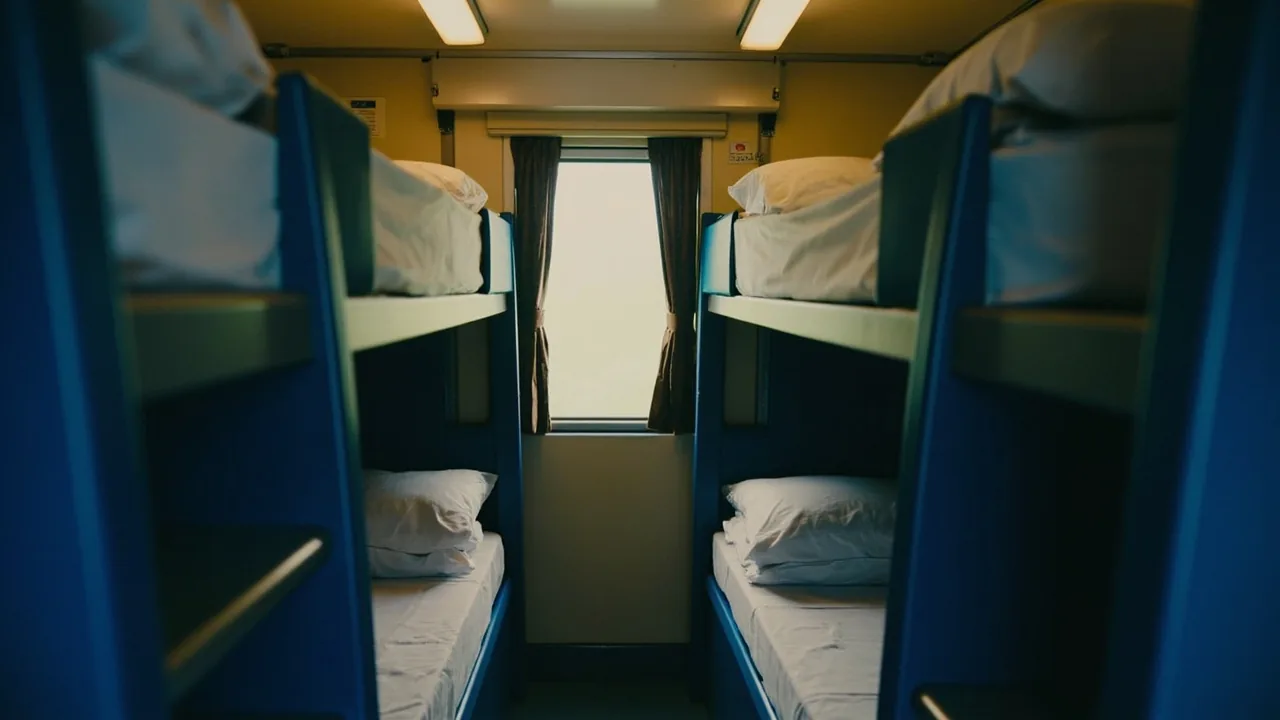
Thea standard backpacker berth. Four bunks in a cabin, no door, only a curtain. The bottom bunk is at seat height and wider than the top; the top bunk is at ceiling height and narrower. The bottom bunk is the better berth, but the top bunk is where you sit during the day because the train converts the bottom bunk into two facing seats. Pillow, blanket, and a clean sheet are provided. AC runs at 23 to 25 degrees: cool enough to sleep, warm enough that you do not need a jacket. The fare is ₹2,287-₹4,288 (~800-1,500 THB or ~$23.74-$44.51).
AC Second Class (A/C Seat)
Recline-only seat, no berth. The seat tilts back about 40 degrees but does not go flat. Padding is firm. The a/c seat is the cheapest air-conditioned option on a sleeper train, ₹1,715-₹3,145 (~600-1,100 THB or ~$17.81-$32.64), but for a 13-hour overnight it is borderline. Skip it if you can stretch to the berth.
Fan Second Class (Berth)
Open windows, no air-conditioning, ceiling fans. The fare is 400-700 THB. The Chiang Mai route has limited fan class service in 2026; Hat Yai and some Isan routes still run it. The fan carriage is workable in November to February when the night air is cool, but sticky in March to May. Travellers report the fan carriage is louder than the a/c carriage because the windows are open.
Which Should You Pick?
- Solo, on a budget: AC second class upper berth, ₹2,287-₹3,145 (~800-1,100 THB or ~$23.74-$32.64). Best value.
- Couple or friends: AC first class two-bed, ₹3,431-₹6,861 (~1,200-2,400 THB or ~$35.61-$71.22), split two ways.
- Privacy or solo in your own cabin: AC first class single, ₹4,860-₹9,434 (~1,700-3,300 THB or ~$50.45-$97.93).
- Long-haul Chiang Mai with bad back: AC first class two-bed, every time.
- Hard-up, winter only: Fan second class, ₹1,144-₹2,001 (~400-700 THB or ~$11.87-$20.77).
Routes, Prices, and Timings
Subodh’s Pro Tip: All SRT fares below are checked at the Singapore Station counter on the day of writing. Online D-Ticket adds ₹372-₹572 (~130-200 THB or ~$3.86-$5.94). Use the D-Ticket booking site for the actual quoted price.
Bangkok to Chiang Mai
- Distance: 713 km
- Operator: SRT, Special Express trains 7, 9, 13, 25, Express 51
- Travel time: 12 hours 50 minutes to 14 hours
- Frequency: 6 trains nightly
- AC 2nd class a/c berth: ₹3,099-₹3,282 (~1,084-1,148 THB or ~$32.17-$34.07)
- AC 1st class two-bed: ₹5,555-₹6,072 (~1,943-2,124 THB or ~$57.66-$63.03)
- AC 1st class single: ₹7,842-₹9,300 (~2,743-3,253 THB or ~$81.40-$96.53)
Bangkok to Surat Thani
- Distance: 651 km
- Operator: SRT, Express trains 35, 37, 43, 45
- Travel time: 8 hours 40 minutes to 11 hours
- Frequency: 6 trains nightly
- AC 2nd class a/c berth: ₹1,701-₹2,310 (~595-808 THB or ~$17.66-$23.98)
- AC 1st class two-bed: ₹3,554-₹4,440 (~1,243-1,553 THB or ~$36.89-$46.09)
Bangkok to Hat Yai
- Distance: 974 km
- Operator: SRT, Express trains 29, 31, 33, 37
- Travel time: 14 to 16 hours
- Frequency: 5 trains nightly
- AC 2nd class a/c berth: ₹2,950-₹3,282 (~1,032-1,148 THB or ~$30.63-$34.07)
- AC 1st class two-bed: ₹5,355-₹6,112 (~1,873-2,138 THB or ~$55.58-$63.45)
Bangkok to Chiang Rai (via Den Chai)
- Distance: ~790 km
- Operator: SRT to Den Chai, then transfer to Chiang Rai-bound sleeper
- Travel time: 14 to 15 hours including 30 to 60 minute Den Chai change
- Total AC 2nd class a/c berth: ₹3,431-₹3,717 (~1,200-1,300 THB or ~$35.61-$38.58)
Bangkok to Nong Khai
- Distance: 624 km
- Operator: SRT, Express trains 23, 25, 133
- Travel time: 10 to 11 hours
- Frequency: 4 trains nightly
- AC 2nd class a/c berth: ₹2,442-₹2,882 (~854-1,008 THB or ~$25.34-$29.91)
- AC 1st class single: ₹7,585 (~2,653 THB or ~$78.73)
Bangkok to Ubon Ratchathani
- Distance: 575 km
- Operator: SRT, Express trains 21, 23, 25, 67
- Travel time: 9 to 11 hours
- Frequency: 4 trains nightly
- AC 2nd class a/c berth: ₹2,310-₹2,785 (~808-974 THB or ~$23.98-$28.90)
Bangkok to Kanchanaburi
- Distance: 129 km
- Operator: SRT, train 259 plus a transfer at Nong Pladuk
- Travel time: 3 hours total
- Frequency: 2 trains daily, no sleeper service
- Fare: ~₹286 (~100 THB or ~$2.97)
Bangkok to Singapore (split Thai Section)
The through-train service is suspended in 2026. Travellers report that you now take the SRT sleeper to Hat Yai, then a Malaysian KTM train to Kuala Lumpur, then a KTM or bus to Singapore. The Thai section is the same as the Bangkok to Hat Yai fare.
For full route bookings across the Malaysian and Singapore sections, use the rail aggregator at 12go.asia to compare SRT + KTM segments.
Thailand Sleeper Train Map
The SRT network radiates from Bangkok. The four main north-side overnight routes are: Bangkok to Chiang Mai, Bangkok to Chiang Rai via Den Chai, Bangkok to Nong Khai, Bangkok to Ubon Ratchathani. The four main south-side overnight routes are: Bangkok to Surat Thani, Bangkok to Hat Yai, Bangkok to Trang, Bangkok to Nakhon Si Thammarat. The peninsula route east to Cambodia is Bangkok to Aranyaprathet, the land crossing to Poipet. The Keeree Nil and the Buri Ram sleeper routes (Northeast) leave Bangkok Hua Lamphong. The newest sleeper path is the Bangkok to Vientiane via Nong Khai, which connects to the Laos-China railway at Thanaleng station.
Subodh’s Pro Tip: The SRT publishes a printable map at railway.co.th. Download the PDF before you travel because the route diagrams inside stations are small and outdated.
Are Trains Safe in Thailand?
Yes, Thai sleeper trains are safe. The SRT has had no major passenger safety incidents on overnight services in the past decade. The carriages are attended by SRT staff, the doors are locked once the train is in motion, and the platforms are staffed. The principal safety concerns are:
- Pickpockets on the platform, not inside the train. Keep your bag in front of you at Hua Lamphong and Krung Thep Aphiwat concourses.
- Slipping on the gap between the platform and the carriage. SRT platforms are stepped high; mind the step.
- Heat in the fan class during summer. Carry water.
- Missed station stops in deep sleep. Set an alarm for 30 minutes before arrival; the train conductor shouts the next station but does not always wake you.
The doors on Thai sleeper trains are not locked from the outside. You can open them at any time. Most travellers report riding on the train between carriages to stretch, or standing at the open door between stops for fresh air. The SRT staff will close the doors before the train moves.
Are Sleeper Trains Safe at Night?
Yes. The cabin curtains are drawn but not locked. The corridor is lit. The SRT staff patrols each carriage every 30 minutes. You can lock valuables in a small daypack and slip the strap around your wrist while sleeping. Travellers report that wallets and phones are safer in the upper bunk than in the lower, because the lower-bunk passenger is the one a pickpocket would reach. Keep a copy of your passport in a separate bag from the original.
Safety Alert: Indian travellers with the MEA travel advisory flag in your passport should check the official MEA travel advisories page before departure. The southernmost provinces of Thailand (Pattani, Yala, Narathiwat) have a separate advisory that does not affect the railway network, but the MEA site has the latest position.
What to Pack on a Sleeper Train
Subodh’s Pro Tip: The SRT bed is 175 cm long and 60 cm wide. The blankets are thin but the carriage AC is set to 22 degrees centigrade. A light jacket is useful.
- Passport (the original, plus one photocopy)
- Phone and power bank (SRT does not have power points in second class cabins; first class has one socket per cabin)
- Water bottle (the trolley sells water at ₹57 (~20 THB or ~$0.59); bring a refillable)
- Snacks (instant noodles, bread, biscuits)
- Toilet paper (the carriage toilet runs out by 02:00)
- Slip-on footwear (you will be asked to remove shoes on the lower bunk; the floor is cold)
- A small padlock for the cabin door
- Earplugs (the wheels are not loud, but the carpeted cabin absorbs noise less than a hotel)
Booking Day-Of and Last-Minute Backups
If the AC second class is sold out, the SRT runs a same-day AC first class waitlist at the station counter. Show up 1 hour before departure and ask. Most waitlist requests get fulfilled 30 minutes before the train leaves, because reserved passengers do not show up. The counter staff charges a ₹86 (~30 THB or ~$0.89) waitlist fee.
If the train is fully sold, the next best option is a VIP overnight bus. The Sombat Tour VIP bus from Bangkok to Chiang Mai is ₹2,001-₹2,573 (~700-900 THB or ~$20.77-$26.71) and takes 9 hours. Travellers report that the bus is less comfortable than the train but faster. Book the Bangkok to Chiang Mai VIP bus on 12go if the train is full.
Common Mistakes Indians Make
- Booking the wrong station. Bangkok to Chiang Mai trains leave from Krung Thep Aphiwat (the new terminal) in some months, and Hua Lamphong in others. The D-Ticket site shows the station; double-check before you leave your hotel.
- Confusing AC first class single with AC first class two-bed. The single is more expensive and is the cabin with one bed. The two-bed has two. On the booking page, the cabin layout is shown as a small icon.
- Not bringing a jacket for the AC. The cabin temperature is set around 22 degrees. Travellers report waking up cold at 03:00.
- Booking the Hat Yai train and missing the connection to Malaysia. The Hat Yai sleeper arrives at 09:00. The KTM transfer to Butterworth is at 14:00. The connection is workable, but you need to cross the immigration at Padang Besar before the KTM leaves.
- Exchanging money at the airport instead of using a forex card. The Bangkok SRT counter at Krung Thep Aphiwat does not accept cash in large THB notes; bring small denomination for the tuk-tuk to the station. For the actual fare, the D-Ticket site accepts Visa and Mastercard and is the cleanest way to pay.
What Most Guides Don’t Tell You
- The D-Ticket site is in Thai and English. Switch to English interface at the top right, otherwise the passport field is in Thai characters and your booking will fail.
- Cancelled trains are infrequent but happen during the monsoon (June to October). The SRT refunds the ticket in full if you book through the site, plus the ₹286 (~100 THB or ~$2.97) booking fee. The station counter does not refund the queue fee.
- Lower berths in the AC second class are wider than the upper. If you are tall, book the upper. If you are shorter or with a child, book the lower.
- The food trolley stops at major stations and accepts cash only. Carry ₹286 (~100 THB or ~$2.97) in small notes.
- You can walk between carriages at any speed. The corridor is wide and the windows are open. The break between carriages is the only dark spot on the train; mind your step.
- The SRT luggage rules are: 60 kg per passenger in second class, 80 kg in first class. There is no check-in for luggage; you take it to your cabin and store it under the bed or on the rack above the door.
Subodh’s Take
Thailand sleeper trains are the single best way to move between Bangkok and the rest of the country. The cabin is more comfortable than any overnight bus, the food trolley is cheap, and the staff is helpful. The default is AC second class a/c berth at ₹2,287-₹4,288 (~800-1,500 THB or ~$23.74-$44.51) for the route, and you only need to upgrade to first class if you are travelling with a partner or want privacy. Book 30 days out, choose the Special Express train 13 if you want to save three hours on the Bangkok to Chiang Mai run, and bring a light jacket and a passport photocopy. The single biggest mistake is booking the wrong station. The single biggest under-told secret is that the lower berth is wider than the upper but the upper berth is where you sit during the day.
For a full Bangkok to Chiang Mai sleeper itinerary, including the goodbye brunch at the Chiang Mai terminus, see the Bangkok to Chiang Mai overnight route guide and the Thailand 7-day trip plan.
For cash and payment logistics on the trip, see how to carry money abroad from India and the best forex card for India.
For packing for the train, see the Southeast Asia packing list.
FAQ
Where is the Sleeper Train Booking Site?
The official SRT D-Ticket site is at dticket.railway.co.th. The English version is at the top right. The site accepts Mastercard, Visa, and JCB. The booking fee is ₹286 (~100 THB or ~$2.97) plus 1.5 percent credit-card fee. Tickets open 30 days before departure.
Can I book a sleeper train at the station on the day of departure?
Yes, at the station counter. The counter at Hua Lamphong and Krung Thep Aphiwat opens 30 minutes before the first train. Travellers report that the queue is 30 to 60 minutes in the morning and 10 minutes in the late afternoon. Same-day booking is fine for unpopular trains (Hat Yai, Nong Khai) but the Bangkok to Chiang Mai Special Express trains sell out 2 weeks in advance.
Is the Thailand sleeper train safe for solo female travellers?
Yes. The cabins are mixed-gender in second class, same-gender on request in first class. The SRT staff patrols each carriage every 30 minutes. Travellers report that solo women prefer the second class lower berth near the toilet for easy access. The corridor is well-lit. The station concourses are staffed by SRT police who respond to complaints.
What is the difference between AC first class and AC second class a/c berth?
AC first class is a private cabin with one or two beds, lockable door, a small sink, and a wall mirror. AC second class is a four-bed cabin with a curtain instead of a door. The first class compartment is quieter and has more luggage space. AC second class is roughly half the price.
How long is the Bangkok to Chiang Mai sleeper train?
The fastest sleeper train is the Special Express 13, which takes 12 hours 50 minutes. The slowest is the Express 51, which takes 14 hours. The train departs Bangkok between 17:00 and 22:00 and arrives Chiang Mai between 06:00 and 12:00 the next day.
Does the Thailand sleeper train have food?
Yes. A trolley passes through the carriage every 2 to 3 hours, selling instant noodles, rice dishes, snacks, water, and coffee. The price is ₹114-₹286 (~40-100 THB or ~$1.19-$2.97). The trolley accepts cash only. Major stations also have a 10-minute stop where you can buy food from the platform vendor stalls.
Can I bring my luggage on the sleeper train?
Yes. The luggage allowance is 60 kg per passenger in second class, 80 kg in first class. There is no check-in. You take your luggage to the cabin and store it under the bed or on the rack above the door. Travellers report that a backpack-sized bag fits under the bed; a suitcase fits on the rack.
Is the sleeper train in Thailand cheaper than a flight?
Yes, for the routes covered. The Bangkok to Chiang Mai train is ₹3,099-₹3,282 (~1,084-1,148 THB or ~$32.17-$34.07) in AC second class a/c berth. The Bangkok to Chiang Mai flight is ₹4,288-₹8,577 (~1,500-3,000 THB or ~$44.51-$89.03) on AirAsia. The train is overnight, the flight is 1 hour 10 minutes. The train saves you a night’s hotel.
What is the Cleanest Sleeper Train in Thailand?
The Special Express trains 7 and 13 are the most modern. The Express 51 is older and rougher. The Bangkok to Vietnam-via-Nong Khai Express 25 is adequate.
Are Sleeper Trains Safe in Thailand Right Now?
Yes, sleeper trains in Thailand are safe. The SRT network has not had a major passenger safety incident in the past decade. The carriages are attended by SRT staff, the doors are locked once the train is in motion, and the platforms are staffed. The standard precautions are the same as for any night travel: keep your passport in a money belt, keep valuables in the upper berth, and stay alert at the station concourse. For the latest position before departure, check the Indian MEA travel advisory page and the SRT official news page.
