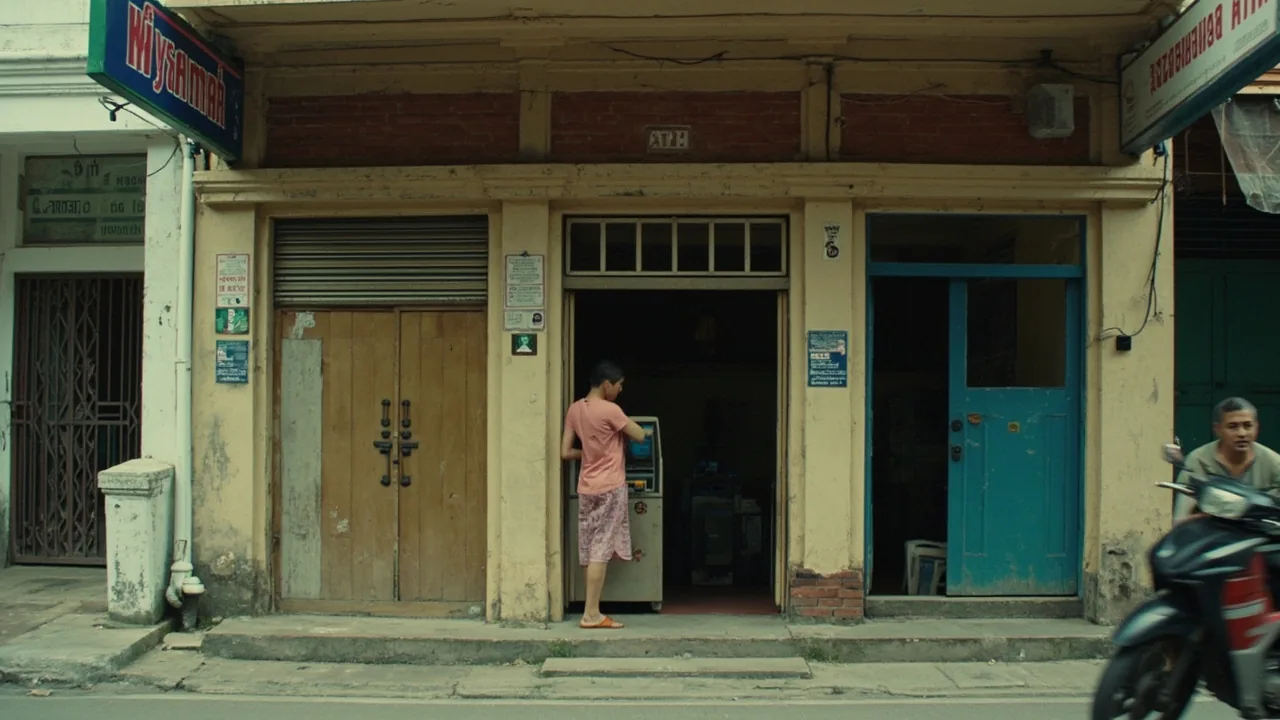
Using ATMs in Myanmar: Limits, Fees & Indian Card Options
Using a Myanmar ATM in 2026 is possible but unreliable. If you fly into Yangon with only an HDFC or SBI debit card, expect failures before a withdrawal works. The banking system has been fractured since 2021. Bring enough USD cash to cover three to five days, then build in time to find a working machine.
Subodh’s Pro Tip: Verified 2026-07-17 at 1 USD = ₹96.3294. The MMK has multiple official and parallel rates floating around Yangon. Treat any number you see quoted in MMK as approximate, and anchor your mental budget in USD.
Quick Answers
| What | Answer | Price (INR) |
|---|---|---|
| Are ATMs in Myanmar working in 2026? | Yes, but unreliable | Cards often declined, machines often empty |
| Best payment method | Bring USD cash from India, exchange in Yangon | ₹96.33 per USD (mid-rate) |
| Backup method | KBZ or CB Bank ATM with Visa/Mastercard | 5,000 MMK (~₹172) flat fee |
| Worst option | Relying only on Indian debit/credit cards | Cards decline or machines run empty |
| Daily withdrawal limit (most ATMs) | 300,000 MMK | ~₹10,300 (~107 USD) |
| Indian forex card markup | 2% to 3.5% | Plus the 5,000 MMK ATM fee |
What Happens at a Yangon ATM in 2026
Travellers report mixed outcomes, and the experience shifts week to week. Here is the pattern: KBZ Bank and CB Bank are the two ATM networks most travellers encounter in Yangon. Both accept Visa and Mastercard, including some Indian forex cards and a smaller number of standard Indian debit cards. Both charge a flat 5,000 MMK fee per withdrawal on foreign cards, on top of whatever your own bank charges. If you are still sorting your Myanmar visa, check our Myanmar visa guide for Indians first - you need the e-Visa before you land.
The complication is not the fee. It is the reliability. Reports from Yangon in 2026 describe ATMs that swallow cards, machines that display “transaction failed” after a successful authorisation, and queues where the second or third machine is offline. At Yangon International Airport, multiple KBZ machines in the arrivals hall have been reported out of service simultaneously, leaving the CB Bank branch in downtown Yangon as the only reliable option.
Safety Alert: Before booking, check the current Indian MEA travel advisory for Myanmar at mea.gov.in and your own government’s travel page. The security situation has been volatile since 2021 and advisories shift. Do not rely on third-party blogs for safety decisions.
The practical consequence is that you cannot plan around a single ATM withdrawal. Most travellers who try to live on plastic in Myanmar end up losing hours hunting for a working machine, or worse, stranded without cash when every nearby ATM is down.
How the Fees Work
When you swipe an Indian card at a KBZ or CB ATM, three separate charges can stack:
- The Myanmar bank’s fee. KBZ and CB charge 5,000 MMK (about ₹172 at 1 MMK = ₹0.0344, or roughly $4.75 USD at 1 USD = ₹96.3294) per foreign-card withdrawal.
- Your Indian bank’s markup. Standard Indian debit cards from HDFC, SBI, ICICI, and Axis charge 2% to 3.5% above the mid-market rate as a forex markup. Forex cards from Niyo, Fi, and HDFC ForexPlus sit in the same band or slightly higher.
- Your bank’s flat ATM fee. Many Indian banks charge ₹100 (~$1.04) to ₹300 (~$3.11) per international ATM transaction on top of the markup.
On a 300,000 MMK withdrawal, the 5,000 MMK Myanmar fee is roughly 1.7% of the transaction. That alone is more expensive than most Indian debit cards charge for domestic ATM use, but less painful than a 3.5% markup on a forex card.
Subodh’s Pro Tip: Decline Dynamic Currency Conversion (DCC) every time. If the ATM offers to charge you in INR instead of MMK, press No. The DCC rate can be 5% to 8% worse than your bank’s own conversion, and there is no recovery once you accept.
Comparison of Options for Indians in 2026
| Option | Markup / Fee | Reliability in Myanmar | One-line verdict |
|---|---|---|---|
| USD cash from India, exchanged in Yangon | 0% to 2% spread | Works every time | The realistic default |
| Standard Indian debit card (HDFC, SBI, ICICI, Axis) | 2% to 3.5% markup + ₹100 (~$1.04) to ₹300 (~$3.11) bank fee | Unpredictable; travellers report mixed outcomes | Carry as a thin backup, not a plan |
| Forex card (Niyo, Fi, HDFC ForexPlus) | 2% to 3.5% markup + 5,000 MMK ATM fee | Unpredictable; some work, some don’t | A backup, not the backbone of your cash strategy |
| Zero-markup debit card (Fi, Niyo SBM) | 0% markup + 5,000 MMK ATM fee | Same network reliability as any foreign Visa/Mastercard | Best card option if you can withdraw at all |
| Credit card | 3.5%+ forex markup + cash advance fee | Widely accepted at hotels, almost nowhere else | Skip for ATM cash; fine for hotel guarantees |
Subodh’s Pro Tip: A zero-markup debit card from Fi or Niyo is the cheapest card option in absolute terms, but only if the underlying network (Visa or Mastercard) is functional at KBZ or CB on the day you try. The card markup is the smaller problem; the network reliability is the larger one.
Indian-Specific Gotchas: RBI, TCS, and the USD Cash You Bring
Most Indian travellers funding a Myanmar trip through ATMs run into a different wall: the Reserve Bank of India’s Liberalised Remittance Scheme (LRS) cap and the Tax Collected at Source (TCS) rules. Our Myanmar trip cost breakdown has detailed daily budgets if you want to plan around these limits.
Under LRS, you can remit up to USD 250,000 per financial year for permitted purposes, including travel. The catch is the TCS. As of current RBI rules, foreign currency expenditures above ₹7 lakh per trip trigger 20% TCS unless you can show the trip was funded out of an earlier forex card purchase, an existing forex balance, or a business-class air ticket. In plain terms: if you load ₹2 lakh onto a forex card or a zero-markup debit card in one go, your bank may deduct 20% TCS at source, refundable only when you file your ITR.
The workarounds travellers use:
- Load the card in chunks under ₹7 lakh per trip to stay within the TCS exemption.
- Carry USD cash bought against an A2 form at an Indian bank, which counts as a forex purchase, not a remittance.
- Use the forex card only at the airport or for a known large purchase (a hotel booking, a train ticket), and pay day-to-day Myanmar expenses in cash from your USD stack.
Safety Alert: Keep the A2 form you got when buying USD cash in India. Customs can ask for it on re-entry if you are carrying more than USD 5,000 (the equivalent) in currency. The declaration limit at Indian airports is USD 3,000 cash above which you must declare.
The Realistic Myanmar Cash Strategy
The travellers who report the smoothest trips in 2026 do roughly this:
- Before leaving India, buy ₹38,561 (~400 USD) to ₹77,123 (~800 USD) in cash from a bank or licensed forex agent. HDFC, ICICI, and Thomas Cook will sell you USD notes against an A2 form at rates within 1% to 2% of mid-market.
- Carry a zero-markup debit card (Fi or Niyo) as backup, loaded with ₹20,000 (~$207.46) to ₹30,000 (~$311.19).
- Keep a second standard debit card from a different bank in a separate bag, in case the primary is blocked or lost.
- Skip the forex card entirely unless your employer has a corporate policy requiring one. The markup is the same or worse than a zero-markup debit card, and the card adds another PIN and another failure mode.
In Yangon, exchange USD cash at a licensed money changer (the gold shops around Sule Pagoda and Bogyoke Aung San Market are the traditional spots). The rate will be 1% to 3% off mid-market, plus or minus a small commission depending on the denomination. Bring ₹4,820 (~50 USD) and ₹9,640 (~100 USD) bills in clean condition. Torn, marked, or older-series notes are routinely refused.
If you need to top up with an ATM withdrawal mid-trip, plan around KBZ Bank and CB Bank branches in Yangon and Mandalay. Airport ATMs are the first to run empty. Hotel ATMs, where they exist, are the most reliable. Avoid standalone ATM kiosks in tourist areas; the network uptime is worse. For getting between cities, see our Yangon to Mandalay bus guide and Myanmar overland corridors.
Subodh’s Pro Tip: Withdraw the maximum 300,000 MMK per transaction. The 5,000 MMK fee is fixed, so a larger withdrawal reduces the fee as a percentage of what you take out.
Withdrawal Limits at KBZ and CB
| Bank | Per-transaction limit | Notes |
|---|---|---|
| KBZ Bank | 300,000 MMK (~₹10,300) | Most common ATM network in Yangon |
| CB Bank (CB Pay) | 300,000 MMK (~₹10,300) | Second most common; slightly better uptime reports |
| Other banks | Varies | AYA, Myawaddy, and United Amara have ATMs but lower limits and worse reliability |
Daily limits are usually capped at one transaction per card per machine in 24 hours, though some travellers report being able to do a second withdrawal at a different branch of the same bank on the same day. The 5,000 MMK fee applies each time.
What Goes Wrong When People Deviate
The most common mistake Indian travellers report in 2026 is arriving in Yangon with only an Indian debit card and zero USD cash. The reasoning is usually “I will just use the ATM.” The reality is that a single ATM failure on day one, combined with no USD cash fallback, means a stranded traveller trying to convert emergency money at a hotel desk at a 10% to 15% spread.
The second most common mistake is carrying too much USD cash and not telling customs. The RBI cash-carrying limit for Indian residents leaving the country is ₹289,211 (~3,000 USD) cash, or ₹867,633 (~9,000 USD) if a family member is travelling with you, beyond which you must declare. Travellers carrying USD 1,500 to USD 2,000 fall well within the limit and face no questions, as long as the notes are clean.
The third is using a credit card for ATM cash advances. Most Indian credit cards charge 2.5% to 3.5% cash advance fee on top of the forex markup, plus interest from day one. There is no grace period on cash advances. Use a debit card for ATM withdrawals, never a credit card.
Getting Connected
You will want a working data connection the moment you land in Yangon, both for Grab and ride-hailing apps and for checking bank alerts when an ATM declines. A physical SIM from MPT or Telenor costs around 5,000 MMK for a basic data pack; bring your passport. As a fallback, Get Nomad eSIM before you fly and have data the moment the plane doors open.
Where to Stay in Yangon
FAQ
Are ATMs in Myanmar working in 2026? Yes, but with significant reliability problems. KBZ and CB Bank ATMs in Yangon and Mandalay generally accept foreign Visa and Mastercard, including some Indian cards. Travellers regularly report machines being out of service, out of cash, or declining otherwise valid cards. Do not plan around any single ATM.
Which Indian cards work at Myanmar ATMs? Travellers have reported successful withdrawals from Fi and Niyo debit cards, and from HDFC ForexPlus cards at KBZ and CB Bank machines. Standard HDFC, SBI, ICICI, and Axis debit cards work sometimes and fail sometimes. No Indian card has consistent uptime in Myanmar in 2026.
What is the ATM withdrawal limit in Myanmar? 300,000 MMK per transaction at KBZ and CB Bank, the two networks foreign travellers use most. Daily limits are typically one transaction per machine, though some travellers report a second withdrawal at a different branch the same day. The flat fee is 5,000 MMK per foreign-card transaction.
Should I bring USD cash to Myanmar? Yes. The most reliable way to get Myanmar Kyat in 2026 is to bring USD cash from India, exchange it at a licensed money changer in Yangon, and use ATMs only as a top-up. Plan for ₹4,820 (~50 USD) to ₹9,640 (~100 USD) per day of your trip, plus a buffer.
Does UPI work in Myanmar? No. UPI does not work in Myanmar. Some Yangon hotels accept international credit cards for room payment, but day-to-day transactions are cash. Plan to spend almost entirely in MMK.
How much cash can I carry out of India to Myanmar? The RBI limit for Indian residents is USD 3,000 cash per person without declaration, or up to USD 9,000 if a family member is travelling with you, above which you must declare at Indian customs. Most travellers carry USD 800 to USD 2,000 (~₹77,064 to ~₹192,659), well within the limit.
What happens if my Indian card is declined at every Yangon ATM? You are not stranded. Walk to a licensed money changer with your USD cash, exchange for MMK, and proceed. The exchange rate at a gold shop or licensed changer in downtown Yangon is within 1% to 3% of mid-market. Do not exchange at the airport, where the spread is wider.
Subodh’s Take
The honest version of this article is short. Myanmar in 2026 is not a destination where you can wing it on plastic. Bring USD cash. Carry one zero-markup debit card and one backup. Plan your budget so that the worst case, every ATM you find is broken, is still a manageable holiday. The travellers who get frustrated are the ones who treated Myanmar like Bangkok or Bali and assumed the card infrastructure would just work.
Planning more of Southeast Asia? Browse our complete SEA backpacking hub for country guides, visa info, and budget breakdowns across Thailand, Vietnam, Laos, Cambodia, and beyond.
- Subodh