Vietnam Money Guide for Indians: Dong Notes, ATM Charges, Best Forex Card & Scams to Avoid in 2026
Verified against the State Bank of Vietnam’s published Dong exchange rates, current Visa/Mastercard ATM fee disclosures for Indian issuers (HDFC, ICICI, Niyo, Fi), and traveller reports from HCMC, Hanoi and Da Nang over the last six months. If a number below changes, it’ll be in the exchange rate or your bank’s ATM surcharge, not in the basic mechanics.
If you take one thing from this guide: bring a zero-markup forex debit card (Fi or Niyo), withdraw Dong in ₹7,360 (~2,000,000 VND or ~$76.40) lumps from bank-affiliated ATMs (Vietcombank, BIDV, VietinBank), and always decline the ATM’s offer to convert to INR. That’s the whole game in one sentence. Everything else below is the detail that keeps you from getting nickel-and-dimed at the wrong end of a transaction.
Quick Answers
| What | Answer | Price (INR) |
|---|---|---|
| Best payment method | Zero-markup forex debit card (Fi, Niyo, or Paytm HDFC) | 0% markup; ATM fee ~₹100-₹350 (~$1.04-$3.63) per withdrawal |
| Backup payment method | Forex card (HDFC, Axis, Niyo) loaded before departure | 2% to 3.5% markup over interbank rate |
| Cash to carry from India | Carry ₹15,000 in INR cash max; convert at airport or first ATM | Airport rates 3% to 6% worse than city ATMs |
| Best ATM network | Vietcombank, BIDV, VietinBank (avoid standalone Citibank, ACB for large withdrawals) | Limit ₹7,360 (~2,000,000 VND or ~$76.40) to ₹18,400 (~5,000,000 VND or ~$191.01) per swipe |
| UPI / RuPay acceptance in Vietnam | zero outside tourist SIM top-up kiosks | — |
| Worst option | Currency exchange booths at Noi Bai / Tan Son Nhat arrivals | Spread 5% to 8% over mid-market |
How Payment Works in Vietnam
Vietnam is a heavily cash-first economy, more so than Thailand. Cards are accepted in hotels, big-city restaurants, supermarkets, and tourist booking offices. Markets, xe ôm (motorbike taxi) drivers, hole-in-the-wall phở stalls, and most homestays outside Hanoi and HCMC take cash only. You’ll realistically use cash for 60% to 70% of transactions.
Two things trip up Indians here more than any other country in the region: the Dong’s confusing denominations, and DCC at the ATM. Both are covered below.
DCC (Dynamic Currency Conversion): The Single Most Expensive Mistake
When you put an Indian debit or credit card into a Vietnamese ATM, the machine often pops up a question: “Convert to INR?” If you say yes, the ATM (not your bank) decides the exchange rate, and it always includes a 5% to 8% margin on top of whatever your bank would have charged. Always choose “No, charge in VND” or “Decline conversion.” Your home bank will do the conversion at the interbank rate plus whatever fee they disclose.
This is the same trick that runs at card swipe machines in tourist-area shops. If the waiter says “Pay in INR?” the answer is always no.
Subodh’s Pro Tip: If your home bank’s app lets you set a foreign-transaction alert, do it before you fly. Every single DCC charge that snuck through will show up in the app’s transaction feed within hours, so you can dispute it from Vietnam itself instead of discovering it back home.
Dong Denominations: What You’re Holding
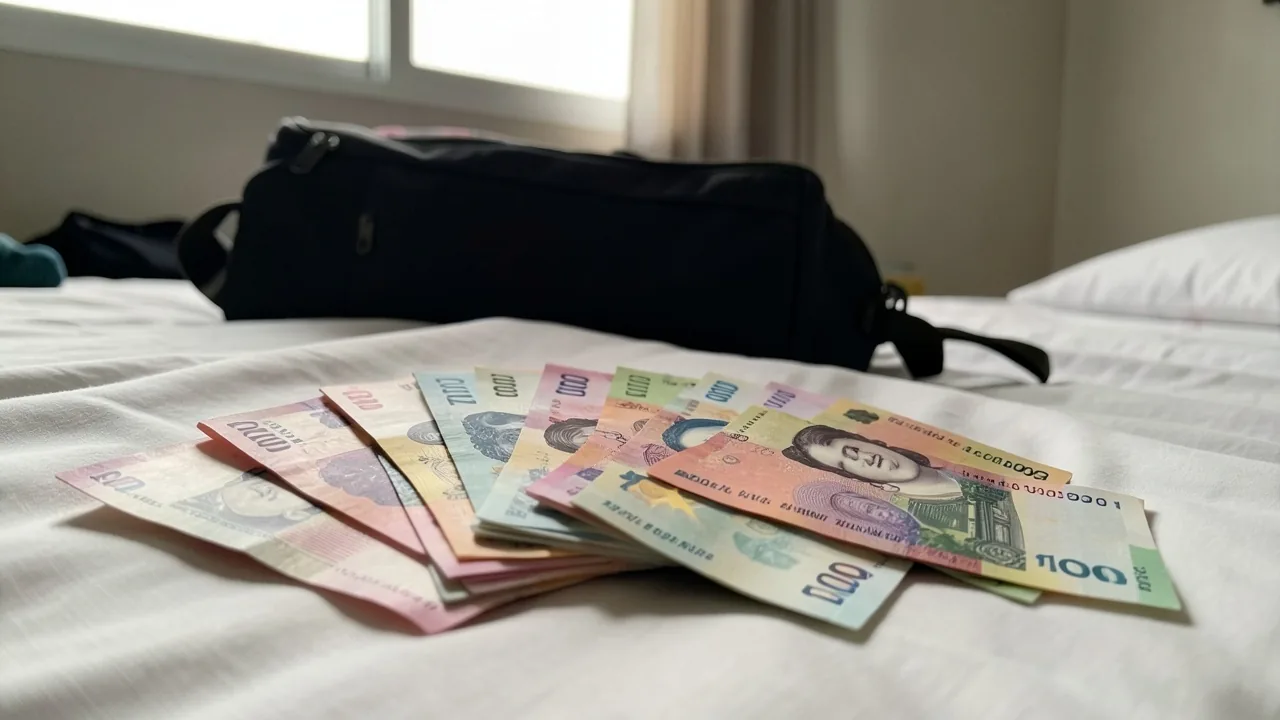
The Vietnamese Dong has zero subunits. There are no “cents.” It’s also one of the lowest-value circulating currencies on earth, which is why cash bundles look comical to first-time visitors.
Common banknotes and what they buy in 2026 (rates from State Bank of Vietnam, mid-July 2026):
| Denomination | What it buys |
|---|---|
| ₹4 (~1,000 VND or ~$0.04) | Roughly a single piece of candy from a convenience store |
| ₹7 (~2,000 VND or ~$0.08) | A small bag of iced tea from a street stall |
| ₹18 (~5,000 VND or ~$0.19) | A basic xe ôm ride for one short hop, or a single banana |
| ₹37 (~10,000 VND or ~$0.38) | A bowl of phở at a no-frills street stall |
| ₹74 (~20,000 VND or ~$0.76) | A draft beer at a bia hơi, or a short GrabBike ride |
| ₹184 (~50,000 VND or ~$1.91) | A casual lunch with drinks |
| ₹368 (~100,000 VND or ~$3.82) | A sit-down dinner with a drink at a tourist-area restaurant |
| ₹736 (~200,000 VND or ~$7.64) | A mid-range dinner for one with a main, drink, and tip |
| ₹1,840 (~500,000 VND or ~$19.10) | A guesthouse dorm bed for one night or a budget hotel room |
Notes are polymer (since 2003) and hard to counterfeit at street level. The scams that do happen are change-giving (short-changing on big notes) and tear damage (a vendor refuses a slightly torn note and “can’t give change,” hoping you fold).
Safety Alert: Always unfold your ₹1,840 (~500,000 VND or ~$19.10) bills and check the corners before paying. Vendors occasionally tear a corner, palm the note back into circulation at full value, and pass the problem to you. A torn note is technically valid but won’t get accepted at most shops.
For a deeper breakdown of what specific amounts mean day to day, see the Vietnam budget guide.
ATM Use in Vietnam: Banks, Limits, Fees
Which ATMs to use
Cash-group ATMs in Vietnam look almost identical but charge wildly different fees. The three you want:
- Vietcombank (green logo): Largest ATM network, often the lowest fee. Machines inside bank branches during banking hours are nearly always surcharge-free above a minimum.
- BIDV (blue logo): Strong coverage in mid-tier cities (Hue, Da Nang, Hoi An, Nha Trang). Slightly higher fee than Vietcombank but more reliable.
- VietinBank (yellow logo): Best presence around Hanoi Old Quarter. Slightly higher per-transaction fee.
Avoid: standalone Citibank, HSBC, and Standard Chartered ATMs in tourist areas. They look “international” and safe, but their markups are 2x to 3x domestic bank ATMs. Also avoid Sacombank and ACB’s tourist-area machines, where intermediary fees are inconsistent.
Fees for Indian cards
Real numbers from mid-2026 disclosures for common Indian card products:
- HDFC Infinia / Diners Club: 0% foreign markup, but dynamic currency conversion fee may apply if you wrongly accept it. ATM withdrawal fee: ₹100 (~$1.04) per transaction plus 3.5% transaction fee.
- ICICI Sapphiro Forex Card: 0% markup on most variants, ATM fee ₹100 (~$1.04) to ₹200 (~$2.08) per withdrawal after a threshold.
- HDFC Forex Plus Card: 1% to 2.5% markup, ATM fee ₹100 (~$1.04) to ₹200 (~$2.08) per swipe.
- Niyo Global Card (debit): 0% markup, ATM fee ₹100 (~$1.04) to ₹150 (~$1.56) per withdrawal.
- Fi Federal Bank Debit Card (with travel mode active): 0% markup, ATM fee around ₹100 (~$1.04) to ₹300 (~$3.11) per swipe depending on the partner bank.
- Paytm HDFC Forex Card: 0% markup on Visa network, ATM fee around ₹200 (~$2.08) per withdrawal.
The cheapest combination in actual practice: Niyo or Fi debit for the swipe-and-ATM bulk, with a backup Visa/Mastercard forex card as a fallback if one card gets blocked. Travelers report that HDFC’s fraud-detection system occasionally blocks Vietnamese ATM withdrawals for 24 to 48 hours with no obvious trigger.
ATM withdrawal limits
Most Vietnamese ATMs cap at ₹7,360 (~2,000,000 VND or ~$76.40) per transaction for foreign cards, sometimes ₹18,400 (~5,000,000 VND or ~$191.01) on newer Vietcombank machines. Per-day limits vary by your home bank (typically ₹50,000 (~$519.05) to ₹150,000 (~$1,557.16)). Withdraw the maximum each time because the per-transaction fee is fixed.
Subodh’s Pro Tip: If your daily cap is ₹50,000 (~$519.05) and the ATM maxes at ₹7,360 (~2,000,000 VND or ~$76.40), you’ll be fine. If your daily cap is ₹25,000 (~$259.53) and the ATM only allows ₹7,360 (~2,000,000 VND or ~$76.40) per swipe, you’ll need multiple trips. Set your daily ATM limit higher (most banks allow it via the app) before you fly.
Comparison of Popular Payment Options for Indians
A side-by-side look at the actual costs of moving money in Vietnam, verified against bank fee disclosures in June 2026 and traveller reports. “Markup” means the percentage gap between the rate you get and the real mid-market rate.
| Method | Markup | ATM / issuance fee | Daily limit | Who it’s best for | Verdict |
|---|---|---|---|---|---|
| Fi Federal Debit (travel mode) | 0% | ₹100 (~$1.04) to ₹300 (~$3.11) per withdrawal | Configurable up to ₹200,000 (~$2,076.21) | Most Indian backpackers | Cheapest default option. Pin generation through the app, sets FX rate at Visa’s interbank rate. |
| Niyo Global Debit | 0% | ₹100 (~$1.04) to ₹150 (~$1.56) per withdrawal | ₹150,000 (~$1,557.16) default; can be raised | Travellers who want a physically issued card in India first | Same cost as Fi in practice, more like a traditional card with a physical chip-and-PIN. |
| HDFC Forex Plus Card | 1% to 2.5% | ₹100 (~$1.04) to ₹200 (~$2.08) per withdrawal | Configurable | People who load money in advance in India and want zero risk of running out | Higher markup, but predictable. Good as a backup, not as primary. |
| Axis Multi-Currency Forex | 1.5% to 3% | ₹200 (~$2.08) per withdrawal | Configurable | Travellers with leftover balance from a previous trip | Easiest to reload with leftover currency. Worse margin than HDFC. |
| Indian bank debit card (Visa/Mastercard) | 3% to 3.5% standard | ₹200 (~$2.08) to ₹350 (~$3.63) per swipe | Bank default | Only if you’ve forgotten to get a forex card | The default Indian Visa/Mastercard debit card carries RBI’s standard 3.5% cross-currency fee. Don’t use it if you have any alternative. |
| Cash exchanged in India (Thomas Cook / Muthoot / banks) | 4% to 6% | None | N/A | Last-resort emergency cash | Buy a small amount just-in-case. Don’t rely on it. The rate at the airport counter is the worst you’ll find. |
| UPI / RuPay in Vietnam | Not accepted | N/A | N/A | Nobody | Roughly 0% acceptance outside Viettel/Mobifone top-up kiosks where it sometimes works for SIM recharges. Treat as unavailable. |
India-Specific Gotchas: RBI, TCS, and LRS
Three Indian regulations affect what you do before and during the trip. These are the ones that catch people out:
The 20% TCS rule
Any foreign exchange purchased through a bank-issued forex card or sent abroad under LRS attracts 20% Tax Collected at Source (TCS) if the total exceeds ₹7 lakh per financial year (FY26 terms). At the time of writing, the budget proposal to lower this threshold to ₹3 lakh has not been enacted, so ₹7 lakh remains the floor for the full 20% rate. Crucially, the 20% is recoverable as a credit against your income tax. It’s an advance, not a tax.
What this means in practice:
- Loading a forex card in India triggers TCS on amounts above ₹7 lakh per FY.
- Buying foreign currency cash in India also triggers TCS at the same threshold.
- International debit card spend (your Fi/Niyo spending overseas) does not, in current bank practice, trigger TCS as a separate charge at load time. The 20% TCS applies when you remit, not when you spend via debit.
You don’t need to do anything special for trips under ₹7 lakh per FY. If you’re going over, file ITR-TCS reconciliation or claim it as credit at year-end.
The LRS cap
You can remit up to USD 250,000 per financial year under the Liberalised Remittance Scheme. For a Vietnam trip you’ll use a fraction of that, well under ₹7 lakh for almost everyone.
PAN and KYC requirements
HDFC, ICICI, Axis and Niyo all require PAN for forex card issuance, even if the load amount is small. Fi and Paytm HDFC don’t need a separate forex card issuance but require PAN-linked mobile KYC for international activation. Carry a PAN card copy separate from your passport, in case the issuer needs it.
For a step-by-step breakdown of how much cash to carry versus card versus bank transfer, see how much money to carry to Vietnam from India.
What Real Travellers Use
Across travellers who’ve done the HCMC to Hanoi route in the last 12 months, the pattern that holds:
- Primary: One zero-markup debit card (Fi or Niyo). Withdrawals of ₹7,360-₹18,400 (~2,000,000-5,000,000 VND or ~$76.40-$191.01) per ATM visit, bank-affiliated machines only.
- Backup: One pre-loaded forex card (HDFC Forex Plus is the most common). Used only if the primary card is blocked or compromised.
- Reserve cash: ₹9,633 (~100 USD) to ₹19,266 (~200 USD) in pristine, unfolded USD bills for emergencies and homestays in remote areas. USD is more readily exchangeable than INR cash in Vietnamese cities.
- INR cash: A few thousand rupees for arrival expenses (visa fees, SIM card, first cab) and for transit through Indian airports. Don’t try to exchange INR in Vietnam; few exchangers accept it, and the rate is awful.
Towns under 100,000 people are cash-only. Sapa’s homestays, Ha Giang’s guesthouses, Phong Nha’s hostels, Mekong Delta homestays: ATMs may exist but card machines won’t. Travellers report that small-town ATM fees through Indian cards run ₹300 (~$3.11) to ₹500 (~$5.19) per swipe, often including the bank’s own cross-currency markup. Withdraw less often in these towns and top up before going in.
Subodh’s Pro Tip: Most travellers who run into trouble in Vietnam are not victims of complex scams; they just didn’t carry enough physical Dong for a homestay or bus operator in a town that only takes cash. ATM in Hanoi/HCMC before boarding any long bus.
Common Scams Targeting Indians
Vietnamese tourist scams are not as aggressive as Bangkok’s, but they target the same vulnerable point: foreign visitors handling unfamiliar currency. The recurring ones:
1. The “Tear and Refuse” at markets
You’ve probably noticed this in the denominations section. Vendors occasionally damage a high-value note (₹736-₹1,840 (~200,000-500,000 VND or ~$7.64-$19.10)) by tearing a corner, then when you pay with cash they slip that damaged note back into your change. Or they claim a note you handed them was already torn. Inspect every note you receive as change.
2. Airport taxi overcharging at Noi Bai and Tan Son Nhat
Taxi touts at arrivals insist on fixed prices of ₹1,840 (~500,000 VND or ~$19.10) to ₹2,576 (~700,000 VND or ~$26.74) for “official airport taxi” into central Hanoi or HCMC. The meter rate is ₹920-₹1,288 (~250,000-350,000 VND or ~$9.55-$13.37) for the same trip, almost a 3x markup. Use Grab (Vietnam’s ride-hailing app, works on data), or walk to the airport’s official taxi line.
3. “Note substitution” at money changers
You hand over a ₹1,840 (~500,000 VND or ~$19.10) note. The changer palms it under the counter, slides a ₹736 (~200,000 VND or ~$7.64) back to you, and says “this is what you gave me.” Counterfeit-game tactics: count your money before and after every exchange, in front of the changer, with your hand visibly on the bills.
4. DCC at restaurants and shops
Already covered above. The waiter says “Pay in INR, your currency, lower total?” The total is always higher than paying in VND. Decline, pay in local currency.
5. “Friendly” motorbike assistants at tourist sites
Someone helps you park your bike or take a photo, then demands ₹368 (~100,000 VND or ~$3.82) afterward. Politeness can make this awkward to refuse, but it is not standard practice. Decline the offer explicitly upfront if you don’t want the charge.
6. Bag snatching from motorbikes
More of a HCMC phenomenon than Hanoi. Bag on the side of the bike (rather than across the body) is snatchable. Wear backpacks on your front in crowded District 1 streets.
7. Fake “tour guides” at bus stations
Outside major bus stations (Mien Dong, Giap Bat, Nuoc Ngam), unofficial “guides” offer to help you find your bus, then charge a hefty fee. They may also redirect you to a different, more expensive bus operator. Get your bus operator name and ticket reference, show it directly to the official counter.
Safety Alert: Beyond these wallet-level concerns, treat any “biggest-economy-in-Southeast-Asia”-style background briefing with caution: Vietnam is politically stable for tourists but occasionally adjusts visa or banking rules between issuances. Before departure, check the Indian MEA travel advisory (mea.gov.in) and Vietnam’s own tourism advisory portal for the current state of play. Local-day news or older travel blogs won’t always catch a rule change.
Getting Connected
You need data on your phone to run Grab, check your bank app after suspicious transactions, and look up current Dong exchange rates. The two options that work reliably for Indians in Vietnam:
- Physical SIM: Viettel or Mobifone stores at the airport or official Viettel counters in District 1 (HCMC) or Hoan Kiem (Hanoi). Tourist SIM packages cost ₹368-₹736 (~100,000-200,000 VND or ~$3.82-$7.64) for 7 days of high-data, or ₹1,104-₹1,840 (~300,000-500,000 VND or ~$11.46-$19.10) for 30 days. Bring your passport for KYC.
- eSIM: For travellers who can’t wait at the airport, or who want data working before they land: Get Nomad eSIM. Plans from 1 GB to unlimited Vietnam coverage, activated on landing via QR scan. No passport, no kiosk queue.
Keep your home bank’s mobile app install on the same phone. Every DCC trap and overcharge becomes visible within minutes if your bank push-notifies you of foreign transactions.
Subodh’s Take
The thing that surprises most Indian travellers in Vietnam is how quickly the Dong math becomes second nature. By day three, you stop doing “convert everything to rupees” and just read the number on the note. The other thing that surprises people is that the cheapest cash setup (Fi or Niyo debit plus a small forex card backup) costs almost nothing in fees, while the “easier” setup (HDFC Forex Plus or Axis forex as primary) silently bleeds 2% to 3% on every transaction. Over a 14-day trip at ₹1.2 lakh total spend, that 2% is around ₹2,400 (~$24.91) you just burned for no upside. The card choice up front is where the money is saved, not the money managed.
For a deeper dive into Vietnam’s broader expense layout, see the Vietnam trip budget in INR for 7 to 10 days, 2026 backpacker breakdown and INR to Vietnam currency exchange.
Planning a wider Southeast Asia trip? Start with the Southeast Asia backpacking hub for country-by-country guides, routes, and budget breakdowns.
For a breakdown of common tourist scams across the region, see Southeast Asia travel scams.
FAQ
Does UPI work in Vietnam? Almost nowhere. A handful of Viettel/Mobifone recharge counters accept it for SIM top-ups. Treat UPI as effectively unavailable. Don’t budget your trip around it.
What if my forex or debit card gets blocked by the bank in Vietnam? It happens, especially with HDFC. The fix is always the same: call the bank’s 24/7 international number (on the back of the card), answer security questions, and request temporary international enablement. Most blocks lift within 30 minutes. This is exactly why a backup card, ideally from a different issuer, is non-optional.
How much INR cash can I carry out of India? RBI’s general rule is up to ₹25,000 (~$259.53) per person when leaving India. Above that, you can carry foreign currency up to USD 3,000 in cash without customs declaration. Practically speaking, most Indian travellers fly with ₹10,000 to ₹15,000 in INR, convert a small amount at the airport, then rely on ATM withdrawals in Vietnam.
Is it worth exchanging USD to Dong in India before flying? No. Airport counters in India give rates 3% to 6% worse than the spot rate, and Vietnamese airports have decent ATMs on arrival (Hanoi Noi Bai, HCMC Tan Son Nhat). The only exception is if you have leftover USD from a previous trip, in which case carry ₹9,633 (~100 USD) to ₹19,266 (~200 USD) in clean, unfolded bills as an emergency reserve.
What should I do if an ATM offers to convert to INR? Always decline. Choose “Charge in VND” or “Without conversion.” Your home bank will do the conversion at the interbank rate plus their disclosed fee. The ATM’s “conversion in INR” includes a 5% to 8% markup that goes to the ATM operator, not your bank. This single decision is the biggest avoidable cost in Vietnam financial logistics.
Are Dong counterfeits a problem at street level? Rare in practice. Polymer notes are hard to counterfeit, and vendors would have to know how to receive a fake. The real risk isn’t counterfeits; it’s tear damage, change-giving errors, and the “note substitution” scam at money changers where the changer palms your ₹1,840 (~500,000 VND or ~$19.10) and hands you back a ₹736 (~200,000 VND or ~$7.64).
Where to Stay
Booked hostels, family-run guesthouses, and the occasional boutique stay along the HCMC. Hanoi corridor, all vetted for clean bathrooms, working Wi-Fi, and a location that saves you a cab fare. We pick places where Dong cash lands you a real bed, not a bunk in a dorm hallway.
