What to Buy in Luang Prabang: 10 Things Worth the Baggage Space (And 5 to Skip)
📍 Market: Luang Prabang Night Market (Sisavangvong Road) + Phousi Morning Market
🛍️ Best buys: Hmong textiles, sa paper, coffee beans, Lao-Lao whiskey
💰 Budget: ₹1,709-₹3,418 (~400,000-800,000 LAK or ~$17.90-$35.80) for a full haul
Skip the silver bowl-shaped “antiques” and the factory-laundered silk scarves, and put your kip toward things that came from the hill villages around town. This guide is part of our Southeast Asia backpacking hub, with country-level budget and route breakdowns.
At current rates (1 LAK = ₹0.0043), 100,000 LAK ≈ ₹430.
Quick Answers
| What | Answer | Price (INR) |
|---|---|---|
| Where do most souvenirs come from? | Hmong and Khmu villages around town, sold at the Night Market and Phousi Morning Market | ₹214-₹2,136 (~50,000-500,000 LAK or ~$2.24-$22.37) |
| Is the Night Market fixed-price or bargaining? | Fixed price on most stalls, polite negotiation welcome | ₹128-₹641 (~30,000-150,000 LAK or ~$1.34-$6.71) per stall |
| Best coffee to buy? | Lao whole beans from Bolaven Plateau farms, roasted in town | ₹342-₹641 (~80,000-150,000 LAK or ~$3.58-$6.71) per 500g |
| Cheapest item to grab as a gift? | Sa paper bookmarks, postcards, tea-light holders | ₹43-₹107 (~10,000-25,000 LAK or ~$0.45-$1.12) |
| Item to skip outright? | ”Antique” silver bowls (often fake), factory silk scarves, tiger balm knockoffs | — |
The Two Markets You Need to Know
Before listing what’s worth buying, you need to know where to find it, because most of the same items show up at different price points in different spots.
Phousi Morning Market runs from around 5:30 AM to 10 AM along the street opposite the Royal Palace. This is the working market. Locals buy vegetables, river fish, dried buffalo skin, and fermented soybean paste here. Upstairs, a quieter section sells textiles, baskets, and silver. Prices run 20 to 40 percent lower than the Night Market for the same weaving, because the morning market is built for repeat local trade, not tourist markup. If you’re an early riser doing the alms-giving ceremony on Phousi Hill, come straight here.
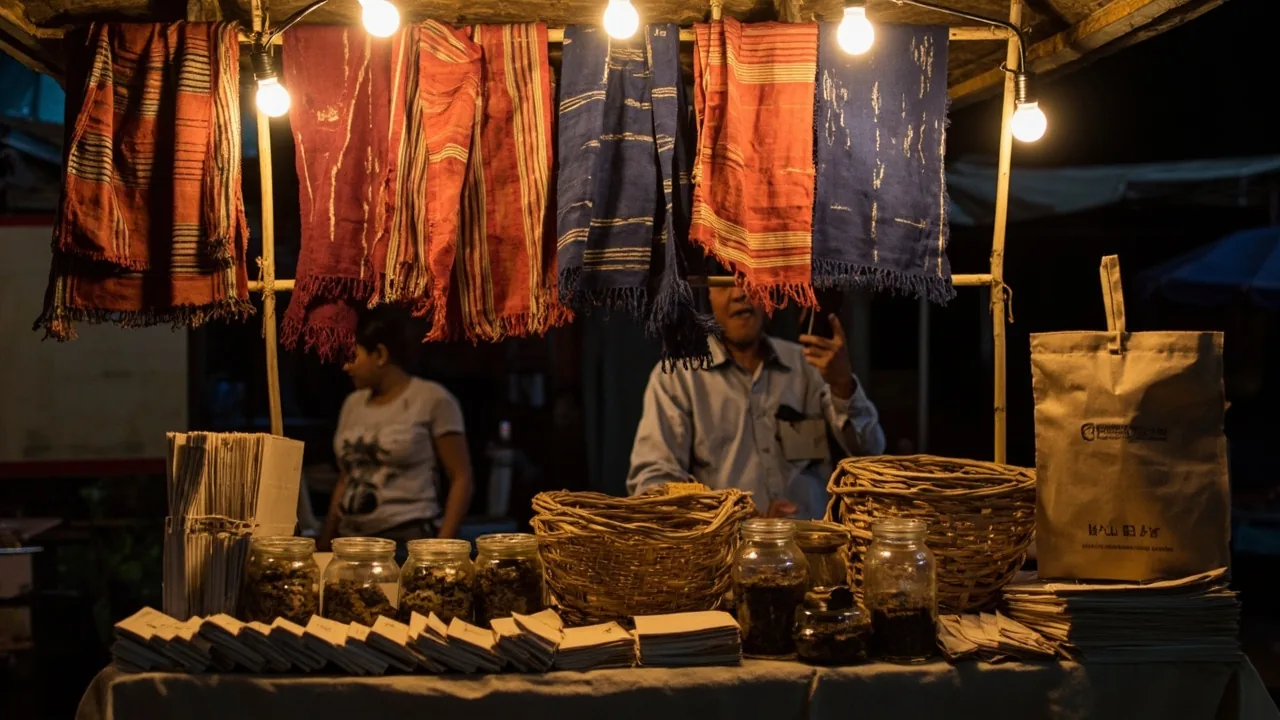
The Night Market on Sisavangvong Road runs every evening from about 5 PM to 10 PM, with the street closed to traffic from late afternoon. About 300+ stalls set up along the road and the side alleys. Prices are mostly fixed (no aggressive bargaining culture), and the energy is the better half of the experience. Bring cash in small notes; many vendors cannot break ₹427 (~100,000 LAK or ~$4.47) after 8 PM.
A third option, the Village Weaving Workshops on the outskirts of town (TAEC, Ock Pop Tok’s main craft centre, and a few small co-ops signposted from the airport road), give you the chance to see the weavers at work and buy direct from the workshop. Markups are higher, but so is authenticity and quality.
What’s Worth Buying
1. Hmong and Khmu Hand-Embroidered Textiles
This is Luang Prabang’s signature craft. Hemp and cotton shoulder bags, wall hangings, and table runners with cross-stitched geometric patterns come from Hmong and Khmu villages in the surrounding hills. The night market stalls labelled “Authentic Village Made” are usually genuine, but check for the giveaway signs: hand-stitched motifs are slightly irregular (machine embroidery is too perfect), natural-dye colors bleed a little when damp, and the back of the fabric shows the same threads as the front.
Where: Night Market, second alley behind the main temple-facing stalls. Also upstairs at Phousi Morning Market. Price: ₹342-₹2,136 (~80,000-500,000 LAK or ~$3.58-$22.37) depending on size and density of beadwork. Worth it for: shoulder bags, small wall hangings, baby carriers. Skip the giant bedspreads unless you have room in your bag.
2. Sa Paper (Mulberry Paper) Goods
Laos’s mulberry paper, called “saa paper,” is made from the inner bark of the mulberry tree. It’s thick, fibrous, and textured, different from machine-made paper. Bookmarks, photo albums, lampshades, journals, and lanterns all come from the same handful of paper-making villages in Luang Prabang province.
Where: Night Market paper stalls (look for the ones with photo albums on display), plus the free in-town paper-making demonstrations at places like TAEC. Price: ₹107 (~25,000 LAK or ~$1.12) for a journal, ₹214-₹342 (~50,000-80,000 LAK or ~$2.24-$3.58) for a small lamp, ₹43-₹64 (~10,000-15,000 LAK or ~$0.45-$0.67) for a bookmark. Worth it for: journals, lampshades, and the larger bookmarks. Skip the greeting-card packs (too thin, often glued on a paper backing).
3. Bolaven Plateau Coffee
Laos grows exceptional coffee on the Bolaven Plateau in the south, mostly arabica, with a growing robusta scene. Local roasters in Luang Prabang sell whole beans in vacuum-sealed 500g bags, plenty for a few months of home brewing if you drink it slow.
Where: Small coffee-roaster shops along Sakkaline Road, plus a few stalls at the Night Market. Look for a roast date printed on the bag (within the last 4 weeks). Price: ₹342-₹641 (~80,000-150,000 LAK or ~$3.58-$6.71) per 500g for arabica. Worth it for: medium-roast arabica beans. Skip the instant “3-in-1” sticks, those are Thai imports sold to tourists who don’t know better.
4. Weaving Village Products (Direct from the Workshop)
Buying direct from a weaving village or workshop gets you better quality for the same money, since you’re cutting out the market middlemen. Many of these workshops also double as training centres for younger Hmong and Khmu women.
Where: Ock Pop Tok is the most established (NAXAY village, tuk-tuk ₹64 (~15,000 LAK or ~$0.67) from town). The Mulberry Café and a few smaller co-ops on the airport road also sell direct. Price: ₹855-₹3,418 (~200,000-800,000 LAK or ~$8.95-$35.80) for a hand-loomed silk scarf, 500,000+ LAK for larger silk pieces. Worth it for: silk scarves, table runners, cushion covers. Not worth it for small accessories you’ll find cheaper at the market.
5. Natural-Dye Scarf Sets
These overlap with the weaving village list above, but the natural-dye scarves sold at the Night Market (mostly cotton, with subtle earth-tone colors) are a solid lower-cost option.
Where: Night Market stalls in the second row back from the main road (the front-row stalls have the same scarves at double the price). Price: ₹256-₹427 (~60,000-100,000 LAK or ~$2.68-$4.47) for a single scarf, ₹641-₹1,068 (~150,000-250,000 LAK or ~$6.71-$11.19) for a matching set of 3. Worth it for: cotton sets in indigo, brown, and natural white. Skip anything described as “100% silk” at the same price, because genuine silk costs much more.
6. Lao-Lao Whiskey
Lao-Lao is the local rice whiskey, traditionally brewed in hill villages. It comes in unmarked plastic bottles or fancy souvenir bottles with snakes, scorpions, or whole ginseng inside. The plain stuff is what locals drink. The tourist bottles with creatures are mostly packaging.
Where: Night Market alcohol stalls in the back corner. Also some small minimarts on Sakkaline Road. Price: ₹128 (~30,000 LAK or ~$1.34) for a 750ml unmarked bottle of regular Lao-Lao. ₹342-₹641 (~80,000-150,000 LAK or ~$3.58-$6.71) for a souvenir bottle with a snake or scorpion. Worth it for: the unmarked bottles, if you drink whiskey or plan to cook with it. Pass on the snake bottles unless you genuinely want the visual.
7. Tea (Mostly Green and Jasmine)
Northern Laos grows decent green and oolong teas, mostly for the domestic market. The tea stalls at the Night Market carry Lao-grown tea alongside imported Chinese and Vietnamese varieties.
Where: Night Market tea stalls in the middle section, plus the larger minimarts in town. Price: ₹214-₹427 (~50,000-100,000 LAK or ~$2.24-$4.47) for a 100g packet of loose-leaf green tea. Worth it for: locally-grown green or oolong. Skip the “herbal detox” blends, those are mostly imported filler.
8. Wooden Souvenirs and Lacquerware
Carved wooden elephants, walking sticks, lacquerware bowls, and long wooden spoons mostly come from workshops in the town outskirts. Quality ranges from mass-produced (Night Market front row) to genuinely nice (workshop direct).
Where: Night Market wood stalls in the alley near the Royal Palace end. Some pieces are also sold at the Morning Market. Price: ₹214-₹855 (~50,000-200,000 LAK or ~$2.24-$8.95) for a small carved item, 200,000+ LAK for bowls or larger pieces. Worth it for: small spoons, smaller carvings, and any lacquerware bowl you’re sure you’ll use. Skip elephant carvings bigger than your hand (breakable, heavy in your bag).
9. Silver Jewelry (From Recognisable Workshops)
Luang Prabang has a long silversmithing tradition, especially in a few family-run workshops around town. Genuine silver pieces are sold by weight plus a small craft premium.
Where: A handful of fixed silver shops on Sakkaline Road and around Phousi Hill. A few morning market stalls also sell silver, but verify the weight. Price: 80,000+ LAK per gram for genuine silver work, plus the craft fee. Worth it for: simple bangles, rings, and pendant chains. Skip anything described as “antique” or “hill tribe collectible” at the market (almost always fake).
10. Beaded and Hemp Bags (Day Bags)
If you want a cheap replacement bag for daily use that you’ll use back home, hemp and cotton shoulder bags from the weaving villages are built to last.
Where: Night Market bags section in the back alleys, plus the morning market upstairs. Price: ₹214-₹513 (~50,000-120,000 LAK or ~$2.24-$5.37) for a basic hemp shoulder bag, up to ₹1,068 (~250,000 LAK or ~$11.19) for heavily beaded pieces. Worth it for: simple hemp shoulder bags. Skip anything covered in plastic sequins (the sequins fall off within a month).
The 5 Things to Skip
These are the items that either get bought and forgotten, are factory-made and passed off as local, or are poor value.
- “Antique” silver bowls and opium weights: Almost all of these on the Night Market are new, cast in town or imported from China. Genuine antique silver is in museums. Real opium weights still surface in remote villages, but the only safe place to verify and buy them is through a recognised dealer.
- “Vintage” Hmong baby carriers: Even at ₹6,410 (~1,500,000 LAK or ~$67.12), most market baby carriers are reproductions made in the last 5 years. Real 50-year-old pieces go for much more and need expert 3. Factory silk scarves: If the price is ₹214 (~50,000 LAK or ~$2.24) and the seller says “silk,” it’s polyester. Real silk costs 5x that at minimum.
- Tiger Balm and medicinal herbs in unmarked jars: The legitimate Tiger Balm brand is sold at pharmacies. The unmarked jars at the market are usually camphor oil in generic packaging.
- Buddha amulets and “blessed” beads: Laos is Buddhist, but the trinket market is mostly souvenirs, not religious objects. If you want a real Buddhist item, the temples sell blessed bracelets for a small donation, and that money supports the monks.
When and How to Shop
Best time of day: Morning market at 6 AM for unstaged prices. Night market at 6 PM for energy and variety. Avoid 9 to 10 PM when vendors start packing up and prices drift.
Cash matters: Bring ₹214 (~50,000 LAK or ~$2.24) and ₹427 (~100,000 LAK or ~$4.47) notes. Most stalls cannot break ₹427 (~100,000 LAK or ~$4.47) after 8 PM. There are no card readers at either market.
Bargaining: Light, polite negotiation is welcome at the Morning Market and a few Night Market stalls, especially for items over ₹427 (~100,000 LAK or ~$4.47). Most Night Market stalls are fixed-price, so bargaining aggressively just wastes everyone’s time.
What to bring for safe transport: A separate cloth bag for fragile items. The bags from any shop work fine for this. Wrap soapstone, glass, and lamps in a T-shirt before packing. If you’re planning more days in town, our Luang Prabang city guide covers transport, accommodation, and the best things to do at night beyond shopping.
Where to Eat While You Shop
The night market stalls are mostly souvenirs. For actual food, you need to step off the main road.
For Lao food with a view, Breeze Bar By Best cafe sits on a hill above town, a few minutes’ walk uphill from the Night Market. The Lao coffee cocktails and the breezy terrace give you a place to sit and rest between shopping rounds.
For Indian food when you need a dal-chawal reset, M&M Restaurant Indian Halal Food serves Punjabi-style curries, roti, and rice near the main town area, walkable from both the morning and night market routes.
For vegetarian and Indian-strict-veg options in Luang Prabang, lean on M&M and the few other Indian restaurants around town; hostel kitchens in Luang Prabang are small, and ingredient sourcing for Indian veg cooking takes work.
What It Costs in Your Baggage Allowance
A reasonable shopping haul for most travellers, two textiles, one paper item, one coffee bag, one small wooden piece, and a Lao-Lao bottle, runs ₹1,709-₹2,564 (~400,000-600,000 LAK or ~$17.90-$26.85) total, around 11 to 14 kg of luggage weight depending on the wood. Stick to that budget and you have most of the meaningful items from the list above.
If you go over ₹3,418 (~800,000 LAK or ~$35.80), you’re into premium silk and silver territory, where the workshop-direct purchases start making more sense than the market. Planning the rest of your Laos leg? Our 2-week Laos itinerary maps out Luang Prabang to Vang Vieng to Vientiane with daily cost breakdowns.
Getting Connected in Luang Prabang
Laos has decent 4G in town, weaker signal at Phousi Hill and out toward the weaving villages. The local carriers, Unitel and Lao Telecom, sell tourist SIMs at the airport and at shops on Sakkaline Road for around ₹214 (~50,000 LAK or ~$2.24) for 30 days of data. If you’d rather skip the airport counter, the Get Nomad eSIM is a prepaid data option you can set up before you fly.
FAQ
Is bargaining expected at the Luang Prabang Night Market? Not really. Most stalls are fixed-price. Polite negotiation is okay at the Morning Market and on larger purchases, but pushing too hard on a Night Market vendor just wastes both your time.
What’s the best souvenir from Luang Prabang to bring home as a gift? For one or two gifts, the heavy-embroidered Hmong shoulder bag is the move: durable, light, recognisably Lao, and under ₹641 (~150,000 LAK or ~$6.71). For a bigger batch of small gifts, sa paper bookmarks at ₹43-₹64 (~10,000-15,000 LAK or ~$0.45-$0.67) each work well.
Where can I find authentic Hmong textiles vs factory-made? Go to the weaving workshops outside town for the highest authenticity, especially Ock Pop Tok and the smaller co-ops on the airport road. At the Night Market, look for hand-stitching irregularities, natural-dye bleeding, and the same thread on the back of the fabric as the front.
Is Lao-Lao safe to bring back through customs? Yes, up to 2 litres per person in luggage without issue. Keep it in checked baggage, not cabin. The unmarked bottles travel better than the souvenir snake bottles (the seal on souvenir bottles is sometimes loose).
How much cash should I bring to the Night Market? Bring small notes, ₹214 (~50,000 LAK or ~$2.24) and below. Most stalls cannot change ₹427 (~100,000 LAK or ~$4.47) after 8 PM. Plan on ₹1,282-₹2,136 (~300,000-500,000 LAK or ~$13.42-$22.37) if you intend to buy 5 to 8 items.
Do vendors at the Phousi Morning Market speak English? Less reliably than the Night Market. Have your phone’s translation app ready or bring a quick-translation phrase book. The morning market is also where you’ll see the freshest produce and the better local prices.
Subodh’s Take
The single best souvenir buy in Luang Prabang is a hemp shoulder bag from the back-alley Night Market stalls, priced between 50,000 and ₹513 (~120,000 LAK or ~$5.37). It’s light, durable, useful back home, and the patterns are genuinely from the local Hmong and Khmu villages. Buy two if you’re traveling as a couple and you’ve got gifts sorted without overspending.
