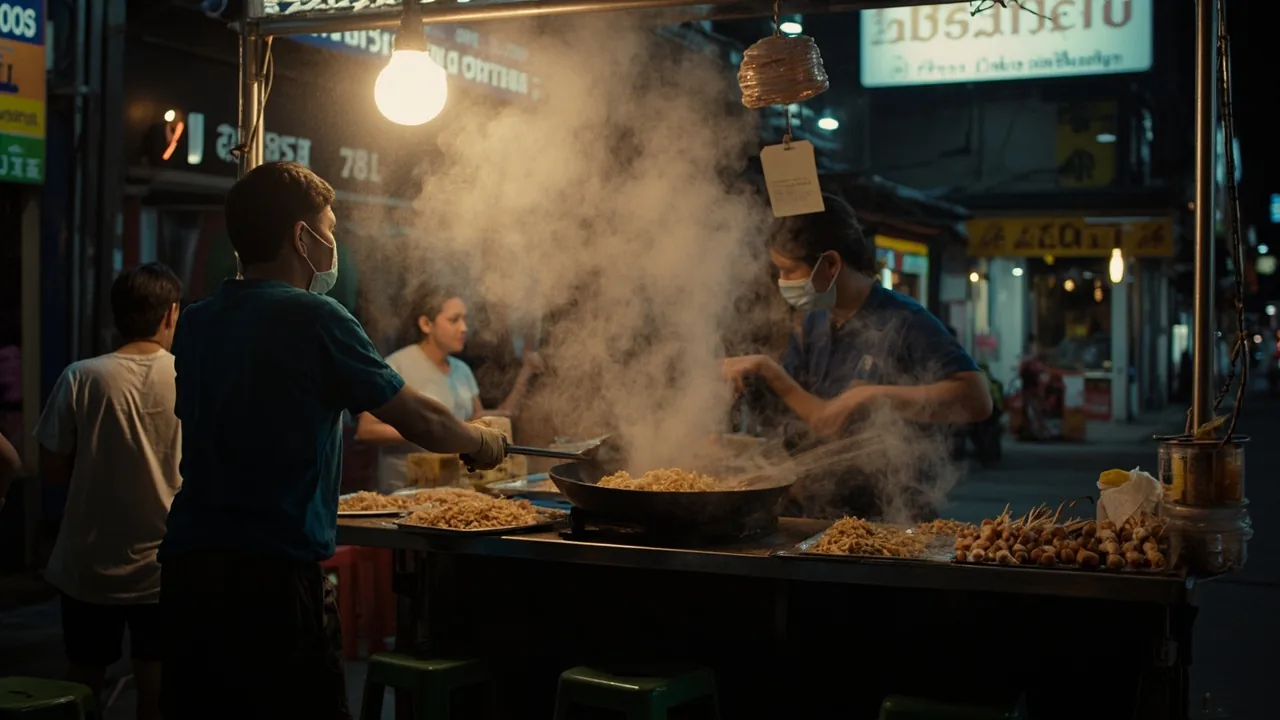
Bangkok vs Hanoi for Food Lovers: Who Wins on the Plate?
This bangkok street food best ever food review compares both capitals for Indian backpackers. Bangkok offers breadth, Hanoi offers depth. A street meal starts at ₹172 (~60 THB or ~$1.79) in Bangkok versus ₹92 (~25,000 VND or ~$0.96) in Hanoi, and the standard split is 4 days Bangkok, 3 days Hanoi.
Quick Answers
This comparison is part of our Southeast Asia Backpacking Hub.
| What | Answer | Price (INR) |
|---|---|---|
| Cheapest street meal | Bangkok pad thai from a street wok | ₹172 (~60 THB or ~$1.79) |
| Same meal in the other city | Hanoi street food (banh mi, phở, bún chả) | ₹92 (~25,000 VND or ~$0.96) |
| Best Indian-veg fallback | Bangkok (Amritsr, Indique) | ₹2,872 (~1,000 THB or ~$29.79) |
| Best cooking class experience | Hanoi (smaller groups, market visits) | ₹3,499 (~950,000 VND or ~$36.29) |
| Most days you need for a proper food crawl | Bangkok | 4 days |
Tip from Subodh: Bangkok covers more ground; Hanoi goes deeper into each dish. Pick based on whether you want range or focus.
Quick Comparison Table
| Factor | Bangkok | Hanoi |
|---|---|---|
| Daily budget (budget traveller) | ₹2,300 (~$23.86) | ₹1,800 (~$18.67) |
| Visa for Indians | Visa-free 60 days | E-visa ₹2,410 (~$25), 90 days |
| Best months | Nov to Feb (cool, dry) | Oct to Dec and Mar to Apr |
| Veg food availability | Easy (Indian restaurants, Jay options, veg street stalls) | Workable but narrower |
| Safety (solo) | good, watch for bag snatches in tourist zones | good, watch for scooter traffic |
| English spoken | Strong in food zones | Moderate, better among younger Hanoians |
| Vibe | Sensory overload, 24/7 food clock | Lakeside calm with concentrated food streets |
| Best for | Travellers who want every Thai dish in one trip | Travellers who want to learn one cuisine properly |
Choose Bangkok If…
- You want pad thai, boat noodles, mango sticky rice, and Isaan som tum from the same city, often within a five-minute walk. Few places on earth match Bangkok’s range. Our street food showdown between Bangkok, Hanoi, and Penang digs deeper into the dish-by-dish comparison.
- You eat strictly vegetarian or halal and need a guaranteed Indian backup everywhere. Bangkok has multiple Amritsr and Indique-style restaurants, plus 7-Eleven for emergencies, plus plenty of veg-friendly Thai spots.
- You want late-night food. Bangkok’s street food runs deep into the night; Chinatown’s Chinatown Bangkok (Yaowarat) tour is a 10 PM affair, not a morning one.
- You are doing a short first trip and want the food scene to be the easiest part, not a research project.
Choose Hanoi If…
- You want one cuisine done well. Phở, bún chả, bánh mì, egg coffee, bánh cuốn: Hanoi does these at a level Bangkok cannot match because Bangkok is doing a hundred other things. See our Thai vs Vietnamese food comparison for a deeper dive into how the two cuisines stack up.
- You want a cooking class that includes a wet market walk and small-group instruction. Hanoi’s class quality and price ratio beats Bangkok’s.
- You are a vegetarian who already knows how to navigate fish sauce-heavy food. Vietnamese vegetarianism (chay) is a real category here.
- You like your food city less frantic. Hanoi’s Hanoi Old Quarter tour food crawl is walkable in an evening; Bangkok’s needs BTS hops.
Bangkok: Pros and Cons
Pros:
- Greatest range of any Southeast Asian food city, including regional Thai (Isaan, northern, southern) all in one place
- Strongest Indian food backup for vegetarians and anyone craving a dal-chawal fix
- Street food runs 24/7, with the famous Yaowarat night shift after sunset
- Hygiene at well-trafficked stalls is generally safe; tourist-expectant vendors know the bar
Cons:
- Sensory overload is real. Some travellers find the heat, noise, and crowd pressure at famous spots (Yaowarat, Somboon) exhausting after two days.
- Tourist trap risk around Khao San Road and the most-photographed stalls; prices can be 2-3x the local rate if you don’t walk one street over
- Less of a “slow food” culture; most meals are grab-and-go, fewer sit-down street spots than Hanoi
- Cooking classes skew larger and more touristy; harder to find authentic market visits
Hanoi: Pros and Cons
Still deciding between Vietnamese cities? Our Hanoi vs Ho Chi Minh City comparison breaks down which one deserves your time.
Pros:
- Best phở and bún chả in Vietnam, full stop. The northern style is lighter, herb-forward, and frankly better.
- Cooking classes here are smaller, cheaper, and almost always include a wet market walk
- Coffee culture (egg coffee, coconut coffee, Vietnamese drip) is unmatched in the region
- Old Quarter is genuinely walkable; a planned food crawl covers 8-10 stops on foot
- Less tourist-trap pricing pressure than Bangkok at famous spots
Cons:
- Narrower Indian food backup. There are options, but quality is inconsistent outside the main hotel districts.
- Wet market tours expose you to a lot of pork and fish sauce; strict vegetarians need to pre-arrange class menus.
- Traffic around the Old Quarter is genuinely dangerous on a scooter; food crawl logistics need a guide or a slow pace.
- Winter (Dec-Feb) can be cold and grey; food still works but the lakeside vibe dampens.
Cost Comparison in ₹
Verified 2026-07-18. Rates used: 1 THB = ₹2.87, 1 VND = ₹0.0037. (1 USD = ₹96.33.)
| Expense | Bangkok | Hanoi |
|---|---|---|
| Dorm bed (avg/night) | ₹1,292 (~450 THB or ~$13.40) | ₹737 (~200,000 VND or ~$7.64) |
| Street food meal | ₹172 (~60 THB or ~$1.79) | ₹92 (~25,000 VND or ~$0.96) |
| Restaurant meal (mid-range) | ₹718 (~250 THB or ~$7.45) | ₹368 (~100,000 VND or ~$3.82) |
| Local transport (per day) | ₹431 (~150 THB or ~$4.47) | ₹184 (~50,000 VND or ~$1.91) |
| SIM card (tourist, 7 days) | ₹859 (~299 THB or ~$8.91) | ₹737 (~200,000 VND or ~$7.64) |
| Visa fee | Free | ₹2,410 (~25 USD) |
| Cooking class (half day) | ₹4,307 (~1,500 THB or ~$44.68) | ₹3,499 (~950,000 VND or ~$36.29) |
| Beer (local, large) | ₹230 (~80 THB or ~$2.38) | ₹74 (~20,000 VND or ~$0.76) |
| 7-day total (budget) | ₹14,500 (~$150.41) | ₹11,000 (~$114.10) |
| 7-day total (comfortable) | ₹26,000 (~$269.70) | ₹19,500 (~$202.27) |
Bangkok is roughly 30 percent more expensive at the budget end and 35 percent more at the comfortable end. The gap narrows once you factor cooking classes (Bangkok’s mid-tier are pricier) and closes further on transport (Bangkok’s BTS adds up).
Pro tip: Eat where office workers eat at lunch, not where tour buses stop at dinner. The price difference at the same dish is often 50 percent. Choose Bangkok if you want range; Hanoi if you want focus.
The Bananarchy Take
If you have seven days and food is your trip’s purpose, spend four in Bangkok and three in Hanoi. Bangkok’s range is the headline: pad thai at noon, Isaan som tum at 3 PM, Khao Mun Gai at 6 PM, mango sticky rice at 10 PM. No other city compresses this much Thai food into one walkable core. But the depth question is real. After two days in Bangkok, you’ll know you’ve barely scratched the surface. After two days in Hanoi, you’ll feel like you understand the cuisine. If nightlife matters too, check our Hanoi nightlife guide for what happens after the last bowl of phở.
For Indian vegetarians, Bangkok is materially easier. The Jay food scene, the Indian restaurants (Amritsr Sukhumvit Soi 22 for North Indian, Indique for fine dining), and the veg-friendly Thai spots mean you don’t have to plan every meal. Hanoi’s chay (vegetarian Buddhist) restaurants exist but are scattered, and the cooking classes default to meat unless you book a dedicated veg class.
For cooking classes, Hanoi wins on the experience-to-price ratio: smaller groups, market visits, and a cuisine you can replicate in an Indian kitchen (phở at home is doable; pad thai is harder). Bangkok’s classes are polished but touristy.
Safety alert: Both cities are safe for Indian travellers at the level most backpackers operate (hostels, food streets, day trips). Stay current via the Indian MEA travel advisory at mea.gov.in and your government’s advisory page before departure. Generic advice: keep your phone away from the road edge in Hanoi (scooter grab-and-run is a real category), and watch for gem taxi and tuk-tuk scams in Bangkok’s tourist zones.
Getting Connected
Both cities are straightforward for SIMs. Bangkok’s AIS and TrueMove offer ₹859 (~299 THB or ~$8.91) 7-day tourist packs with 15 GB; Hanoi’s Viettel and Mobifone sell ₹737 (~200,000 VND or ~$7.64) 7-day packs with similar data. ESIM works at airport kiosks in both. Get Nomad eSIM is the easiest option if you don’t want to queue at the airport.
Where to Stay in Bangkok
| Hostel | Rating | Book |
|---|---|---|
| Mad Monkey Bangkok | 9.64 | Check prices |
| Nomads Bangkok Khao San Road Hostel | 9.86 | Check prices |
| Hide Bangkok Hostel | 10.0 | Check prices |
| Line Bangkok Hostel | 9.66 | Check prices |
Where to Eat in Each City
Bangkok’s street food anchors around Yaowarat (Chinatown) for the night shift, Sukhumvit Soi 38 for the morning market shift, and Banglamphu for the Khao San Road lunchtime trade. Travellers report that the boat noodles near Chinatown are some of the best cheap meals in the city. For your Indian backup, Check Indique tours on GetYourGuide, butter chicken at around ₹1,350 (~14 USD) per person; Amritsr Sukhumvit Soi 22 serves stuffed parathas in the ₹2,872-₹5,743 (~1,000-2,000 THB or ~$29.79-$59.57) range. If you want something off the Thai-Indian axis, Check Mustache Bangkok on GetYourGuide, a creative Middle Eastern spread with a Lamb Kofta Platter worth ordering.
Hanoi’s food map is the Old Quarter and the lakeside streets. The phở here is the main event, locals argue endlessly about which stall serves the best bowl, and a ₹147 (~40,000 VND or ~$1.53) bowl justifies the trip. For an evening crawl with seating, Check May Hanoi Train Street Restaurant on GetYourGuide, coffee and local dishes in a walkable Old Quarter setting.
For Bangkok’s non-food anchors (when you need a break from eating), the Bangkokian Museum tour is the most underrated half-day in the city, and the Temple of the Emerald Buddha tour is the one temple you have to see.
Can You Do Both?
Yes, and you should. The standard split is 4 days Bangkok, 3 days Hanoi, or extend to 5+4 if you have the time. Fly Bangkok to Hanoi direct on VietJet or AirAsia for roughly ₹4,500 (~$46.68) one way if booked two weeks ahead; budget more for last-minute fares. Total combined trip estimate: ₹25,000 (~$259.33) to ₹45,000 (~$466.79) for 8 days at a comfortable backpacker level, excluding flights from India.
The Bananarchy trip runs this exact Thailand-Vietnam-Laos-Cambodia loop on one fixed itinerary if you want the food scenes pre-planned with the rest of the region tied in.
FAQ
Is Bangkok street food safe for Indian travellers? Yes, at well-trafficked stalls in tourist zones. Travellers report that Bangkok’s hygiene at popular food streets (Yaowarat, Sukhumvit Soi 38) is on par with mid-range restaurants. Avoid raw seafood at low-traffic stalls and unrefrigerated drinks with ice from unknown sources.
Is Hanoi cheaper than Bangkok for food? Yes. A bowl of phở in Hanoi runs ₹92-₹147 (~25,000-40,000 VND or ~$0.96-$1.53); the equivalent noodle dish in Bangkok is ₹172-₹345 (~60-120 THB or ~$1.79-$3.57). Across a 7-day food-heavy trip, Hanoi saves you roughly 30 percent on food.
Which city has better Indian vegetarian food? Bangkok. The Amritsr chain and Indique offer reliable North Indian at ₹2,872-₹5,743 (~1,000-2,000 THB or ~$29.79-$59.57) per person, plus dozens of Jay-veg Thai spots. Hanoi’s chay (Buddhist vegetarian) restaurants are good but scattered.
Do I need a cooking class in either city? You don’t need one, but Hanoi’s classes are worth it. Half-day with market visit runs ₹3,499 (~950,000 VND or ~$36.29); you leave with phở and bún chả you can cook at home. Bangkok’s classes are pricier and larger-group.
Can I get a visa for both on the same trip? Yes. Thailand is visa-free for Indians for 60 days (as of 2026). Vietnam needs an e-visa (apply online, ~₹2,410 (~25 USD), 90 days, 3 working days processing). Apply for the Vietnam e-visa before you fly.
