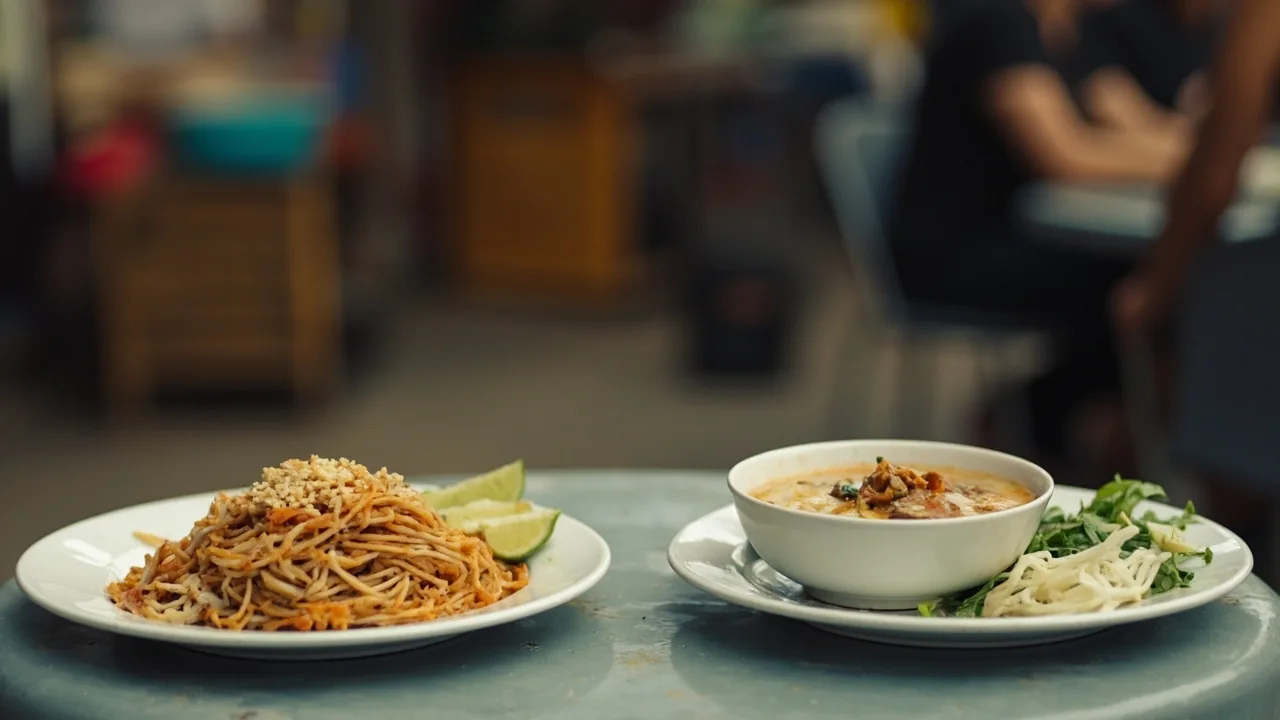
Thai vs Vietnamese Food: Which Wins for Backpackers?
Pick Vietnamese food if you’re a vegetarian, watching your stomach, or chasing the cheapest bowl of noodles on the continent. Pick Thai food if you want stronger flavours, a wider regional spread, and don’t mind the occasional “wait, was that shrimp paste?” surprise. Both are top-tier street food cultures, and the honest answer is that your stomach will be happier in Hanoi than in Bangkok, while your taste buds will argue about it for a year after you get home. For related planning, see our guide on Sea Backpacking Hub.
This is the comparison I get asked about more than any other. Backpackers split into two camps, both loud, and both wrong about the details. So here’s the actual breakdown, from someone who has eaten both cuisines through three trips each, side by side, on roughly the same budget.
Quick Answers
| What | Answer | Price (INR) |
|---|---|---|
| Cheaper street meal | Vietnam (pho or banh mi) | ~₹60 (~15,000 VND) |
| Spicier cuisine | Thailand (especially the south) | ~₹80 (~130 THB) |
| Better for vegetarians | Vietnam (Buddhist roots, dedicated veg menus) | ~₹70 (~18,000 VND) |
| Healthier overall | Vietnam (more raw veg, herbs, grilled meats) | ~₹60 (~15,000 VND) |
| Bigger variety of regional cuisines | Thailand (4 distinct regions) | ~₹80 (~130 THB) |
Quick Comparison Table
| Factor | Thai food | Vietnamese food |
|---|---|---|
| Average street food meal | ~₹80 (~130 THB) | ~₹60 (~15,000 VND) |
| Spiciness range | Mild to hot | Mild to medium hot |
| Vegetarian options | Good, but watch for hidden fish sauce | Excellent, Buddhist-influenced |
| Regional variety | 4 cuisines (north, central, south, northeast) | 3 cuisines (north, central, south) |
| English on menus | Widespread | Widespread in tourist areas |
| Best for | Spice lovers, flavour chasers | Vegetarians, budget travellers, herb fans |
| Vibe | Bold, punchy, sweet-sour-spicy balance | Light, fresh, herb-forward, brothy |
| Allergen risk for vegetarians | Higher (fish sauce, oyster sauce, shrimp paste) | Lower (mushroom-based stocks common) |
Choose Thai Food If…
- You want the spiciest meals on the continent, and you’re not afraid to ask for “pet pet” (Thai for “spicy spicy”) only to get a smirk and a footnote on your bill.
- You like sweet-sour-spicy-salty all hitting at once. Thai cooking balances four tastes in one bite, Vietnamese usually focuses on two or three.
- You want four distinct regional cuisines in one country. Northern Thai (mild, herbal), central (coconut milk, sweet), southern (turmeric, intense heat), and northeastern Isaan (fermented, punchy, eaten with sticky rice).
- You’re travelling in a group where at least one person eats meat without restrictions. Thai menus have more variety for omnivores.
Choose Vietnamese Food If…
- You’re vegetarian or cooking for one. Vietnam has the best vegetarian food in Southeast Asia, full stop. Buddhist monasteries in the country have been serving meat-free menus for centuries, and the “com chay” (vegetarian restaurants) you’ll find in every city serve dishes that don’t apologise for the lack of meat.
- You want to eat lighter. Vietnamese food is broth-heavy, herb-heavy, and rarely deep-fried in a way that leaves a weight on your chest. After two weeks of pad thai, most travellers say their stomachs feel different.
- You’re chasing the lowest possible food bill. A bowl of pho or a banh mi from a street stall in Hanoi can be had for what you’d pay for a cup of chai in Mumbai.
- You like dishes you can customise at the table. Vietnamese food arrives with a plate of herbs, lime, chilli, and bean sprouts on the side, and the idea is that you build the bowl yourself.
Thai Food. Pros and Cons
Pros:
- The four-taste balance (sweet, sour, salty, spicy) is doing something other cuisines aren’t. Tom yum soup, pad thai, green curry, som tam (papaya salad) all hit different points on the flavour map.
- Massive regional variety. You can eat in Chiang Mai, Bangkok, Phuket, and Koh Samui and have four completely different meals.
- Cooking classes are easier to find and more developed. Bangkok and Chiang Mai have whole ecosystems of day courses with market visits.
- Stronger sweet-spicy fusion with Indian-adjacent flavours in southern Thailand, where the cuisine shares DNA with Malay cooking.
Cons:
- The hidden fish sauce and shrimp paste problem is real. Many “vegetarian” Thai dishes are cooked with fish sauce as the base. Travellers who don’t speak Thai often eat seafood without knowing.
- Spiciness is unpredictable. A “mild” green curry in tourist areas can still blow a North Indian palate away, and asking for “no spicy” sometimes just shifts the dish from a 7 to a 4 on the heat scale.
- Cooking oil is heavier. Thai stir-fries use more oil than Vietnamese cooking, and if you have a sensitive stomach, three meals a day of pad thai catches up.
If you want to compare Thai food against another Southeast Asian cuisine (Cambodian, in particular), the flavour overlap is strong, and Thai vs Cambodian food breaks that down. The Thai-Vietnamese comparison also pairs well with our street food showdown between Bangkok, Hanoi, and Penang, which goes deeper on the numbers.
Vietnamese Food. Pros and Cons
Pros:
- Best vegetarian food in Southeast Asia, and it’s not close. “Quan chay” vegetarian restaurants serve mock meats that don’t taste like penance, and Buddhist-influenced menus mean even non-veg restaurants have a meat-free section.
- Fresh herbs come with almost every dish. Thai basil, cilantro, mint, perilla, sawtooth coriander. The visual on the table is part of the meal.
- Cooking is lighter. Broths, grills, fresh rolls, rice paper wraps. Your stomach feels different after a week of Vietnamese food versus a week of Thai food.
- Cheaper at the street level. A banh mi in Hanoi can be ₹55 (~15,000 VND or ~$0.57). A proper bowl of pho with all the trimmings is ₹110-₹147 (~30,000-40,000 VND or ~$1.14-$1.52). Try finding a meal in Bangkok for under ₹114 (~40 THB or ~$1.19).
Cons:
- Sauces can be a quieter source of seasoning. Vietnamese cooking leans on fish sauce too, though usually more transparently. The good news: vegetarian restaurants and Buddhist-influenced spots substitute mushroom-based stocks.
- Less spice variety. If you want a Thai-style 10-out-of-10 heat, Vietnamese food rarely gets there. The chilli is usually on the side, and it’s a compliment, not a dare.
- Regional variety is narrower than Thailand’s. Northern Vietnamese food is milder and more broth-focused, central (Hue) is spicier and more elaborate, southern is sweeter and uses more coconut milk. Three distinct cuisines, but the regional shift isn’t as dramatic as in Thailand.
If Vietnamese food is on your radar, the Laotian vs Vietnamese food comparison is a useful next read, since Laos picks up some of the same flavour DNA with a few twists.
Cost Comparison in ₹
This is where the rupee difference becomes real. Both countries are cheap, but Vietnam is consistently 20-30% cheaper on food, even accounting for the Thai baht’s slight strength.
| Expense | Thailand (₹) | Vietnam (₹) |
|---|---|---|
| Dorm bed (avg/night) | ~₹430 (~150 THB) | ~₹258 (~70,000 VND) |
| Street food meal | ~₹80 (~130 THB) | ~₹60 (~15,000 VND) |
| Restaurant meal | ~₹300 (~500 THB) | ~₹230 (~60,000 VND) |
| Local transport (per day) | ~₹172 (~60 THB) | ~₹70 (~20,000 VND) |
| SIM card (tourist) | ~₹290 (~299 THB) | ~₹200 (~170,000 VND) |
| Visa fee | ₹2,000 (~$20.76) | ₹2,500-₹3,500 (~$25.95-$36.33) |
| Top activity (cooking class) | ~₹1,750 (~1,800 THB) | ~₹1,100 (~800,000 VND) |
| Beer (local, 330ml) | ~₹115 (~140 THB) | ~₹70 (~8,000 VND) |
| 7-day food total (budget) | ~₹4,000 (~$41.52) | ~₹2,800 (~$29.06) |
| 7-day total (comfortable) | ~₹6,500 | ~₹4,800 |
Right now, 1 INR ≈ 0.3486 THB and 1 INR ≈ 270 VND. That’s the rate at the time of writing, and it explains why Vietnamese food prices look so low in the table. The rupee stretches further in Vietnam on almost every line.
The Bananarchy Take
Here’s my honest take, and it’s not the one most travel blogs give.
Vietnamese food wins for most Indian backpackers, and the reason isn’t flavour. It’s the vegetarian pipeline. You can walk into a “quan chay” in Hanoi, point at the menu, and walk out with a meal that didn’t have a fish sauce moment. In Thailand, you need to actively manage that risk every single meal, and it gets tiring. If you’re vegetarian (or cooking for a vegetarian partner), Vietnam is the answer.
Thai food wins for taste. Tom yum, pad kra pao, massaman curry, gaeng keow wan, som tam. The flavour combinations are more aggressive, more layered, and more memorable. If you’re eating meat and want the most thrilling meal-to-meal experience, Thailand edges Vietnam out.
The third option, and the one I’d recommend, is doing both. Thailand and Vietnam share a border, run a ₹1,927-₹3,854 (~20-40 USD) night bus between Bangkok and Ho Chi Minh City, and have completely different food scenes. Two weeks in Vietnam, then overland into Thailand via Cambodia or Laos, gets you the full picture. Bananarchy’s one trip covers this loop if you want the logistics handled.
Getting Connected
For food research on the road, you’ll want data. Thailand’s tourist SIM at the airport is around ₹855 (~299 THB or ~$8.87) for 8 days, and the 7-Eleven version is the same SKU, ₹57-₹86 (~20-30 THB or ~$0.59-$0.89) less. Vietnam’s tourist SIM is around ₹624 (~170,000 VND or ~$6.48) for similar data. Both are fine.
If you don’t want to queue at the airport, Get Nomad eSIM covers both countries and activates before you land.
Can You Do Both?
Yes, easily, and you should. The standard backpacking loop is Bangkok → Chiang Mai → Laos → Vietnam → Cambodia → Bangkok, and food is the highlight of the entire thing. Vietnam runs roughly ₹2,408-₹4,335 (~25-45 USD) a day, Thailand runs ₹3,372-₹5,299 (~35-55 USD) a day, and the food experiences are complementary.
If you only have two weeks, do either Vietnam or Thailand, not both. The overland travel eats time. If you have three to four weeks, do 10 days in Vietnam (Hanoi → Hoi An → Ho Chi Minh City) and 10 days in Thailand (Bangkok → Chiang Mai), with a flight between them. Total food cost for 20 days: roughly ₹9,000-₹12,000 (~$93.42-$124.56) on a budget, sitting comfortably around ₹14,000 (~$145.32) if you want cooking classes and a few nicer restaurants.
The famous Reunification Express train between Hanoi and Ho Chi Minh City is a good option if you want to see Vietnam’s geography shift from north to south while eating your way through it.
FAQ
Which cuisine is spicier, Thai or Vietnamese?
Thai is spicier. Vietnam uses chilli as a side condiment you can add to taste. Thai cooking builds the spice into the dish itself, and southern Thai food can hit levels that surprise even people who eat phall regularly. If spice is your currency, Thailand wins.
Which is better for vegetarians, Thai or Vietnamese food?
Vietnamese food is better for vegetarians. Buddhist influence in Vietnam created a vegetarian restaurant culture (“quan chay”) with dedicated menus. Thai food has vegetarian options, but hidden fish sauce and shrimp paste are a constant risk in non-veg restaurants. For strict vegetarians, Vietnam is the safer choice.
Is Vietnamese food cheaper than Thai food?
Yes, by roughly 20-30%. A bowl of pho in Hanoi is around ₹110-₹147 (~30,000-40,000 VND or ~$1.14-$1.52). A bowl of pad thai in Bangkok is around ₹172-₹286 (~60-100 THB or ~$1.78-$2.97). The gap is real on every food line, and it’s the main reason backpackers on tight budgets call Vietnam the cheapest food country in Southeast Asia.
Can I do both Thai and Vietnamese food in one trip?
Absolutely. The most common route is Bangkok → fly or bus to Hanoi → travel south through Vietnam → fly back to Bangkok. Two weeks in each is the sweet spot. A month between the two (including Laos or Cambodia) is the standard backpacker loop.
Which has better street food culture, Bangkok or Hanoi?
Both are world-class. Bangkok has more variety and more vendor density. Hanoi has a more focused street food scene built around pho, banh mi, and bun cha. For a first-time street food trip, Bangkok is easier to navigate. For a deeper street food dive, Hanoi rewards travellers who speak a little Vietnamese or travel with a local guide.
Which cuisine is healthier, Thai or Vietnamese?
Vietnamese food is generally lighter and more herb-forward. Thai cooking uses more oil and coconut milk. Both cuisines use fresh ingredients, and both are healthier than most Western diets. If you’re worried about your stomach, Vietnam edges out.
