Bangkok vs Hanoi vs Penang: Which City Has the Best Street Food for Indian Backpackers?
Verified 2026-07-17. Research-based comparison using current menus, traveller reports, and official tourism sources for each city. Planning the wider region? Our Southeast Asia backpacking hub covers the full multi-country route.
If you want the most variety and a street food bangkok scene that runs from breakfast through 2 AM, Bangkok is your city. If you want the cheapest meals in Southeast Asia, go to Hanoi. If you’re vegetarian, halal-friendly, or looping through Malaysia, Penang is the sleeper pick most Indians overlook.
Prices, dishes, hygiene, and where to eat in each city, compiled from current menus, traveller reports, and official tourism sources as of July 2026.
Quick Answers
| What | Answer | Price (INR) |
|---|---|---|
| Cheapest full meal | Hanoi bun cha or banh mi from a street stall | ~₹120 (~32,000 VND) |
| Most expensive “street” meal | Bangkok seafood bowl at Chinatown | ~₹600 (~210 THB) |
| Best for vegetarians | Penang (hawker centres mark veg lots of Chinese veg) | ~₹150 (~6 MYR) |
| Best midnight food | Bangkok (street stalls open past midnight citywide) | ~₹170 (~60 THB) |
| Best hygiene reputation | Penang (cleaner hawker centres, government grading) | ~₹150 (~6 MYR) |
Verified 2026-07-17. Prices are typical street-stall averages per dish; sit-down restaurants run 2-3x more.
Quick Comparison Table
| Factor | Bangkok | Hanoi | Penang |
|---|---|---|---|
| Daily food budget | ₹2,872 (~1,000 THB or ~$29.79) | ₹552 (~150,000 VND or ~$5.73) | ₹1,065 (~45 MYR or ~$11.05) |
| Visa for Indians | e-visa / visa exemption on arrival (verify current rules with Thai embassy before travel) | E-visa ~₹2,410 (~25 USD) | eNTRI / eVISA options |
| Best months | Nov to Feb (cool dry) | Oct to Dec, Mar to Apr | Dec to Feb (less rain) |
| Veg food availability | Strong (Jay restaurants, dedicated veg stalls) | Harder (fish sauce everywhere, fewer veg stalls) | Best of three (Chinese veg, Indian Muslim, hawker variety) |
| Safety (solo) | High, well-policed | High, just watch for scooters | High, family-friendly |
| English spoken | Moderate (menu pictures help) | Low to moderate | Moderate (signs often English) |
| Vibe | Bustling, neon, sensory overload | Gritty, aromatic, lived-in | Heritage-rich, calmer, food-obsessed |
| Best for | Variety hunters, night owls, first-timers | Budget backpackers, pho purists, slow eaters | Vegetarians, foodies on a Malaysia loop, repeat SEA visitors |
Choose Bangkok If…
- You want the widest variety under one roof. Bangkok runs pad thai next to som tum next to khao soi next to boat noodles, all on the same street. Book a Bangkok street food tour if you want a guide to cut through the chaos.
- You’re feeding a mixed group. Bangkok has the largest concentration of dedicated vegetarian Jay food stalls and Indian restaurants of the three cities.
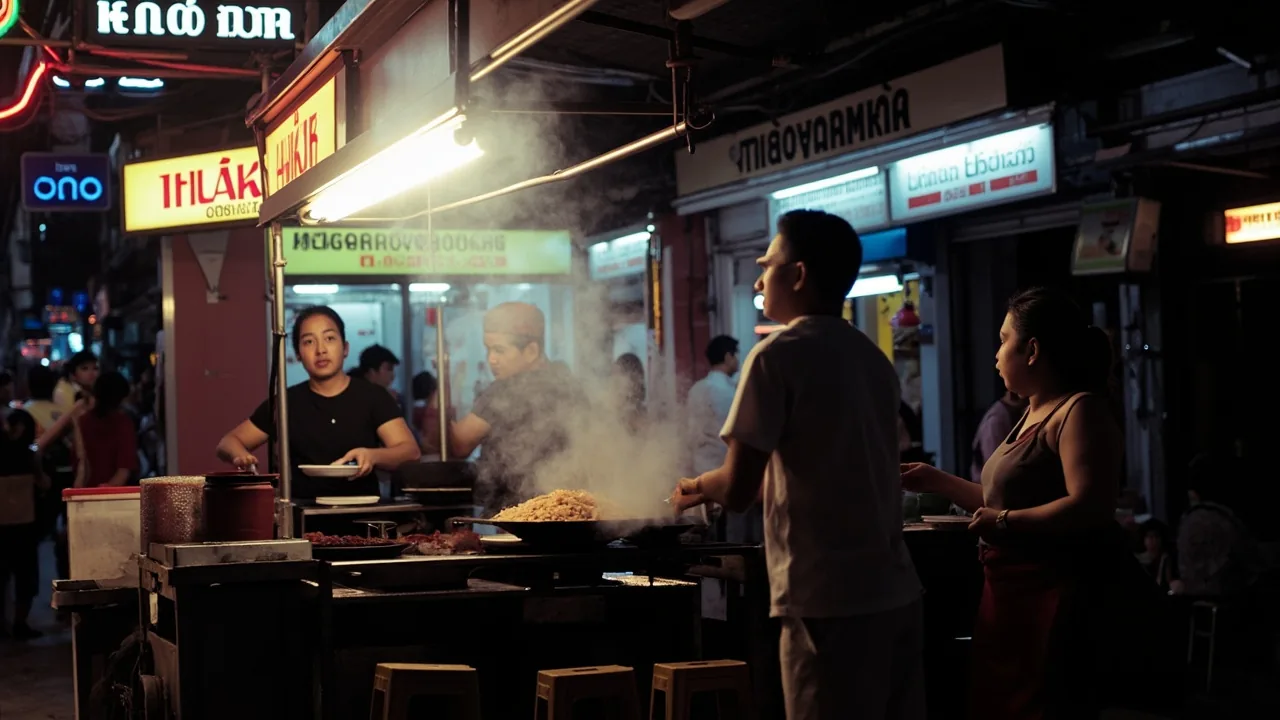
- You eat late. Bangkok’s street stalls are open past midnight in most tourist neighbourhoods. Yaowarat (Chinatown) is the headline act, but Soi Rambuttri, Banglamphu, and Sukhumvit Soi 38 all keep grilling.
- You want the full sensory overload. Neon, smoke, noise, and five languages in 200 metres. Bangkok’s street food scene performs itself.
Choose Hanoi If…
- You want the cheapest meals that still taste incredible. A bowl of pho from a streetside stall can run ₹110-₹184 (~30,000-50,000 VND or ~$1.15-$1.91). Book a Hanoi Old Quarter street food walking tour to hit the classics in one evening.
- You want the most aromatic, layered flavours of the three. Hanoi’s use of star anise, fish sauce, grilled meat, and fresh herbs is different from Bangkok’s sweet-sour-salty-spicy balance.
- You’re a slow eater. Hanoi’s street stalls are mostly low plastic stools on the pavement, not standing counters. You sit, you sip, you watch the traffic.
- You want to eat what locals eat. Hanoi’s scene tilts more local than Bangkok’s tourist-heavy stretches. You’ll be one of a handful of foreigners at most stalls.
Choose Penang If…
- You’re vegetarian. Penang’s hawker centres mark vegetarian stalls with green signs, and Chinese Buddhist vegetarian (often accidentally vegan) is a whole sub-scene here. George Town’s Lebuh Cintra and Lebuh Chulia have dense veg coverage.
- You want halal. Penang’s Indian Muslim stalls serve murtabak, roti canai, biryani, and mee goreng that are clean and labelled. Hard to find in Bangkok’s main street food strips, harder still in Hanoi.
- You want the cleanest hawker experience. Penang’s larger centres (New Lane, Gurney Drive hawker centre) are graded, with washing stations and waste disposal that Bangkok and Hanoi street stalls can’t match.
- You’re looping Malaysia-Singapore-Thailand. Penang sits between Singapore and Bangkok geographically. If your itinerary already includes KL or Langkawi, Penang’s hawker scene is the cheapest food stop on the route.
Bangkok: Pros and Cons
Pros:
- 24-hour food culture. Markets and street stalls run through the night, especially Yaowarat (Chinatown) and Banglamphu.
- Widest variety: Thai-Chinese-Indian-Muslim-Japanese all on the same street. Song Wat’s street art and food lanes are worth a half-day.
- Strong vegetarian infrastructure. Ratchawat and Samsen Road both have dense Jay (vegetarian) clusters, and you’ll find Indian restaurants in every tourist zone.
- English-friendly menus with photos at most tourist-area stalls.
Cons:
- Tourist pricing is real. Stalls around Khao San Road and Silom mark up 30-50% over the same dish three blocks away.
- Hygiene is a roll of the dice. Bangkok’s heat plus open-air stalls means traveller’s stomach hits some people. Stick to stalls with high turnover (cooked-to-order, long queues).
- Pollution and traffic make pavement eating less pleasant than Hanoi or Penang.
Hanoi: Pros and Cons
Pros:
- Cheapest of the three by a wide margin. A proper meal (protein + rice/noodles + drink) lands at ₹184-₹368 (~50,000-100,000 VND or ~$1.91-$3.82) even in the Old Quarter.
- Pho and bun cha here are non-negotiable. The northern style is lighter, herb-forward, and uses less sugar than southern Vietnam.
- The Old Quarter’s 36 streets still function as a working food market for residents, not a tourist trap.
- Bia hoi (fresh draft beer) at ₹18-₹26 (~5,000-7,000 VND or ~$0.19-$0.27) a glass is the cheapest drink in Southeast Asia.
Cons:
- Hardest of the three for vegetarians. Fish sauce and shrimp paste show up in dishes that look safe. The two dedicated pure-veg Indian restaurants, Rutba Indian Restaurant Hanoi and Rishikesh Indian Restaurant Hanoi, are reliable fallbacks when street food gets too uncertain.
- Street English is limited. You’ll point at pictures or at the next table’s dish more than in Bangkok or Penang.
- Hygiene at pavement stalls is hit-or-miss. Stick to busy stalls, avoid raw vegetables unless you can peel them yourself.
Penang: Pros and Cons
Pros:
- Hawker food is a UNESCO-recognised cultural heritage here. The variety and quality per stall is the highest of the three cities.
- Best vegetarian and halal infrastructure of the three. Chinese veg stalls, Indian Muslim murtabak stalls, and a strong Buddhist veg tradition mean you never go hungry as a veg traveller.
- Cleanest hawker centres. New Lane, Gurney Drive, and Red Garden have proper seating, washing stations, and waste management.
- Cheaper than Singapore, comparable to Bangkok on a per-meal basis once you account for portion size (Penang portions are larger).
Cons:
- Smaller scene. Penang’s hawker centres are concentrated in George Town; outside the city, food options thin out fast.
- Less variety than Bangkok. You’ll find char koay teow, hokkien mee, asam laksa, and roti canai in heavy rotation, but the international mix Bangkok offers isn’t here.
- Hot and humid most of the year. Eating outdoors in Penang’s climate is a commitment.
Cost Comparison
Verified 2026-07-17. Bangkok at 1 THB ≈ ₹2.87, Hanoi at 1 VND ≈ ₹0.0037, Penang at 1 MYR ≈ ₹23.64. Prices are typical street-stall or hawker-centre averages; sit-down restaurants run 2-3x more.
| Expense | Bangkok (THB) | Hanoi (VND) | Penang (MYR) |
|---|---|---|---|
| Dorm bed (avg/night) | ₹1,723 (~600 THB or ~$17.87) | ₹1,105 (~300,000 VND or ~$11.46) | ₹1,657 (~70 MYR or ~$17.19) |
| Street food meal | ₹144-₹287 (~50-100 THB or ~$1.49-$2.98) | ₹110-₹221 (~30,000-60,000 VND or ~$1.15-$2.29) | ₹142-₹284 (~6-12 MYR or ~$1.47-$2.95) |
| Restaurant meal | ₹861 (~300 THB or ~$8.94) | ₹663 (~180,000 VND or ~$6.88) | ₹829 (~35 MYR or ~$8.59) |
| Local transport (per day) | ₹574 (~200 THB or ~$5.96) | ₹295 (~80,000 VND or ~$3.06) | ₹473 (~20 MYR or ~$4.91) |
| SIM card (tourist, 7 days) | ₹859 (~299 THB or ~$8.91) | ₹737 (~200,000 VND or ~$7.64) | ₹592 (~25 MYR or ~$6.14) |
| Beer (street stall) | ₹287 (~100 THB or ~$2.98) | ₹74 (~20,000 VND or ~$0.76) | ₹355 (~15 MYR or ~$3.68) |
| Top food tour | ₹5,169 (~1,800 THB or ~$53.62) | ₹3,315 (~900,000 VND or ~$34.38) | ₹4,261 (~180 MYR or ~$44.20) |
| 7-day food + lodging total | ₹25,844 (~9,000 THB or ~$268.08) | ₹10,312 (~2,800,000 VND or ~$106.97) | ₹18,938 (~800 MYR or ~$196.44) |
| 7-day comfortable total | ₹51,687 (~18,000 THB or ~$536.15) | ₹22,098 (~6,000,000 VND or ~$229.22) | ₹42,610 (~1,800 MYR or ~$442) |
If you’re cooking most meals at the hostel, you’ll save 30-40%. But for veg travellers, eating out is usually safer than hostel kitchens.
Where to Eat in Hanoi
Since the rest of this guide focuses on street stalls and hawker centres, here’s where to eat if you end up choosing Hanoi. The Old Quarter is dense with footstool joints, but a few addresses anchor the scene.
Local / regional:
- May Hanoi Train Street Restaurant sits on the famous Train Street stretch, with local Vietnamese coffee and small plates as the trains rumble past. Worth a visit for the spectacle even if you don’t eat a full meal here.
- Small-Group Street Food Walking Tour is the move if it’s your first night in Hanoi. A local guide cuts through the language barrier and the dozen-stall decision fatigue.
Indian / pure veg:
- Rutba Indian Restaurant Hanoi is the highest-rated Indian option in the city and the first port of call when you’ve had your fifth bowl of pho in three days.
- Rishikesh Indian Restaurant Hanoi is the second pure-veg Indian option, useful when Rutba has a queue.
Where to Stay in Hanoi
| Hostel | Rating | Book |
|---|---|---|
| The One Hostel & Rooftop Pool Hanoi | 9.7 | Check prices |
| Hanoi Loopers Hostel & Rooftop Bar | 9.56 | Check prices |
| Mad Monkey Hanoi | 9.5 | Check prices |
| Hanoi Buffalo Hostel | 9.36 | Check prices |
Must-Try Dishes by City
Bangkok:
- Pad thai from a street wok (₹172-₹230 (~60-80 THB or ~$1.79-$2.38)). Skip the tourist strips; Banglamphu and Soi 38 are stronger. For a deeper Thai vs Vietnamese food breakdown, see our cuisine comparison.
- Khao soi (Northern Thai curry noodles) at any Chiang Mai-style spot; Bangkok has plenty, ₹230-₹345 (~80-120 THB or ~$2.38-$3.57).
- Mango sticky rice from a market stall, ₹172-₹230 (~60-80 THB or ~$1.79-$2.38). Best in season (March-June).
- Boat noodles in the Bangkok suburbs, ₹86-₹144 (~30-50 THB or ~$0.89-$1.49) a bowl, dark and intense.
- Jay pad thai at any vegetarian stall, marked with yellow flags, ₹144-₹230 (~50-80 THB or ~$1.49-$2.38).
Hanoi:
- Pho at a streetside stall, ₹110-₹184 (~30,000-50,000 VND or ~$1.15-$1.91). The Old Quarter has dozens; the ones with the longest queues are usually right.
- Bun cha (grilled pork with cold noodles), Hanoi’s signature lunch, ₹147-₹221 (~40,000-60,000 VND or ~$1.53-$2.29).
- Banh mi from a vendor with the bread baked in-house, ₹55-₹92 (~15,000-25,000 VND or ~$0.57-$0.96). A full meal for under 25 rupees.
- Egg coffee at any cafe in the Old Quarter, ₹92-₹147 (~25,000-40,000 VND or ~$0.96-$1.53).
- Bia hoi (fresh draft beer) at Ta Hien Beer Street corner joints, ₹18-₹26 (~5,000-7,000 VND or ~$0.19-$0.27) a glass.
Penang:
- Char koay teow at a hawker stall, ₹189-₹284 (~8-12 MYR or ~$1.96-$2.95). Stir-fried flat noodles with prawns, egg, bean sprouts.
- Asam laksa, the sour-spicy fish tamarind soup, ₹142-₹237 (~6-10 MYR or ~$1.47-$2.46). Acquired taste for most Indians but worth trying. For how Penang stacks up against Singapore’s hawker scene, see Penang vs Singapore food comparison.
- Hokkien mee (prawn noodle soup), ₹189-₹284 (~8-12 MYR or ~$1.96-$2.95). Different from the KL version; darker broth, heavier prawn flavour.
- Roti canai at any Indian Muslim mamak stall, ₹36-₹71 (~1.50-3 MYR or ~$0.37-$0.74). Cheap, filling, halal.
- Cendol for dessert, shaved ice with pandan jelly, ₹71-₹118 (~3-5 MYR or ~$0.74-$1.23).
Hygiene and Safety
The honest truth: traveller’s stomach hits in all three cities if you’re not careful. A few rules cut your risk by 80%:
- Eat where locals queue. High turnover = fresh food. If a stall has 20 customers, the food isn’t sitting.
- Pick cooked-to-order over pre-made. Wok dishes (pad thai, char koay teow) are safer than pre-cooked meat on display.
- Avoid ice from unknown sources. Bangkok 7-Eleven ice is fine. Random street cart ice is a gamble.
- Skip raw vegetables unless peelable. Banana, mango, dragon fruit: yes. Lettuce, herbs, cucumber slices: risky.
- Carry ORS and a probiotic. Pharmacies in all three cities stock both at low cost.
Safety note: For current safety and health advisories relevant to Indian travellers, check the MEA travel advisory page (mea.gov.in) and your registered state’s advisory portal before departure. Bangkok, Hanoi, and Penang are all generally safe for Indian tourists, but check for any specific recent updates.
Getting Connected
All three cities have working 4G/LTE coverage and affordable tourist SIM cards. Bangkok’s AIS and TrueMove 7-day tourist SIMs run ₹859 (~299 THB or ~$8.91). Hanoi’s Viettel and Mobifone tourist SIMs run around ₹737 (~200,000 VND or ~$7.64). Penang’s Hotlink and Celcom tourist SIMs run around ₹592 (~25 MYR or ~$6.14). If you’d rather skip the airport SIM counter, Get Nomad eSIM works in all three countries and lets you activate before you land.
Can You Do More Than One?
Yes, and most Indian backpackers do. For a broader Hanoi vs Ho Chi Minh City breakdown before you commit, see which Vietnam city to visit. The most efficient order:
- Bangkok → Hanoi → Penang (north-to-south is the natural overland/fly route). Bangkok 4 nights, fly to Hanoi (check current fares on 12go), Hanoi 4 nights, fly to Penang via KL or direct (check 12go). Total food + lodging for 12 nights: roughly ₹51,687 (~18,000 THB or ~$536.15) + ₹9,208 (~2,500,000 VND or ~$95.51) + ₹21,305 (~900 MYR or ~$221).
- Penang → Bangkok → Hanoi also works if you’re entering via Malaysia from Singapore or Bali.
Don’t try to overland Bangkok to Hanoi unless you have 3-5 extra days for the slow boat or sleeper train via Laos. Flying is faster and not much more expensive.
FAQ
Which city has the cheapest street food for Indian backpackers? Hanoi. A full meal at a street stall runs ₹110-₹221 (~30,000-60,000 VND or ~$1.15-$2.29), roughly half what the same dish costs in Bangkok.
Where can vegetarians eat safely in all three cities? Bangkok has the largest vegetarian infrastructure (Jay stalls, dedicated veg markets). Penang is the easiest for clearly-labelled vegetarian and halal hawker options. Hanoi is hardest for vegetarians, so plan for Indian restaurants on off-days.
Is Penang street food cheaper than Bangkok? Roughly comparable on a per-dish basis (₹142-₹284 (~6-12 MYR or ~$1.47-$2.95) vs ₹144-₹287 (~50-100 THB or ~$1.49-$2.98)), but Penang portions tend to be larger and the variety within hawker centres is denser.
Which city is safest for Indian solo travellers? All three are safe. Bangkok has the largest Indian tourist population and the most English support infrastructure. Penang is the most family-friendly. Hanoi is safe but requires more attention to traffic and street-food hygiene.
Do I need to speak the local language to enjoy street food? You don’t need to, but in Bangkok and Penang you can get by with pointing and photos. In Hanoi, fewer stall owners speak English; a translation app or a food tour solves this.
Which city should I pick if I have only 3 days? Bangkok. The street food scene is the most concentrated and you can cover the highlights (Yaowarat, Banglamphu, a Jay market) in 2-3 days of focused eating.
Subodh’s Take
Bangkok is the answer for most first-time Indian backpackers. The variety, the vegetarian options, the 24-hour availability, and the sheer scale of the street food scene make it the lowest-friction, highest-reward food city in Southeast Asia. Hanoi wins for budget and for flavour purists, but you need to accept that you’ll eat a lot of pork and a lot of fish sauce, and that veg options are sparse. Penang is the sleeper: if you’re already on a Malaysia-Singapore loop, or you’re a vegetarian who needs variety beyond Indian restaurants every meal, it’s the best food city most Indians skip. If you’re still weighing the party side of things after dinner, see Bangkok vs Ho Chi Minh City nightlife for how both cities compare once the street stalls close.
