Sapa vs ho chi minh: Which Hill Tribe Trek Wins for Indian Backpackers?
For Indian backpackers choosing between Sapa and Chiang Rai for a hill tribe trek, here is the short answer: Sapa wins on scenery and price, while Chiang Rai wins on logistics and food.
Pick Sapa if you want rice-terrace treks with Hmong and Red Dao villages, a hard climb, and cheap homestays. Pick Chiang Rai if you want gentle forest walks to Akha and Karen villages with smoother logistics and better food back at the guesthouse.
Quick Answers
| What | Answer | Price (INR) |
|---|---|---|
| Cheapest 2-day trek | Sapa (group trek with homestay) | ₹2,946 (~800,000 VND or ~$30.56) |
| Cheapest 2-day trek | Chiang Rai (group tour, Akha village) | ₹10,050 (~3,500 THB or ~$104.25) |
| Toughest single-day trek | Sapa (Fansipan summit day) | ₹5,524 (~1,500,000 VND or ~$57.31) |
| Easiest half-day trek | Chiang Rai (Doi Wao easy village walk) | ₹2,297 (~800 THB or ~$23.83) |
| Best month for clear skies | Both: late September to early December | ₹0 |
| Best hostel in Sapa | The Zen House Sapa | from ₹737 (~200,000 VND or ~$7.64) |
Exchange rates used: 1 INR ≈ 269 VND and 1 INR ≈ 0.35 THB (mid-2026).
Quick Comparison Table
| Factor | Sapa (Vietnam) | Chiang Rai (Thailand) |
|---|---|---|
| Trek daily cost (mid-range, group) | ₹4,420 (~1,200,000 VND or ~$45.84) | ₹12,922 (~4,500 THB or ~$134.04) |
| Visa for Indians | E-visa ₹2,410 (~25 USD), 90 days multiple entry | Visa-free 60 days (bilateral agreement) |
| Best months | September to December, March to May | November to February |
| Hill tribe encounters | Hmong, Red Dao, Tay, Giay | Akha, Karen (Pgaz Kyaung), Hmong |
| Trail difficulty | Hard (mud, stairs, altitude) | Easy to moderate |
| Scenery | Terraced rice paddies, mist, Fansipan | Forests, tea plantations, Mekong views |
| Veg food availability | Decent (vegan spots in town) | Excellent (Indian restaurants, vegan cafes) |
| English spoken | Moderate (guides yes, locals patchy) | Good in town, basic in villages |
| Vibe | Cold, foggy, raw, mountain-town | Warm, dry, polished, gateway-town |
| Best for | Travellers with 3-4 days, decent fitness, photography | Travellers with 2 days, soft intro, comfort-first |
The Chiang Rai cost looks higher, but it includes transport, guide, meals, and guesthouse for the full trek, while the Sapa figure is just the guide fee. Apples to apples on a per-trek basis, Chiang Rai comes out roughly the same once you add Sapa’s transport and homestay costs. The 7-day totals in the cost section below show the real comparison.
Choose Sapa If…
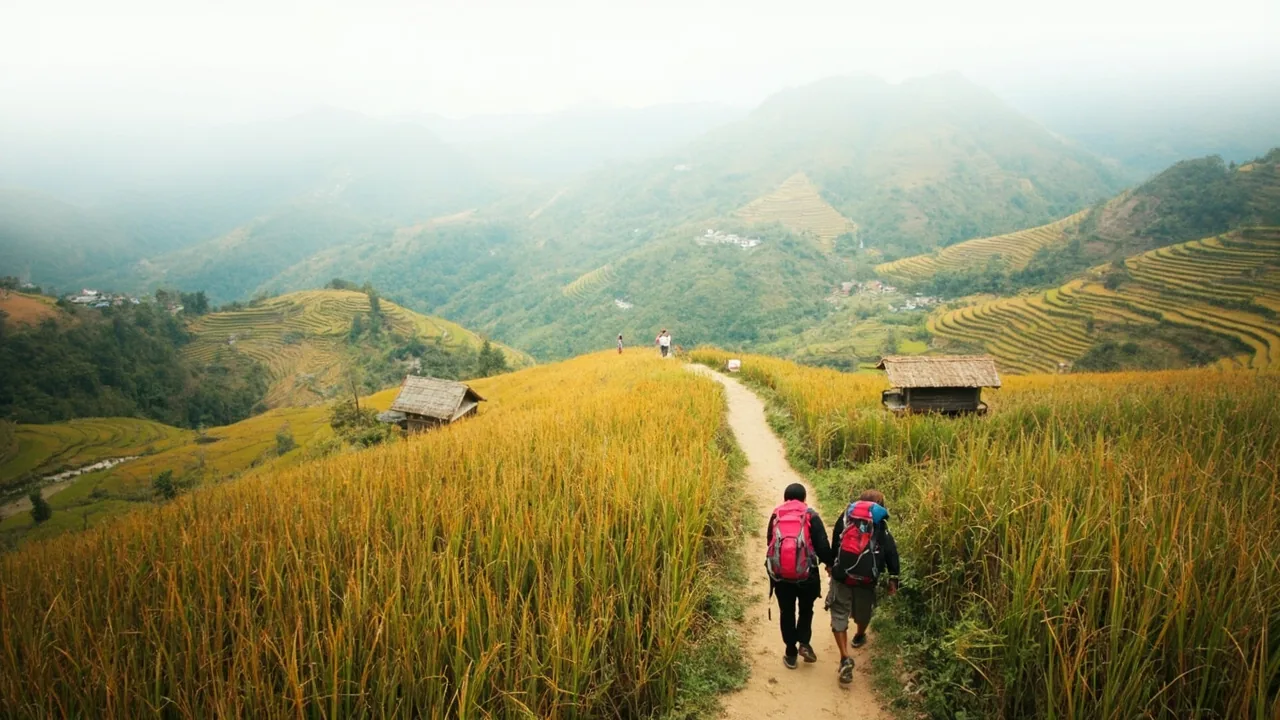
- You want the most photogenic rice terraces in Southeast Asia. The Muong Hoa valley around Sapa Green Valley and the Lao Chai to Ta Van stretch are what the Instagram photos are from. No filter needed if you hit it in late September at harvest.
- You’re comfortable with a hard day. Sapa’s classic 2-day trek involves 14-18 km on Day 1 with 800m of elevation gain and a lot of slippery mud in shoulder season. If you’ve only done flat terrain before, this is the day that decides whether you’ll enjoy Vietnam or resent it.
- You want a homestay night in a Hmong or Red Dao village. Sleeping on a wooden floor in a stilt house, eating what the family eats, and waking up inside the mist is the entire reason to come here. The Chiang Rai version is closer to a comfortable guesthouse.
- You have 3-4 days in the area. Sapa deserves at least one full rest day on arrival (Hanoi to Sapa by sleeper bus is 6 hours, and altitude at 1,600m hits harder than people expect). Trying to cram a trek into a 2-day Sapa stop is the most common mistake Indian travellers make.
- You’re already looping through northern Vietnam. Sapa fits between Hanoi and Ha Giang, or as a side trip from Hanoi. It does not fit a Thailand-first itinerary without a costly internal flight. If you’re choosing between Sapa and Da Lat, see our Sapa vs Da Lat comparison for the full breakdown.
Choose Chiang Rai If…
- You only have 2 days for the trek. Chiang Rai’s standard Doi Chang or Doi Wao routes are 6-10 km per day, and most operators run a half-day option. You can land in Chiang Rai, trek the next morning, and be on a bus to Chiang Mai by evening.
- You want a soft introduction to hill tribe trekking. The Karen and Akha villages around Chiang Rai have been receiving visitors for decades. The paths are wider, the guides speak better English, and there’s usually a kettle waiting at the homestay. For first-time trekkers, this is the right starting point.
- You need real Indian food within an hour of finishing the trek. Chiang Rai has full-service Indian restaurants, including India At Chiang Rai , North - South Indian Vegan Veg Non Veg Gluten Free Halal Meat Restaurant (full-service North and South Indian menu), and a vegan burger cafe called Kunda Vegetarian Vegan Burger Cafe Chiang Rai that pulls in trekkers on rest days. Sapa’s veg scene is improving but it’s still a vegan cafe in a town of 30,000, not a city.
- You want to combine the trek with the Golden Triangle and the White Temple in the same 3-day window. Chiang Rai is the more efficient base for that loop.
- You’re not confident on slippery terrain. Sapa’s stairs and ridge walks in the wet season (June to August) are no joke. Chiang Rai’s trails drain better and the gradients are gentler.
Sapa, Pros and Cons
Pros:
- The rice terraces are the single best trekking scenery in Southeast Asia. Muong Hoa, Y Linh Ho, and the trek toward Hang Pho Temple deliver what the postcards promise. Hang Pho Temple sits on the eastern ridge and is a common stop on the route.
- Trek prices are roughly half of Chiang Rai for the same duration. A 2-day group trek with homestay runs ₹2,946-₹5,524 (~800,000-1,500,000 VND or ~$30.56-$57.31); Chiang Rai charges ₹10,050-₹15,793 (~3,500-5,500 THB or ~$104.25-$163.82) for similar scope.
- Hmong and Red Dao homestays are genuinely family-run. The host family often weaves, farms, and lives a normal hill-tribe life the rest of the year.
- Multiple route options. From 1-day valley walks to 4-day Fansipan summit pushes, there’s a real progression for returning trekkers.
- Hostel scene is strong. The Zen House Sapa and Moc Home Sapa both run their own guided treks out the door.
Cons:
- Altitude and mud are real. Sapa town sits at 1,600m and the trails go up from there. Travellers who arrive straight from Hanoi’s heat (35°C, sea level) often feel it on Day 1.
- Sapa town itself is overrun. The square at Sapa Park and the central market have heavy tourist traffic, and souvenir vendors can be pushy. The town is a staging area, not the attraction. The valleys are.
- Trail conditions collapse in the wet. June to August means leeches on the lower paths and slippery stairs. Many trekkers do the rice-terrace season in October-December instead, which is also the best time for clear views.
- Hanoi to Sapa logistics are still a slog. Sleeper bus is 6 hours, train to Lao Cai then 1-hour transfer is 8 hours total. There’s no quick way in.
- Limited Indian food options. Andee Sapa Restaurant & Vegan handles vegan travellers well, but the Indian-restaurant scene is thin. Pack some ready-to-eat dals if you’re on a longer stay.
Chiang Rai, Pros and Cons
Pros:
- Easy access. Chiang Rai has an airport (15-minute drive into town) and direct buses from Chiang Mai (3-4 hours). No sleeper bus, no Lao Cai transfer.
- Trail variety with low commitment. Half-day, full-day, and overnight options all leave from town. If your knees pack it in mid-trek, you’re never more than a few km from a paved road.
- Comfortable base. Chiang Rai town has Western-style coffee, real Thai massage, and reliable Wi-Fi. Sapa’s lodging ranges from cold concrete to warm homestay, with less in between.
- Great Indian food. Two proper Indian restaurants and a vegan burger cafe mean trekkers who want a hot masala after a cold day don’t have to hunt.
- Excellent side activities. The White Temple (Wat Rong Khun), the Blue Temple, the Black House, and the Golden Triangle all sit within a day of Chiang Rai. The trek is one of three things on a normal Chiang Rai itinerary, not the whole point.
Cons:
- Scenery is good but not Sapa. Forests, tea fields, and Mekong valley views are pleasant, but they don’t produce the jaw-drop moment of a terraced valley at dawn in Sapa.
- Hill tribe encounters can feel staged. Karen and Akha villages around Chiang Rai have been on the day-tour circuit for 20+ years. Some villages sell souvenirs first and culture second. The better Chiang Rai operators (a local homestay collective or a vetted booking agency) avoid this, but check reviews carefully.
- Trek prices are roughly double Sapa. The all-in package model in Chiang Rai (transport + guide + meals + lodge) makes for predictable budgeting but a higher per-day rate.
- Hot season is genuinely hot. March to April in Chiang Rai is 35°C+ with high humidity. The morning-only trek window can save you, but afternoons on the trail are punishing.
- Less of a “backpacker town” feel. Chiang Rai is more of a Thai regional hub. Meeting other trekkers at your hostel happens in Sapa more easily than in Chiang Rai.
Cost Comparison in ₹
Prices below are in local currency, with INR and USD equivalents for easy comparison.
| Expense | Sapa (Vietnam) | Chiang Rai (Thailand) |
|---|---|---|
| Dorm bed (avg/night) | ₹737 (~200,000 VND or ~$7.64) | ₹1,005 (~350 THB or ~$10.43) |
| Street food meal | ₹129 (~35,000 VND or ~$1.34) | ₹172 (~60 THB or ~$1.79) |
| Restaurant meal (mid-range) | ₹442 (~120,000 VND or ~$4.58) | ₹718 (~250 THB or ~$7.45) |
| Local transport (per day) | ₹184 (~50,000 VND or ~$1.91) | ₹574 (~200 THB or ~$5.96) |
| Tourist mobile data | ₹184 (~50,000 VND or ~$1.91) | ₹859 (~299 THB or ~$8.91) |
| Visa fee (Indian passport) | ₹2,410 (~25 USD) | ₹0 (visa-free 60 days) |
| 2-day trek (group, mid-range) | ₹4,420 (~1,200,000 VND or ~$45.84) | ₹12,922 (~4,500 THB or ~$134.04) |
| Beer (local) | ₹74 (~20,000 VND or ~$0.76) | ₹230 (~80 THB or ~$2.38) |
| 7-day total (strict budget) | ₹12,890 (~3,500,000 VND or ~$133.71) | ₹17,230 (~4,642,000 VND or ~$178.54) |
| 7-day total (comfortable) | ₹27,622 (~7,500,000 VND or ~$286.53) | ₹45,944 (~12,380,000 VND or ~$475.92) |
Sapa’s strict 7-day budget assumes dorm beds, street food, one 2-day trek at the cheapest operator, and bus-included travel from Hanoi. The comfortable version includes a private room in Sapa town, restaurant meals, and a 3-day trek with The Zen House Sapa. Chiang Rai comfortable assumes guesthouse, restaurant meals, and a 2-day package including Karen village stay.
Visa note for Indian travellers: Vietnam’s e-visa is ₹2,410 (~25 USD single entry; ~50 USD multiple entry), processed online in 3 working days, valid 90 days. Thailand offers visa-free entry for 60 days under the bilateral agreement. Complete the TDAC digital arrival card before flying to Thailand.
The Bananarchy Take
For your first hill tribe trek in Southeast Asia, Chiang Rai is the better choice. It teaches you how a multi-day village trek works without testing your fitness, gives you the Indian food and clean bedding to recover, and slots into a 2-night itinerary. You’ll come back from Chiang Rai knowing whether you love trekking or just liked the idea of it.
For your second or third time, or if you already know you want the harder trek, Sapa is in a different league. The rice terraces, the mist, and the Hmong homestay are the reason Southeast Asia trekkers have a list of “treks I’d do again.”
If you’re already doing the Vietnam loop, do Sapa. If you’re already doing the Thailand loop, do Chiang Rai. Trying to fly from Bangkok to Hanoi just for Sapa usually costs more than the entire Chiang Rai trip, and the trek won’t feel as good when you’re jet-lagged.
Bananarchy’s fixed-cost trip includes the Sapa trek as an optional add-on. If you also want to trek from Chiang Rai, ask the team before booking.
Getting Connected
Mobile data is straightforward in both destinations. In Sapa, Vinaphone and Viettel sell 30-day tourist SIMs at the bus station and most hotels for ₹184 (~50,000 VND or ~$1.91) with 3-5 GB/day. Coverage drops to edge on the trails; download offline maps in town.
In Chiang Rai, AIS, DTAC, and TrueMove sell prepaid tourist packages for ₹859 (~299 THB or ~$8.91) with 15 GB over 8 days. Coverage is much better, including most trail sections.
Can You Do Both?
Yes, but only if your trip is at least 21 days and you fly between them. The overland route is Hanoi > Sapa > back to Hanoi > fly to Bangkok > bus to Chiang Rai > bus to Chiang Mai. That’s 4 days of transit alone. The faster route is:
- Days 1-3: Hanoi arrival, overnight bus to Sapa
- Days 4-7: Sapa trek and town
- Days 8-9: Sleeper bus back to Hanoi, fly Hanoi to Chiang Rai (₹8,676-₹14,461 (~90-150 USD) with AirAsia or VietJet)
- Days 10-12: Chiang Rai trek and Golden Triangle
- Days 13-15: Bus to Chiang Mai
Total: 15 days, 1 internal flight. Budget around ₹66,294 (~18,000,000 VND or ~$687.67) + ₹34,458 (~12,000 THB or ~$357.43) including the flight, two treks, accommodation, and food. That’s the realistic minimum.
If you only have 10 days, pick one. Don’t try to half-do both. The internal flight eats 6 hours and ₹11,568 (~120 USD) you could spend on a better trek.
For the routing details, our Hanoi to Sapa corridor guide covers the bus and train options, and Chiang Mai vs Pai is a good reference for the Thailand side after Chiang Rai.
For the full SEA trail, check our SEA backpacking hub or our Thailand vs Vietnam comparison for a broader country-level breakdown.
FAQ
Is Sapa or Chiang Rai better for first-time trekkers? Chiang Rai. The trails are shorter, the gradients are kinder, and the base town has better food and Wi-Fi for recovery days. Sapa is a better second trek.
Can I do a day trek in Sapa? Yes. Most Sapa operators offer 1-day options for ₹2,210-₹2,946 (~600,000-800,000 VND or ~$22.92-$30.56) covering Lao Chai to Ta Van with a lunch stop. You won’t see the most dramatic terraces on a day trek, but the valley floor route is still excellent. It’s a 10-12 km round trip.
Which has better weather for trekking? Sapa is best September to December (rice harvest, clear skies) and March to May (warmer, still dry). Avoid June to August unless you want mud and leeches. Chiang Rai is best November to February (cool and dry) and worst March to April (hot and smoky from agricultural burning).
Do I need a guide in Sapa or Chiang Rai? In Sapa, technically no (the trails are signed and locals will point you), but a Hmong or Red Dao guide gives you language access to families in the villages and helps you avoid the slippery shortcut that lands you in the wrong valley. In Chiang Rai, most treks are operator-only because the Karen village homestays are managed through licensed operators. Self-guided Chiang Rai trekking is rare.
Are the hill tribe villages ethical to visit? Both Sapa and Chiang Rai have ongoing concerns about commodification, especially during peak season. The better operators (look for community-based collectives and family-run agencies) split revenue with villages, pay guides directly, and limit group size. Avoid the cheapest day-trip operators, especially in Chiang Rai, where some buses run 30+ passengers through a Karen village in 40 minutes. The Zen House Sapa and Moc Home Sapa both run small-group treks through the same family networks we trust.
What’s the closest hostel in Sapa to the trek trailheads? Dinh Sapa Trekking Adventures & Hostel sits near Sapa Square, which is the main departure point for valley treks. Book the trek through the hostel and you’ll be on a van within 30 minutes of breakfast.
How do I get from Chiang Rai to Sapa? Fly Chiang Rai to Hanoi with a connection (typically via Bangkok or Bangkok Don Mueang); budget $150-220 for the flight. Then take a sleeper bus from Hanoi to Sapa (6 hours). It’s a full travel day. Most travellers do this only as part of a longer loop.
Subodh’s Take
Chiang Rai is the right answer for your first hill tribe experience, the right answer if you only have 2 days, and the right answer if you’re prioritising Indian food and a hot shower. Sapa is the right answer if you want the trek you’ll talk about for a decade, if you’ve already done a soft trek and want to push, and if you’re already in Vietnam. The cheap price is real, the scenery is genuinely better, and the mud is just part of the experience.
For most Indian backpackers on their first Southeast Asia loop, the honest answer is: do whichever one is on the route you’re already taking, and save the other one for next time. Both are worth it. Neither is a bad choice.
