Sapa vs Chiang Rai: Which Trekking Destination Is Better for Indian Backpackers?
Pick Sapa if you want Vietnam’s most dramatic rice-terrace treks and are happy to commit to a night bus or train from Hanoi. Pick Chiang Rai if you want Thailand’s quieter northern gateway with gentle hill trails and easier access from Chiang Mai. The trails are different in feel, the costs are close, and the visa situations diverge more than you’d expect for two nearby countries.
I checked this against current Thai and Vietnamese visa rules (July 2026), reviewed Sapa hostel prices on Hostelworld for July-August 2026, and cross-checked bus and sleeper-train fares on 12go for the Hanoi-Sapa and Chiang Mai-Chiang Rai legs. The FX rates below were pulled on 2026-07-17.
Quick Answers
| What | Answer | Price (INR) |
|---|---|---|
| Cheapest flight from India | Bangkok → Hanoi via VietJet (~3h 30m) | ~₹9,000 (~$93.36) one way |
| Visa for Indians | Vietnam: e-visa ₹2,410 (~25 USD); Thailand: visa-free 60 days | ₹2,400 (~$24.90) / ₹0 (TH) |
| Dorm bed (avg/night) | Sapa ₹921 (~250,000 VND or ~$9.55); Chiang Rai ₹861 (~300 THB or ~$8.94) | ~₹860-₹925 (~$8.92-$9.60) |
| 2-day Sapa trek (Cat Cat + Lao Chai + Ta Van) | ~₹4,420 (~1,200,000 VND or ~$45.84) incl. Homestay + meals (~₹4,440) | ~₹4,440 (~$46.06) |
| Chiang Rai day trek (White Temple + Blue Temple + Karen village) | ~₹2,297 (~800 THB or ~$23.83) incl. Transport + lunch (~₹2,295) | ~₹2,295 (~$23.81) |
| Best months | Both: October to December (cool, dry, terraced) | , |
Subodh’s Pro Tip: If you’re in Southeast Asia for under three weeks, pick one and go deep. Trying to cram both Sapa and Chiang Rai into a single trip usually means flying and burning a full day each way.
Quick Comparison Table
| Factor | Sapa (Vietnam) | Chiang Rai (Thailand) |
|---|---|---|
| Daily budget | ~₹2,400 (~$24.90) | ~₹2,200 (~$22.82) |
| Visa for Indians | E-visa, ₹2,410 (~25 USD), apply 3 days ahead | Visa-free, 60 days, just bring passport |
| Best months | October to December; also March to May | November to February |
| Veg food availability | Hard, strict veg is tough outside the hostels serving vegan set menus | Easier, at least two dedicated Indian/veg restaurants in town |
| Safety (solo) | Generally safe; watch for slippery terraced paths in rain | Generally safe; standard Thailand level of petty theft caution |
| English spoken | Patchy, guides are okay, market vendors less so | Functional at hotels and tour desks |
| Vibe | Mountain town, misty terraces, cold nights, ethnic-minority homestays | Small Thai city, Buddhist temples, hot springs nearby, gateway feel |
| Best for | Trekkers who want altitude, terraced scenery, and a night-bus adventure | Travellers who want a quieter Chiang Mai alternative with cultural day trips |
Choose Sapa If…
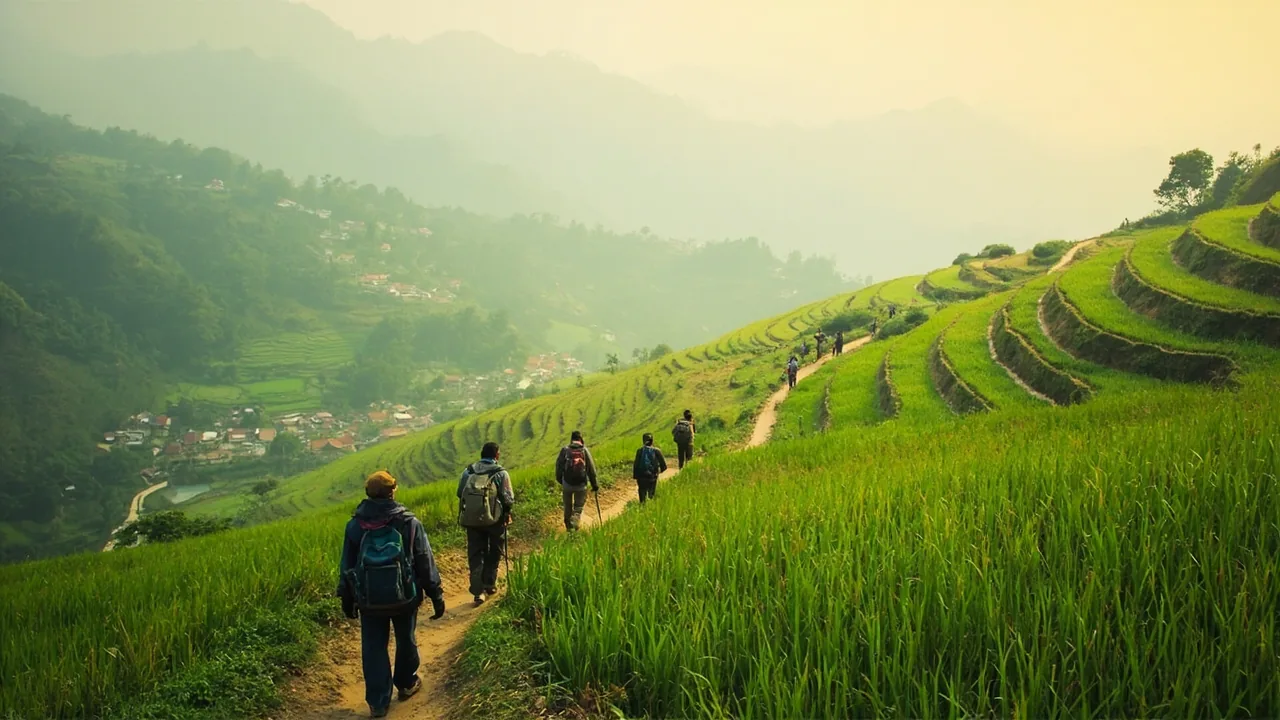
- You want dramatic rice-terrace scenery that looks like a green staircase into the clouds. Sapa’s terraced fields in October and November, just after harvest, are why photographers book a year ahead.
- You’re already in northern Vietnam and don’t mind a 6-hour sleeper train or 5-hour bus from Hanoi. The journey is part of the experience, not a detour.
- You want to trek and sleep in a H’mong or Dao homestay. Multi-day treks that include home-cooked dinners, sleeping on a wooden floor under a mosquito net, and waking up to mist rolling down the valley.
- You like cool weather. Sapa sits around 1,500 metres, so nights drop to 10-15°C from December to February. If you’ve been sweating through Bangkok and Hanoi, that cold shower air feels like medicine.
Choose Chiang Rai If…
- You want the easier visa path. India-Thailand is currently visa-free for 60 days for Indian passport holders. No application, no photo upload, no fee. Show up at Bangkok and you’re in.
- You’re already in Chiang Mai and want a quieter, smaller, less-touristy base for a few days. Chiang Rai is 3-4 hours by bus north and feels like Chiang Mai did 15 years ago.
- You want cultural day trips, not multi-day hikes. The White Temple (Wat Rong Khun), Blue Temple, and the Karen long-neck villages around Mae Sai are half-day or full-day trips, not overnight treks.
- You want better Indian food on standby. Chiang Rai has at least two dedicated Indian/veg restaurants (more on those below) plus Thai Buddhist temple food that’s accidentally vegetarian much of the time.
Sapa. Pros and Cons
Pros:
- Most spectacular terraced scenery in Southeast Asia at a backpacker price
- Multi-day treks with homestay meals included for ~₹4,420 (~1,200,000 VND or ~$45.84)
- Cool climate, a real break from Vietnam’s coastal heat
- Strong hostel-trek culture: book a 2-day trek at your hostel reception and you’re walking the next morning
Cons:
- Visa costs ₹2,410 (~25 USD) for Indians via the official e-visa portal, and you must apply at least 3 working days before arrival
- Fog can wipe out visibility for half a day in November-January, bring layers, not just a jacket
- Strict-veg food is limited to a couple of vegan spots (Andee Sapa Restaurant & Vegan and Thong Dong Vegan Kitchen & Cafe) and whatever you can negotiate at the homestay
Chiang Rai. Pros and Cons
Pros:
- Visa-free entry for Indians (60 days), no paperwork before you fly
- Cheaper dorm beds (₹861 (~300 THB or ~$8.94) / ~₹860 (~$8.92) vs Sapa’s ~₹925 (~$9.60))
- Easier Indian food scene, including Kunda Vegetarian Vegan Burger Cafe and India At Chiang Rai
- Cleaner streets, milder culture shock if it’s your first SE Asia trip
Cons:
- Trekking is less dramatic. Chiang Rai’s hill trails are forested and rolling, not terraced
- Day trips, not multi-day treks, most “trekking” here is a half-day walk to a Karen village
- Hot and humid most of the year, especially March-April when temperatures climb past 38°C
- Smaller backpacker scene, you’ll meet fewer solo travellers than in Chiang Mai
Cost Comparison in ₹
| Expense | Sapa (Vietnam) | Chiang Rai (Thailand) |
|---|---|---|
| Dorm bed (avg/night) | ₹925 (~$9.60) | ₹860 (~$8.92) |
| Street food meal | ₹92 (~$0.95) | ₹115 (~$1.19) |
| Restaurant meal | ₹370 (~$3.84) | ₹575 (~$5.96) |
| Local transport (per day) | ₹555 (~$5.76) | ₹290 (~$3.01) |
| SIM card (tourist) | ₹370 (~$3.84) | ₹290 (~$3.01) |
| Visa fee | ₹2,400 (~$24.90) | ₹0 |
| Top activity (e.g. Day trip) | ₹4,440 (~$46.06) | ₹2,295 (~$23.81) |
| Beer | ₹92 (~$0.95) | ₹115 (~$1.19) |
| 5-day total (strict budget) | ₹20,000 (~$207.46) | ₹16,500 (~$171.16) |
| 5-day total (comfortable) | ₹37,000 | ₹32,000 |
Verified 2026-07-17 at 1 INR = 0.3485 THB and 1 INR = 270 VND. Always check the rate on the day you convert; THB and VND both move against the rupee week to week.
Where to Stay in Sapa
Sapa’s hostel scene is built around trekking. The best ones run their own guided walks, so you’re booking a bed and a trail at the same desk.
| Hostel | Rating | Vibe | Book |
|---|---|---|---|
| Amica House | 9.96 | Quiet, design-led, central | Check prices |
| The Zen House Sapa | 9.96 | Yoga mornings, plant-based cafe | Check prices |
| Dinh Sapa Trekking Adventures & Hostel | 9.2 | Trekking-first, social dorms | Check prices |
| Venus Sapa Hostel | 8.62 | Budget-friendly, basic but clean | Check prices |
| For Chiang Rai, you’ll find a smaller hostel scene. Most backpackers base themselves in Chiang Mai and bus up for 2-3 nights, which is why this article leans toward the Chiang Mai hub for accommodation depth. |
What to Eat
Sapa (Vietnam, veg-friendly):
- Thong Dong Vegan Kitchen & Cafe (rating 4.9): Plant-based Vietnamese done right, vegan spring rolls and jackfruit curry in a garden setting. Around ₹295-₹442 (~80,000-120,000 VND or ~$3.06-$4.58) for a main (~₹296-444).
- Andee Sapa Restaurant & Vegan (rating 4.8): Local vegan dishes, useful when you need a hot meal after a cold trek. Around ₹331-₹479 (~90,000-130,000 VND or ~$3.44-$4.97).
Chiang Rai (Thailand, Indian/veg-friendly):
- Kunda Vegetarian Vegan Burger Cafe Chiang Rai (rating 4.9): Burgers and Thai veg plates. Around ₹345-₹517 (~120-180 THB or ~$3.57-$5.36).
- India At Chiang Rai (rating 4.9): North and South Indian, vegan and halal options, gluten-free marked on the menu. Around ₹431-₹718 (~150-250 THB or ~$4.47-$7.45) for a thali.
Safety Alert: Don’t drink tap water in either destination. Stick to bottled or filtered water from your hostel. Sapa’s high-altitude stomach bugs hit travellers harder than Bangkok’s.
The Bananarchy Take
If you want one mountain-trek experience in Southeast Asia, go to Sapa. The terraced valleys are a once-in-a-lifetime view, the homestay nights are a story you tell for years, and the trek infrastructure is mature enough that you don’t need to plan. It’s a 6-hour sleeper bus from Hanoi, but the moment you wake up at 5:30 a.m. With the mist over the valley, you stop counting travel hours.
If you’re already doing northern Thailand and want a quieter add-on, Chiang Rai is the better pick. Day trips, gentle treks, better Indian food, no visa paperwork. You won’t get the dramatic terraced photo, but you also won’t spend half your trip on buses.
The mistake is trying to combine them on a short trip. Hanoi to Chiang Rai is a flight, not a bus ride, and you’re burning a full day each way. If you’ve got 30 days, you can do Sapa, fly to Bangkok, bus to Chiang Mai, and bus up to Chiang Rai. If you’ve got 14 days, pick one country and go deep.
Our one-trip loop covers both Sapa and northern Thailand (plus Laos and Cambodia) on a single fixed-cost route, so the “can you do both” logistics are already handled if you want the no-planning version.
Getting Connected
Both destinations have tourist SIMs at the airport or town shops. Vietnam’s Viettel and Mobifone sell 30-day tourist packs around ₹368 (~100,000 VND or ~$3.82) with 3-4 GB/day. Thailand’s AIS, DTAC, and TrueMove H all do 8-day tourist SIMs around ₹859 (~299 THB or ~$8.91) with 15 GB total. For either country, an Get Nomad eSIM works from the moment you land and avoids the airport kiosk queue.
Can You Do Both?
Yes, but not cheaply in time. The realistic combined trip is 14 days minimum, with this routing:
- Hanoi (2 nights): Arrive, recover from the flight, grab your e-visa in advance.
- Sapa (4 nights): Sleeper train from Hanoi on night 1, two full trekking days, one rest day, return to Hanoi.
- Fly Hanoi → Bangkok (1 day): Budget carriers like VietJet and AirAsia do this for ~₹9,000 (~$93.36) one way if booked a week ahead.
- Chiang Mai (4 nights): Slow down, do a cooking class, walk the old city.
- Chiang Rai (3 nights): Bus up, see the White Temple and Blue Temple, do a Karen village day trip, bus back.
Total cost for 14 days, strict budget: ~₹60,000 (~$622.38) including the Hanoi-Bangkok flight. Comfortable: ~₹100,000 (~$1,037.30). The flight is the budget-breaker; if you skip it and overland through Laos, the time cost jumps to 3-4 extra days.
Subodh’s Pro Tip: Book the Hanoi-Bangkok flight on VietJet or AirAsia at least 14 days ahead. Walk-up fares on those carriers can hit ~₹18,000 (~$186.71) for the same route.
FAQ
Is Sapa cheaper than Chiang Rai for Indian backpackers?
Sapa is slightly cheaper on dorms, beer, and street food, but the visa fee (₹2,410 (~25 USD) / ~₹2,400 (~$24.90)) and the longer overland journey from Hanoi wipe out the difference. End-to-end for 5 days, Chiang Rai comes in around ₹3,500 (~$36.31) cheaper.
Do Indians need a visa for Chiang Rai?
No. Thailand is visa-free for Indian passport holders for 60 days. Just bring your passport with at least 6 months validity.
Do Indians need a visa for Sapa?
Yes. Vietnam requires an e-visa for Indian citizens, ₹2,410 (~25 USD), applied online at the official portal, processed in 3 working days. Print two copies.
Which is better for vegetarian Indian food, Sapa or Chiang Rai?
Chiang Rai wins. There are at least two dedicated Indian/veg restaurants in town (Kunda and India At Chiang Rai), plus Thai temple food. Sapa has two vegan spots but no North Indian restaurants.
Can I do a day trek from Chiang Rai or do I need to commit to multi-day?
Day treks are standard in Chiang Rai: half-day Karen village walks, full-day temple-and-village circuits. In Sapa, day treks exist but the multi-day Cat Cat → Lao Chai → Ta Van route is the actual reason most people go.
Which is safer for solo Indian women travellers?
Both are generally safe at the level a solo backpacker would experience. Sapa’s trekking routes have guides, you’re rarely alone on the trail. Chiang Rai is a small Thai city with standard city-level petty theft caution. Standard SE Asia rules apply in both: don’t walk alone in remote areas after dark, register with your hostel.
Which has better weather for trekking?
Both peak in November-December. Sapa stays trek-worthy into March. Chiang Rai gets dangerously hot in March-April and the trails lose their appeal; November-February is the sweet spot.
Safety Note: Before you book either trek, check the current travel advisory from the Ministry of External Affairs at mea.gov.in and the destination country’s own tourism advisory page. Local weather and trail conditions change week to week, especially during the monsoon shoulder months of September and May.
Closing
I’ve walked both trails. Sapa makes you earn the view, and Chiang Mai-Chiang Rai lets you ease into Thailand without the visa dance. Pick the country that matches the rest of your itinerary. For a deep Vietnam trip, Sapa. For a deep Thailand trip, Chiang Rai. Don’t split the difference.
