Angkor Wat Guide for First-Timers: Which Temples, Dress Code, Sunrise Tips & Is It Overrated?
Angkor Wat needs two days minimum: a one-day pass costs ₹3,564 (~37 USD) and barely scratches the surface, a three-day pass costs ₹5,972 (~62 USD) and lets you see the temples properly. The sunrise crowd peaks 5:00–6:15 AM in high season, so arrive by 4:45 AM. Dress code at the Bakan tower: shoulders and knees covered, no exceptions.
That is the entire answer in three paragraphs. Everything below is the how. For broader Southeast Asia backpacking context, see our Southeast Asia backpacking hub.
Quick Answers
| What | Answer | Price (INR) |
|---|---|---|
| 1-day pass | Angkor Enterprise main ticket | ₹3,564 (~37 USD) |
| 3-day pass | Same pass, valid 10 days | ₹5,972 (~62 USD) |
| 7-day pass | Same pass, valid 1 month | ₹6,936 (~72 USD) |
| Sunrise peak crowd | 5:00 to 6:15 AM (Nov to Feb) | Free with pass |
| Bakan tower dress code | Shoulders + knees covered, scarves removed | $0 (free wrap available at entrance) |
| Tuk-tuk full day | Negotiate morning of | ₹1,445 (~15 USD) to ₹2,408 (~25 USD) |
| Official ticket portal | angkorenterprise.gov.kh | ₹3,564 (~37 USD) to ₹6,936 (~72 USD) |
| Best months | Nov to Feb (dry, cool) | $0 |
| Worst months | Aug to Sep (rainy, muddy, low water) | $0 |
Verified against the official Angkor Enterprise portal on 2026-07-17.
What Is Angkor Wat, Exactly?
Angkor Wat is a 12th-century Khmer temple complex 6 km north of Siem Reap, Cambodia. It is the largest religious monument in the world by land area (about 162 hectares), built by Suryavarman II as a Hindu Vishnu temple that later converted to Buddhism. The wider Angkor Archaeological Park contains over 70 temples spread across 400 square km, of which about 20 are worth visiting on a normal trip. The word “Angkor” comes from the Sanskrit “nagara” (city); “Wat” means temple.
The park is split into the Small Circuit (Angkor Wat, Bayon, Ta Prohm, Banteay Kdei, plus a handful of smaller stops), the Grand Circuit (Preah Khan, Neak Pean, Ta Som, East Mebon, plus further-out temples), and the Roluos group (Bakong, Lolei, Preah Ko, 13 km east, the oldest stuff). Most first-timers do Small Circuit day 1, Grand Circuit day 2, then either Beng Mealea or a sunrise-only return to Angkor Wat on day 3.
Step-by-Step: Your First Angkor Day
Step 1: Buy your pass the night before
The official counter at the Angkor Enterprise main office on National Road 6 (300 m before the Angkor Wat entrance) opens at 4:30 AM during high season and queues are short before 5:00. You can also buy online at angkorenterprise.gov.kh and collect at the counter, but the online system has been flaky; travellers in early 2026 reported the e-ticket pickup taking longer than just walking up to the window.
Bring your passport. The pass is biometrically linked to your face via a photo taken at the counter. The photo is checked at random checkpoints inside the park, so your pass is non-transferable.
Step 2: Sunrise at Angkor Wat
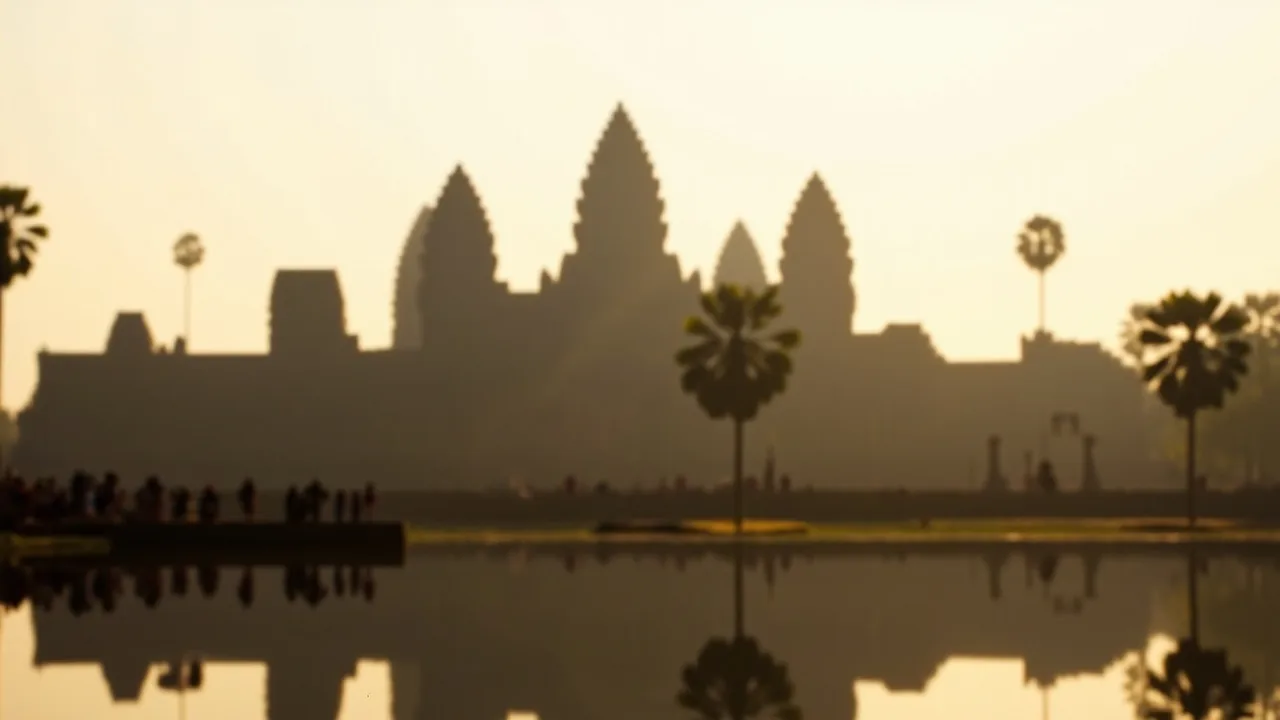
The signature reflection shot is from the small reflecting pond on the west side of the temple, directly in front of the central lotus towers. The sun rises behind the towers, so the framing is dead-on.
Arrival timing:
- High season (Nov to Feb): 4:30 AM to claim a front-row spot. The pond fills up by 5:00 AM.
- Shoulder season (Mar, Oct): 5:00 AM is fine.
- Low season (May to Sep): Arrive any time before sunrise. You will have the pond to yourself but the cloud cover usually kills the reflection.
The crowd at peak high season is genuinely awful: 200 to 300 people shoulder-to-shoulder on the bank, every phone on a selfie stick. If you want quiet, do the sunrise at Phnom Bakheng (the hilltop temple south of Angkor Wat) instead. Fewer people, higher view, but the actual sun is blocked by Angkor Wat itself so the framing is less dramatic.
Subodh’s Pro Tip: The sunrise crowd thins out by 6:15 AM. If you arrive at 6:30, you get the same pond, the same light on the towers, and 80% fewer humans in your photos. Skip the 4 AM alarm.
Step 3: Dress code at Angkor Wat (Bakan tower)
The upper level of Angkor Wat, called the Bakan tower, has a strict dress code enforced by guards at the summit staircase:
- Shoulders covered (no tank tops, no sleeveless)
- Knees covered (no shorts, no short skirts)
- No hats, scarves, or head coverings inside the sanctuary itself
- No shoes on the upper terraces (you carry them)
Enforcement is inconsistent but real. Guards will turn you back at the stairs if you show shoulders. Most travellers carry a ₹96 (~1 USD) sarong or scarf and wrap up at the checkpoint.
The dress code applies to the Bakan tower at Angkor Wat, and is also enforced at Phnom Bakheng and Banteay Srei. You can walk the lower galleries of Angkor Wat in a t-shirt and shorts all day. Other temples (Bayon, Ta Prohm, Preah Khan) have no dress code.
Safety Alert: The Bakan tower summit staircase is steep and the treads are uneven, polished smooth by 800 years of feet. Wear shoes with grip, not flip-flops. The handrail is a steel cable that flexes. Travellers with knee issues regularly turn back halfway.
Step 4: The temple sequence (Small Circuit, day 1)
Most guides start you at Angkor Wat (because sunrise), then loop south and east:
- Angkor Wat proper (2 to 3 hours). Outer galleries, inner courtyard, Bakan tower if you dressed.
- Ta Prohm (1 to 1.5 hours). The “Tomb Raider temple” with strangler figs growing through the corridors. Crowded until 9 AM, calmer after.
- Banteay Kdei (45 min). Quieter, similar style to Ta Prohm with massive tree roots. Skip if short on time.
- Bayon (1.5 to 2 hours). The face tower temple at the centre of Angkor Thom. 216 stone faces of Avalokiteshvara, every one smiling slightly differently.
- Phimeanakas + Baphuon (45 min). Within Angkor Thom, easy add-ons.
- Phnom Bakheng (sunset, optional). Hilltop temple with the panoramic view. The sunset crowd is worse than the sunrise crowd. Arrive by 4:30 PM or skip it.
Tuk-tuk drivers know this loop cold. Most charge ₹1,445 (~15 USD) to ₹2,408 (~25 USD) for a half-day Small Circuit and ₹1,927 (~20 USD) to ₹2,408 (~25 USD) for a full day that includes sunrise.
Step 5: Eat lunch inside the park
There is a basic cafeteria near the Angkor Wat entrance (rice, noodle soup, fried rice, ₹289 (~3 USD) to ₹482 (~5 USD)). It is fine. Better option: most tuk-tuks stop at a roadside Khmer restaurant on the way between temples, where amok (fish curry steamed in banana leaf, ₹289 (~3 USD) to ₹385 (~4 USD)) and lok lak (stir-fried beef with lime, ₹289 (~3 USD) to ₹385 (~4 USD)) are the safe choices. See our lunch spots near Angkor Wat guide for more options. Bring a refillable water bottle; refill stations exist at most temple entrances.
If you need Indian food for lunch, Siem Reap town is 15 minutes back, but that breaks your day. Carry nuts and fruit instead.
Step 6: Sunset decision
Two real options:
- Phnom Bakheng: Panoramic, but the temple caps at 300 people at a time and the line starts at 4:00 PM. The actual sun sets behind a hill, so the colour is muted. Skip in peak season.
- Stay at Angkor Wat until close: The temple stays open until 6:00 PM. The west-facing galleries catch the late light with zero crowd. Locals do this; tourists don’t.
Step-by-Step: Day 2 (Grand Circuit)
Day 2 is the day the temples become yours. Crowd drops 70% on day 2 of a 3-day pass because most tourists do 1-day passes and never come back.
Grand Circuit order (counterclockwise, 26 km loop):
- Preah Khan (1.5 hours). The “Sword of Khan” temple, similar in feel to Ta Prohm but bigger and quieter. Massive corridors, roofless galleries, a few spectacular tree-root formations.
- Neak Pean (30 min). A small island temple on an artificial lake. Photogenic but quick.
- Ta Som (30 min). Mini Ta Prohm, one giant strangler fig over the east gate. Worth 20 minutes.
- East Mebon (45 min). Pyramid temple with elephant statues at the corners. Less restored, more atmospheric.
- Pre Rup (sunset, optional). Brick pyramid temple, similar feel to East Mebon but higher. Best sunset in the park because the temple faces west and crowds are tiny.
Then either drive back to Siem Reap for dinner or stop at one of the Khmer restaurants near the road for amok and a Beer Cambodia.
Step-by-Step: Day 3 (Choose One)
If you have a third day, you have four real options. Pick based on your energy and your interest:
| Option | What it is | Time | Notes |
|---|---|---|---|
| Beng Mealea | 40 km east, unrestored jungle temple, Ta Prohm but 100x bigger | Half day | Entry fee + tuk-tuk required |
| Koh Ker | 2.5 hours north, the pyramid temple Prasat Thom, often empty | Full day | Entry fee + car required |
| Banteay Srei | 25 km north, the “Citadel of Women” with pink sandstone carvings | Half day | Included in Angkor pass + tuk-tuk |
| Floating villages (Kompong Khleang or Chong Khneas) | Stilted houses on Tonle Sap lake | Half day | Boat + tuk-tuk required |
Beng Mealea is the most “wow” day for first-timers: you walk through roofless corridors with trees growing through every doorway, no tourists, no railings, no guards. Bring a headlamp; some interior corridors are dark.
Is Angkor Wat Overrated?
Honest answer: it depends on what you want.
It is overrated if:
- You read “largest religious monument in the world” and expect a single dramatic building. Angkor Wat is huge but the visual punch is the lotus silhouette at sunrise, not the architecture itself.
- You are not a temple person. After Bayon and Ta Prohm, the next 17 temples blur together. There is a real “temple fatigue” curve that hits most visitors by 1 PM on day 1.
- You go during peak high season (Dec to Jan) when Angkor Wat is genuinely overrun. The crowds at the main pond are a selfie stick convention.
It is worth it if:
- You give it 2 to 3 days, not 1. The second day is where the temples become yours.
- You go in shoulder season (Mar to Apr, Oct) when crowds drop 40 to 50% and the weather is still dry.
- You hire a guide for at least Angkor Wat and Bayon. A good Khmer guide explains the bas-reliefs (the 800-metre-long gallery of Hindu myths at Angkor Wat is unreadable without narration) and the temple symbolism. The difference between walking the corridors alone and walking them with a guide is the difference between “old rocks” and “this is why Suryavarman II built this as a funeral temple pointing west, not east.”
The most common regret among first-timers is “I only got a 1-day pass and tried to cram Angkor Wat, Bayon, and Ta Prohm in by 2 PM.” Get the 3-day pass. Use day 1 for the headline temples, day 2 for the Grand Circuit, day 3 for Beng Mealea or Banteay Srei. For more Cambodian destinations beyond Angkor, see our top cities to visit in Cambodia.
Subodh’s Pro Tip: If you are a first-timer on a tight budget, skip the ₹5,972 (~62 USD) guide and download a free audio guide before you arrive (the SmartGuide app has a credible Angkor Wat one). The guide is worth it only if you have never seen a Hindu bas-relief before. After one temple with a guide, you can self-guide the rest.
Common Mistakes Indians Make at Angkor Wat
-
Buying the 1-day pass to “save money”. The 1-day pass is $37, the 3-day pass is $62. The extra $25 buys you two more days of entry and access to Beng Mealea and Koh Ker extensions. The 1-day pass saves you ₹2,408 (~25 USD) and forces you to sprint between temples.
-
Trusting tuk-tuk drivers who say “the ticket office is closed, buy from me”. It is a scam. The official Angkor Enterprise counter opens at 4:30 AM and accepts cash USD. No official sells tickets out of a tuk-tuk. If someone offers, walk away.
-
Wearing shorts and a tank top to the Bakan tower. You will be turned back at the stairs. Wrap up at the base, or carry a scarf from Siem Reap.
-
Going to Phnom Bakheng for sunset on a peak-season day. The 300-person cap creates a 90-minute queue starting at 4 PM. You will watch the sunset from the queue, not the temple.
-
Paying for a “floating village” tour at Chong Khneas. Chong Khneas is a tourist trap 20 minutes from Siem Reap with staged photo ops and aggressive kids on boats. If you want a real floating village, go to Kompong Khleang (45 minutes, ₹1,927 (~20 USD) to ₹2,890 (~30 USD) by tuk-tuk, fewer tourists, real village).
What Most Guides Don’t Tell You
-
The pass photo is checked. Your face is photographed at the ticket counter and the photo is verified at random checkpoints inside the park. You cannot share a pass with your partner. The fine for a fake is ₹9,633 (~100 USD) plus deportation.
-
Drone use requires a permit. The Angkor Authority issues drone permits at their main office, takes 3 to 5 business days, and costs $50. Flying without a permit inside the park gets your drone confiscated and a $200 fine.
-
The bas-reliefs at Angkor Wat are best in late afternoon light. Most guides do Angkor Wat at sunrise and move on, which means the gallery is empty by 4 PM. If you want to study the carvings, return at 4 PM on your second day. The light is flat but the galleries are empty and you can take your time.
-
Siem Reap is louder than the temples. Pub Street noise travels. If you stay near Pub Street, you will hear bass until 2 AM. Stay 600 m north (around Wat Bo Road) for quiet.
-
Water inside the park is expensive. The cafeteria charges ₹144 (~1.50 USD) per bottle. Bring a refillable bottle from Siem Reap. Refill stations exist at the main temple entrances.
Where to Stay in Siem Reap
Most backpackers stay near Pub Street or along Wat Bo Road. Pub Street is loud until 2 AM but central; Wat Bo Road is quieter, 10 minutes’ walk to the restaurants. Budget hostels run ₹385 (~4 USD) to ₹578 (~6 USD) for a dorm. Private rooms start at ₹963 (~10 USD). For a full breakdown, see our Siem Reap accommodation guide.
Where to Eat in Siem Reap (For Indian Travellers)
After a day of temple climbing, you need a real meal. The temple trail has zero Indian food, so most Indian travellers eat in town before and after.
For Khmer food (try these once, they are excellent):
- Angkor Hand-Pulled Noodles & Dumplings is the city’s most loved lunch spot, hand-pulled noodles and pork dumplings, expect a queue at 1 PM.
- Angkor Mondial is the affordable Khmer-and-Chinese fallback when you want stir-fried morning glory and a Khmer curry under ₹482 (~5 USD).
- For late-night post-temple meals, ណាក់ណាក់ស៑ុប & Pizza 24h keeps the kitchen open past midnight and serves Khmer soup and pizza until 4 AM.
For Indian food (when you need a dal-chawal fix):
- Indian Restaurant in central Siem Reap is the go-to for simple thalis and butter chicken, basic setting, prices in the ₹385 (~4 USD) to ₹578 (~6 USD) range.
- Galaxy Indian Restaurant and Saffron Indian Restaurant in Poipet (the border town, not Siem Reap proper) are popular if you are crossing overland from Thailand and need a meal before the bus.
Veg travellers: most Khmer restaurants can do a veg amok (mushroom instead of fish) on request. Indian restaurants in Siem Reap do proper paneer and dal. See our vegetarian food in Cambodia guide for more options. Avoid the buffet places on Pub Street; the food sits out.
Getting Connected in Cambodia
Buy a Smart or Cellcard tourist SIM at the airport (7-day SIM with 10 GB of data, verified against the Cellcard Phnom Penh counter on 2026-06-26). Airport kiosks charge ₹482 (~5 USD); the official Cellcard shop in town charges ₹289 (~3 USD) for the same plan, and the price difference is purely a location markup. Bring your passport for registration.
If you want to skip the airport queue, Get Nomad eSIM is a clean alternative with data packages starting around ₹482 (~5 USD) for 5 GB, activation is QR code and works before you land.
Mobile data in Cambodia is solid in Siem Reap and along the temple roads. Inside Beng Mealea and Koh Ker you will drop to 2G; download your maps offline the night before.
Getting Around Siem Reap
For a full Siem Reap city guide, including where to stay and nightlife, see our dedicated article. Tuk-tuks are the only practical way to the temples. Prices are negotiated, not metered:
- Full-day temple run (Angkor Wat sunrise + Small Circuit): ₹1,927 (~20 USD) to ₹2,408 (~25 USD)- Half-day sunset run: ₹1,445 (~15 USD) to ₹1,927 (~20 USD)- Single drop within town (Pub Street to your hostel): ₹193 (~2 USD) to ₹482 (~5 USD) Bicycle rental from hostels is ₹193 (~2 USD) to ₹289 (~3 USD) per day and works if you only want Angkor Wat (6 km, flat road). It does not work for the Grand Circuit; the loop is 26 km and the midday heat is brutal.
Grab and PassApp (the local rideshare) work in Siem Reap but most drivers refuse temple runs because the distance is too far.
FAQ
How early should I arrive for sunrise at Angkor Wat?
4:30 AM in high season (Nov to Feb) for a front pond spot. By 5:00 AM the pond is shoulder-to-shoulder. If you arrive at 6:30 AM, you skip the crowd but still get the post-sunrise golden light on the towers, which is arguably better for photos.
Is the dress code strictly enforced at Angkor Wat?
Yes at the Bakan tower upper level. Shoulders and knees must be covered, scarves removed at the sanctuary entrance, shoes carried. Enforcement at other temples is inconsistent but the Bakan tower guards do turn people back. A ₹96 (~1 USD) sarong from the night market solves it.
Is a 1-day pass enough for Angkor Wat?
No for first-timers. You will see Angkor Wat, Ta Prohm, and Bayon in a sprint and miss everything else. The 3-day pass at ₹5,972 (~62 USD) is the sweet spot. You use day 1 for the headline temples, day 2 for the Grand Circuit (Preah Khan, Ta Som, East Mebon), day 3 for Beng Mealea or Banteay Srei.
Can I hire a guide at the temple entrance?
Yes, official Khmer guides (licensed by the Angkor Authority) hang out near the main entrance and charge ₹2,408 (~25 USD) to ₹3,853 (~40 USD) for a half-day tour of Angkor Wat and Bayon. Unofficial guides will offer ₹963 (~10 USD) but their English is hit-or-miss and they cannot legally lead you inside the sanctuaries. Verify the license badge.
Is Angkor Wat safe for Indian travellers?
Yes. The temple park is one of the safer tourist sites in Southeast Asia. Petty crime is low; the main scams are tuk-tuk overcharging and fake ticket sellers at the entrance. Standard precautions: keep your bag zipped, do not accept “free” guided tours that end at a souvenir shop, and book your tuk-tuk the night before, not from strangers at the bus station. For more on Cambodia-specific safety, see our full Cambodia safety guide for Indian travellers.
Do Indians need a visa for Cambodia?
Yes, you need either a ₹2,890 (~30 USD) visa on arrival or a ₹3,468 (~36 USD) e-visa. Apply at www.evisa.gov.kh for the e-visa; the queue at the airport is shorter. Both give 30 days single entry, extendable at the immigration office for ₹4,335 (~45 USD). See our Cambodia visa guide for the full process and the common rejection reasons.
What is the best time of year to visit Angkor Wat?
November to February is dry season, 25 to 30°C, low humidity. The temples look clean and the reflection ponds work. December and January are the busiest, so come in November or February if you want smaller crowds. Avoid August and September: the rains turn the jungle temples into mud baths and the reflection ponds are often dried up.
Subodh’s Take
Angkor Wat is the single best reason to come to Cambodia, and it is worth the international flight alone if you give it three days. The mistake most first-timers make is buying the one-day pass, sprinting through the headline temples by 2 PM, and leaving disappointed. The temples reward slow time, a guide for the first temple, and a willingness to come back at 4 PM when the day-trippers are gone. The sunrise crowd is overrated; the 6:30 AM crowd, the late-afternoon bas-reliefs, and the empty Grand Circuit on day 2 are where Angkor Wat becomes a memory and not just a photo.
