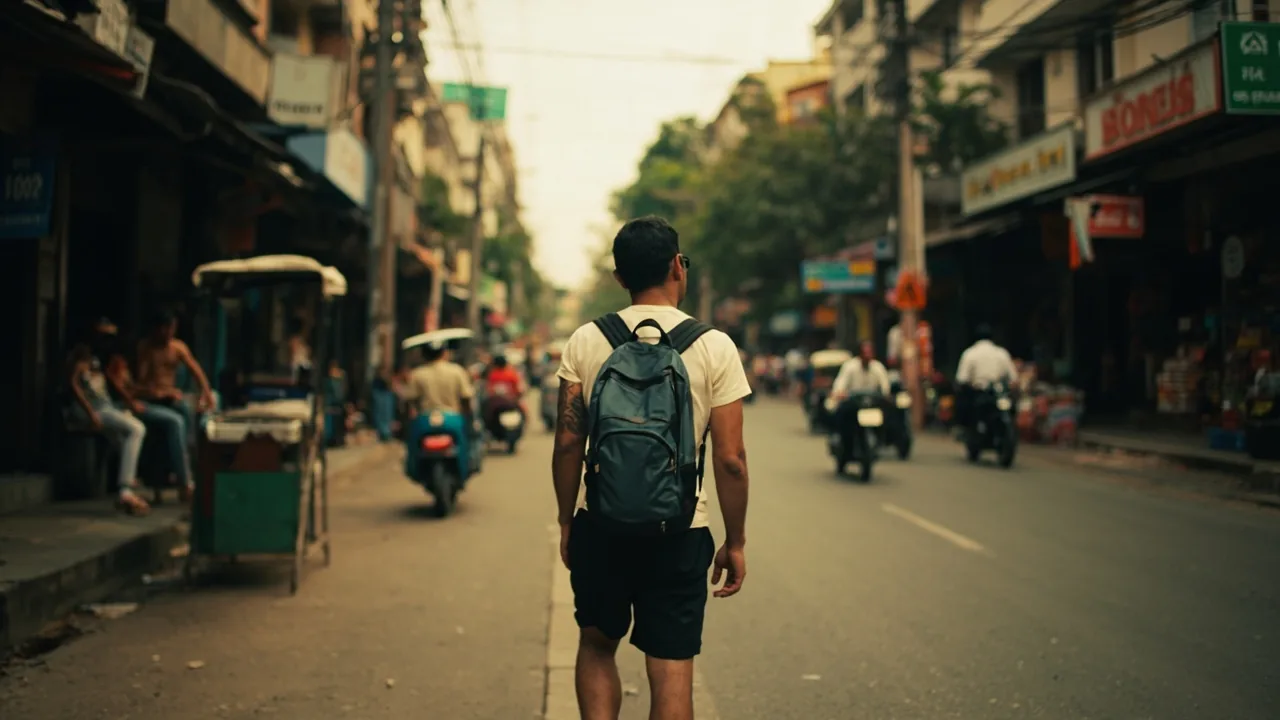
Is Cambodia Safe for Indian Travelers? Solo Female Tips, Common Scams in Phnom Penh & Siem Reap
Short answer: yes. Cambodia is generally safe for Indian travellers, including solo female backpackers. Petty scams, such as overpriced tuk-tuks, inflated Angkor tickets, and pickpocketing around Pub Street, are the real day-to-day risk, not violent crime. Carry photo ID at all times and check the current advisory before any land border crossing. See our Southeast Asia backpacking hub for the full picture.
Quick Answers
| What | Answer | Price (INR) |
|---|---|---|
| Overall safety | Safe with normal precautions | , |
| Main risks | Tuk-tuk scams, pickpocketing, overcharging | , |
| Solo female safety | Generally fine, dress modestly at temples | , |
| Photo ID required | Yes, carry passport at all times (legally required) | , |
| Tap water | Don’t drink, brush teeth with bottled | , |
| Emergency number | Police 117, Ambulance 119, Tourist Police 1288 | , |
| Currency | Cambodian Riel (KHR) and USD both accepted | , |
Verified against the Indian Embassy in Phnom Penh advisories and the official Cambodia e-visa portal on 2026-07-17.
What Do We Mean by “Safe” in Cambodia?
“Safe” in Cambodia mostly means two things: low violent-crime risk for tourists, and high petty-scam risk that can drain your wallet fast. Violent crime against foreigners is rare in Phnom Penh and Siem Reap compared to bigger Asian capitals. What tourists lose money to is the small-stuff: tuk-tuk drivers quoting 5x the going rate, “free” guides at Angkor who appear out of nowhere, and bag-snatching on motorbikes at traffic lights.
For Indian travellers specifically, two extra things matter. First, you must carry your passport at all times. Cambodian law requires foreign nationals to carry photo identification, and tourists have been detained for hours for not having it on them. Second, dress modestly at temples (covered shoulders and knees), especially for women, since the Angkor complex enforces this strictly at the main gates.
Common Scams in Phnom Penh
Phnom Penh scams cluster around the riverfront, the markets, and tuk-tuk drivers who hang out near the Royal Palace. For a deeper dive, see our Cambodia scams and safety guide.
Tuk-tuk overcharging
Tuk-tuk drivers at the airport, bus stations, and the Riverside quote ₹482-₹963 (~5-10 USD) for trips that should cost ₹193-₹289 (~2-3 USD). The fix is simple: walk 100 metres away from the terminal and hail one on the street. The fare for any trip within central Phnom Penh is ₹193-₹482 (~2-5 USD). If a driver insists on a flat “tour” rate, ask him to use the meter (most don’t have one) or agree on the price before getting in.
The “temple is closed today” scam
A common trick near the Royal Palace: a driver tells you the palace is closed for a Buddhist holiday or a royal ceremony, then offers to take you to “another nice temple” (which turns out to be a shop where he gets a commission). Verify opening hours yourself at the palace gate. If your driver refuses to go, find another one.
Bag-snatching from motorbikes
Drive-by bag-snatching happens, mostly at traffic lights on busy roads. Wear your backpack on the front in Phnom Penh traffic, and don’t keep your phone in your back pocket. Solo female travellers should avoid walking alone on quiet streets after 10 pm; take a tuk-tuk or PassApp (the local Grab equivalent).
Fake tuk-tuk “tours”
Drivers offer half-day “city tours” for ₹963-₹1,445 (~10-15 USD). These usually involve stops at shops that pay the driver commission (gem stores, tailors, souvenir factories). If you want a real tour, book it through your hostel or a known operator, not from a driver who approaches you on the street.
Common Scams in Siem Reap
Siem Reap’s scam ecosystem centres on Pub Street, the Old Market, and the Angkor ticket office.
Angkor ticket scams
The official Angkor pass is ₹1,927 (~20 USD) for a one-day, ₹3,853 (~40 USD) for three-day, ₹5,972 (~62 USD) for seven-day (verified at the Angkor Enterprise ticket office). Anyone selling “discounted” tickets on the street is either selling a fake or skimming your money. Buy only at the official ticket centre on the road to Angkor. The ticket comes with your photo taken on-site, so there’s no way to resell it.
Tuk-tuk rip-offs at Pub Street
Pub Street tuk-tuk drivers inflate fares after dark, especially during the post-beer rush around midnight. Agree on the fare before you get in: ₹193-₹289 (~2-3 USD) for a trip within town, ₹482 (~5 USD) maximum. The full-day Angkor tour in a tuk-tuk is ₹1,445-₹2,408 (~15-25 USD); if anyone quotes more, walk away.
”Free” guides at Angkor
Unofficial guides approach tourists at temple entrances offering “free” tours. They lead you through the temple, then demand ₹963-₹1,927 (~10-20 USD) at the end, sometimes with threats. Politely say “no, thank you” and keep walking. If you want a guide, book through your hostel or use a registered operator.
Pub Street pickpocketing
Pub Street is pickpocket territory, especially during sunset happy hour when the crowd is dense. Keep your phone in your front pocket, don’t put your bag on the back of your chair, and watch your drink. Solo female travellers report feeling safe on Pub Street in groups but say it gets uncomfortable if they’re alone and visibly drunk.
Solo Female Safety Tips
Cambodia is generally safe for solo female travellers, but the standard rules apply: dress modestly outside the beach areas, don’t walk alone after dark in unfamiliar neighbourhoods, and trust your instincts on tuk-tuk drivers. See our solo female travel in Cambodia guide for more.
Dress code
Cambodia is conservative compared to Thailand or Vietnam. At temples, cover shoulders and knees (the Angkor gate staff will turn you away otherwise). In Phnom Penh and Siem Reap, shorts and t-shirts are fine during the day, but bring a light scarf or shawl for temple visits and for evenings in local neighbourhoods.
Transport at night
Don’t walk alone after 10 pm, even on Pub Street, and especially not on the quiet streets behind it. Use PassApp or Grab for short trips, or ask your hostel to call a trusted tuk-tuk driver. Most hostels keep a list of reliable drivers.
Accommodation
Stay in hostels with female-only dorms or private rooms for the first few nights until you’ve read the city. The dorm-bed scene in Phnom Penh and Siem Reap is well-established, with female-only options available at most major hostels.
Health
Carry hand sanitiser, drink only bottled water, and bring oral rehydration salts. Street food is generally safe if it’s cooked in front of you and served hot. Pharmacies are everywhere in both cities, and most sell common antibiotics without a prescription (though a travel-doctor visit before you fly is still the right call).
Motorbike Safety
Renting a motorbike in Cambodia is cheap and convenient, but it’s also the single biggest risk factor for tourists. Road conditions are poor, traffic is chaotic, and Cambodians drive on the right. For rental details, see our Cambodia motorbike rental guide.
Get the right licence
An Indian driving licence alone is not enough. To ride legally in Cambodia, you need either an International Driving Permit (IDP) or a Cambodian licence. Most rental shops don’t ask, but if you have an accident, your travel insurance will not cover you without one. The IDP costs around ₹3,000 (~$31.14) through the Indian Automobile Association and is the cheaper option.
Check the bike before riding
Photograph the bike from all sides, note any scratches, and check the brakes and tyres. Rental shops will blame you for pre-existing damage if you don’t document it. Take a short test ride in the parking lot before heading out.
Don’t ride at night
Cambodia has one of the highest road-fatality rates in Southeast Asia. Night riding is the most dangerous, especially outside Siem Reap and Phnom Penh where roads are unlit. If you do ride at night, wear a helmet (always), use lights, and avoid highways.
Helmet law
Helmets are legally required for both driver and passenger. Police set up checkpoints in tourist areas, and the fine is around ₹482-₹963 (~5-10 USD) if you’re caught without one. Rental shops provide helmets, but they’re often low-quality; bring your own if you have one.
Border and Conflict Considerations
Two things matter specifically for Indian travellers in 2026.
Photo ID requirement
Cambodian law requires all foreign nationals to carry photo identification at all times. For tourists, this means your passport. A photocopy is technically not enough; police can detain you for several hours while they verify your status at a station. Travellers report being asked for ID at random checkpoints, especially on intercity buses and at the Angkor ticket office. Keep your passport on you, or use a hotel safe during your stay and carry a certified copy along with a passport photo for ID purposes.
Border tension
The Cambodia-Thailand border has seen periodic tension over the past year, including a flare-up in mid-2025 that led to temporary border closures. Before you travel, check the current advisory on the Indian Ministry of External Affairs site (mea.gov.in) and the Cambodian Ministry of Foreign Affairs site. For crossing details, see our Cambodia border crossings guide. Avoid the specific border crossings that are flagged as restricted at the time of your travel; the main tourist crossings (Poipet, Cham Yeam, O Smach) have been operating normally in 2026, but verify before you book.
Current advisories
For the most up-to-date information, check your government’s official travel advisory before departure. Indian travellers should look at the MEA advisory page and the Indian Embassy in Phnom Penh site (embindpp.gov.in). The Australian Smartraveller site is also a useful cross-reference, since it tends to update faster on regional security events.
What Most Guides Don’t Tell You
Three gotchas that don’t make it into the standard safety lists:
The “free” Angkor sunrise tuk-tuk scam. Some drivers offer a free 4 am tuk-tuk to Angkor Wat for sunrise, then take you to a different temple where they pressure you to buy overpriced water, snacks, or “donations.” Agree on the temple and the fare the night before, and pay only after you arrive at the actual Angkor Wat entrance.
Bag-snatching at Phnom Penh traffic lights. Drive-by snatching from motorbikes is more common in Phnom Penh than in Siem Reap. Keep your phone and wallet in your front pockets, wear your backpack on your chest, and don’t hang bags on the side of the tuk-tuk.
Passport retention by “police.” Scammers posing as police will ask to see your passport, then claim there’s a problem and demand a “fine.” Real police don’t demand on-the-spot cash fines for tourists; if you’re stopped, ask to go to the station or call the tourist police hotline (1288).
Where to Eat (Indian + Local Spots)
Food safety question is its own category for Indian travellers. Both Phnom Penh and Siem Reap have a solid Indian-restaurant scene, so you never have to eat something risky if you don’t want to.
For Indian food (strict veg included):
- Indian Restaurant (4.9 rating): Basic Indian dishes in a simple setting. Cheap and filling; ask for veg options.
- Gorkha Palace Phnom Penh Indian and Nepalese Restaurant (4.8 rating): Indian and Nepalese dishes in a cozy setting. Good for dal-bhat and momos.
- Mekong Authentic Indian Restaurant (pure Indian food) (4.9 rating): North Indian curries and tandoori specialties. Casual setting.
For local Cambodian food (adventurous eating):
- HoubHoub Cambodian Restaurant (BKK1) (4.8 rating): Authentic Cambodian cuisine in a lively local atmosphere.
- Tevy’s Place (4.8 rating): Cozy restaurant offering traditional Cambodian dishes.
- Cuisine Wat Damnak - Phnom Penh (4.7 rating): Upscale contemporary Cambodian cuisine, worth the splurge for a special meal.
Don’t eat at roadside stalls that have been sitting out for hours, and skip the pre-cut fruit unless you peel it yourself. Ice in drinks is generally safe in tourist-area restaurants.
Things to Do
- Phare, The Cambodian Circus (4.8 rating): Dinner and a show, supporting local youth artists. A Siem Reap highlight, book tickets on GetYourGuide in advance.
Getting Connected
A local SIM is essential for PassApp, Grab, and Google Maps. Cellcard and Smart both sell tourist SIMs at the airport for ₹289 (~3 USD). You need your passport to register. For SIM prices and data plans, see our Cambodia SIM card guide. Get Nomad eSIM if you’d rather not swap physical SIMs, works on landing.
FAQ
Is Cambodia safe for solo female travellers? Generally yes, with the same precautions you’d take anywhere: dress modestly at temples, don’t walk alone after 10 pm, and use PassApp or a hostel-recommended tuk-tuk at night. Most solo female travellers report feeling safe in Phnom Penh and Siem Reap, with Pub Street being the only spot where heavy drinking changes the vibe.
Do I need to carry my passport at all times? Legally, yes. Cambodian law requires foreign nationals to carry photo ID. Most tourists carry their passport and use a hotel safe for valuables, but the passport stays on the person. A photocopy is not a substitute if you’re stopped.
Is it safe to take a tuk-tuk at night? Yes, if it’s a PassApp or a driver your hostel has recommended. Random tuk-tuks on the street at 1 am are riskier; agree on the fare before getting in, and share your location with someone.
What should I do if I get stopped by “police”? Ask for their badge number, call the tourist police hotline (1288), and ask to go to the station. Real police don’t demand on-the-spot cash fines from tourists.
Is Siem Reap safer than Phnom Penh? Siem Reap generally feels safer for first-time visitors because it’s smaller, more tourist-oriented, and has less motorbike traffic. Phnom Penh is busier and has more scams, but it’s also where you’ll find the most Indian restaurants and the most direct flights from Bangkok.
Are there areas I should avoid in Cambodia? Avoid the Cambodia-Thailand border regions if current advisories flag them. Within cities, both Phnom Penh and Siem Reap are safe in tourist areas; the rougher neighbourhoods at the edges of Phnom Penh are not where you’ll be staying anyway.
For visa, SIM, and money tips, see our Cambodia travel essentials guide.
Subodh’s Take
Cambodia gets an unfair reputation for danger because of its history, but day-to-day tourist safety in Phnom Penh and Siem Reap in 2026 is on par with Vietnam or Thailand. The actual risks are petty and predictable: tuk-tuk overcharging, Angkor ticket scams, and the occasional bag-snatch. Carry your passport, book Angkor guides through your hostel, agree on tuk-tuk fares before you sit down, and double-check the current border advisory before any land crossing. That’s 90% of it. The remaining 10% is just normal Southeast Asia travel sense.