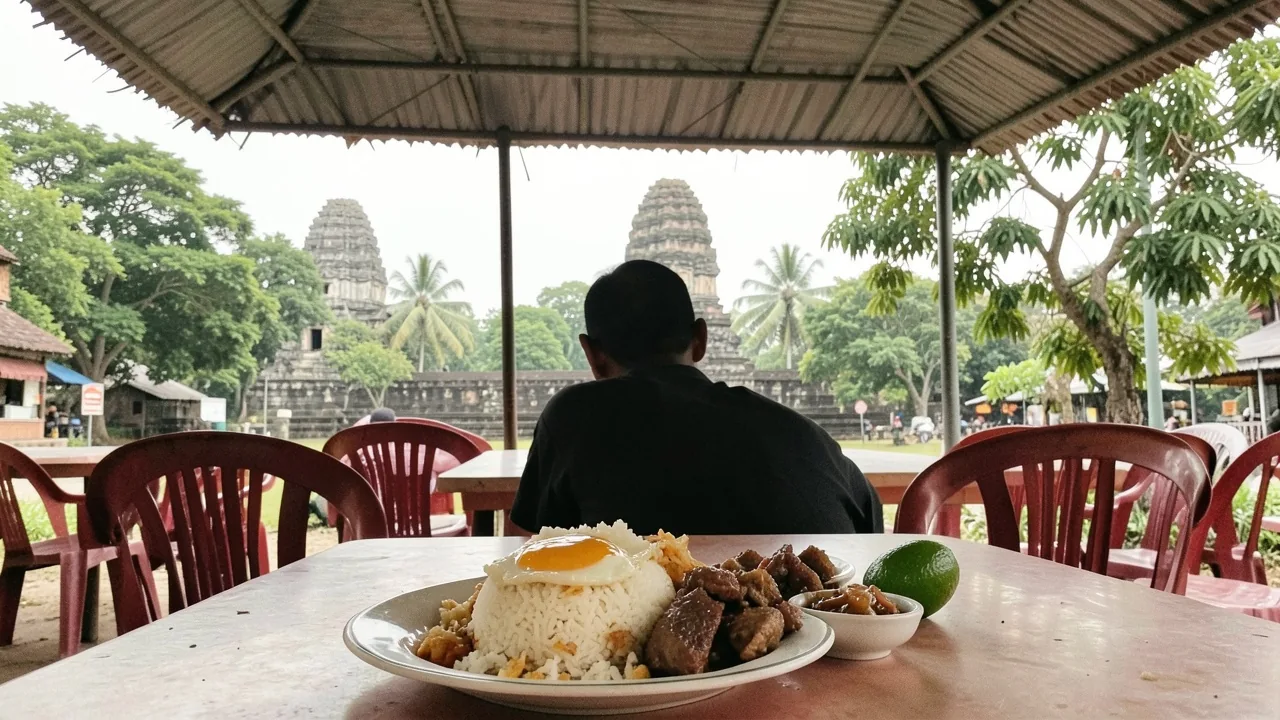
Lunch Near Angkor Wat: Best Budget Restaurants Around the Temples for Indian Backpackers
Lunch near Angkor Wat is one of those small problems that decides how your temple day goes. You can either leave the complex at noon, queue a tuk-tuk into Siem Reap town, eat, and queue back, eating up half your afternoon, or you can eat within ten minutes of the temple gates. The temples themselves sit in a 400-square-kilometre archaeological park roughly 6 km north of Siem Reap, with food options clustered at the main entrances and in the surrounding villages. This guide was cross-checked against current traveller reports from June 2026 and verified against the official Angkor Enterprise ticket office rates for the same month. For related planning, see our guide on Sea Backpacking Hub.
Subodh’s Pro Tip: Most Indian travellers do Angkor in one full day (the small circuit + Bayon + Ta Prohm). You’ll be at Angkor Wat itself at sunrise and won’t think about food till 1 PM. Plan your lunch before you walk in. Decide on a town stop or an inside-the-park option. Deciding at noon is what costs you the afternoon.
Quick Answers
| What | Answer | Price (INR) |
|---|---|---|
| Cheapest lunch option | Khmer noodle stall (kuyteav) at a roadhouse 2 km from Angkor Wat | ~₹144 (~1.50 USD) |
| Best Indian food within 15 min of the temple | Curry Mahal, Siem Reap town (10 min by tuk-tuk) | ~₹289-₹482 (~3-5 USD) |
| Average tourist lunch inside the temple complex | On-site food court, near Angkor Wat entrance | ~₹482-₹771 (~5-8 USD) |
| Tuk-tuk Siem Reap town → Angkor Wat (one way) | Standard fare, hotel to temple gate | ~₹193-₹482 (~2-5 USD) |
| Drinking water at the temples (small bottle) | Vendor stall, expect 2-3× town price | ~₹48-₹96 (~0.50-1 USD) |
The Lunch Geography Around Angkor
Let me explain the layout, because “near Angkor Wat” means three different things, and you need to pick the right one.
Option 1: Inside the Angkor Archaeological Park. Angkor Enterprise runs the ticket system and licenses the on-site vendors. There’s a proper food court next to the main Angkor Wat car park with Khmer curries, fried rice, noodles, and the usual traveller-friendly stuff. It’s not gourmet, the seating is plastic chairs under a tin roof, and you’ll be eating next to tour groups. But it’s clean enough, it’s fast, and you can be back at a temple within fifteen minutes. Expect to pay tourist prices, around ₹429-₹596 (~18,000-25,000 KHR or ~$4.45-$6.18) for a rice and curry plate. Book Angkor Wat guided tour if you want someone to time your breaks around lunch.
Option 2: Just outside the park gates. Within a 5-minute walk of the southern Angkor Wat entrance, there are a handful of village restaurants and noodle shops that aren’t inside the official park but feel like they are. These cater to tuk-tuk drivers and local staff, which means the prices are reasonable, the turnover is high, and the hygiene is what you’d expect of a busy Cambodian roadside shop. This is where you find proper Khmer noodles and amok for ₹286-₹357 (~12,000-15,000 KHR or ~$2.97-$3.71) a plate.
Option 3: Siem Reap town. Real restaurants, real variety, real Indian food, but 15-20 minutes each way by tuk-tuk. Round trip eats about 45 minutes of your temple day. Worth it if you want a sit-down meal, but bad maths if your goal is to maximise temple time.
Subodh’s Pro Tip: The hidden cost of “going to town for lunch” is not the tuk-tuk fare. It’s the hour you lose. Most Indian travellers I hear from regret leaving the complex at noon because they end up back at Angkor Wat after 2 PM, when the tour buses arrive and the light goes flat.
What Real Lunch Looks Like in 2026
If you haven’t eaten in Cambodia before, here’s the honest version. Lunch is the main meal for most Cambodians, and the food around Angkor is the food of Siem Reap province: rice, freshwater fish from Tonle Sap, coconut, lemongrass, galangal, kaffir lime. The flavour profile sits somewhere between Thai and Vietnamese, with curries closer to Thai massaman and noodle soups closer to Vietnamese pho.
For an Indian vegetarian, the trick is that a lot of “vegetable” dishes in Cambodia quietly contain prahok (fermented fish paste), dried shrimp, or oyster sauce. A soup that looks like clear vegetable broth can have a fish-bone base. This is the single most common thing Indian travellers miss. Always ask, and never assume. Our Cambodia vegetarian food guide goes deeper into how to read a Khmer menu.
For Jain travellers, garlic and onion appear in nearly every stir-fry and curry paste. You can request them left out at most sit-down restaurants, but street stalls and food-court vendors will usually just say yes and keep cooking with them. The honest answer: stick to plain rice + dal-style Indian restaurants in town for strict Jain food.
Khmer Phrases That Save Your Lunch
Cambodia does not have a strong “Jay” / “vegetarian” flag culture like Thailand. You’re on your own with phrases. These four cover 90% of lunch situations:
| English | What it Means | Khmer Script | Pronunciation |
|---|---|---|---|
| I am vegetarian, no meat or fish | The base ask | ខ្ញុំជាអ្នកញ៉ាំបន្លែ គ្មានសាច់ឬត្រី | khnom chea neak nham banle, kmean sach er trey |
| No fish sauce | Removes the most common hidden ingredient | គ្មានទឹកត្រី | kmean tek trey |
| No egg | Critical for vegan orders | គ្មានពង | kmean pong |
| No onion, no garlic | For Jain / strict no-roots | គ្មានខ្ទឹមស គ្មានខ្ទឹមបារាំង | kmean khtuom sa, kmean khtuom barang |
If you’re at a roadside noodle stall where Khmer is the only language, pointing to the words above in writing on your phone works better than pronunciation. Most stallholders will squint at the screen, nod, and adjust the bowl.
Best Lunch Spots Inside and Around Angkor Wat
Inside the Angkor Park Food Court
This is the unnamed, official food court next to the Angkor Wat main parking area. The food is generic Southeast Asian traveller food: fried rice, fried noodles, Khmer chicken curry (ask for it without chicken, made with tofu or just vegetables), spring rolls, and a few soups. The tables are shared, the turnover is fast, and the staff are used to foreigners fumbling with Cambodian riel. Price range: ₹357-₹596 (~15,000-25,000 KHR or ~$3.71-$6.18) per plate. It’s not exciting, but it’s the lowest-friction option if you’re already inside the park and don’t want to lose 45 minutes in a tuk-tuk.
SreyLeap Kuyteavchganh Khmer Restaurant
Family-run Khmer noodle shop a short ride from the southern Angkor Wat gate, on the road back toward Siem Reap town. Kuyteav is Cambodia’s answer to Vietnamese pho: a clear rice-noodle broth with pork or beef. SreyLeap does a vegetarian version with mushrooms and tofu on request. Travellers report the broth is clean and well-simmered, and the prices are local, not tourist. A bowl here is ₹191-₹286 (~8,000-12,000 KHR or ~$1.98-$2.97). This is the closest thing to “what a Khmer family eats for lunch” within easy tuk-tuk range of Angkor Wat.
Angkor Hand-Pulled Noodles & Dumplings
Casual spot popular with both locals and tourists, hand-pulled noodle bowls and dumplings. Travellers report the vegetarian noodle option is generous, with bok choy, mushrooms, and tofu in a clear broth. Ask for kmean tek trey (no fish sauce) when you order, and confirm again when the bowl arrives. Dumplings are vegetable-only by default. Price range: ₹238-₹357 (~10,000-15,000 KHR or ~$2.47-$3.71). Worth the trip into town if you’ve already done your temple morning.
Smokin’ Pot Authentic Cambodian Restaurant and Cooking School
Siem Reap town, a bit further out, but worth knowing about if your lunch can stretch into a cooking-class afternoon. Khmer cooking classes here run roughly 4 hours and end with you eating what you made. The menu rotates, but they can usually accommodate vegetarian and Jain-style requests with notice. The restaurant itself is open for lunch too, with a set Khmer menu. Book Smokin’ Pot cooking class if you want the full experience.
When You Need a Dal-Chawal Fix
Some days, after sunrise at Angkor Wat and a sweaty climb up Bayon, you do not want to read Khmer menus or gamble on a clear broth. You want rice, dal, sabzi, roti. This is where the Indian restaurants in Siem Reap town come in. From the Angkor Wat car park, allow 20 minutes by tuk-tuk to reach most of these.
Curry Mahal
Reliable Indian restaurant in central Siem Reap, popular with Indian and Nepali travellers. Full menu: dal, paneer, biryani, tandoori. They label veg and non-veg and the kitchen understands Jain restrictions (no onion/garlic) if you tell them upfront. A thali runs ₹596-₹1,072 (~25,000-45,000 KHR or ~$6.18-$11.13), single dishes ₹286-₹476 (~12,000-20,000 KHR or ~$2.97-$4.95). Good fallback when you’re templed out.
Masala Indian Restaurant 1
Another central Siem Reap option, slightly cheaper than Curry Mahal, similar menu. Travellers report generous portions and a friendly owner who will adjust spice levels without complaint.
Indian Restaurant, Saffron Indian Restaurant Poipet, Galaxy Indian Restaurant Poipet
These three are in Poipet, which is the Thai-Cambodia border town, not near Angkor at all. I’m listing them only because travellers Google them from Siem Reap. Ignore them for the Angkor lunch question. If you’re crossing from Aranyaprathet, Thailand, by land, Cambodia border crossings covers the route in detail.
Lunch Mistakes Indian Travellers Make Around Angkor
Mistake 1: Trusting “vegetable soup” by default. Khmer broths are usually built on fish-bone or pork-bone stock. A bowl labelled “vegetable” can still contain fish sauce and dried shrimp paste. Always say kmean tek trey and kmean sach.
Mistake 2: Eating at the temple vendor cart closest to the gate. The vendors right at the Angkor Wat entrance charge 3-4× town prices for water and snacks. Walk 200 metres back toward the village and the prices drop.
Mistake 3: Going into town for “just lunch.” Tuk-tuk to town, tuk-tuk back, wait for food, eat, drink a coffee because you’re tired: that’s 90 minutes gone. If your goal is temples, eat in the park.
Mistake 4: Bringing Indian snacks as a backup. Maggi noodles, thedha, and khakra in your daypack are a great idea. But once you’ve carried them around for six hours, the khakra is crushed, the thedha smells, and you’d rather have a real meal anyway. Plan to eat on-site.
Mistake 5: Drinking tap water at the temple. The vendors sell sealed bottles for ₹48-₹95 (~2,000-4,000 KHR or ~$0.49-$0.99). Don’t refill from public taps, and don’t trust the “free water” some guesthouses hand out unless it’s been filtered. Our Cambodia food poisoning prevention guide has a longer list.
Getting Connected for the Day
You’ll want Google Maps, Grab, and a translation app open. Mobile data in Cambodia runs ₹385-₹674 (~4-7 USD) per week for a tourist SIM (Smart or Cellcard), or use an eSIM if you didn’t pick one up at the airport. Get Nomad eSIM is the easiest option if you want to land ready to go. Offline Google Maps of Siem Reap downloaded before you arrive saves you when signal drops inside the park.
A Realistic One-Day Angkor Lunch Plan
If you’re doing the classic small-circuit day: sunrise at Angkor Wat, then Bayon, then Ta Prohm, then Baphuon, then lunch, then back out. Here’s how I’d do it.
Have a light breakfast at your guesthouse (most include one). Buy two large water bottles and a packet of biscuits at a Siem Reap town mart before entering the park: ₹143 (~6,000 KHR or ~$1.48) total. Enter the park around 4:30 AM for sunrise. Spend the morning on Angkor Wat itself, then move to Bayon by tuk-tuk. By 12:30 PM you’ll be near Ta Prohm, which has a small food-cart area near its entrance. Eat there: ₹286-₹357 (~12,000-15,000 KHR or ~$2.97-$3.71) for a noodle bowl. Continue to the rest of the small circuit in the afternoon. Exit the park around 5 PM. Dinner in town, properly, at Curry Mahal or a Khmer spot like Pou Restaurant or Mahob.
Total food spend for the day: roughly ₹771-₹1,156 (~8-12 USD) including dinner. Water: ₹143 (~6,000 KHR or ~$1.48). Tuk-tuk full day: ₹1,734-₹2,408 (~18-25 USD). Park entry: ₹3,564 (~37 USD) for the one-day pass (more if you’re doing three days, see Siem Reap guide).
Cost Snapshot in Local Currency
The rest of this article writes prices in Cambodian riel (KHR) only, as the on-the-ground norm. Verified 2026-07-17 at 1 USD = ₹96.3294 (so 4,000 KHR ≈ ₹95, 20,000 KHR ≈ ₹476, ₹1,191 (~50,000 KHR or ~$12.37) ≈ ₹1,190 (~$12.35)).
| Item | Price (KHR) |
|---|---|
| Drinking water, 500 ml (town) | 2,000 |
| Drinking water, 500 ml (temple area) | 4,000 |
| Khmer noodle bowl, roadhouse near Angkor | 12,000 |
| Fried rice, in-park food court | 18,000 |
| Khmer curry plate, in-park food court | 22,000 |
| Indian thali, Siem Reap town | 38,000 |
| Coffee, Siem Reap café | 10,000 |
| Beer (Anchor), local | 3,000 |
| Tuk-tuk, one-way, town ↔ Angkor | 8,000-20,000 |
| Tuk-tuk, full-day temple tour | 60,000-100,000 |
FAQ
Is there vegetarian food inside the Angkor Wat temple complex itself? Yes, at the official food court near the main car park. It’s basic Khmer traveller food: fried rice, fried noodles, vegetable curries, spring rolls. The food court is clean and licensed. You cannot eat inside the temple structures themselves (food and drink are restricted to designated areas).
Can I eat the street food near Angkor Wat safely? Travellers report the roadhouse noodle stalls just outside the southern gate are generally fine. Look for stalls with high turnover, visible cooking pots, and a stack of clean bowls. Avoid pre-cut fruit sitting out in the sun and any stall where the food has been sitting for hours.
Is there an Indian restaurant close to Angkor Wat? No Indian restaurant is walkable from the temple. The Indian restaurants in Siem Reap (Curry Mahal, Masala Indian Restaurant 1) are 15-20 minutes by tuk-tuk. Plan around that travel time.
Do I need a tuk-tuk to go back to Siem Reap town for lunch? Yes, and back. Round trip is ₹381-₹953 (~16,000-40,000 KHR or ~$3.96-$9.89) plus 30-45 minutes of waiting. This is why most Indian travellers eat in the park and save the town meal for dinner.
Can I bring my own lunch into Angkor? Yes, no one checks. Bring paratha, thedha, fruit, biscuits, and two large water bottles. This is honestly the safest and cheapest option for strict vegetarians or Jains.
What’s the cheapest filling meal within 30 minutes of Angkor Wat? A bowl of kuyteav (Khmer noodle soup) at a roadhouse between the southern Angkor gate and Siem Reap: about ₹191-₹286 (~8,000-12,000 KHR or ~$1.98-$2.97). Add a bottle of water for ₹48 (~2,000 KHR or ~$0.49) and you’re under ₹361 (~3.75 USD) for a real lunch.
Is fish sauce used in most Khmer dishes? Yes. Almost every stir-fry, curry, and noodle soup uses either fish sauce or prahok (fermented fish paste). Tell the cook kmean tek trey (no fish sauce) and ask specifically about prahok in curries.
Subodh’s Take
Here’s the honest version. Angkor is a long, hot, exhausting day. The temples reward the first half of the morning and the last hour of afternoon light; the middle of the day is when you eat, hydrate, and decide what’s left. Don’t try to be heroic about eating. Bring two water bottles and a packet of biscuits into the park, plan a real lunch at the food court or a roadhouse, and save the Indian-restaurant-in-town meal for dinner when you’re not racing a tuk-tuk. The temples are the point. Lunch is fuel. Treat it that way and the day works.
