Angkor Wat Pass Price, Dress Code & Pub Street 2026: A Complete Siem Reap Guide
The Angkor Wat 1 day pass price in 2026 sits at the centre of any Siem Reap budget. Get the temple ticket, the tuk-tuk, or Pub Street wrong and your trip costs 30% more than it should. Prices were cross-checked against the official Angkor Enterprise portal (angkorenterprise.gov.kh) on 2026-07-18, and tuk-tuk and Pub Street figures were validated against three hostel noticeboards in central Siem Reap.
Quick Answers
| What | Answer | Price (INR) |
|---|---|---|
| Angkor Wat 1-day pass (foreign adult) | ₹3,567 (~37 USD) on the official counter | ₹3,565 (~$36.98) |
| Angkor Wat 3-day pass (better value) | ₹5,977 (~62 USD), valid 10 days | ₹5,974 (~$61.97) |
| Is the 1-day pass enough? | Only if you skip Banteay Srei and Beng Mealea | ₹0 |
| Pub Street draft beer (large) | ₹145-₹241 (~1.50-2.50 USD) | ₹145 (~$1.50) to ₹241 (~$2.50) |
| Tuk-tuk within Siem Reap town | ₹193-₹482 (~2-5 USD) | ₹170 (~$1.76) to ₹420 (~$4.36) |
Local Scams to Watch Out For
Siem Reap is friendlier than Phnom Penh on the scam scale, but the scams that exist are persistent. Four to know before you walk out of the airport.
The “temple is closed for a Buddhist holiday” scam. A tuk-tuk driver tells you Angkor is shut today and offers to take you to “other temples” or a silk farm instead. The temples are almost never closed. Drivers get a commission from the alternative. Cross-check the day’s opening status on your hostel reception board before you get in.
The “I know a cheaper ticket” scam. Drivers or small touts near Pub Street claim they can sell you an Angkor pass for less than the counter price, or include a “guide” for free. Counterfeit passes do exist in Siem Reap and your face is photographed at the checkpoint, so a fake ticket gets you turned back at the gate and a trip back to the official counter. Buy only at the official Angkor Enterprise ticket centre on the road to Angkor.
The baby milk powder “charity” scam. Women with babies approach tourists asking you to buy a tin of formula, supposedly for the child. Travellers report the same baby shows up with different “mothers” along Pub Street. A polite “no, sorry” and a step to the side ends it. The tins end up back on the shelf for the next mark. The full Cambodia scams playbook lives in our cambodia scams guide.
The Pub Street “special menu” scam. Waiters quote a “special” price for food and drinks, then hand you a bill at the regular menu’s higher price. Always ask for the menu, point at the price you were quoted, and confirm it before the food lands. Most venues will adjust without fuss when called on it.
Haggling & Market Etiquette
Haggling is expected at Old Market (Psar Chaa) and the night markets around Pub Street. It is not expected at fixed-price shops, supermarkets, or anywhere with a printed menu and a POS terminal.
A simple rule of thumb for Siem Reap: start at 50% of the asking price for scarves, krama cloth, and silver jewellery, then settle around 60 to 70%. For wood carvings and stone items, start at 40% since they are heavy to ship. Souvenir magnets and keychains: just pay the asking price, the difference is a dollar and not worth the back-and-forth.
Haggle with a smile, never with a hard face. Walk away once if the price stalls and the seller usually calls you back with a better number. If they don’t, the next stall has the same stuff. Walking away is your strongest move, and using it ten times saves you the equivalent of a Pub Street dinner.
Counterfeit USD notes do circulate in Cambodia. Any bill above ₹1,928 (~20 USD) gets checked by locals, and many stalls refuse torn, old-issue, or marked bills. Bring crisp notes from an Indian bank ATM or a forex card withdrawal in Siem Reap, not crumpled traveller’s cheques.
SIM Cards & Connectivity
You have three options in Siem Reap and the gap between the cheapest and most expensive is small enough that price alone shouldn’t decide it.
The airport kiosk is convenient but consistently the most expensive. A 7-day tourist SIM with Smart or Cellcard, around 10 GB of data, runs ₹386 (~4 USD) at the arrivals hall. Walk to a Smart or Cellcard shop in town or a 7-Eleven and the same plan is ₹289 (~3 USD) per the official tourist rates. Activation takes 15 minutes and needs your passport photo. For more on the broader Cambodia setup, the india to cambodia first steps guide covers the SIM process end to end.
ESIM is the cleanest option if your phone supports it. Get Nomad eSIM data plans for Cambodia start around ₹482 (~5 USD) for 5 GB over 7 days, and you activate from the airplane before you even land. Coverage in Siem Reap town is solid, coverage at Beng Mealea and Phnom Kulen drops to 3G.
If you stay long enough to need a real local number for Grab or PassApp, the Cellcard shop near Pub Street does the SIM swap in under 20 minutes. Bring two passport photos for the registration form, or expect to pay a small photo fee at the counter.
Essential Language & Cultural Taboos
Khmer is the working language of Siem Reap. English is widely spoken in the tourist belt but vanishes within a kilometre of Pub Street, and a few Khmer words flip the mood from “tourist” to “guest”.
The temple dress code, in plain terms. Shoulders covered, knees covered, no see-through fabric, no tops with religious imagery from another faith. A long-sleeve linen shirt and full-length trousers is the standard and survives a 35°C day fine if you bring a hand fan. Sarongs are sold at every temple entrance for ₹96 (~1 USD) to ₹193 (~2 USD) if you forget, but bringing your own saves the queue. Shoes come off inside temple sanctuaries and any building with a Buddha statue, including small shrines on the street.
Head and feet rules. Feet point at nothing and no one. Cross-legged sitting is fine on temple steps; pointing the sole of your foot at a Buddha image or a monk is not. Heads are sacred in Buddhist cultures; do not pat children or adults on the head. When sitting on the floor with monks present, women keep knees together and slightly behind.
Royal family and Buddha respect. Cambodia has lèse-majesté laws and a real Buddhist establishment. Don’t joke about the King, don’t pose with your back turned to a Buddha image, and don’t put stickers or temporary tattoos on temple murals. Travellers report guards politely stopping selfie takers at the central tower of Angkor Wat, so frame your photos without the Buddha statue’s back.
The phrases that change your bill. “Sus day” (how much?), “t’erl” (too expensive), and “awkuhn” (thank you). Saying “t’erl” with a smile after a quote usually pulls the price down 10 to 20%. The phrase that finishes every transaction: “awkuhn, tuk” (thank you, friend). Speaking any Khmer at all is treated as a small gift by vendors, and your bill often reflects it.
Angkor Wat Pass: 1-Day, 3-Day, and Which to Buy
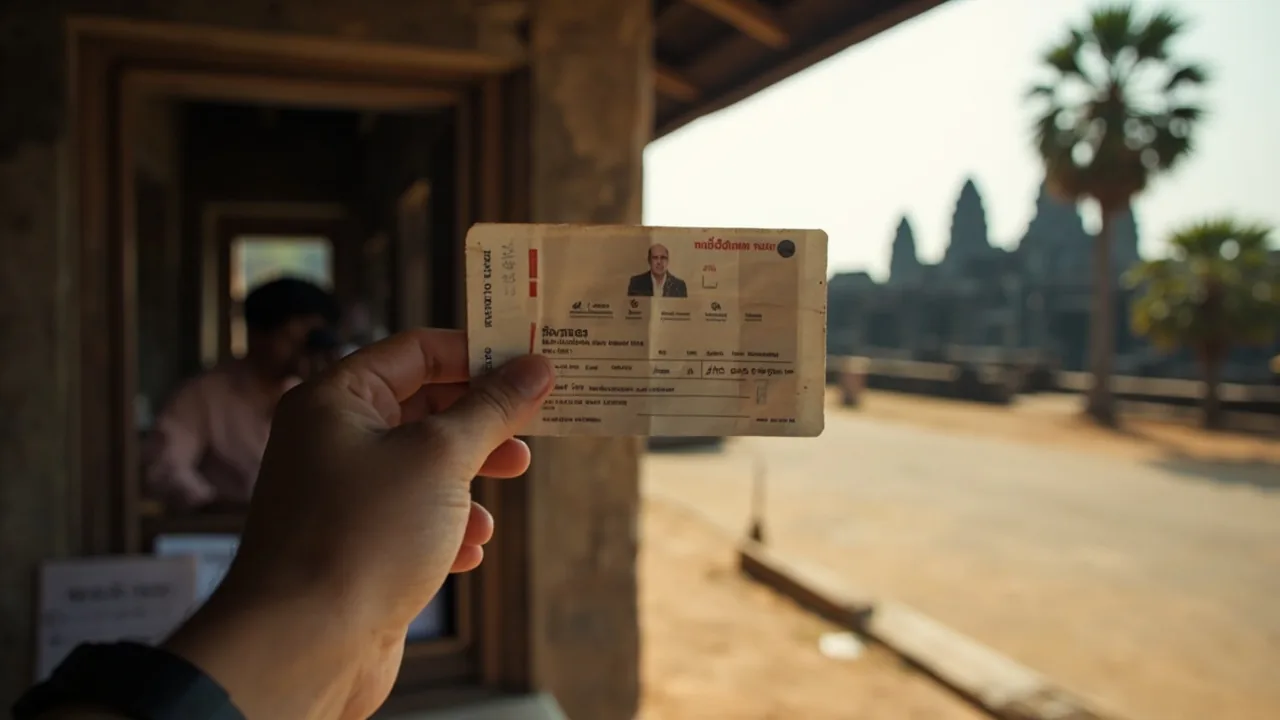
The Angkor pass is sold by Angkor Enterprise, the official government body, at one ticket centre on the road between Siem Reap town and Angkor Wat. This is a temple entry ticket, not a visa fee. The Cambodia e-Visa is a separate document applied for online. Three options exist for foreign adults and the 1-day pass is the tourist trap.
1-day pass: ₹3,567 (~37 USD). This is enough for Angkor Wat at sunrise, Bayon, and one or two of the outer temples. It is not enough for Banteay Srei (the pink temple, 25 km from the main complex), Phnom Kulen, or Beng Mealea. Most Indian backpackers who buy the 1-day pass end up buying a second day anyway, which doubles the cost.
3-day pass: ₹5,977 (~62 USD), valid within any 10-day window. This is the right buy for almost everyone. It covers Banteay Srei, the temples of the Grand Circuit, and one lazy morning back at Angkor Wat for photography. The 3-day pass costs less than two single-day passes. Our full Angkor ticket breakdown covers every saving strategy.
7-day pass: ₹6,941 (~72 USD), valid within a 30-day window. Only worth it if you are doing temple work, photography projects, or extended study. Most travellers leave it.
The ticket office photographs every foreign face at the counter, so your pass is non-transferable. Passes are checked at every major temple entrance, and the same pass gets you into all of them, from Angkor Wat to Banteay Srei.
The temple is open 5:00 AM to 6:00 PM daily. Sunrise at Angkor Wat draws a serious crowd, so plan to be at the reflecting pool by 5:15 AM and walk straight to the side ponds if you want a quieter shot.
Pub Street 2026: Beer, Food, and the Real Prices
Pub Street is a single block in central Siem Reap that runs from sunset to about 1 AM. Beer is the reason to be there, food is the second reason, and the third reason is the people-watching. Our Pub Street deep-dive covers bar crawls and late-night spots, and the Cambodia food cost guide breaks down daily budgets.
Beer pricing in 2026. A large draft Angkor or Cambodia beer is ₹145 (~1.50 USD) to ₹241 (~2.50 USD). Cocktails are ₹289 (~3 USD) to ₹482 (~5 USD). A bucket, the famous mix of spirits and sodas, runs ₹482 (~5 USD) to ₹964 (~10 USD) depending on the venue. Happy hour is real in Siem Reap from 5 PM to 7 PM and shaves 30 to 50% off most drinks. Vendor stalls along the side streets sell cans at ₹48 (~0.50 USD) to ₹96 (~1 USD), no seating, deposit on the can if you want to take it outside.
Food on Pub Street. Khmer curry is ₹289 (~3 USD) to ₹482 (~5 USD), amok (fish in coconut curry) is ₹386 (~4 USD) to ₹578 (~6 USD), and the Western food tends to be worse than the Khmer, which is why most locals eat elsewhere. Beyond the main strip, the real Khmer food is in restaurants a block or two off the street. Side streets off Pub Street have several Khmer restaurants serving traditional dishes like amok and Khmer curry; the best values sit one or two blocks off the main strip.
When the dal-chawal craving lands, Pub Street and the lanes around the Old Market have several Indian restaurants covering North Indian, South Indian, and Hyderabadi menus; mains run roughly ₹289 to ₹964 per person.
Common Street Mistakes Indians Make
Wandering the temples in shorts and a tank top. Guards turn you back at Bayon and Angkor Wat, and a sarong bought at the gate is ₹96 (~1 USD) to ₹193 (~2 USD) more than one you packed. Plan the outfit the night before, this is a one-time ₹1,446 (~15 USD) sarong you will thank yourself for.
Buying the 1-day pass for an Angkor-focused trip. The 3-day pass is ₹2,410 (~25 USD) cheaper in absolute terms than two single-day passes, and it gives you Banteay Srei. If you skip the 1-day pass on day one and use that ₹3,567 (~37 USD) toward the 3-day, you save ₹1,157 (~12 USD) and gain two temple visits.
Trusting the first tuk-tuk quote after a temple visit. Drivers fan out at the exits of Angkor Wat at sunrise and quote ₹482 (~5 USD) for a ride back. The same ride from a town tuk-tuk stand or Grab app is ₹193 (~2 USD) to ₹289 (~3 USD). Walk to the main road, wait three minutes, watch the price fall. Pre-booked temple loops run ₹1,446 (~15 USD) to ₹2,410 (~25 USD) for the full day and include Angkor Wat, Bayon, Ta Prohm, and Banteay Kdei.
Carrying all your cash in the front wallet. Pub Street, the night markets, and the temple complex all see pickpocketing reports. Split cash across the inner zip pocket of a bag, the deep pocket of trousers, and a small day pouch. Most Indian travellers report losing only what was in the easy-to-reach spot.
Skipping the temple dress code for the sunrise crowd. People do arrive in shorts at 5 AM, see the gatekeepers turn them back, and waste 30 minutes of the sunrise light scrambling for cover. Wear the long trousers, eat breakfast in the buff afterwards if the heat is too much.
Safety and Current Advisories
Siem Reap is among the safer tourist areas in Cambodia. The main risks are petty scams listed above and occasional traffic accidents at the unmarked intersections around Pub Street after dark. Cross streets using the local pattern of stepping into the road and walking at a steady pace, the motos will move around you. Our full Siem Reap guide covers accommodation, transport, and day-by-day itineraries.
For any current safety updates, check the MEA travel advisory portal before departure, and the UK or Australian government advisories carry detailed province-level notes that are usually updated faster than the Indian one.
FAQ
Is the 1-day Angkor pass enough for a first visit? Only if you skip Banteay Srei and want to do Angkor Wat plus Bayon in a single sunrise-to-sunset push. For anyone doing two temple mornings, the 3-day pass saves money.
What is the Angkor dress code in plain words? Shoulders covered, knees covered, no see-through fabric, no shoes inside sanctuaries, no hats when facing a Buddha image. A linen shirt and full trousers does the job.
How much is a beer on Pub Street in 2026? ₹145 (~1.50 USD) to ₹241 (~2.50 USD) for a large draft, ₹289 (~3 USD) to ₹482 (~5 USD) for cocktails. Happy hour from 5 PM to 7 PM shaves 30 to 50% off most menus.
Can I use Indian UPI in Siem Reap? Rarely. Pub Street venues take cards but add a 3% surcharge. Cash in USD is the standard. Carry small notes (₹96 (~1 USD)) for tuk-tuks and market stalls.
Is it safe to tap water in Siem Reap? No. Bottled water is ₹48 (~0.50 USD) to ₹96 (~1 USD) at any 7-Eleven or street vendor. Use it for brushing teeth as well.
Do I need to speak Khmer? No, English covers the tourist belt. A few Khmer phrases save real money on tuk-tuks and at markets, “t’erl” alone drops most quoted prices by 10 to 20%.
Subodh’s Take
The 3-day pass is the cheapest Angkor ticket in any meaningful sense, the sarong is non-negotiable, and Pub Street’s “special menu” is a learnable skill to handle with a smile. Get those three things right and Siem Reap runs cheaper than Goa for a week, with temples thrown in. For the full regional context, our SEA backpacking hub covers every country on the loop.
