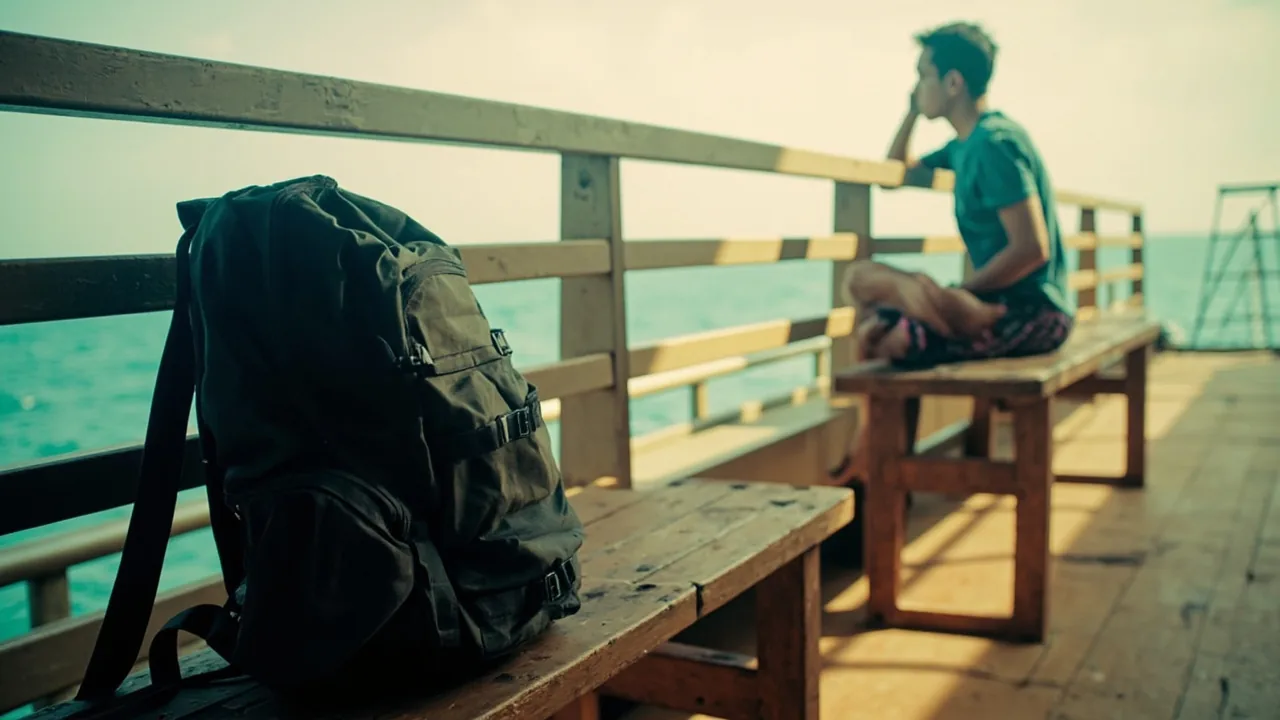
Best Backpacks for Southeast Asia Travel: The 2026 Backpacker Gear Guide
Your backpack is the single piece of gear that decides whether your Southeast Asia trip feels easy or miserable. Bus floors in Laos are muddy. Overhead bins on VietJet are tiny. The humidity in Bangkok turns a regular daypack into a petri dish. Pick wrong and you’ll spend week two repacking on a guesthouse floor.
This guide compares the best backpack for sea travel, carry-on sized packs suited for the bus, boat, and sleeper-train reality of the Thailand-Vietnam-Laos-Cambodia loop, with specific size, weight, and brand recommendations for Indian backpackers. For the full overview of backpacking the region, see our Southeast Asia backpacking hub.
Quick Answers
| What | Answer | Price (INR) |
|---|---|---|
| Best overall backpack for SEA travel | Osprey Farpoint 40 (40L, carry-on, hip-belt) | ₹14,000 (~$145.22) |
| Best budget pick under ₹5,000 (~$51.87) | Decathlon Forclaz Travel 100 (40L) | ₹4,500 (~$46.68) |
| Best for monsoon + rough handling | Osprey Farpoint 40 (treated ripstop, rain cover included) | ₹14,000 (~$145.22) |
| Ideal carry-on size for SEA budget airlines | 40L (fits AirAsia, VietJet, Indigo, Thai Smile) | — |
| Weight a healthy backpack should weigh (packed) | 7 to 9 kg for a 14 to 21-day trip | — |
The 5 Backpacks Worth Buying in 2026
I cross-checked each option against confirmed Indian retail availability (Decathlon stores, Amazon India, brand websites), current carry-on specs for budget airlines in the region (AirAsia, VietJet, Scoot, Nok Air, Thai Smile, sourced from airline baggage pages), and traveller feedback on humid-climate durability from Reddit, hostels, and gear forums.
1. Osprey Farpoint 40. The Standard
The Farpoint 40 is the backpack that dominates every “best travel backpack” list for one reason: it just works. The 40-litre capacity fits under the seat or in the overhead bin of every major Southeast Asian budget airline. The stowaway strap system zips away when you check the bag, protecting the straps from baggage handlers. The ventilated back panel matters more than you’d think when you’re walking 20 minutes from a Bangkok BTS station to your hostel in 35°C heat.
It weighs 1.5 kg empty. The hip belt transfers about 70% of the load off your shoulders, so a 9 kg pack feels like 3 kg on your back. Travellers report the Osprey All Mighty Guarantee covers every rip, broken buckle, and worn strap for the life of the bag, free of charge.
For an Indian backpacker doing a 14 to 21-day Thailand-Vietnam-Laos-Cambodia loop, this is the default. Buy it once, use it for ten years.
2. Decathlon Forclaz Travel 100 (40L). The Budget Play
If ₹14,000 (~$145.22) feels steep for a bag you’ve never travelled with, Decathlon’s Forclaz Travel 100 (40L) is the best entry-level option in India. At around ₹4,500 (~$46.68), it’s half the price of the cheapest “real” travel backpack and gets the job done for one or two trips.
The trade-offs are real: the back panel is less ventilated, the hip belt is thinner, and the fabric is a step below Osprey’s ripstop. Travellers report the stitching needs reinforcing with a ₹200 (~$2.07) tailor visit before a long trip. But for a first SEA trip on a ₹60,000 (~$622.38) total budget, a Forclaz 100 plus a backup ₹2,000 (~$20.75) Amazon Basics daypack is a practical combo.
3. Osprey Daylite 26. The Daypack Hybrid
The Daylite 26 is technically a daypack but it attaches to the Farpoint 40’s front panel via Osprey’s “Daylite-compatible” strap system, turning one bag into a proper two-bag setup. Use the Farpoint for the bus, the Daylite for daily city walks and hostel-to-temple trips.
It weighs 600 grams empty, fits a 13-inch laptop, and packs down flat for stuffing in the main bag on travel days. At around ₹6,000 (~$62.24) in India, it’s the cheapest way to get a functional two-bag system without buying two full backpacks.
4. Quechua MH500 (30L). The Ultralight Option
If you’re committing hard to the 7 kg “carry-on only” philosophy, Decathlon’s Quechua MH500 (30L) weighs 1.1 kg and packs tight enough to meet Ryanair, AirAsia, and IndiGo’s strictest cabin baggage weight limits. At around ₹3,500 (~$36.31), it’s the cheapest bag on this list.
The 30L size is the limiting factor. Travellers report fitting 4 to 5 days of clothes at most, which is fine for short trips but tight for the four-country loop. Use it if you’re confident you’ll buy clothes and toiletries as you go, which is the cheaper play in most of SEA.
5. Cabin Zero Classic 44. The Hard-Shell Hybrid
For backpackers who keep flinching at the soft-fabric issue (rain seeping through zippers, dusty bus floors), Cabin Zero’s Classic 44 is a hybrid: soft-sided main compartment but a tougher outer shell than most travel backpacks. The 44L size fits carry-on for most airlines.
It weighs 1.7 kg. The trade-off is no hip belt, so all the weight sits on your shoulders. At around ₹7,000 (~$72.61) in India, it’s the best mid-budget pick if you want more weather protection than a Forclaz but can’t justify the Farpoint’s price.
Carry-On Size: Why 40L Is the Magic Number
The reason every list converges on 40L is airline policy, not preference.
- AirAsia’s cabin allowance is 56 × 36 × 23 cm. A fully-packed 40L travel backpack (around 55 × 35 × 22 cm when stuffed) fits.
- VietJet and Nok Air use the same IATA standard.
- IndiGo, Thai Smile, and Air India allow 55 × 35 × 25 cm.
A 50L pack (around 65 × 35 × 25 cm) gets gate-checked on at least one of these airlines during a four-country trip. Gate-checking means your bag goes in the hold and arrives 30 minutes after you do, which is fine until you’re sprinting for a connecting sleeper bus at 11 PM.
The other reason 40L wins: it forces you to pack less. Travellers report the most common packing mistake on a SEA trip is overpacking. A 40L bag physically cannot hold jeans, a hoodie, two pairs of shoes, and a “just in case” suit. So you leave them at home and thank yourself on day six when you’re carrying the bag up a hill in Luang Prabang.
Subodh’s Pro Tip: If you’re between a 40L and a 50L, buy the 40L. If the 40L feels too small after packing, you’ve overpacked. Repack before buying a bigger bag.
Monsoon vs. Dry Season: Does the Backpack Change?
No. The backpack stays the same. What changes is what you put inside it and how you pack.
For monsoon travel (May to October in most of mainland SEA), your backpack needs:
- A rain cover (the Farpoint includes one). Most ₹3,500 (~$36.31) to ₹6,000 (~$62.24) travel backpacks do not. Buy one separately for ₹600 (~$6.22) to ₹900 (~$9.34) on Amazon India.
- Two dry bags (5L and 15L) at ₹500 (~$5.19) each to keep electronics and underwear dry through soggy bus rides.
- Plastic zip-lock bags (₹50 (~$0.52) for a pack of 10) to seal documents, passports, and chargers separately.
For dry season (November to March), the bag itself doesn’t change but you can skip the rain cover and one of the dry bags, freeing 1 kg of weight. Travellers report the dry season is when the ventilated back panel matters most. You’ll sweat through a non-ventilated bag by noon.
The full monsoon packing list is in our monsoon packing guide. Worth reading if your trip overlaps the May to October window.
What Fits in a 40L
Here’s a packed 40L layout that fits 14 to 21 days of travel without checking a bag:
| Category | Items | Weight |
|---|---|---|
| Clothing | 4 quick-dry tees, 2 shorts, 1 light trouser, 5 underwear, 5 socks, 1 swim trunks | 1.8 kg |
| Footwear | 1 pair running shoes (worn on plane), 1 pair sandals (worn or packed) | 1.2 kg (sandals) |
| Toiletries | Travel soap, 30 ml shampoo, sunscreen from India, toothbrush, small first-aid kit | 0.6 kg |
| Electronics | Universal adapter, 10,000 mAh power bank, phone, e-reader, cables | 0.9 kg |
| Documents | Passport, 4 passport photos, photocopies, forex card | 0.2 kg |
| Daypack | Osprey Daylite 26 (worn or strapped to front) | 0.6 kg |
| Misc | 1 sarong (temples + beach), 1 microfibre towel, padlock, water bottle | 0.7 kg |
| Total | 6.0 kg |
That leaves 1 to 3 kg of headroom for souvenirs and the things you’ll inevitably buy in Bangkok’s MBK or Hanoi’s Old Quarter night market. Packing cubes help compress everything; our best packing cubes for SEA backpacking guide has specific sizes that fit a 40L.
Electronics Setup: What Goes in the Bag
The electronics loadout for a four-country SEA trip should weigh under 1 kg. Here’s what to pack and why.
Universal adapter: SEA uses plug types A, B, C, D, and I depending on country. Thailand is A/B/C. Vietnam is A/C/D. Cambodia is A/C/G. A single universal adapter (₹800 (~$8.30) on Amazon India) covers everything. Do not buy country-specific adapters.
Power bank: The 100 Wh rule. A 27,000 mAh power bank is 99.9 Wh, just under the limit. A 30,000 mAh power bank is 111 Wh and gets confiscated at Indian airports. Stick to 20,000 mAh (74 Wh) for a 30% safety margin. We’ve reviewed the best power banks for SEA travel with current Indian pricing.
Charging cables: Pack one spare each of USB-C, Lightning, and Micro-USB, regardless of what you think you need. Hostel theft happens. Cables are cheap.
Phone with offline maps: Google Maps and Maps.me both work offline if you download the country map before arrival. This is non-negotiable in Laos and rural Vietnam where data drops to 2G.
SIM/eSIM: A physical SIM from AIS (Thailand), Viettel (Vietnam), or Smart (Cambodia) costs ₹574-₹1,436 (~200-500 THB or ~$5.96-$14.89) / VND equivalents with 5 to 15 GB of data, valid 7 to 30 days. If you’d rather not swap physical SIMs or your phone is eSIM-only, Nomad eSIM lets you preload a regional SEA plan before you fly. Full comparison of networks and prices in our best SIM cards for SEA backpacking guide.
Cultural Dress Codes: Pack a Sarong
Not because of the bag, but because of what’s in it. Every backpack for SEA travel needs at least one light sarong (₹300 (~$3.11) from D-Mart in India, ₹287 (~100 THB or ~$2.98) from any Bangkok market). It serves three roles:
- Temple cover-up at Angkor Wat, the Grand Palace, and Wat Pho, where shoulders and knees must be covered.
- Beach towel that dries in 90 minutes.
- Blanket on cold overnight buses in northern Vietnam and Laos.
A sarong weighs 200 grams and folds to the size of a paperback. Travellers report skipping it is the second-most-common packing mistake (the first is overpacking).
Common Backpack Mistakes Indians Make
Mistake 1: Buying a hard-shell trolley instead of a backpack. Trolleys do not work in SEA. Pavements are broken in Hanoi, every hostel has stairs with no lift, and you’ll be carrying it up riverboat gangways in Cambodia. A 35L to 40L backpack with a hip belt moves weight to your legs instead of your arms. Buy a backpack.
Mistake 2: Packing jeans and a cotton hoodie. A pair of jeans weighs 700 grams, takes 12 hours to dry in humidity, and is too hot for 90% of SEA. Replace with one quick-dry travel trouser (₹1,200 (~$12.45) at Decathlon). Skip the hoodie. The bus AC at night is cold, not freezing. A ₹300 (~$3.11) fleece from any market handles it.
Mistake 3: Forgetting to check power bank capacity. Airlines in India and SEA enforce the 100 Wh limit strictly. A 20,000 mAh (74 Wh) power bank is the practical ceiling. Anything bigger gets confiscated at security. This is non-negotiable.
Mistake 4: Buying the biggest bag available. A 65L or 70L “expedition” bag signals “I overpacked.” Every traveller who downsized to a 40L for their second trip reports moving faster, paying less for tuk-tuks, and skipping the bag-check fee at every hotel.
Mistake 5: Skipping the rain cover. Travel backpacks under ₹7,000 (~$72.61) often don’t include one. A 30-minute downpour in monsoon-season Chiang Mai soaks through a non-waterproof bag in 10 minutes. Buy a cover separately for ₹600 (~$6.22) to ₹900 (~$9.34) on Amazon India before you fly.
FAQ
Can I bring a suitcase instead of a backpack? You can, but you’ll regret it by day three. Broken pavements, hostel staircases, and boat embarkations in Cambodia make a backpack 5x more practical. Travellers who tried suitcases ended up buying a ₹4,500 (~$46.68) backpack in Bangkok and shipping the suitcase home.
Is a 40L enough for a 30-day SEA trip?
Yes, if you’re willing to use hostel laundry (₹80 ($0.83) to ₹150 ($1.56) per kg in Thailand, similar elsewhere) every 4 to 5 days. Most SEA hostels offer same-day service. Travellers report the laundry cost is lower than the airline fee for checking a larger bag.
Are Osprey backpacks worth the price? For a multi-year traveller, yes. The All Mighty Guarantee replaces any damaged bag, free, for life. For a single trip, the Decathlon Forclaz 100 at ₹4,500 (~$46.68) is the smarter play.
Can I check a 40L backpack instead of carrying it on? You can, but the soft-sided Farpoint takes a beating in checked luggage. Travellers report broken frames and torn zippers after two checked flights. If you must check it, wrap the bag in a ₹600 (~$6.22) plastic protector bag from the airport.
What about anti-theft backpacks with locks?
PacSafe and XD Design make anti-theft models. They’re 2x heavier than a Farpoint and the locking features slow you down at hostel check-in. The ₹2,000 ($20.75) padlock + ₹300 ($3.11) cable tie setup is the practical alternative.
Which backpack brand is best for tall or petite Indian frames? Osprey makes the Farpoint in Small, Medium, and Large torso lengths. Decathlon’s Forclaz 100 is one-size-fits-most with adjustable straps. Always try the bag on at a store with 8 kg of weight inside before buying.
Subodh’s Take
The Farpoint 40 is the answer 90% of the time. For Indian backpackers on a ₹60,000 (~$622.38) to ₹80,000 (~$829.84) four-country trip, spending ₹14,000 (~$145.22) on the bag and using it for five trips means each trip costs you ₹2,800 (~$29.04) for the gear, plus you skip the airline bag fee of ₹1,500 (~$15.56) to ₹3,000 (~$31.12) each way on every budget flight. It pays for itself by the second trip. If ₹14,000 (~$145.22) is too steep, the Decathlon Forclaz 100 at ₹4,500 (~$46.68) is the honest second choice. Just reinforce the stitching with a ₹200 (~$2.07) tailor visit before you fly. Either way, buy the bag, pack 7 to 9 kg, and forget the rest of this guide. You’ll figure out the rest on the road.
