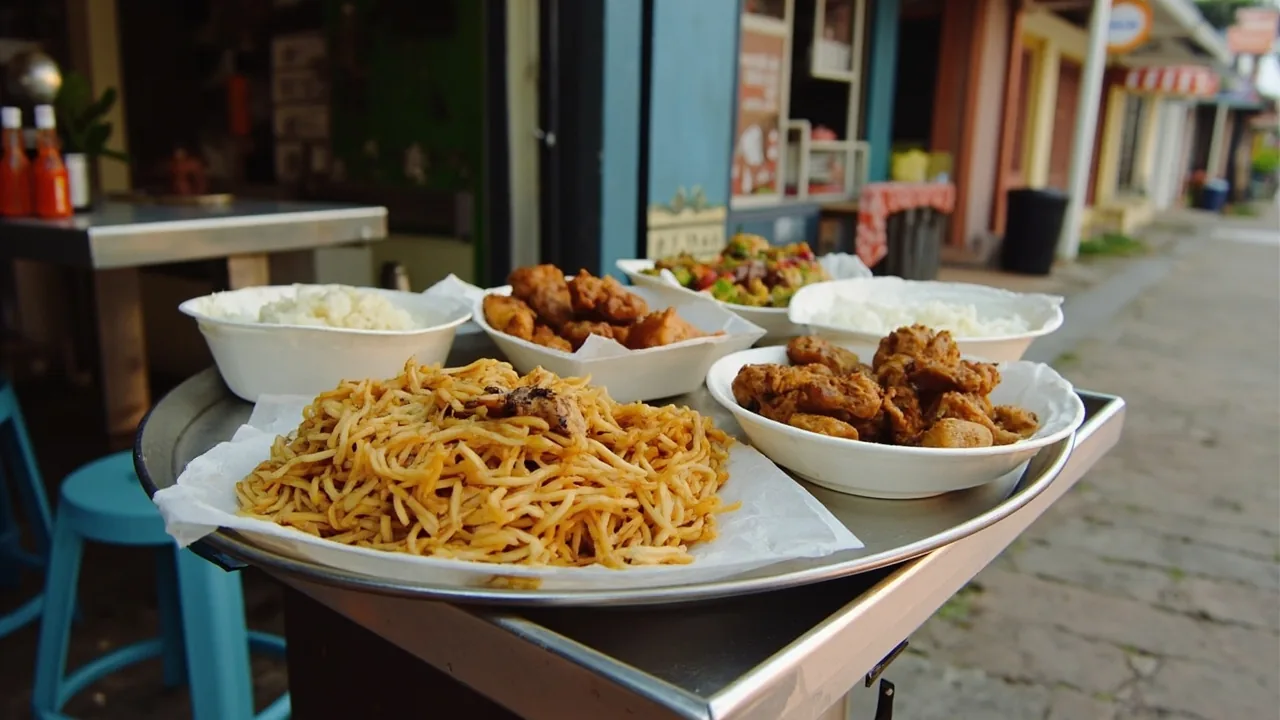
Best Food in Phuket: Beyond the Tourist Traps
`
Phuket has two food scenes. The one in the brochures (floating seafood platters, sunset cocktails, beach-club brunches) and the real one (O-tao at a wet-market stall, Hokkien noodle soup on a plastic stool, kebabs in a parking lot behind Bangla Road). This guide is about the second one. Every place below is either a real Phuket local haunt, a verified Indian fallback for vegetarians, or a market where you can graze a full dinner for ₹287 (~100 THB or ~$2.97). AIS tourist SIM at Phuket airport counter is ₹858 (~299 THB or ~$8.89) for 8 days, the same SKU at 7-Eleven is the same minus ₹57 (~20 THB or ~$0.59), which is the kind of small useful detail that separates a guidebook from a vibes piece. For related planning, see our guides on Sea Backpacking Hub and Indian Food in Chiang Dao a Budget Backpacker S Restaurant Guide.
Quick Answers
| What | Answer | Price (INR) |
|---|---|---|
| Cheapest full meal in Phuket | Local canteen rice-and-curry lunch (Local Canteen Phuket area) | ₹172 (~60 THB or ~$1.78) |
| Signature Phuket street food | O-tao (oyster omelette, Phuket’s Hokkien version) | ₹172 (~60 THB or ~$1.78) |
| Best Old Town breakfast spot | Cafe Delight Phuket Old Town | ₹344 (~120 THB or ~$3.57) |
| Indian veg/Jain fallback | Shree Ganesha 2 Pure Veg & Jain Food | ₹717 (~250 THB or ~$7.43) |
| Patong Indian meal (aloo kulcha + chole) | Amritsr Restaurant Patong | ₹581-₹1,453 (~200-500 THB or ~$6.14-$15.35) |
Note: at current rates, 1 THB = ₹2.8690, so 100 THB is about ₹287. Use that to sanity-check every baht figure below.
The Real Phuket Food Scene (and Where It Hides)
Phuket is an island, so fish is everywhere, but the food scene is Hokkien-Chinese not Thai. Phuket Town was a tin-mining port filled with migrants from Hokkien (Fujian) province in the 1600s and 1700s, and the recipes they brought with them (braised pork leg, oyster omelette, Hokkien-style fried noodles, moo hong) are still what locals eat at home. Thai food came later, and southern Thai food (turmeric, fish sauce, intense heat from bird’s eye chillies) is its own third layer.
This is why you should not eat the way you’d eat in Bangkok or Chiang Mai. The same Pad Thai stall that does well in Bangkok might be mediocre here because the local palate wants something sharper and smokier. Travellers who come to Phuket expecting Bangkok food end up eating at chains. Travellers who come expecting Phuket food end up eating O-tao, moo hong, Hokkien mee, kanom jeen, and southern Thai curries you cannot find on the mainland.
The other thing to know: Phuket’s seafood restaurants are mostly tourist markup. The same crab that costs ₹5,164 (~1,800 THB or ~$53.50) on Patong Beach Road is on the boat the morning before, and a local would never pay that. If you want seafood, go to a market like Rawai and pick your fish yourself, then pay a vendor to cook it for you (the cooking fee is usually ₹287-₹574 (~100-200 THB or ~$2.97-$5.94) per kg of seafood).
Subodh’s Pro Tip: Eat your big meal at lunch, not dinner. Phuket lunch specials at local Thai places are ₹172-₹287 (~60-100 THB or ~$1.78-$2.97). Dinner is when prices double and portions shrink.
Key Phrases in Local Script
| English Phrase | What it Means | Local Script | Pronunciation |
|---|---|---|---|
| I am vegetarian | No meat, no seafood | ฉันกินมังสวิรัติ / เจ | chan kin mang-sa-wi-rat / jay |
| No fish sauce | Fish sauce is in nearly everything | ไม่ใส่น้ำปลา | mai sai nam pla |
| No egg | Skip the egg (Jay) | ไม่ใส่ไข่ | mai sai khai |
| No oyster sauce | Critical for Jay cooking | ไม่ใส่น้ำมันหอย | mai sai nam man hoi |
| No shrimp paste | Hides in curries and fried vegetables | ไม่ใส่กะปิ | mai saikapi |
| Spicy, but not too spicy | Thai “medium” is still hot | เผ็ดน้อย | phet noi |
| Vegetarian, no meat, no fish | Triple specification | เจ ไม่เอาเนื้อ ไม่เอาปลา | jay, mai ao nuea, mai ao pla |
The single most useful word is Jay (เจ). It is a Chinese-origin Buddhist term that means fully vegan, no eggs, no dairy, and (in strict practice) no onions or garlic. Thai people understand it even if they have never seen a vegetarian in their life. If you say “gin jay” (eat vegetarian), you will be steered away from fish sauce and toward the small Jay corner of the menu that almost every decent Thai place has.
What Locals Eat: Phuket’s Signature Dishes
Most travel food guides for Phuket just say “try Pad Thai” and call it a day. That is Bangkok content recycled for the island. Here is what Phuket has that you cannot get elsewhere.
O-tao (ออซ่าว). The Phuket signature. A crispy-on-the-outside, custardy-on-the-inside oyster omelette fried in a screaming-hot pan with mung-bean batter, eggs, oysters, and sometimes pork fat. The Phuket version is heavier on the batter than the Bangkok or Hat Yai versions, almost a thick pancake around the oysters. The smell hits you from 20 metres away. Street price is ₹172 (~60 THB or ~$1.78) at a wet-market stall, double that near the beach. The version at the markets in Phuket Old Town after dark is the real one.
Moo Hong (หมูโฮ้ง). Hokkien-Chinese braised pork belly, slow-cooked in a five-spice-heavy dark soy and palm sugar broth until the pork shreds. Served over jasmine rice with a bowl of the broth on the side. Locals eat this for breakfast. It is rich, sweet, and deeply savoury at the same time. For vegetarians there is a Jay-style version at the bigger Old Town restaurants using mushrooms instead of pork, but the real thing has pork fat. There is no clean substitute.
Hokkien Mee (หมี่ฮกเกี้ยน). Stir-fried yellow noodles with prawns, squid, pork, egg, and a thick sweet soy glaze. The Phuket version is darker and sweeter than the Penang version tourists sometimes confuse it with. Not a vegetarian dish, and there is no clean Jay version.
Kanom Jeen (ขนมจีน). Fermented rice noodles served cold with a curry poured over them (usually a southern Thai fish curry or chicken curry, but Jay versions with vegetable curry exist). The toppings bar at the front of any kanom jeen stall is the thing: shredded banana flower, cucumber, long beans, pickled mustard greens, boiled egg, fish balls. Vegetarian travellers can usually negotiate a vegetable-curry base and skip the fish ball.
Pad Mee (ผัดหมี่). A stir-fried noodle dish using thinner egg noodles in a sweet-savory sauce, often with seafood or chicken. Common in Old Town. Travellers report that the Old Town spots have a stronger wok hei (smoky char) than the beach-area ones.
Kaeng Som (แกงส้ม). Southern Thai sour curry, sharp with tamarind and turmeric, usually made with fish but a vegetable version is common. It is one of the most aggressively local dishes on the island. Vegetarians should ask for the Jay version (no shrimp paste, vegetable protein).
Mango Sticky Rice (ข้าวเหนียวมะม่วง). Not a Phuket original (it is more central Thai), but you will see it everywhere because the island grows excellent mangoes. Cheap version is ₹143-₹230 (~50-80 THB or ~$1.49-$2.38) at markets; the polished cafe versions are ₹430 (~150 THB or ~$4.46). Our mango sticky rice guide breaks down which stalls on the island are worth it.
Chu-chee Pla (ฉู่ฉี่ปลา). Thick red curry paste fried with fish, an Old Town restaurant staple. Skip if you are vegetarian.
Subodh’s Pro Tip: The Pad Thai here is fine but not the point. Eat O-tao or Moo Hong instead. If a tourist menu has Pad Thai as its headline dish, that place is cooking for tourists.
Where to Eat: Old Town, Markets, Beaches
Phuket has three distinct eating zones, and each rewards a different approach. Patong is the worst of the three for honest food. Phuket Town and the Old Town walkable streets are the best. The southern beaches (Rawai, Nai Harn) have a relaxed local scene that most tourists skip.
Lao Pa Sat Phuket Town (rating 4.8). A traditional market rather than a single restaurant, and the easiest place to graze a full Phuket meal on a budget. Walk in, point at what looks good, eat at the plastic tables in the middle. You can build an entire dinner (O-tao plus a kanom jeen plus a dessert plus a fresh fruit shake) for ₹430-₹717 (~150-250 THB or ~$4.46-$7.43) per person.
Cafe Delight Phuket Old Town (rating 4.8). Quaint vintage-vibe cafe on the Old Town walk. Good for a slow breakfast, the kind of place where you order one coffee and end up spending two hours reading because the air-conditioning works and there is no rush. A meal and a coffee lands around ₹574 (~200 THB or ~$5.94).
Foodee’s Phuket (rating 4.9). Casual local-Phuket menu, the kind of place where Thai university students go. Solid kanom jeen, decent curries, well-priced. Mains in the ₹230-₹430 (~80-150 THB or ~$2.38-$4.46) range.
Local Canteen Phuket (rating 4.9). Budget canteen style, the rice-and-curry lunch option that locals eat on weekdays. Rice plus two or three dishes plus a soup for ₹172-₹230 (~60-80 THB or ~$1.78-$2.38). The most affordable meal you can find on the island.
TAPAS Cafe & Restaurant, Phuket Old Town (rating 4.8). Fusion, slightly higher-end, good for an Old Town evening. Prices lean into the ₹574-₹1,148 (~200-400 THB or ~$5.94-$11.89) range per plate.
Our Nomad Boutique & Cafe Phuket (rating 4.7). Half-Thai, half-Western menu, with a coconut curry soup that travellers specifically recommend. The kind of cafe that exists for digital nomads but does not feel exclusionary if you are not one. Mains around ₹430-₹717 (~150-250 THB or ~$4.46-$7.43).
Blue Elephant Phuket Cooking School & Restaurant (rating 4.7). The famous Bangkok brand has a branch here. Half-cooking-class, half-restaurant. Prices are higher (₹1,148-₹2,295 (~400-800 THB or ~$11.89-$23.78) per dish) but if you take the cooking class you get the meal as part of it, which is the better deal.
Phuket thailand (rating 4.7). Traditional Thai restaurant. Mains around ₹344-₹717 (~120-250 THB or ~$3.57-$7.43). The name is bad for SEO but the food gets consistent local praise.
Little Phuket (rating 4.6). Wood-fired pizza, which is not a Phuket dish but the place is run by a Thai-Italian family and gets a pass. Useful if you have been eating Thai food for a week and want a break that is not McDonald’s.
If you want to book a guided food walk instead of figuring out the Old Town on your own, See Phuket food tours on GetYourGuide lists the current options, most of which start at ₹2,869-₹5,164 (~1,000-1,800 THB or ~$29.72-$53.50) per person and last three to four hours.
Subodh’s Pro Tip: Phuket Town Sunday Walking Street (Thalang Road) is the best food event on the island every Sunday from 4pm to 10pm. It is also where the prices are honest. If you only have one food outing on the island, make it this.
The Indian Food Fallback: When You Need a Dal-Chawal Fix
Even with the phrases above, there are days when you have been out in the sun too long, eaten one too many mystery curries, and just want roti, dal, chawal, and someone who understands that paneer should not be made with oyster sauce. Phuket has more Indian options than you would expect, mostly because of the Patong-Bangla tourism cluster and the Patel-run businesses in Phuket Town.
Shree Ganesha 2 Pure Veg & Jain Food (rating 4.9). Phuket’s main pure-veg and Jain option, and the only one that takes Jain rules seriously (no onion, no garlic, no root vegetables depending on what the cook is willing to do). Family-friendly, thali-style meals. Expect to pay ₹717-₹1,148 (~250-400 THB or ~$7.43-$11.89) per person.
PAPAJI BANGKOK in Phuket (rating 4.9). On Patong Beach Road, North Indian plus Arabic menu. Biryani runs around ₹861 (~300 THB or ~$8.92) per person. Useful if you are staying near Patong and do not want to leave the beach area.
Amritsr Restaurant Patong (rating 4.9). Steps from Patong Beach. North Indian menu, aloo kulcha with chole is the reliable order. Moderate prices, family-run feel.
Amritsr Restaurant Phuket Kalim Beach (rating 4.9). Sister branch to the Patong one, on the cliffside at Kalim (the quieter beach just north of Patong). Sea view from the dining area. The signature stuffed Amritsari Kulcha is the thing to order; per-person spend ₹574-₹1,434 (~200-500 THB or ~$5.94-$14.86).
Vrindavan, Phuket (rating 4.9). The upscale Indian vegetarian option, traditional North Indian preparations, slightly pricier than the Amritsr and Shree Ganesha branches. Useful when you want a proper sit-down rather than a canteen.
Amritsr Restaurant Patong Beach Road (rating 4.8). Lively family-run spot near Patong, Punjabi menu, consistent quality.
For more across Thailand, our Indian restaurants in Thailand guide covers Bangkok, Chiang Mai, and the islands.
Patong Specifically: What to Skip and What to Try
Patong Beach Road and Bangla Road are the densest tourist-trap food zones in Thailand. The seafood restaurants with the English menus and the big plastic lobster out front are priced 2x to 4x above what locals pay for the same product. The traveller reviews of these places are heavily filtered, and “great seafood, amazing views” almost always means a captive-audience markup on the same prawns you can buy at the market for a quarter of the price.
If you are staying in Patong and do not want to leave:
- Eat lunch at the back-of-soi 6 and soi 8 canteens. The Bangla Road alleys hide surprisingly cheap Thai food once you get two streets in.
- Do not eat at any seafood restaurant with a hostess out front and English-language specials boards. If they are pushing you in, they are marking up.
- Go to Amritsr on Beach Road for Indian, or one of the local Thai canteens on Rat-U-Thit Road for Thai.
- For seafood, walk to Rawai (15 minutes by songthaew from Patong, ₹86 (~30 THB or ~$0.89)) and pick your fish at the morning fish auction, then pay a vendor to cook it.
Common Food Mistakes Indians Make in Phuket
Mistake 1: Ordering “vegetarian” and expecting a fully veg meal. What happens: the kitchen interprets it as “no meat” but adds fish sauce or shrimp paste, because Thai cooks treat those as flavour base, not seasoning. You eat a “veg” dish that is swimming in fermented shrimp. How to avoid: say “Jay” (เจ) and back it up with “mai sai nam pla, mai sai kapi, mai sai khai” (no fish sauce, no shrimp paste, no egg). If they nod without writing anything down, pick a different stall.
Mistake 2: Trusting a “no meat” sign on a Pad Thai stall. What happens: the egg is still in the Pad Thai, the sauce is still fish sauce, and the tofu is fried in the same oil as the pork. How to avoid: ask for “Pad Thai Jay” specifically. The cook will still use a separate pan at the better stalls. At the busy ones, they will use the same pan and lie about it.
Mistake 3: Eating at Patong Beach seafood restaurants without checking the price of the catch by weight. What happens: a 1.2 kg crab marked “market price” turns into a ₹8,033 (~2,800 THB or ~$83.22) bill because they cooked it and you cannot send it back. How to avoid: ask the price of every seafood item by the kilo BEFORE they cook it. If they refuse to tell you, leave. Real restaurants will quote the kilo price up front.
Mistake 4: Assuming McDonald’s is safe. It mostly is, but the McDonald Thailand fries have beef flavouring in some items (the Samurai pork burger, the pork floss-topped rice burgers) and the salads sometimes have anchovy dressing. The potato wedges and corn are clean. How to avoid: stick to the regular fries, hash browns, drinks, and pie. Skip anything regional.
Mistake 5: Drinking the ice. What happens: nothing, in 2026. Most street stalls in Phuket use commercial ice from factories, not homemade. How to avoid: this is mostly a 2000s worry now. But still avoid ice from a roadside cooler that has been sitting in 35-degree sun for six hours.
The broader rules are in our street food safety guide.
Food Safety and Hygiene
Phuket’s street food is generally safer than what you would eat in similar-tier cities in India, mainly because the turnover is high and the stalls are inspected by the local health authority. The standard rules:
- Eat at stalls with high turnover. A stall selling 100 plates a day is safer than a quiet one selling 5.
- Watch the cook’s hands. If they handle raw meat and then your vegetables without washing, pick a different stall.
- Skip pre-cut fruit that has been sitting out. Buy it whole and peel it yourself.
- Drink bottled water only. The 7-Eleven 600ml bottle is ₹20 (~7 THB or ~$0.21), the 1.5L is around ₹43 (~15 THB or ~$0.45).
- Skip the shellfish if you have any doubt. Vibrio bacteria from warm-water shellfish are the most common source of food poisoning in Thailand.
Getting Connected
The single most useful app for finding honest food in Phuket is Google Maps plus a working data connection. The phrases above get you through ordering, but you need Maps for finding the Old Town alleys, the wet markets, and the Indian restaurants that are not on Beach Road.
Physical SIM at the airport (AIS or TrueMove tourist packages, ₹858 (~299 THB or ~$8.89) for 8 days, ₹1,719 (~599 THB or ~$17.80) for 15 days) is fine. The 7-Eleven SIMs are the same SKU for ₹57 (~20 THB or ~$0.59) less if you do not mind the walk. If you would rather skip the airport counter entirely, Get Nomad eSIM gives you data on landing without a SIM card swap.
FAQ
Is Phuket safe for vegetarian and Jain travellers? Yes, with caveats. The Old Town and the Sunday Walking Street have Jay-friendly vendors. Pure veg and Jain is mostly concentrated in the Shree Ganesha branch in Phuket Town. The beach areas have fewer pure-veg options, so plan to either trek into town for Indian food or rely on Jay-style local Thai dishes with the phrases above.
Can I find real southern Thai food in Phuket? Yes, at the local canteens and at the kanom jeen stalls. Foodee’s Phuket and Local Canteen Phuket both do southern Thai preparations. The hotel restaurants mostly do central Thai, which is milder and not what the locals eat.
Is the seafood in Phuket good, or is it tourist-trap markup? The seafood itself is good. Rawai and the southern fish markets have excellent catch. The Patong seafood restaurants are mostly tourist markup (1.5x to 4x over market price). Buy at the market and pay a vendor to cook it for the honest experience.
Is there a wet market in Phuket Town where I can eat O-tao at the source? Yes. Lao Pa Sat Phuket Town is the easiest one, and there are several smaller morning markets in the Old Town alleys. Go before 11am for the freshest stalls.
Do I need to speak Thai to eat well in Phuket? No. English is widespread on the beach and in the Old Town restaurants. The phrases above are only needed at local canteens and at the wet markets.
Are the Indian restaurants in Phuket hygienic? The ones in this guide are. The Amritsr branches and Shree Ganesha have consistent traveller reviews on cleanliness. Avoid the unnamed Indian places in Bangla Road alleys, which are aimed at the drunk-tourist late-night crowd.
How much should I budget per day for food in Phuket? ₹430-₹717 (~150-250 THB or ~$4.46-$7.43) per day if you eat at canteens and markets. ₹1,004-₹1,434 (~350-500 THB or ~$10.40-$14.86) if you mix in a sit-down lunch and one Indian meal. 800+ THB if you are doing the seafood-restaurant thing.
Subodh’s Take
Phuket is one of the most misjudged food destinations in Southeast Asia, and Indian travellers in particular end up eating badly because they plan around the hotel buffet and the Patong seafood traps. The real food on this island is Chinese-Thai fusion, southern Thai, and the wet-market stalls of Phuket Town, none of which make it into the glossy brochures. Spend one evening on Thalang Road on a Sunday, eat O-tao at a stall where the cook is frying forty at a time, and learn to say “Jay” with confidence. That is the trip.
