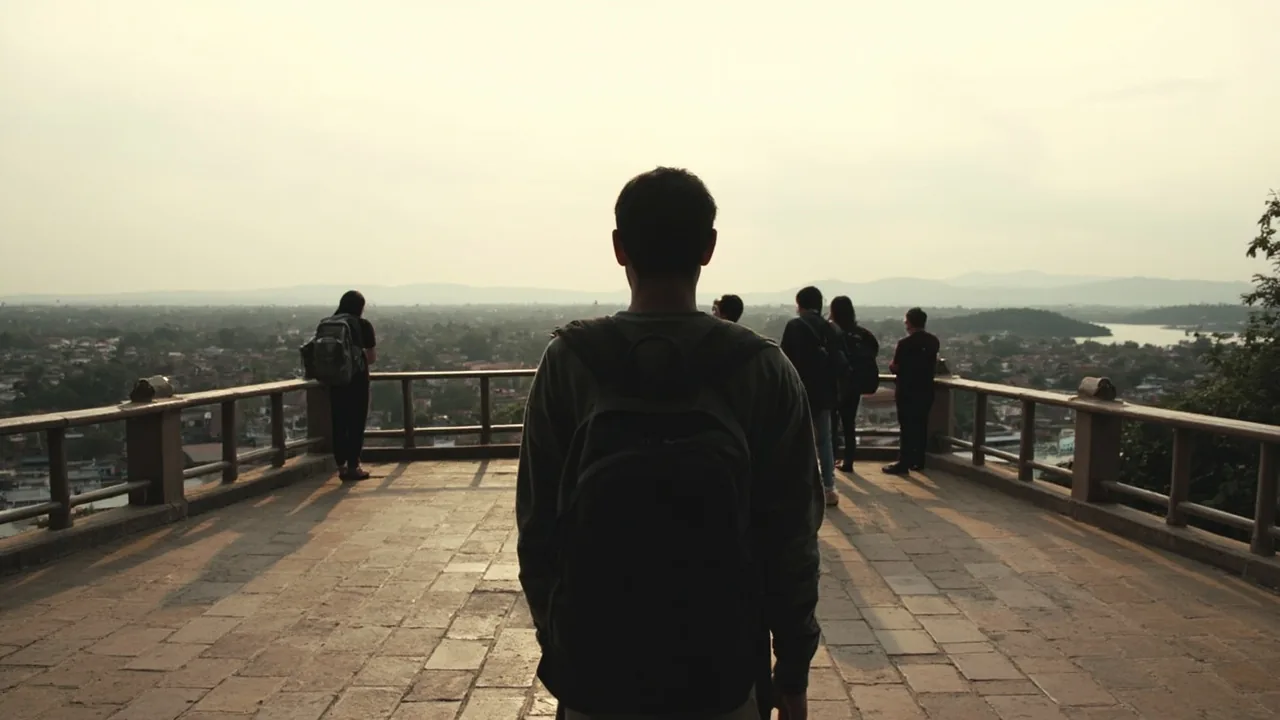
Best Sunset Spots & Photo Locations Near Luang Prabang (2026)
**Phousi Hill is the best sunset spot in Luang Prabang, but it’s the obvious choice, not the only one. Kuang Si Falls, Pak Ou Caves, and the Mekong bend photograph completely differently at golden hour. Below: the exact spots, fees, dress rules, and the spots most photographers miss.
Quick Answers
| What | Answer | Price (INR) |
|---|---|---|
| Best sunset spot in Luang Prabang | Phousi Hill, gates close around 17:30 in low season | ₹129 (~30,000 LAK) |
| Best waterfall photo | Kuang Si Falls, turquoise pools | ₹108 (~25,000 LAK) |
| Best river photo | Pak Ou Caves at the Mekong-Nam Ou confluence, slow boat from Luang Prabang | — |
| Best street photography area | The Old Town between Wat Xieng Thong and the Royal Palace Museum | — |
| Best hidden photo location | The Mekong riverbank near Wat Xieng Thong, almost no other tourists | — |
| Best Indian-friendly dinner after the shoot | M&M Restaurant, full thali | ₹129 (~30,000 LAK) |
| Time of year for photography | November to February, dry season, clear skies | — |
What Makes Luang Prabang a Photographer’s Town
Luang Prabang is a UNESCO World Heritage town built around two rivers, the Mekong and the Nam Khan, with a 328-step hill in the middle and a tiered waterfall 30 km south. The light here is different from Thailand or Vietnam: golden hour lasts longer in the dry season because dust from the surrounding hills softens the sun’s drop. Sunrise is 06:30 in December, 05:45 in July, and sunset is between 17:30 (December) and 19:00 (June). For the broader Southeast Asia backpacking route that connects Luang Prabang to Thailand, Vietnam, and Cambodia, see the SEA backpacking hub.
Verified against UNESCO World Heritage Centre records and local tourism sources on the date above.
How to Plan a Photography Day (Step-by-Step)
Step 1: Pick your sunrise or sunset window
Sunrise is empty. Sunset is packed. Pick sunrise if you want Phousi Hill to yourself (the gate opens around 05:30 for alms-giving ceremonies anyway, so you’ll be there before any photographer crowd). Pick sunset if you want the golden Mekong glow and don’t mind the 200-step queue at the summit.
Subodh’s Pro Tip: The best photo of Phousi Hill is from the Mekong riverbank looking back at the hill. To get the pagoda in silhouette, stand on the riverbank near Wat Xieng Thong just before the lights on the hill start. You get the gold-stitched temple roof against a purple sky without climbing a single step.
Step 2: Hit the temple circuit at golden hour
Walk the old town from Wat Xieng Thong toward Wat That Luang around 16:00. The gilded roofs catch low-angle light in a way they don’t at noon. Wat That Luang, in the heart of the old town, is the smaller, less-photographed cousin of the famous That Luang in Vientiane, and it sits on a quiet side street where you can shoot the orange stupa against old teak shutters without anyone in your frame.
For a less-photographed temple, Wat Sibounheuang sits a few blocks east of the main drag, with a double-tiered gilded roof that catches light from a side angle the bigger temples miss. Almost no one walks past here on the typical tourist loop.
Step 3: Climb Phousi Hill for sunset (or skip it)
Phousi is the answer for “best sunset spot in Luang Prabang,” and the answer is correct, but only if you go at the right time. The hill is 100 metres tall, 328 steps, and you’ll hit 50+ people at the top for the 17:00 to 18:30 window in high season.
- Entry fee: ₹129 (~30,000 LAK or ~$1.34)
- Hours: 05:30 to 19:30 in dry season; closes earlier in wet season
- Best time to climb: Arrive 45 minutes before your intended photo time. Walk up in five minutes if you’re fit, ten if you take photos on the way up.
Safety Alert: The summit stairs are uneven, handrails are loose, and some of the viewing areas are unrailed. Don’t bring a tripod into the crowd at peak time. The same camera position from the steps 30 metres below the summit gives nearly identical results without the bottleneck.
Step 4: Photograph Kuang Si Falls in the morning
Kuang Si is 30 km south, and most tour buses arrive 09:00 to 12:00. Those tour buses are also why everyone thinks Kuang Si is crowded. If you arrive at 07:00, you get the upper pools to yourself, and the light filters through the canopy straight onto the turquoise water. Bring a wide-angle lens; the upper cascades don’t fit in a phone frame.
For the dress code question (Kuang Si is a multi-level waterfall with swimming pools at the bottom): wear a sarong or quick-dry shorts over swimwear. The falls are inside a nature reserve, and the same modest-dress rules as a Lao temple apply. For Indian travellers specifically, most women on the standard Luang Prabang tours wear leggings and a t-shirt rather than swimsuits at the upper tiers. You can swim in the lower pools; cover knees and shoulders with a quick-dry layer if you’re female. Pack a change of clothes; the lower pools get slippery at the edges.
Step 5: Capture the Mekong slow boat at Pak Ou
Pak Ou Caves is the other “must photograph” stop near Luang Prabang, accessible only by slow boat up the Mekong. The boat takes about two hours each way, leaves from the boat dock near the Royal Palace Museum, and costs roughly ₹561 (~130,000 LAK or ~$5.82) for a round-trip boat + cave entry.
The photographic payoff: the Mekong-Nam Ou river confluence about 20 minutes before Pak Ou, where brown water meets clearer water in a clear eddy line. It’s the shot every travel magazine misses because they’re focused on the caves themselves.
Step 6: Eat the photo, then photograph the food
After sunset, head down from Phousi to the night market area and walk to M&M RESTAURANT INDIAN HALAL FOOD if you’ve been missing north Indian food. A thali runs around ₹129 (~30,000 LAK or ~$1.34), dal-chawal-rajma in a quiet room away from the night-market crowd.
If you want Lao food at a sunset-view spot, Breeze Bar By Best cafe sits on a hill overlooking the town and the Mekong. Coffee Lao (₹52 (~12,000 LAK or ~$0.54)) is the local roast, sweet and strong; pair it with the view, not the cocktail list.
Best Spot to Take Pictures in Luang Prabang: The Full List
For those Googling “best spot to take pictures in Luang Prabang,” the top-tier options, in order of golden-hour payoff:
- Phousi Hill summit (sunset), classic Luang Prabang shot, gold-stitched roof against sky, river bend below. ₹129 (~30,000 LAK or ~$1.34).
- Kuang Si Falls upper tier (morning), turquoise pool against limestone green, no tourists if you arrive by 07:30. ₹108 (~25,000 LAK or ~$1.12).
- Pak Ou Caves Mekong bend (mid-morning), the river confluence, accessible only by slow boat. Round trip about ₹561 (~130,000 LAK or ~$5.82).
- Wat Xieng Thong at sunrise, the red-and-gold temple, golden gateway on the town side, faces east. Entry by donation.
- The Mekong riverbank near Wat Xieng Thong (sunset), back-lit shot of Phousi Hill from across the water.
- The Living Land Company rice paddies, 15 minutes outside town, mountain-backed rice fields. Community-based farming experience; best conditions at planting (June) or harvest (November).
Check Luang Prabang tours on GetYourGuide
Common Mistakes Photographers Make in Luang Prabang
- Climbing Phousi Hill at 17:00 in high season. You queue for 30 minutes and you get a frame with someone else’s phone in it. Either arrive at 16:00 to claim a spot, or shoot from across the river.
- Showing up at Kuang Si at 10:00. The tour buses do too. Go at 07:00 or after 15:00, when the buses leave.
- Wearing swimsuits at the upper tier at Kuang Si. It’s a protected nature reserve with the same rules as a temple, not a beach. Bring a sarong.
- Shooting Pak Ou Caves at noon. The caves face south, and the boat dock is in deep shadow by 14:00. Book the morning slow boat. For more beyond Pak Ou, see best day trips from Luang Prabang.
- Forgetting a dry bag on the slow boat. The Mekong is brown, the wind picks up around 14:00, and a phone fall means a phone lost. Buy a ₹22 (~5,000 LAK or ~$0.22) dry bag at the Luang Prabang morning market before you board.
What Most Photography Guides Don’t Tell You
The Luang Prabang weather shifts photography plans more than anything else. November to February is dry season with clear skies; March to May is burning season (smoke haze reduces visibility to about 3 km); June to October is wet season with afternoon cloud cover. Check the Luang Prabang weather by month breakdown before you set up a specific date.
The alms-giving ceremony (Tak Bat) is one of the most-photographed rituals in Southeast Asia. Photos are technically not allowed at close range; monks at the main morning alms route along Sakkarine Road have been known to ask photographers not to shoot with flash. Use a long lens from across the street, not in front of the procession.
For the slow boat logic, see the Mekong slow boat guide. The Pak Ou day-trip uses a different boat operation than the Huay Xai to Luang Prabang two-day slow boat, and they’re not interchangeable.
Safety Note: Luang Prabang’s old town is generally safe at all hours for camera gear. The night market is busier than most tourists expect and pickpocketing incidents have been reported in high season; keep the camera in front of you, not on a strap swinging behind. Check the latest Laos travel advisory from the Indian Ministry of External Affairs before your trip.
Where to Stay in Luang Prabang
Most photographers base themselves in the Old Town between the Royal Palace and Wat Xieng Thong, walkable to every spot on this list. Hostels run ₹400-800 (~93,000-186,000 LAK or ~$4.15-$8.30)/night; boutique guesthouses ₹1,200-2,500 (~279,000-582,000 LAK or ~$12.44-$25.92). Book early in November-February when the dry-season crowd fills up fast.
Getting Connected
Buy a Lao Telecom SIM at Luang Prabang airport or any official store. The 4G tourist package runs ₹129 (~30,000 LAK or ~$1.34) for 8 GB over 7 days. Network coverage in the old town and at Kuang Si Falls is reliable, drops to 3G on the slow boat route to Pak Ou. For more on getting into the city, see how to get to Luang Prabang.
For an eSIM you can activate before you fly: Get Nomad eSIM.
Carrying Money for Photography Day Costs
Most photography spots around Luang Prabang take cash (LAK only, USD sometimes for tour packages). Bring small bills; riverbank photo spots charge around ₹22 per spot, and vendors there rarely carry change for the 50,000 LAK banknote. Stock up on smaller-denomination kip at a BCEL ATM before heading out.
Carry a forex card with no foreign transaction fee and withdraw from BCEL ATMs in Luang Prabang (ATM-rich, both on the main street and in the night market area). For card-vs-cash-vs-UPI detail for Indian travellers in this region, see carry-money-india-abroad.
Verified against BCEL Bank’s published rates on 2026-07-17.
Subodh’s Take
Phousi Hill is the right answer for “best sunset spot in Luang Prabang,” but Phousi Hill at 17:00 in high season is also the most-crowded photography spot in Laos. Skip the queue, walk to the riverbank 50 metres away, and shoot the same hill from across the water. You’ll get a better photo and you’ll enjoy it.
FAQ
Is Phousi Hill worth the entry fee? Yes, at ₹129 (~30,000 LAK or ~$1.34). The town and Mekong bend from the summit are the single best sunset view in town. Go before 16:00 in high season to skip the queue.
Can I swim at Kuang Si Falls? Yes, in the lower pools only. Wear modest-dress swimwear (knees and shoulders covered) and use a sarong or shorts over swimwear at the upper tiers where crowds are denser and dress norms are stricter.
Is it safe to take the slow boat to Pak Ou Caves? Yes, the official slow boats are licensed and run in groups. The two-day Huay Xai to Luang Prabang boat is a different operation from the Pak Ou day trip; book them through your hostel.
What’s the best Indian food in Luang Prabang after a long photography day? M&M Restaurant, near the night market, is the strongest Punjabi option. ₹129 (~30,000 LAK or ~$1.34) for a full thali.
Do I need a permit to photograph temples? No permit is needed for standard photos at the publicly accessible temples (Wat Xieng Thong, Wat That Luang, Wat Sibounheuang). Drone photography needs a permit from the Lao Ministry of Information, Culture, and Tourism; tripods are allowed at outdoor spots but not inside temple halls.
Is Luang Prabang better than Vang Vieng for photography? Different moods. Luang Prabang is a heritage town with temples and rivers; Vang Vieng is karst country with caves and rice paddies. If you have five days in Laos, do both.
What time of year has the best light? November to February, dry season. Burning season (March-April) drops visibility; June to October brings afternoon clouds.
