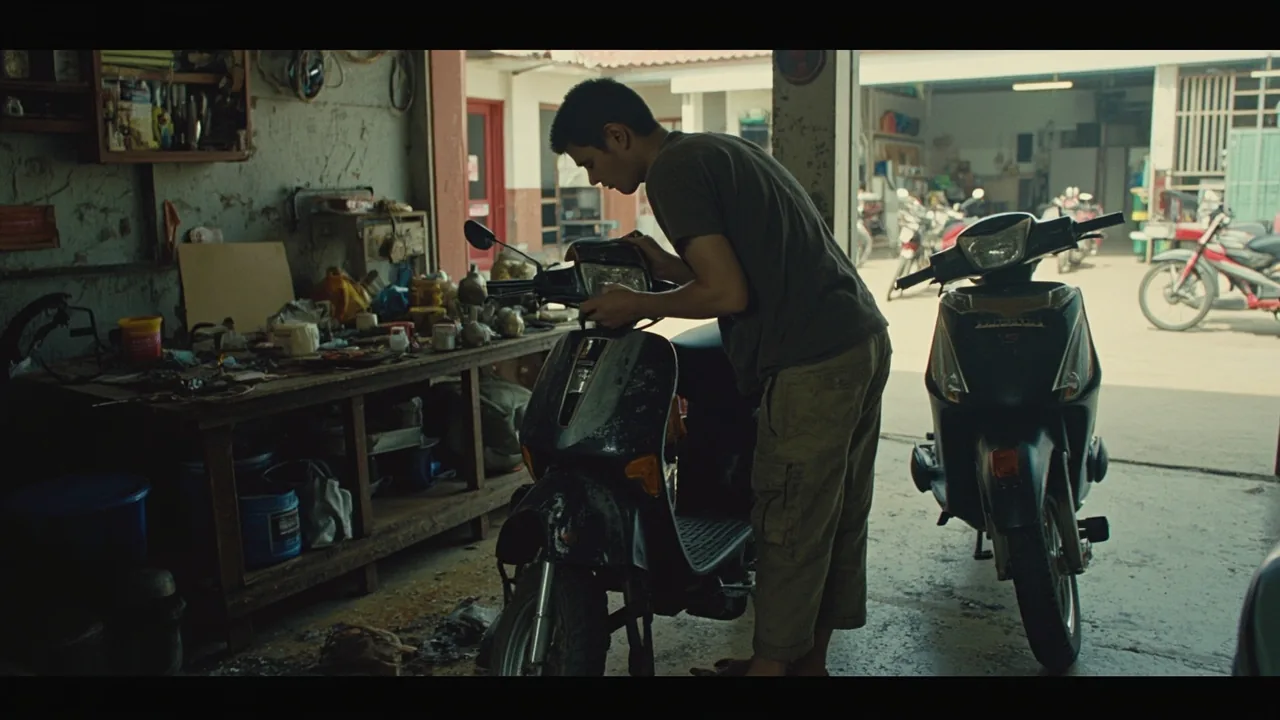
Cambodia Motorcycle Rental & Repair: Everything Breaks, Here’s What to Do
A 110cc Honda Wave is the default backpacker transport across Cambodia. You will rent one within 48 hours of landing in Phnom Penh, Siem Reap, or Sihanoukville, and somewhere in week two, it will break. That is not bad luck, that is the average. The clutch cable snaps on the way to Kampot, the rear tyre goes flat on a red-dirt road outside Battambang, the front brake lever bends sideways after a minor drop near the temples. Every traveller who rides here has at least one of these stories. The question is whether you have the contacts and the cash to fix it without losing two days of your trip. For related planning, see our guides on Sea Backpacking Hub and Cambodia Motorbikerental.
This guide is the playbook I wish someone had handed me on day one: where to rent, what to check before you ride off, what IDP situation plays out at Cambodian police checkpoints, what genuine mechanic work costs (clutch cable, brake pads, tyre, spark plug), how to spot a shady repair shop trying to double-charge you, and what to do when the rental shop blames you for damage you didn’t cause. Prices are in USD because that’s what every shop quotes, with the rupee equivalent computed at 1 USD = ₹96.5289. You may also find Cambodia Dirt Bike Rental useful for this trip.
Quick Answers
| What | Answer | Price (INR) |
|---|---|---|
| Daily Honda Wave 110cc rental | 5-7 USD/day outside Phnom Penh, 7-10 USD/day in Phnom Penh | $5-10/day (~₹480-960) |
| Passport as deposit | Yes, almost every shop asks for it. Cash deposit ₹4,817-₹14,451 (~50-150 USD) works too. | ₹4,817-₹14,451 (~50-150 USD) |
| IDP required for Indian riders | Technically yes, but in practice Cambodia almost never enforces it on tourists. Carry it if you have one. | , |
| Clutch cable replacement | Standard repair, 15 minutes at a roadside shop. Most bikes use Honda Wave-compatible parts. | ₹289-₹482 (~3-5 USD) |
| Police checkpoint “fine” if no IDP | Settled on the spot, never official. Don’t pay more than ₹482-₹963 (~5-10 USD), ask for a receipt. | ₹482-₹963 (~5-10 USD) |
| Daily budget for bike + fuel + food | Wave + petrol + dorm + street food | ~₹1,445-₹1,927 (~15-20 USD) |
The Rental Reality in Cambodia
Cambodia’s rental market is informal but functional. In Phnom Penh and Siem Reap, shops cluster near BKK1 area (Phnom Penh) and around Pub Street / Sivutha Boulevard (Siem Reap). In Sihanoukville, most shops are on or near Serendipity Beach Road. Almost every shop rents the same fleet: white or red Honda Wave 110cc scooters, plus a smaller number of 125cc and 150cc manual bikes. The Wave is what you want for any trip longer than a day. Automatic scooters (often Scoopy or Vision clones) are available but cost more, handle worse on dirt, and break more often. See also: Siem Reap to Angkor Wat Tuk Tuk Price.
Daily rates in 2026: 5-7 USD/day outside the capital, 7-10 USD/day in Phnom Penh and prime Siem Reap locations. Weekly rates drop to roughly 25-40 USD/week. Monthly rates are 60-100 USD/month. These prices have been stable since 2024 because the market is oversupplied; if a shop quotes more than $10/day for a basic Wave, walk away, the next shop on the block will undercut. For related planning, see our guide on Sihanoukville Motorbike Rental Beach Road Guide.
Subodh’s Pro Tip: Rent from a shop, not from your hostel. Hostel “rentals” are usually a handshake deal with a guy whose brother owns the bike. If something goes wrong, you have no address to return to. A proper shop front with a sign and a phone number is your only real protection if you need to dispute damage charges later.
Safety Alert: Most “deposits” are your passport. This is standard practice in Cambodia but it’s a real risk: lose the bike, lose the document you need to fly home. Always offer cash instead. $50-150 USD (₹4,830-14,480) gets you out of leaving your passport. Some shops take a photocopy plus cash; that’s the second-best option.
IDP, License, and the Police Checkpoint Game
Cambodia’s official position is that you need a Cambodian license to ride, and that an International Driving Permit (IDP) with motorcycle endorsement is the only way a foreigner gets one. Reality is messier. Almost no shop asks to see a license at the time of rental. Almost no rider carries a Cambodian license. And almost every backpacker who has ridden in Cambodia for two years has never been asked for one.
What happens at police checkpoints, which are common on the roads between Siem Reap and Phnom Penh, around Sihanoukville, and on highways out of Battambang: the officer will flag you down, ask to see your passport, sometimes ask “license?” in English. If you have an IDP, show it and you are waved through. If you don’t, the officer explains the situation. You then have three options.
- Pay a spot fine and ride on. Anywhere from ₹193-₹482 (~2-5 USD) for a polite officer up to ₹963-₹1,445 (~10-15 USD) for a hungry one. Never pay more than ₹963 (~10 USD) for a license-related stop; if they ask for more, say “no money, go to station,” and they will usually let you go because taking a foreigner to the station is paperwork nobody wants.
- Refuse to pay and go to the station. This is the morally correct option and a hassle. You’ll sit in a hot room for two hours, possibly pay an official fine of around ₹482-₹963 (~5-10 USD) with an actual receipt, and lose half a day. Not worth it for most backpackers, but some riders do it on principle.
- The receipt trick. If you pay the spot fine, ask for a receipt. That receipt is a waiver for the next 2-3 days along the same route. Police radio each other when a foreigner has paid, and the receipt is the proof you’ve been processed. Photocopy it. Phone-photo it. This works.
The bigger risk than checkpoints is accidents. If you crash and hurt someone, your travel insurance is invalid without an IDP, full stop. SafetyWing and World Nomads both explicitly state this. The hospital bill for a broken leg in Cambodia is ₹144,508-₹289,017 (~1,500-3,000 USD) if you’re treated locally, ₹1,445,085-₹4,816,950 (~15,000-50,000 USD) if you need evacuation to Bangkok or Singapore. That single fact is more important than any checkpoint fine.
Safety Alert: Don’t ride without an IDP because checkpoint fines are rare. Ride without an IDP because the day you crash into a tuk-tuk driver and need medical evacuation, your insurance will deny you. Get the IDP from your local RTO before flying, it’s ₹1,000-₹2,500 (~$10.38-$25.95), valid one year.
The Pre-Rental Checklist (Do This Every Time)
Spend 10 minutes on this. It saves you 3 hours of arguing in pidgin English in a garage later.
Walk-around video. Film the entire bike, slowly, on your phone. Start at the front-left corner, walk clockwise, end where you started. Narrate: “Here is a scratch on the tank. Here is a dent in the rear fender.” Then crouch down and film both wheels close-up. Send the video to yourself on WhatsApp so it has a timestamp. If the shop later claims you damaged something, you have video evidence that predates your ride.
Tires. Press the front and rear brake levers. They should feel firm, not spongy. Squeeze them with the bike on the center stand; if the lever touches the grip, the cable is stretched and needs replacing, that’s on the shop before you leave. Look at tire tread: if you can see the wear indicator bars or the tread depth is below 2mm, ask for a different bike.
Lights and horn. Turn the key, check the headlight (high and low beam), both indicators, the brake light (squeeze both brake levers), and the horn. The horn is the thing Cambodian mechanics fix least often. Don’t take a bike with a broken horn.
Brake pads. Look through the wheel spokes at the brake pads. If the pad material is less than 2mm thick, ask the shop to replace them. Most shops will do this free because it takes 10 minutes.
Oil and chain. Ask the shop to show you the oil level. It should be between the two marks on the dipstick. The chain should have some slack but not be hanging loose. A bike with clean oil and a tight chain is a bike the shop has been maintaining; a black-stained air filter is a red flag.
The test ride. Most shops will let you take it around the block. Do this. Listen for knocking sounds, weird vibrations, brake squeal. If anything sounds wrong, ask for a different bike on the spot.
The helmet they give you is a fake-brand half-shell. It will protect you from sun and from a police fine, it will not protect you in a crash at 40 km/h. If you’re riding outside the city, buy a proper helmet at one of the shop fronts in Psar Thmei (Phnom Penh Central Market) or near Pub Street (Siem Reap) for ₹1,927-₹2,890 (~20-30 USD).
Subodh’s Pro Tip: Photograph the odometer reading at pickup. Some shops charge by km over a daily allowance. Others use a flat daily rate. Know which one you signed up for. The video walk-around covers this.
When It Breaks: Common Failures and What They Cost
Here are the five things that go wrong on every Cambodia trip, in order of frequency.
1. Flat tyre or slow puncture. Almost every bike has a slow leak after a week. Roadside repair: ₹96-₹193 (~1-2 USD) for a patch, ₹289-₹482 (~3-5 USD) for a full tube replacement. Time: 15-20 minutes. Any roadside mechanic can do this. You don’t need the rental shop.
2. Clutch cable snap. This is the single most common breakdown on Honda Waves. You pull the lever and the bike just revs without moving. Cable replacement: ₹289-₹482 (~3-5 USD) for the cable itself plus ₹193-₹289 (~2-3 USD) labor. Time: 15 minutes. Most roadside mechanics have Honda Wave-compatible cables in stock. If the cable snaps in a remote area, push the bike to the nearest town. Walking 5 km with a Wave is annoying but not dangerous; they have wheel locks that prevent rolling.
3. Brake pad wear or brake cable stretch. Front brakes go first. Symptoms: lever pulls all the way to the grip, or you hear metal-on-metal scraping. New brake pads: ₹289-₹482 (~3-5 USD) including fitting. Brake cable: ₹289-₹482 (~3-5 USD) including fitting.
4. Engine won’t start. Usually the spark plug, sometimes a dead battery. Spark plug replacement: ₹193-₹289 (~2-3 USD) for the plug, ₹96-₹193 (~1-2 USD) for fitting. Battery: ₹1,445-₹2,408 (~15-25 USD) for a replacement, fitted in 20 minutes. If the bike is older than 3 years, expect to do this at least once on a long trip.
5. Chain comes off or snaps. Chain tension is checked at pickup but stretches fast in Cambodia’s dust and humidity. Re-fitting a slipped chain: ₹96-₹193 (~1-2 USD). New chain and sprocket set: ₹1,445-₹2,408 (~15-25 USD), fitted in 30 minutes.
Subodh’s Pro Tip: Buy a ₹482 (~5 USD) spare clutch cable and a ₹482 (~5 USD) spare inner tube from any shop in Siem Reap or Phnom Penh on day one. Carry them in the under-seat storage. They weigh almost nothing and turn a 3-hour breakdown into a 30-minute roadside fix.
Finding a Good Mechanic vs. Getting Ripped Off
Cambodia has excellent mechanics and lots of them. The country runs on motorbikes; everyone knows how to fix them. The challenge is telling the genuine workshops from the “we’ll keep your bike for three days while we source parts” shops.
The good workshops are clustered near the markets. In Phnom Penh, head to the area around Psar Thmei (Central Market) or along Street 271 near the Olympic Stadium. In Siem Reap, the cluster is near the Phsar Chas (Old Market) and along Sivutha Boulevard. In Battambang, ask any local for “motorbike mechanic” and you’ll get pointed to a row of shops along the river road. In Sihanoukville, the cluster is on Ekareach Street between the Serendipity and Ochheuteal beach areas.
Signs of a good shop: 3-4 bikes already being worked on (they have flow), a wall of organized spare parts (they have stock), a mechanic who looks at the problem before quoting (not just guesses). Signs of a bad shop: empty workshop, parts lying in piles, mechanic says “leave it, I’ll call you” without looking.
Typical labor rates in 2026: ₹193-₹482 (~2-5 USD) for a 15-30 minute job, ₹482-₹963 (~5-10 USD) for anything more involved. If a shop quotes more than ₹963 (~10 USD) for labor on a basic Wave, get a second quote. Parts are usually marked up 30-50% over shop price, which is normal in Cambodia; what’s not normal is quoting 3x retail because you’re a tourist. Google the part on Lazada or Shopee Cambodia before agreeing to a price.
Genuine vs. Cheap parts. Almost every shop uses aftermarket Honda-compatible parts. Genuine Honda parts exist but cost 3-5x more and are rarely worth it for a rental bike. The exception is brake pads; cheap pads fade after a month, so ask for Honda-branded pads if you can find them. For clutch cables, spark plugs, tires, tubes, and chains, aftermarket is fine.
The Damage Dispute: What to Do When the Shop Blames You
This is the scenario everyone dreads and most people handle badly. You return the bike. The shop says the rear fender is dented, or the headlight is cracked, or the mirror is missing. They hold your passport. They quote ₹4,817 (~50 USD), ₹9,634 (~100 USD), sometimes ₹19,268 (~200 USD) for the damage. Here’s how to handle it.
1. Stay calm. The shop owner is running a script. Yelling in English doesn’t work. Speak quietly and slowly.
2. Pull out your pickup video. This is why you filmed it. “Look, here is the rear fender at pickup. Same scratch is there now. I didn’t damage it.” This ends 70% of disputes immediately.
3. Negotiate. If the damage is real and you don’t have video, negotiate. The shop’s first quote is never the final number. Counter at 30% of their ask. They’ll come up slightly. Most disputes settle at ₹963-₹2,890 (~10-30 USD).
4. Refuse to pay more than your deposit. If you left cash instead of a passport, you’ve already capped your exposure. If you left your passport, the use is asymmetric. Ask to keep the passport and “come back tomorrow with the money” so you can think. This buys you time to find another shop to quote a fair repair price.
5. The threat of the police. Don’t call them; in Cambodia, the police are usually on the shop’s side. But the phrase “I will call my embassy” carries weight because shop owners know embassies occasionally intervene and that gets them on a list.
6. Walk away from a bad deal. If the shop is asking ₹19,268 (~200 USD) for damage that’s ₹1,927 (~20 USD) of repair, leave. They’ll call you back and accept a lower number 30% of the time. They won’t call you back 70% of the time, which means you overpaid nothing. The risk is losing the passport deposit, which is why cash is always the better bet.
Subodh’s Pro Tip: Never rent from a shop that won’t let you film the bike at pickup. This is the single biggest red flag. A shop that refuses the walk-around video is planning to claim pre-existing damage was yours.
Long-Distance Trips and Border Crossings
Renting in Phnom Penh and dropping in Siem Reap (vice versa) costs an extra ₹2,890-₹5,780 (~30-60 USD) one-way fee. Most shops arrange this. The road between the two cities is paved and flat, 6-7 hours on a Wave. Stop in Kampong Cham for lunch. Don’t ride it in the dark; Cambodian trucks don’t use headlights, and “dark” starts at 6pm year-round.
Border crossings to Thailand or Laos with a rental bike are not allowed. Every rental contract prohibits taking the bike across an international border, and the border posts will check. If you want to ride into Thailand, return the bike in Cambodia, walk across, rent a new one on the Thai side. Same for Laos.
If you’re heading from Phnom Penh down to the coast (Sihanoukville or Kampot), the road is good and the trip is 4-5 hours. If you’re heading to the temples from Siem Reap, every shop in town rents bikes for the day for this, and most have an arrangement with local repair shops in case you break down at Angkor. The temples are 7-15 km from town; breakdowns happen, but you can usually push a Wave back to the shop area.
For bus alternatives when you don’t want to ride, book Phnom Penh to Siem Reap on 12go, it’s ₹771-₹1,445 (~8-15 USD) and 6 hours. Buses run throughout the day.
Getting Connected
You need mobile data to use maps (Google Maps and Maps.me are both reliable in Cambodia), to call a mechanic if you break down, and to use Grab for tuk-tuks when you don’t want to ride. The cheapest option is a local SIM from Cellcard, Smart, or Metfone, available at the airport for ₹482 (~5 USD) with 5-7 GB of data, valid 30 days. If you don’t want to swap your Indian SIM, get a Nomad eSIM before flying, it’s data-only and activates the moment you land.
Common Mistakes Indians Make on Cambodian Roads
1. Riding at night without lights. Cambodia’s rural roads are unlit, trucks use high beams that blind oncoming riders, and motorcycles are sometimes the smallest thing on the road. Be off the bike by sunset, every sunset.
2. Riding in the rain on red dirt roads. The first 30 minutes of rain turn clay-rich Cambodian laterite into a soap-slick surface. If you see rain starting and you’re not on pavement, pull over and wait 20 minutes. Muddy gear is annoying; crashing into a ditch at 40 km/h because the front wheel washed out is worse.
3. Leaving the passport as deposit and then not getting a receipt. Always ask for a written receipt that lists the deposit amount, the bike plate number, and the return date. Without a receipt, the shop can claim you never left a deposit.
4. Riding without an IDP because “everyone does it.” Everyone does it, until they crash. If you can get an IDP from your local RTO before flying, do it. It costs ₹1,000-₹2,500 (~$10.38-$25.95), takes 30 minutes, and is valid in 150+ countries.
5. Not checking tire pressure. Soft tires make the bike handle like a wet noodle and wear out the rim in a pothole. Every shop has a free air compressor. Stop in once a week.
6. Riding two-up on a Wave. The Wave 110 is rated for one rider plus a small load. Riding two adults on it through Cambodian traffic is how clutch cables snap and brake pads burn out. If you’re traveling as a couple, rent a 125cc or 150cc manual, or take a tuk-tuk for the day.
Subodh’s Pro Tip: When in doubt, take a tuk-tuk. For Phnom Penh and Siem Reap, a tuk-tuk is ₹193-₹482 (~2-5 USD) for any in-city trip, no negotiation past the first quote if you start at the right number. Don’t negotiate with Grab drivers; the app does it.
Where to Eat After the Bike Is Fixed
You will end up at one of three situations often: a roadside restaurant in a small town, a night market in Phnom Penh or Siem Reap, or in your hostel eating whatever’s around. Cambodia has good local food, and Indian food is widely available in tourist areas.
For Cambodian food, the highest-rated local spot in the country is Smokin’ Pot Authentic Cambodian Restaurant and Cooking School in Phnom Penh, a 4.9-rated cooking school and restaurant serving dishes like amok (coconut fish curry) and lok lak (stir-fried beef). Cambodia Kitchen in Phnom Penh is another 4.9-rated spot for authentic Cambodian food in a rustic setting. In BKK1, HoubHoub Cambodian Restaurant sits at 4.8 and is known for a lively local atmosphere and a broad menu of Khmer staples.
For Indian food, Indian Restaurant in Poipet (4.9) and Saffron Indian Restaurant Poipet (5.0) are solid for travelers crossing the Thai border. Galaxy Indian Restaurant Poipet (5.0) rounds out the trio. In Phnom Penh and Siem Reap, Indian restaurants cluster around BKK1 and the Pub Street area respectively; ask any local or check Google Maps for the nearest one to your hostel.
For something completely different, Phare, The Cambodian Circus in Siem Reap is a 4.8-rated performance that combines theater, music, and acrobatics, and supports a local youth arts school. Tickets run ₹1,734-₹3,661 (~18-38 USD) depending on seat class, and it’s a great way to spend an evening if you’ve given up riding for the day.
FAQ
Can I rent a motorbike in Cambodia with just an Indian license? Technically no. In practice, every rental shop will hand you a bike if you show a passport and a cash deposit. But if you crash without an IDP, your travel insurance will deny the claim. Get an IDP from your local RTO before flying, it’s ₹1,000-₹2,500 (~$10.38-$25.95) and takes 30 minutes.
How much should I budget for repairs during a 2-week Cambodia trip? Plan for ₹1,927-₹3,854 (~20-40 USD) in repairs, mostly tyres, cables, and small parts. If you’re heading off the main roads (Kampot countryside, Mondulkiri dirt tracks, Ratanakiri red-dirt), double that. Keep a ₹4,817 (~50 USD) emergency reserve separate from your daily cash.
What happens if I crash and the bike is written off? The rental shop will quote a replacement value of ₹38,536-₹77,071 (~400-800 USD) for a basic Wave, depending on the shop. Your travel insurance does not cover the rental bike itself, only your medical bills. This is one of the strongest arguments for paying the small extra for full rental insurance if the shop offers it (usually $2-3 USD/day).
Can I take a Cambodian rental bike into Thailand or Vietnam? No. Rental contracts prohibit international crossings, and border posts check. Return the bike before the border and rent a new one on the other side.
What’s the average police checkpoint fine for no license? Cash on the spot: ₹193-₹963 (~2-10 USD). Official fine at the station: ₹482-₹963 (~5-10 USD) with a receipt. Never pay more than ₹963 (~10 USD) for a license-related stop, ask for a receipt either way.
Is it safe to ride alone as a solo female rider? Yes, with the same caveats as anywhere in Southeast Asia. Don’t ride at night. Don’t ride alone on remote roads. Tell your hostel where you’re going. Carry a basic first-aid kit. The bike is more dangerous than the people, statistically.
How do I know if a mechanic is overcharging? Ask for a written quote before any work starts. Compare to the second shop’s quote. If a 15-minute clutch cable replacement costs more than ₹771-₹963 (~8-10 USD), you’re being overcharged. Lazada Cambodia lists parts prices if you want a benchmark.
Subodh’s Take
The Honda Wave is the most reliable thing in Cambodia if you do the basic checks, and the most dangerous thing in Cambodia if you don’t. The rental shops aren’t out to scam you, but they also aren’t out to maintain the bike, and the police checkpoints aren’t out to help you, but they also aren’t out to ruin you. Treat the bike like it’s yours, because if something breaks, you’ll be the one standing on the side of the road with a clutch lever that does nothing. Spend the ₹482 (~5 USD) on a spare cable, film the bike at pickup, keep your passport in the hostel safe, and ride before sunset. Everything else works out.
