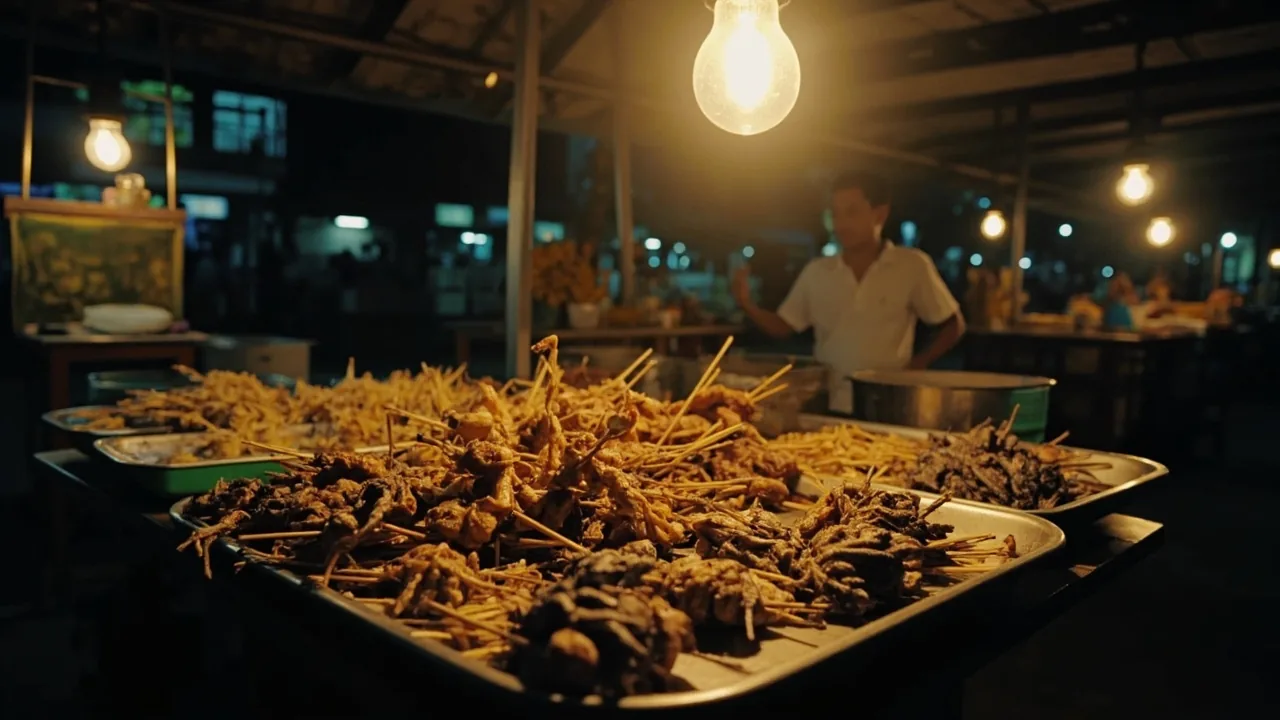
Eating Bugs in Cambodia: The Street Food Insects Guide No One Tells You About
Cambodia’s edible insect scene is one of those travel things that sounds like a gimmick until you smell the frying oil on the side of National Route 6 and see locals queueing up. Fried tarantulas in Skuon, stir-fried water bugs in Phnom Penh, crickets in Siem Reap’s night market, scorpions on cocktail garnishes in Phnom Penh’s boutique bars: bugs are both an everyday street snack and, increasingly, a future-of-food talking point. For Indian travellers, that brings a fresh set of questions. Are insects vegetarian or Jain? Are they safe? What do they taste like, and what happens if you bite the wrong end? For related planning, see our guide on Sea Backpacking Hub.
I’ll walk you through the insects you’ll see sold on the street in Cambodia, where to find them, what they cost in Cambodian riel and rupees, what they taste like honestly, and where Indian dietary lines fall. I’ll also flag the hygiene warnings and the new trend of insects showing up in sit-down restaurants and cocktail bars, because the scene has changed a lot in the last few years.
At current rates, 1 USD = ₹96.5289. Riel moves roughly at 4,000 KHR per dollar.
Subodh’s Pro Tip: The single most underrated insect in Cambodia is not the tarantula. It’s the pang (the giant water bug). Crispy, buttery, and the belly fat is the best part. If you only try one thing, try that.
Quick Answers
| What | Answer | Price (INR) |
|---|---|---|
| Fried tarantula (a-ping) in Skuon | Yes, real, and sold by the basket | ₹85-₹250 (~$0.88-$2.60) |
| Common bugs you’ll see | Tarantula, cricket, silkworm, water bug, scorpion, beetle, grasshopper | ₹85-₹250 (~$0.88-$2.60) |
| Are insects vegetarian / Jain? | Not vegetarian by standard Indian definitions; not Jain | , |
| Safety for first-timers | Generally safe fried; avoid raw or week-old street displays | , |
| Where to try in Phnom Penh / Siem Reap | BKK1 night vendors, Pub Street, Russian Market | ₹85-₹250 (~$0.88-$2.60) |
| Insect trend in restaurants | Yes, sit-down restaurants and cocktail bars now serve insects | , |
Quick clarifier on prices: all prices below are in Cambodian riel (KHR) for what you pay on the street, with rupee conversions at 1 USD = ₹96.5289 and roughly 4,000 KHR per dollar.
What “Cambodia Street Food Insects” Means
Insects in Cambodia aren’t a tourist gimmick cooked up for foreigners. They’ve been a normal rural snack for generations. Rural Cambodians, especially in provinces where protein was historically scarce, ate whatever was abundant: tarantulas from the forest, crickets from the rice paddies, silkworm pupae from the silk trade, water bugs harvested from the rice fields. The town of Skuon (sometimes called “Spiderville”) sits halfway between Phnom Penh and Siem Reap on National Route 6, and it’s the place the fried-tarantula legend comes from. But every Cambodian night market has its own bug stall.
The insects you’ll most commonly see:
- Fried tarantula (a-ping), the famous one. Skuon is the spiritual home. Big, leggy, fried whole with garlic and salt.
- Crickets (sngok), small, crunchy, often fried with soy, lemongrass, and chilli. Probably the most approachable starter.
- Silkworm pupae (sandoek), beige, puffy, slightly sweet. Sold in clusters on sticks.
- Water bugs (pang), the local favourite. Big brown winged bugs, fried until the belly fat goes crisp.
- Scorpions, usually sold fried, tail curled, often on a stick as a garnish or bar snack.
- Beetles and grasshoppers, common, cheap, sometimes fried with chilli and basil.
You will also see scorpions, centipedes, and the occasional silk worm skewered at tourist-facing bars. Skewer them, eat them, but know the difference between a fried-in-front-of-you skewer and one that’s been sitting under hot lamps all day.
Where to Find Insects: Skuon, Phnom Penh, Siem Reap
Skuon, Kampong Cham province. If you’re road-tripping between Phnom Penh and Siem Reap, you’ll drive straight through Skuon. The bus usually stops for 20-30 minutes, and within a minute of stepping off, vendors appear from everywhere selling baskets of fried spiders, crickets, and silk worms. Buy from a stall where the turnover is high (the basket sitting in the sun for hours is not the basket you want). ₹24-₹71 (~1,000-3,000 KHR or ~$0.25-$0.74) per spider, depending on size and your haggling.
Phnom Penh. BKK1 neighbourhood vendors in the evenings, the riverside night market, and most outdoor markets have bug stalls. Pub Street-adjacent vendors sell skewered scorpions and beetles to tourists.
Siem Reap. Pub Street night market, the Old Market area, and the road between Pub Street and the Angkor ticket office all have bug vendors. The vendors here are more tourist-facing than Skuon’s, and prices are slightly higher for the same product.
Sit-down restaurants and cocktail bars. Here’s the change the older guidebooks miss: insects have moved off the street and into proper venues. Phnom Penh’s contemporary Cambodian restaurants have started featuring bugs on tasting menus, sometimes paired with cocktails. Smokin’ Pot Authentic Cambodian Restaurant and Cooking School in Phnom Penh has built a reputation on authentic Cambodian food and occasionally features insects in seasonal preparations; check the menu when you arrive. Cambodia Kitchen in Phnom Penh serves authentic Cambodian cuisine in a rustic setting and has been known to feature local insect preparations when in season. HoubHoub Cambodian Restaurant in BKK1 is the spot to try authentic Cambodian dishes including seasonal local ingredients, with a lively Phnom Penh atmosphere. Travellers report that Tevy’s Place in Phnom Penh and Mr Tet’s restaurant have both featured cricket or water-bug dishes on their local tasting menus at various points. Cuisine Wat Damnak in Phnom Penh is the upscale contemporary Cambodian restaurant where you’re most likely to see insects appear in a tasting menu format. For the bar side, several of Phnom Penh’s cocktail lounges have used scorpions or beetles as garnishes, and Siem Reap’s more experimental bars occasionally serve crickets as a bar snack. This is part of the broader global edible-insect-as-future-protein conversation: the FAO has been pushing insects as a sustainable protein since 2013, and Cambodia’s restaurant scene is starting to reflect that. Phare, The Cambodian Circus in Siem Reap also leans into the cultural side of Cambodian cuisine, sometimes with themed dining nights that feature local ingredients including insects, paired with the show itself.
Safety Alert: Avoid bug stalls where the insects are sitting out in the open under sun lamps for hours. Go for stalls where you can see them being fried to order. Skewered scorpions sold by weight in the tourist night markets are often fried once in the morning and then re-displayed all day; if the scorpion’s body looks dried out and the tail is brittle, skip it.
What Does It Taste Like?
Honest takes, no marketing:
- Fried tarantula. The legs taste like crispy crab shell, slightly nutty. The body (abdomen) is mushy and weird; many travellers spit it out. The best part is the inside of the thorax, which is brownish, a bit like pâté or cod-roe paste. Travellers report that the texture is the harder barrier than the flavour.
- Crickets. Closest to a familiar snack: think crunchy prawn cracker, but with a faintly grassy, nutty aftertaste. The legs are the worst part (they stick in your teeth).
- Silkworm pupae. Soft, slightly sweet, with a strong fermented-bean smell that puts people off. Cambodian kids love them. Indian travellers who grew up eating similar textures (think boiled soybeans, boiled peanuts) adapt faster.
- Water bugs. This is the one locals rave about. When freshly fried, the belly fat goes golden and tastes rich, almost buttery, with a slightly fishy undertone. The wings and legs are too crunchy; focus on the abdomen.
- Scorpions. Mostly texture, not much flavour. The body is crunchy like a chip, the tail has a tiny bit of sting but the venom is destroyed by frying. Skewered bar scorpions are 90% visual.
Prices: What You’ll Pay
Street prices in Cambodia for a portion of fried insects run cheap by global standards, but Skuon’s famous spiders have crept up in price as the YouTube effect kicked in. Here’s a working budget per portion.
| Insect | Typical street price (KHR) | Typical street price (INR) |
|---|---|---|
| Fried tarantula (Sk) | 1,000-3,000 | ₹25-₹75 (~$0.26-$0.78) |
| Fried tarantula (Phnom Penh / Siem Reap market) | 5,000-10,000 | ₹125-₹250 (~$1.30-$2.60) |
| Crickets (small bag) | 2,000-5,000 | ₹50-₹125 (~$0.52-$1.30) |
| Silkworm pupae (skewer) | 1,500-3,000 | ₹40-₹75 (~$0.42-$0.78) |
| Water bugs (3-5 bugs, fried) | 5,000-10,000 | ₹125-₹250 (~$1.30-$2.60) |
| Scorpion (skewered, bar garnish) | 3,000-5,000 | ₹75-₹125 (~$0.78-$1.30) |
| Mixed sampler basket (Sk) | 10,000-15,000 | ₹250-₹375 (~$2.60-$3.89) |
For context, that’s well within the standard Cambodian street food price range (food/street_food) of ₹96-₹289 (~1-3 USD) per portion.
Restaurants charging for insects as part of a tasting menu will charge a lot more (sometimes ₹482-₹1,445 (~5-15 USD) per dish, ₹400-₹1,250 (~$4.15-$12.98)), because the prep and presentation are different. That’s the future-of-food trend showing up in the bill.
Subodh’s Pro Tip: Carry small riel notes. Most bug vendors in Skuon will quote you ₹119 (~5,000 KHR or ~$1.24) for a spider if you look like a tourist; ₹24-₹48 (~1,000-2,000 KHR or ~$0.25-$0.49) is closer to the local rate. Always start low.
Are Insects Vegetarian? Hindu and Jain Considerations
This is the question every Indian traveller asks. Honest answer: it depends who you ask.
Standard Indian vegetarian (lacto-vegetarian) view. Most Indian vegetarian households do not classify insects as vegetarian. The reasoning is that insects are animals (even small ones), and vegetarianism in the traditional Indian sense excludes all animal flesh. So: not vegetarian.
Jain view. No. Insects are living beings with senses, and Jains avoid harming even small creatures. Eating insects is out.
Vegan view. Strictly speaking, insects are animals, so they are not vegan. Some Western vegans who eat honey would draw the line at insects; others might consider insect protein more ethical than factory-farmed meat. This is not a settled position.
Hindu-specific flexibility. Some Hindu traditions treat certain insects (honey, in some interpretations) as products rather than flesh, but this is rare. Travellers from Gujarat, Rajasthan, and the South tend to treat insects as non-veg. Travellers from Bengal, Northeast India, and tribal communities may have a different cultural frame.
Practical answer. If you’re a strict vegetarian, Jain, or Hindu who keeps the traditional line, do not eat insects. If you’re a flexitarian or curious-but-not-strict, treat them as you would any other meat decision. If you want to try them and you’re worried about Indian relatives finding out, don’t post photos on the family WhatsApp group.
If you want Indian food in Cambodia while the rest of your group is doing the spider thing, you have options. Don’s Mumbai Chaat in Phnom Penh does Mumbai street food and home-style cooking, solid for a dal-chawal fix. MDSK in Phnom Penh is the vegan dosa and Indian street food spot, reviewers consistently praise the vada pav. Indian Royal Halal Food Restaurant on the Phnom Penh riverside does upscale Punjabi and Mughlai halal food. Mekong Authentic Indian Restaurant in Phnom Penh does North Indian curries and tandoori. For a fuller list, see our vegetarian food in Cambodia guide.
Hygiene and Safety: What to Watch Out For
Insects are sold on the street, so the same rules that apply to all Cambodian street food apply here. A few specific tips:
- Watch the frying. Eat insects that you can see being fried to order. The sizzle and the bubbling oil is your hygiene signal.
- Avoid the dried-out skewers. Scorpions and beetles sitting on display all day under heat lamps lose moisture, the oils go rancid, and the texture is bad. Pick the stall that’s frying fresh.
- The first bite. For first-timers, start with crickets. They’re the smallest, the easiest to chew, and the lowest commitment. Water bugs and tarantulas are a step up in both texture and psychological barrier.
- Shellfish allergy warning. Fried tarantulas, crickets, and other arthropods contain chitin and proteins cross-reactive with shellfish allergens. If you have a shellfish or crustacean allergy, do not eat insects. This is a real medical risk, not a hypothetical.
- Drink water only from sealed bottles. A bottle of water runs ₹48 (~2,000 KHR or ~$0.49) from any minimart. Don’t drink the water the vendor pours on the side; it’s for washing, not drinking.
- Stomach prep. Bring a course of probiotics, ORS sachets, and a basic antibiotic like norfloxacin (ask your GP before the trip). If you eat street food regularly in Cambodia, traveller’s diarrhoea is a 30-50% probability over a two-week trip, regardless of how careful you are. See our street food safety in Southeast Asia guide for the full routine.
The Future-of-Food Angle: Why Bugs Are Suddenly in Cocktail Bars
Two trends have pushed Cambodia’s insect scene from rural snack to restaurant trend.
The first is the global “alternative protein” conversation. The FAO’s 2013 report Edible Insects: Future Prospects for Food and Feed kicked off a wave of investment in insect protein as a sustainable alternative to beef and chicken. Insects produce far less greenhouse gas per kilo of protein than cattle, require a fraction of the land and water, and can be farmed on organic waste streams. Cambodia, with its existing rural insect-harvest tradition, became an early case study.
The second is the restaurant and bar trend. Phnom Penh’s contemporary dining scene started incorporating insects in tasting menus around 2018-2019, framed as a “locally sourced, sustainable protein” play. Cocktail bars picked it up because a scorpion garnish photographs well and signals a certain kind of venue to the right kind of customer. Siem Reap’s tourist market followed, and now you’ll see crickets in pub food, beetle powder in chocolates, and silkworm pupae as bar snacks.
This is good for sustainability framing but bad for the casual traveller looking for an authentic street-food experience. The street vendors in Skuon haven’t changed their approach in 30 years; they’re still frying spiders in woks over coal fires. The new restaurant trend is a layer on top of that older tradition, not a replacement.
For the Indian traveller, this means you have options on a spectrum:
- Curious, low commitment. Eat a cricket skewer at a Siem Reap night market. ₹75-₹125 (~$0.78-$1.30), no real risk.
- Going for it. A water bug fried fresh in Skuon. ₹125-₹250 (~$1.30-$2.60), full experience.
- Restaurant curious. Try the seasonal insect dish at Cuisine Wat Damnak in Phnom Penh if it’s on the menu that week. Higher price (₹400-₹1,250 (~$4.15-$12.98) per dish), but a real sit-down meal.
- Nope. Eat at one of the Indian restaurants and skip the whole thing. Zero judgment.
Safety Alert: Don’t eat fried insects that have been sitting out for hours in the open air. The oils oxidize, the texture is awful, and the stomach upset risk goes up. Buy fresh, eat fresh.
Where to Eat Insects in Cambodia: Practical Routes
If you’re road-tripping Phnom Penh to Siem Reap (vice versa), Skuon is your natural bug stop. The bus doesn’t always stop, so either book a private taxi (US ₹3,854-₹5,780 (~40-60 USD) for the car, ₹3,300-₹5,000 (~$34.25-$51.90), easily split 3-4 ways), or take the local bus that does stop. You’ll have 20-30 minutes to wander the stalls.
If you’re staying in Phnom Penh, the BKK1 area has the most consistent bug vendors, and you’ll find them in the evening. The riverside night market has them too, with a tourist markup. Siem Reap’s Pub Street has them nightly, but you’ll pay 2-3x the Skuon price.
For the sit-down experience, ask at the hostel’s reception or any of the restaurants listed above; insect dishes are seasonal and not always on the printed menu. Phare, The Cambodian Circus Show Tickets in Siem Reap bundles dinner and show, with a focus on local Cambodian cuisine; ask when booking if a bug dish is on the rotation.
If you want to learn to cook Khmer food (with or without insects), Smokin’ Pot Authentic Cambodian Restaurant and Cooking School runs cooking classes that focus on authentic Cambodian meals. This is the most direct way to understand the cuisine behind the bugs.
For a wider night-market food walk, our Siem Reap lunch and food guide has the day-side recommendations, and food tour booking walking night food tours has night-side tours across Southeast Asia including Phnom Penh and Siem Reap. If a guided tasting is your speed, book a Cambodia food tour through GetYourGuide and skip the Skuon roulette.
Subodh’s Take
Cambodia’s edible insect scene is one of the few “extreme food” things in Southeast Asia that has actual cultural roots, not just tourist theatre. If you’re going to eat a fried tarantula anywhere in the world, this is the right place to do it. If you’re a strict vegetarian or Jain, skip it without guilt; the Indian restaurants in Phnom Penh and Siem Reap have you covered. And if you’re somewhere in between, start with crickets, then water bugs, save the tarantula for Skuon where they’re fried fresh in front of you, and don’t post the photos on the family WhatsApp until you’re back home. Also: bring ORS sachets. Just trust me on that one.
FAQ
Are fried insects in Cambodia safe to eat?
Generally yes, if fried fresh in front of you. Avoid the dried-out skewers sitting under heat lamps all day. If you have a shellfish allergy, skip insects entirely; the chitin cross-reacts.
What does a fried tarantula taste like?
The legs taste like crispy crab shell, slightly nutty. The thorax paste is the best part, a bit like cod roe or pâté. Most travellers skip the abdomen.
Are insects vegetarian in India?
By standard Indian vegetarian definitions, no. Insects are animals, and traditional vegetarianism excludes all animal flesh. Jain dietary law also excludes them.
Where is the best place to try bugs in Cambodia?
Skuon, halfway between Phnom Penh and Siem Reap on National Route 6. That’s the original, the most authentic, and the cheapest. Phnom Penh’s BKK1 and Siem Reap’s Pub Street work too, with a tourist markup.
Why are insects suddenly showing up in Cambodia’s restaurants and bars?
Part of the global alternative-protein movement. The FAO has been pushing insects as sustainable protein since 2013, and Cambodia’s contemporary dining scene has incorporated them into tasting menus and cocktail garnishes since around 2018-2019.
How much should I budget to try the full bug sampler in Cambodia?
About ₹714-₹1,190 (~30,000-50,000 KHR or ~$7.41-$12.35) covers tarantulas, crickets, silkworms, water bugs, and a scorpion skewer from street vendors. A restaurant tasting menu featuring insects runs US ₹963-₹1,927 (~10-20 USD) extra on top of the meal.
Can I find Indian food in Cambodia if I skip the bug scene?
Yes. Don’s Mumbai Chaat, MDSK, Indian Royal Halal Food Restaurant, and Mekong Authentic Indian Restaurant in Phnom Penh are the standard picks. See our vegetarian food in Cambodia guide for the full list.
