Cambodia Budget Trip from India: A Backpacker Breakdown
I’ll give you the honest numbers for a Cambodia budget trip from India. A 7-day trip costs ₹48,000 (~$497.26) to ₹62,000 (~$642.29) all-in for a budget backpacker; a 14-day trip lands at ₹75,000 (~$776.97) to ₹95,000 (~$984.16).
These figures are based on verified 2026 hostel rates, official e-Visa pricing, and FX rates checked on the date above.
Quick Answers
| What | Answer | Price (INR) |
|---|---|---|
| Best payment method | Zero-markup debit card (Fi/Niyo) | ₹0 markup + ATM fee |
| Backup method | US dollars in cash | No FX markup, but bring small notes |
| Worst option | Exchanging INR at Indian airports | 5%-8% worse than mid-market |
| 7-day all-in budget | Mid-backpacker | ₹48,000-₹62,000 (~$497-$642) |
| 14-day all-in budget | Slow traveller | ₹75,000-₹95,000 (~$776.97-$984.16) |
| Per-day budget (on the ground) | Hostel + food + local transport | ₹596-₹954 (~25,000-40,000 KHR or ~$6.18-$9.88) |
| Round-trip flight from India | Cheapest from Delhi, Mumbai, Bengaluru | ₹18,000-₹25,000 (~$186.47-$258.99) |
| Cambodia e-Visa fee | Official portal | ₹3,475 (~36 USD) |
| Cambodia Visa-on-Arrival | At airport counters | ₹2,896 (~30 USD) |
| SIM card with data | Smart or Cellcard (physical) | ₹483 (~5 USD) for 30 days |
| eSIM option | Nomad, paid before flying | From ₹579 (~6 USD) |
| Angkor Wat pass | 3-day (best value) | ₹5,985 (~62 USD) |
Subodh’s Pro Tip: Cambodia uses US dollars as the de-facto currency for anything over a few dollars. Hostels, tours, Angkor, even some street-food vendors quote in USD. Cambodian riel (KHR) is the change you receive. You’ll pay for everything in greenbacks but think in riel. Carry clean, undamaged US dollar bills. Torn notes get refused at visa counters and money changers.
How It Works: The Cambodia Money Setup
Cambodia is one of the easiest Southeast Asian countries to budget for, because most prices are quoted in US dollars anyway. That removes a layer of mental math. But it also means you need US dollars in cash, which complicates the “just use a card for everything” Indian traveller mindset.
The dual-currency reality. Walk into a Phnom Penh cafe and the menu says “coconut, ₹145 (~1.50 USD)”. Hand over a ₹1,931 (~20-USD-denominated) bill, your change comes back as a mix of riel and small USD notes. A bowl of kuy teav at a street stall might be ₹191 (~8,000 KHR or ~$1.98) one place and ₹193 (~2 USD) the next. Both are the same price ($2 ≈ 8,000 KHR). At current rates (1 USD = ₹96.3294, 1 KHR ≈ ₹0.0238), every $1 is about 4,100 KHR. Keep that conversion in your head, and the rest of Cambodia stops feeling confusing.
Cash vs card. Phnom Penh and Siem Reap accept cards in most restaurants, hostels, and tour offices. Sihanoukville, Koh Rong, and rural areas are 80%+ cash. ATMS exist in every provincial capital but they charge. The standard international ATM fee is ₹483 (~5 USD) per withdrawal (some banks charge ₹500 (~$5.18)-equivalent flat), and your own Indian bank will add a foreign-transaction markup on top. Don’t make four withdrawals of ₹4,826 (~50 USD) each, you’ll pay roughly ₹1,931 across those four trips. Withdraw once, take out ₹19,306-₹28,959 (~200-300 USD), and refill when you’ve spent it. Read Using ATMs in Cambodia for the bank-by-bank breakdown of which Cambodian ATMs refund the fee.
UPI does not work in Cambodia. Don’t expect PhonePe or GPay to work anywhere except maybe the airport’s one-off merchant. Cambodia runs on cash + foreign cards. For a full take on this, see UPI Payment Cambodia for Indian Travelers.
Avoid DCC at all costs. Dynamic Currency Conversion is the scam where an ATM offers to charge your card in INR instead of USD. The rate they give you is 5-7% worse than the bank’s. Always choose to be charged in USD (“without conversion”) when the ATM asks. The same rule applies at merchant card readers: if a restaurant asks “do you want to pay in rupees or dollars,” always choose dollars.
Where to Stay: Hostels With Real Prices
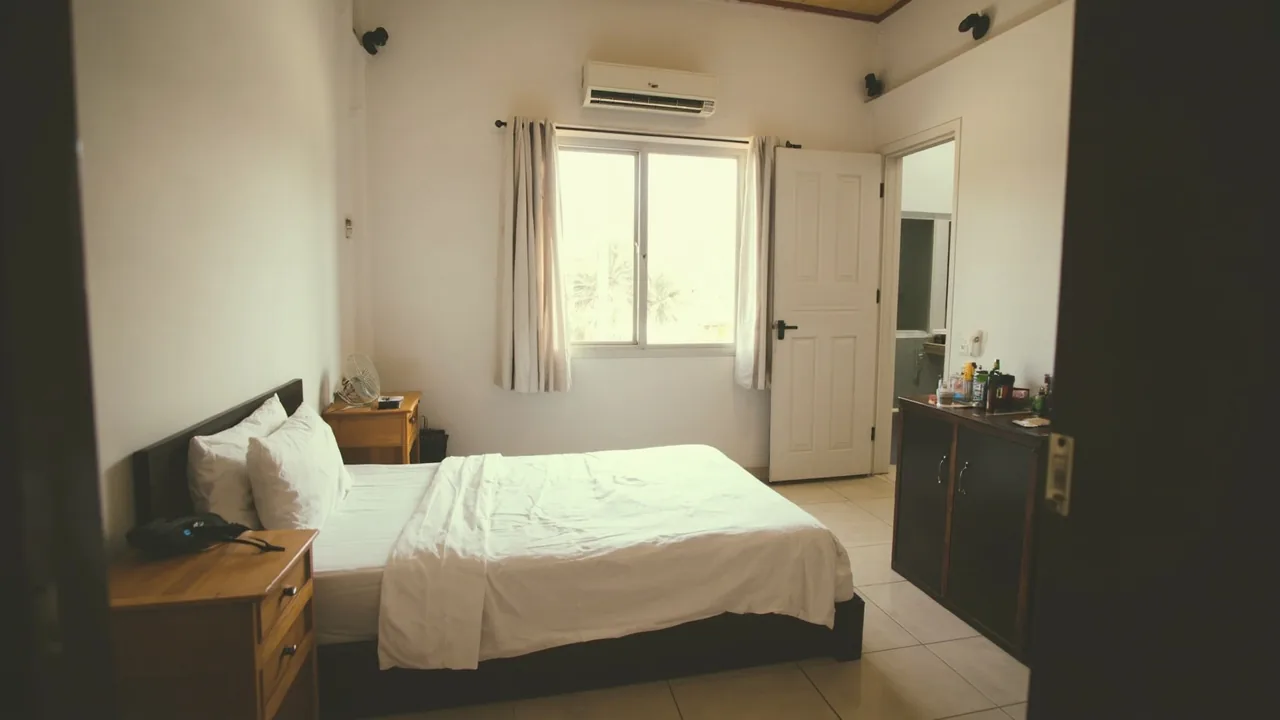
Hostels in Cambodia range from ₹483 (~5 USD) to ₹1,448 (~15 USD) per night for a dorm bed in 2026, depending on the city and the standard. Siem Reap and Phnom Penh have the best value for backpacker dorms. Koh Rong is more expensive because everything (water, electricity, beer) has to be barged in.
Phnom Penh and Siem Reap dorm bed: ₹579-₹1,158 (~6-12 USD) per night Koh Rong dorm bed: ₹965-₹1,738 (~10-18 USD) per night (peak Dec-Feb) Private room in a guesthouse: ₹1,448-₹2,896 (~15-30 USD) per night
Over a 10-night Cambodia trip, that’s roughly $70-150 on accommodation. At the canonical rate of $1 = ₹96.33, that’s ₹6,740-₹14,450 on beds alone.
Subodh’s Pro Tip: Book the first two nights in Phnom Penh or Siem Reap in advance, especially if you’re arriving late. A 11pm Phnom Penh airport arrival with no booking is the single most expensive way to start a Cambodia trip. Hostel staff have been burned by midnight “walk-ins” before, prices double after 10pm.
For the Phnom Penh to Siem Reap overland route, the Phnom Penh to Siem Reap distance guide covers buses, taxis, and the cheap-but-slow options. If you’re arriving from Bangkok, the Bangkok to Siem Reap bus guide is the practical play.
Food: The Daily Eat Budget
Food in Cambodia is honest and cheap if you eat where locals eat. A bowl of noodle soup at a roadside stall runs ₹193-₹338 (~2-3.50 USD). A rice and curry lunch at a proper sit-down Cambodian restaurant is ₹434-₹724 (~4.50-7.50 USD). A beer at a guesthouse is ₹97-₹193 (~1-2 USD).
Daily food budget (per person):
- Street food only: ₹193-₹286 (~2-3 USD)
- Mix of street food + sit-down: ₹190-₹286 (~2-3 USD)
- Western-leaning / cafes: ₹1,448-₹2,124 (~15-22 USD)
Over 10 days, food costs ₹7,240-₹12,066 (~75-125 USD). At ₹96.33/₹97 (~1 USD), that’s ₹7,225-₹12,040 (~$74.85-$124.73). Honestly? Cambodia eats cheaper than Thailand for street food, but the gap has narrowed in the last two years.
For backpacker route planning across Southeast Asia, the Southeast Asia backpacking hub ties this Cambodia budget into the wider Thailand. Vietnam. Laos loop.
Where to eat in Phnom Penh:
- Smokin’ Pot Authentic Cambodian Restaurant and Cooking School: half restaurant, half cooking school, and a great pick if you want to learn amok or lok lak while you eat. Lunch with a drink lands around ₹772-₹1,158 (~8-12 USD). Worth booking a class for at least one afternoon.
- Cambodia Kitchen: a Phnom Penh stalwart for a sit-down amok or fish curry. Mains run ₹483-₹869 (~5-9 USD).
- HoubHoub Cambodian Restaurant (BKK1): BKK1 is the backpacker-friendly district, and HoubHoub is the local crowd pick. Expect mains around ₹386-₹676 (~4-7 USD).
For Indian / vegetarian backup when the dal-rice craving hits hard, the shortlist has you covered:
- Indian Restaurant: Phnom Penh, basic and reliable, dal-rice around ₹386-₹483 (~4-5 USD).
- Galaxy Indian Restaurant, Poipet: if you’re crossing the Thailand-Cambodia border at Poipet, this is the post-immigration comfort food stop. Most travellers report a thali around ₹483-₹676 (~5-7 USD).
- Saffron Indian Restaurant Poipet: same area, slightly fancier, similar pricing.
For the full food cost breakdown by city, the Cost of Food in Cambodia Per Day guide has the menu-by-menu data.
Internal Transport: Buses, Boats, and the Odd Tuk-Tuk
Cambodia’s transport network is cheap, slow, and reasonably safe. The two main long-distance routes backpackers use are Phnom Penh to Siem Reap (5-7 hours by bus) and Sihanoukville to Koh Rong (ferry).
Long-distance bus Phnom Penh to Siem Reap: ₹965-₹1,448 (~10-15 USD), 5-7 hours. Companies like Giant Ibis and Mekong Express are the safe, air-conditioned picks. Book on 12go.
Long-distance bus Bangkok to Siem Reap (overland): ₹2,413-₹3,861 (~25-40 USD), 8-12 hours including border. Travellers from Bangkok often combine Thailand and Cambodia in one trip. Book on 12go.
Ferry Sihanoukville to Koh Rong: ₹676-₹1,158 (~7-12 USD) one-way, 45-90 minutes. Book on 12go. The Koh Rong accommodation side is covered separately in Koh Rong Island Accommodation Budget.
Tuk-tuk / Grab in cities: ₹97-₹483 (~1-5 USD) per ride within Phnom Penh or Siem Reap. Always agree on price before sitting down. Grab works in Phnom Penh but not Siem Reap.
Ho Chi Minh City to Phnom Penh overland: If you’re extending your Cambodia trip from Vietnam, the bus runs ₹1,448-₹2,413 (~15-25 USD) and takes 6-8 hours including the border. Book on 12go.
For a 10-day Cambodia trip covering Phnom Penh + Siem Reap + Koh Rong, total internal transport lands at ₹3,861-₹6,757 (~40-70 USD). At ₹96.33/₹97 (~1 USD), that’s ₹3,853-₹6,743 (~$39.92-$69.85).
The Big-Ticket Item: Angkor Wat Pass
If you skip Angkor, you save ₹5,985 (~62 USD). If you visit Siem Reap and skip Angkor, you went to Siem Reap for no reason. The 3-day pass (₹5,985 (~62 USD) ≈ ₹5,975 (~$61.90)) is the value pick. The 1-day pass (₹3,572 (~37 USD) ≈ ₹3,565 (~$36.93)) only makes sense on a tight schedule. The 7-day pass (₹6,950 (~72 USD) ≈ ₹6,938 (~$71.87)) is for people genuinely doing sunrise research.
Verified 2026-07-21 against the official Angkor Enterprise ticket counter. Prices were last raised in 2017, but always check before paying since the pass price can change.
Visa: The ₹3,475 (~36 USD) Truth
This is where half the Cambodia blogs on the internet are wrong. The Cambodia e-Visa costs ₹3,475 (~36 USD), not ₹2,896 (~30 USD). The ₹2,896 (~30 USD) figure is the visa-on-arrival fee at the airport counter. Both work. The e-Visa is ₹579 (~6 USD) more but saves you a queue at Phnom Penh or Siem Penh airport.
E-Visa fee: ₹3,475 (~36 USD) ≈ ₹3,470 (~$35.95)Visa-on-arrival fee: ₹2,896 (~30 USD) ≈ ₹2,890 (~$29.94)Photo: 4x6 cm, white background Max stay: 30 days, single entry Extendable: Yes, ₹4,344 (~45 USD) extension ≈ ₹4,335 (~$44.91), 30 extra days Official portal: evisa.gov.kh
Apply at least 3 business days before flying. The portal has been known to take 24-72 hours to issue the approval letter. Print two copies: one for the airline check-in counter (some airlines ask), one for the immigration line.
For the full list of e-Visa entry points and the airport queue reality, see Cambodia e-Visa Entry Points Airport Queue. If your visa gets rejected or you overstay, the Cambodia Visa Rejected Refund Overstay Penalty guide covers what to do.
Safety Alert: Indian travellers report occasional hassle at the Poipet land border from Thailand if you don’t have a printed e-Visa or a passport photo. Carry two printed e-Visas, two passport photos (4x6 cm), and ₹3,861 (~40 USD) cash for the VoA fallback. If you’re transiting through Bangkok, the Cambodia Transit Visa Layover Rules guide is worth a read.
Sample Budgets: 5, 7, and 14 Days from India
These numbers are based on verified 2026 hostel rates, food costs, and transport pricing, with FX verified at 1 USD = ₹96.3294 and 1 KHR ≈ ₹0.0238 on the date at the top of this article.
5-Day Cambodia Trip (Phnom Penh + Siem Reap, no Koh Rong)
| Line item | Cost (local) | Cost (₹) |
|---|---|---|
| Round-trip flight from India | , | ₹18,000 (~$186.47) |
| Cambodia e-Visa | ₹3,475 (~36 USD) | ₹3,470 (~$35.95) |
| Hostel dorm × 5 nights | ₹4,826 (~50 USD) | ₹4,815 (~$49.88) |
| Food × 5 days | ₹4,174 (~175,000 KHR or ~$43.24) | ₹4,165 (~$43.15) |
| Phnom Penh → Siem Reap bus | ₹1,158 (~12 USD) | ₹1,155 (~$11.97) |
| Angkor 3-day pass | ₹5,985 (~62 USD) | ₹5,975 (~$61.90) |
| Tuk-tuks + small entry fees | ₹2,896 (~30 USD) | ₹2,890 (~$29.94) |
| Travel insurance (12 days) | , | ₹1,950 (~$20.20) |
| Total | , | ~₹42,420 (~$439.45) |
7-Day Cambodia Trip (adds Koh Rong)
| Line item | Cost (local) | Cost (₹) |
|---|---|---|
| Round-trip flight from India | , | ₹21,000 (~$217.55) |
| Cambodia e-Visa | ₹3,475 (~36 USD) | ₹3,470 (~$35.95) |
| Hostel dorm × 7 nights | ₹7,722 (~80 USD) | ₹7,705 (~$79.82) |
| Food × 7 days | ₹5,844 (~245,000 KHR or ~$60.54) | ₹5,830 (~$60.40) |
| Internal transport (bus + ferry) | ₹3,861 (~40 USD) | ₹3,855 (~$39.94) |
| Angkor 3-day pass | ₹5,985 (~62 USD) | ₹5,975 (~$61.90) |
| Tuk-tuks + small entry fees | ₹3,861 (~40 USD) | ₹3,855 (~$39.94) |
| Travel insurance (14 days) | , | ₹2,275 (~$23.57) |
| Total | , | ~₹53,965 (~$559.06) |
14-Day Cambodia Trip (slow traveller)
| Line item | Cost (local) | Cost (₹) |
|---|---|---|
| Round-trip flight from India | , | ₹23,000 (~$238.27) |
| Cambodia e-Visa | ₹3,475 (~36 USD) | ₹3,470 (~$35.95) |
| Hostel dorm × 14 nights | ₹15,445 (~160 USD) | ₹15,410 (~$159.64) |
| Food × 14 days | ₹11,687 (~490,000 KHR or ~$121.08) | ₹11,665 (~$120.84) |
| Internal transport | ₹7,722 (~80 USD) | ₹7,705 (~$79.82) |
| Angkor 3-day pass + cooking class | ₹7,722 (~80 USD) | ₹7,705 (~$79.82) |
| Tuk-tuks + small entry fees | ₹6,757 (~70 USD) | ₹6,745 (~$69.88) |
| Travel insurance (21 days) | , | ₹3,415 (~$35.38) |
| Total | , | ~₹79,115 |
India-Specific Money Rules (TCS, LRS, and PAN)
Indian travellers have one extra layer of paperwork when sending money abroad: the RBI’s Tax Collected at Source (TCS) and the Liberalised Remittance Scheme (LRS).
LRS limit: $250,000 USD per financial year per PAN card. Cambodia for two weeks won’t approach this.
TCS rule (20% on the 7-lakh exemption): If you spend over ₹7 lakh in a financial year on the LRS scheme (forex cards, foreign remittances, international trips booked via Indian agents), the bank collecting the payment takes 20% TCS on the amount above ₹7 lakh. This was raised to 20% in the 2023-24 budget and held in 2024-25 and 2025-26 budgets. A two-week Cambodia trip at ₹60,000-₹80,000 (~$621.58-$828.77) doesn’t touch this. But if you’re a serial multi-country backpacker doing 4-5 trips a year, the cumulative spend crosses ₹7 lakh and the bank takes 20% on the excess.
PAN card requirement: All forex cards and foreign remittances above ₹50,000 per transaction need a PAN card. The bank will not let you load a forex card without one.
Documents to keep: Every forex-card load receipt, every international ATM slip, and the Form A2 acknowledgment from your bank. If you get audited, these prove the money was for personal travel, not investment.
What Bananarchy Travellers Use
After years of running this route, here’s the setup that survives a Cambodia trip without drama:
- ₹20,000 in cash, converted to USD before flying. Done through a forex agent, not at the airport. The airport INR-to-USD rate is 4-6% worse. Get $20s and $50s, avoid ₹9,653 (~100 USD) bills (tougher to break at small vendors).
- One zero-markup debit card (Fi or Niyo, both work). Use this for ATM withdrawals in Phnom Penh and Siem Reap only. Don’t use it for ₹965 (~10 USD) purchases, the bank sometimes flags micro-transactions abroad.
- A backup Visa/Mastercard in case the primary is blocked. ATMs in Cambodia sometimes eat one network for a day, having a second bank on a different network saves the day.
- A small float of KHR for street food and tuk-tuks. Withdraw ₹19,306-₹28,959 (~200-300 USD) at a time, get riel change, spend the riel first.
The pattern that fails: travellers who arrive with only INR, no USD, no card, and try to find an INR-accepting money changer in Phnom Penh. They pay 8-10% in two-stage conversion losses (INR → USD → KHR) and lose half a day.
Subodh’s Pro Tip: Phnom Penh airport has two ATM banks before immigration: ABA Bank and Sathapana Bank. Sathapana usually has lower fees, but it queues. ABA is faster. Take out ₹28,959 (~300 USD) worth of riel (about ₹29,338 (~1,230,000 KHR or ~$303.93)) once, in one withdrawal, and you won’t need an ATM again for 5 days.
Getting Connected: SIM and eSIM
SIM cards in Cambodia cost ₹483 (~5 USD) for 30 days with 10-15 GB of data. Smart and Cellcard are the two main operators, both have airport counters at Phnom Penh and Siem Reap. Bring your passport, get connected in 10 minutes.
eSIM option: If you’d rather not swap physical SIMs, Nomad eSIM starts at ₹579 (~6 USD) for a 30-day Cambodia plan, paid before flying. Data activates the moment you land.
Working data is non-negotiable in Cambodia: Grab for tuk-tuks in Phnom Penh, Google Maps in Siem Reap, banking SMS alerts to catch card fraud, and Telegram for the hostel chat groups where other travellers post real-time scam warnings.
Comparing the Payment Options
| Method | Markup | ATM Fee | Daily limit | Verdict |
|---|---|---|---|---|
| Zero-markup debit (Fi, Niyo) | 0% | ₹100-₹500 (~$1.04-$5.18) per withdrawal | ₹50,000-₹200,000 (~$517.98-$2,071.92) | The default for big withdrawals |
| Traditional forex card (HDFC, Axis) | 2-3.5% | ₹0-₹200 (~$0-$2.07) | Varies, reload hassle | Worse rate, but useful as backup |
| Cash INR exchanged in India | 5-8% | , | , | Worst option |
| Cash USD bought in India | 0-1% | , | , | Best for big amounts, hard to find change |
| Credit card (Visa/Mastercard) | 0-3.5% | Cash advance fees | Varies | Useful for hostels + Angkor pass online |
The “right” setup for an Indian backpacker doing 14 days in Cambodia is: ₹20,000 (~$207.19) in USD cash bought from a forex agent + Fi/Niyo debit card for ATM top-ups + one Visa/Mastercard credit card for online bookings. That covers all the scenarios.
Subodh’s Take
Cambodia is one of the cheapest countries in Southeast Asia to do from India in 2026. The visa is cheap, the hostels are honest, the street food is real, and USD being the de-facto currency means you never get hit by a bad local exchange rate. The catch is the flight, which is the most expensive line item by a wide margin, and the Angkor pass, which is genuinely expensive but genuinely worth it. If you’re a budget-conscious Indian backpacker trying to figure out where to spend your international trip money, Cambodia is where it goes the furthest.
FAQ
Q: Is Cambodia cheaper than Thailand for Indian backpackers? A: Yes, on the ground. Thailand has gotten more expensive in 2025-26, especially Bangkok and the islands. Cambodia’s street food, hostels, and transport are 20-30% cheaper than Thailand’s equivalents. The flight from India to Cambodia is also often cheaper than to Bangkok.
Q: Do I need a visa for Cambodia from India? A: Yes. Indian passport holders need either an e-Visa (₹3,475 (~36 USD), apply at evisa.gov.kh) or a visa-on-arrival (₹2,896 (~30 USD), paid in cash at the airport counter). The e-Visa is the smoother option for 2026.
Q: What is the cheapest way to get US dollars in India? A: Order from a forex agent (Thomas Cook, Muthoot, or a local agent) 2-3 days before flying. Airport counters charge 4-6% markup. Online forex cards charge 2-3.5% markup but don’t give you physical cash for emergencies. The hybrid is best: ₹19,306-₹28,959 (~200-300 USD) cash + a forex/debit card for ATM top-ups.
Q: Can I use UPI in Cambodia? A: No. UPI does not work in Cambodia as of 2026. Some airports have one-off merchant QR codes, but it’s not reliable. Carry cash and cards.
Q: Is Cambodia safe for Indian tourists? A: Generally yes, with normal Southeast Asia precautions. The Cambodia Safe for Indian Tourists guide has the current advisory. Check your government’s travel advisory before flying, and read up on the latest local situation.
Q: How much cash should I carry into Cambodia? A: ₹19,306-₹28,959 (~200-300 USD) in cash for a 10-day trip, plus a card for ATM top-ups. Cambodia is heavily cash-based outside Phnom Penh. Don’t carry all ₹48,264 (~500 USD) in ₹9,653 (~100 USD) bills, vendors can’t break them. Mix $20s and $50s.
Q: What’s the cheapest month to fly to Cambodia from India? A: April through September (Cambodia’s green/wet season) has the cheapest airfares, sometimes ₹14,000-₹18,000 (~$145.03-$186.47) round trip from Delhi or Mumbai. December-February is peak season and prices go up by 30-50%. Rain doesn’t ruin a Cambodia trip, just bring a rain jacket.