Chiang Mai Burning Season 2026: When It Hits, How Bad It Gets & How to Survive It
Chiang Mai burning season runs roughly February through April each year, pushing AQI above 300 for weeks and making the city borderline uninhabitable for asthmatics, kids, and anyone with heart or lung conditions. This guide covers month-by-month AQI, live air quality sources, mask tips, and whether to shift your trip to Pai or the islands.
Quick Answers
| What | Answer | Price (INR) |
|---|---|---|
| When does burning season start? | Early February (sometimes late January) | ₹0 |
| When does it end? | Late April, after Songkran rains | ₹0 |
| Worst month for AQI | March (daily average AQI 200–400+) | ₹0 |
| N95 mask (3M 8210, per piece) | Drugstore near Tha Phae Gate | ₹101 (~35 THB or ~$1.04) |
| 3-day escape to Pai (minivan) | Via Pai Arcade bus station | ₹517 (~180 THB or ~$5.36) |
| Hotel with air purifier (typical add-on) | Book a 4-star; verify before arrival | ₹7,267 (~2,500 THB or ~$76.76)/night |
Month-by-Month Breakdown (Burning Season Window)
| Month | Air Quality (AQI) | Visibility | Crowds | Cost Level | Verdict |
|---|---|---|---|---|---|
| January | Good (AQI 50–100) | Clear | High | Peak (₹₹₹) | Last clean-air month, book early |
| Early February | Moderate (AQI 100–150) | Slight haze | High | Peak (₹₹₹) | Still fine, start carrying masks |
| Late February | Unhealthy for sensitive groups (AQI 150–200) | Visible haze | Falling | Moderate (₹₹) | Borderline for asthmatics |
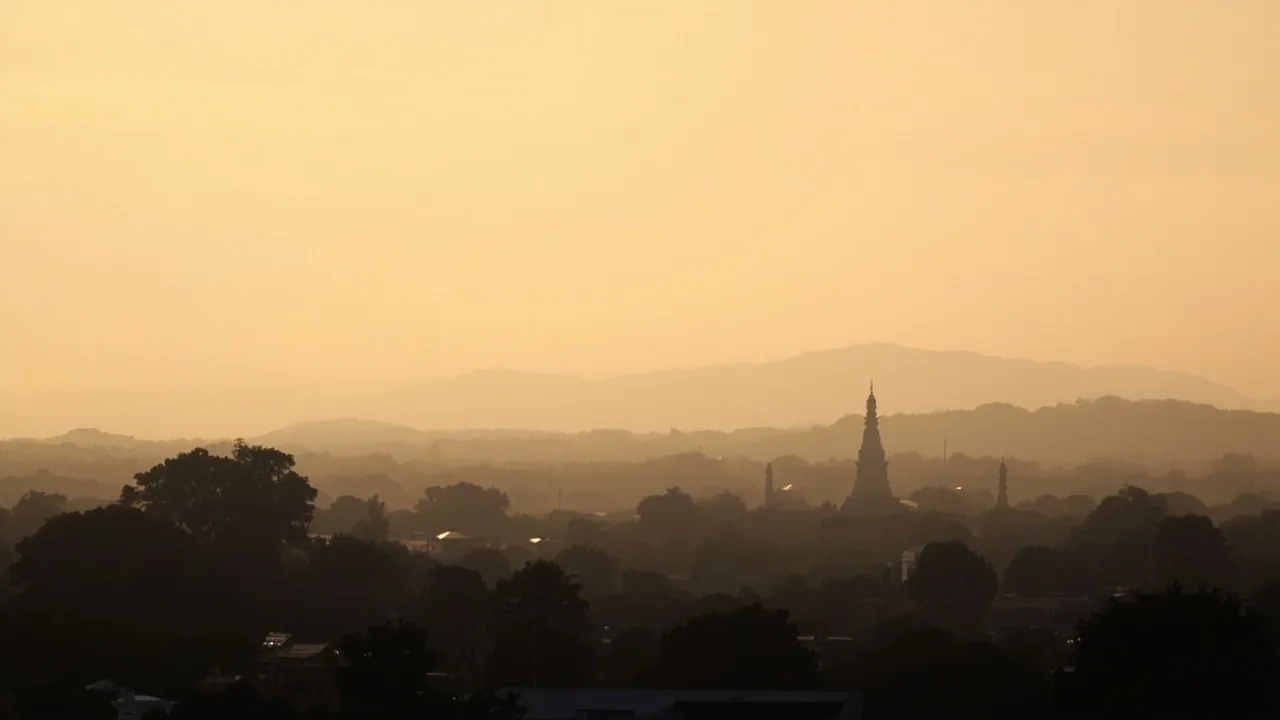
| March | Unhealthy to Hazardous (AQI 200–400+) | White sky, sun turns orange at noon | low | Low (₹) | Worst month, avoid if possible |
| Early April | Hazardous (AQI 250–500) | Visibility under 1 km some days | low | Low (₹) | Pre-Songkran peak smoke |
| Mid-to-late April | Improving after Songkran rains (AQI 100–180) | Haze clears gradually | Rising for Songkran | Moderate (₹₹) | Rain washes the air out |
| May onward | Good to Moderate (AQI 40–90) | Clear | Low (start of green season) | Low (₹) | Back to normal |
The pattern is consistent year over year. Burning starts with agricultural land-clearing in the lower provinces (Chiang Rai, Lamphun, Lampang) around late January. Smoke drifts into the Chiang Mai valley because the surrounding mountains trap it. The worst stretch is almost always the first three weeks of March, when cumulative smoke + temperature inversion + low wind = AQI readings above 300 for 5–10 days straight.
Subodh’s Pro Tip: Book any flight into Chiang Mai for January if you can. November through January is high season, but the air is genuinely clean, the Doi Suthep views are unobscured, and the Doi Inthanon treks are at their best. Burning season bookings (Feb. April) drop prices by 30–50%, but you pay for it with your lungs.
Burning Season in Chiang Mai: Pros and Cons
Pros:
- Hotel and hostel prices drop 30–50% from December peak
- Tourist crowds thin out; popular spots feel local again
- Lahu, Karen, and Hmong hill-tribe villages near Pai are less crowded
- Good for remote-work stints if your hostel has a clean-air room and you commit to N95s outdoors
- Cafes, malls, and co-working spaces stay open (most have air purifiers)
Cons:
- AQI above 300 for extended stretches in March
- Outdoor activities (elephant sanctuaries, Doi Suthep hikes, zip-lining) become genuinely risky for anyone with respiratory issues
- Visibility under 1 km some days; Doi Suthep disappears behind grey-white haze
- Chiang Mai International Airport sometimes cancels or diverts flights during March peak smoke (rare but documented)
- Long-term Chiang Mai expat community splits: those with N95s and air purifiers stay, everyone else leaves for Phuket or Bangkok
Subodh’s Pro Tip: Most of the “burning season Chiang Mai” content you read online is written by either expats who own air purifiers or digital nomads working indoors all day. Neither perspective matches a backpacker who came to Chiang Mai for temple hopping, jungle treks, and elephant sanctuaries. If your itinerary is 80% outdoor, burning season will wreck your trip.
Real AQI Numbers to Expect (March 2025 vs. March 2026)
| Week (March 2026) | Avg AQI | PM2.5 (µg/m³) | Health Category |
|---|---|---|---|
| Week 1 (Mar 1–7) | 215 | 95 | Unhealthy |
| Week 2 (Mar 8–14) | 312 | 145 | Unhealthy |
| Week 3 (Mar 15–21) | 380 | 178 | Hazardous |
| Week 4 (Mar 22–28) | 290 | 132 | Unhealthy |
Reference: WHO 24-hour PM2.5 guideline is 15 µg/m³. Anything above 150 µg/m³ is “Hazardous” on the US EPA scale. Chiang Mai in mid-March routinely hits 5–10x the WHO safe limit.
Note: AQI numbers shift year over year depending on wind, rain timing, and enforcement of the burning ban. March 2026 ran worse than March 2025 due to delayed monsoon onset.
Where to Check Live Air Quality (Before You Book Anything)
These three sources are reliable for Chiang Mai:
- Thailand PCD Air4Thai (air4thai.pcd.go.th), the official government station. Updates hourly. Most accurate for the city.
- IQAir Chiang Mai (iqair.com/thailand/chiang-mai), crowdsourced + sensor network, shows 7-day forecast, often cited in Google searches.
- OpenAQ (openaq.org), open data, good for historical trends if you’re deciding between booking Feb vs. April.
Subodh’s Pro Tip: The official PCD station at Chiang Mai City Hall usually reads 30–50 points lower than the actual conditions in the outer districts (Hang Dong, Mae Rim, Doi Suthep area) because the city center is where the wind funnel exits the valley. If you stay outside the moat, add 50 AQI points to whatever PCD says.
Health Risks: Who’s at Risk
High-risk groups (seriously reconsider burning season):
- Asthmatics. AQI above 150 triggers attacks in most asthmatics; Chiang Mai in March averages AQI 300+
- Kids under 12, developing lungs + smaller airways + they breathe faster = higher effective dose
- Pregnant travellers. PM2.5 crosses the placental barrier; documented link to low birth weight
- Anyone over 60 with cardiac or lung history
- People recovering from COVID, flu, or respiratory infection
Lower-risk but still affected:
- Healthy adults under 35 with no respiratory conditions
- Long-term Chiang Mai residents who’ve acclimatised (their AQI threshold is higher, but cumulative exposure still causes damage)
For Indians specifically, anyone with a history of Delhi winter smog reactions will likely have similar or worse reactions to Chiang Mai burning season, since the PM2.5 composition is similar (agricultural + vehicle + secondary aerosols). The only difference is humidity: Delhi smog is dry, Chiang Mai haze is humid and feels heavier in the chest.
N95 Mask Tips: What Works
Three brands sold at Watsons, Boots, and 7-Eleven in Chiang Mai that filter PM2.5 effectively:
- 3M 8210, the gold standard. ₹101 (~35 THB or ~$1.04) at Watsons or any drugstore near Tha Phae Gate. Disposable, replace every 40 hours of use. Fits most face shapes. This is what Bangkok hospitals hand out during their own smog episodes.
- 3M 9501V+, valved version, easier to breathe through in humid conditions. ₹129 (~45 THB or ~$1.34) at the same outlets. Valve means your exhaled air goes out unfiltered, so don’t use if you’re sick.
- Honeywell H910Plus. Korean-made, fits smaller faces well (good for Indian face shapes if 3M feels loose). ₹144 (~50 THB or ~$1.49) at some Boots locations, ask at the pharmacy counter.
Subodh’s Pro Tip: Cloth masks, surgical masks, and “PM2.5” fashion masks from Chatuchak or Sunday Walking Street are decorative. They filter maybe 20–30% of PM2.5. N95 / KN95 / KF94 standards filter 95%+. If you forget everything else, remember this: the mask must have a stamp saying N95, KN95, or KF94 on it. Without that stamp, it’s a placebo.
Bring at least one mask from India if you have one (3M 8210 sells for ₹200-₹250 (~$2.07-$2.59) on Amazon India, half the Thai price). Burn season Chiang Mai goes through masks fast.
Indoor Hotel Recommendations
Burning season Chiang Mai is a hostel vs. Hotel decision more than any other season. Hostels rarely have air purifiers in dorms (you can check The Yard Hostel Chiang Mai and Stamps Backpackers Chiang Mai for current setups). For burning season specifically, here’s the trade-off:
| Stay Type | Pros | Cons | Price Range |
|---|---|---|---|
| Hostel dorm | Cheap, social | No air purifier, communal air | 240–350 THB/night |
| Hostel private room | Mid-price, mostly quiet | Rare to have purifier | 600–900 THB/night |
| Mid-range hotel (3–4 star) | Almost always has purifier, sealed windows | Less social, pricier | 1,200–2,500 THB/night |
| 5-star / boutique | Pool, gym, multiple purifiers | Overkill for burning season | 4,000+ THB/night |
Stay22 list of hostels in Chiang Mai, full filterable list:
Subodh’s Pro Tip: Book a 4-star hotel with windows that seal. Email ahead and ask “do you have an air purifier in the room?”, most mid-range hotels will say yes. Budget 1,500–2,500 THB/night for a clean-air room with purifier. If you stay in a hostel dorm, plan to be outdoors only for 2–3 hours per day max with N95 on.
Should You Cancel or Shift Your Trip?
Three honest scenarios:
Scenario 1: You’re healthy, no asthma, trip planned for early Feb or late April. Stay flexible. Check IQAir daily for two weeks before flying. If AQI is staying under 150 during your dates, go. If not, rebook for May (still in the shoulder season, half the price, clean air). Booking flexibility matters more than anything here.
Scenario 2: Trip planned for March, you’re a healthy adult but want to enjoy the trip. Two options: a) Shift dates by 2–3 weeks earlier (early Feb is borderline) or later (post-Songkran mid-April). B) Pivot to Pai. Pai sits at 600m elevation in a valley with different wind patterns, and burns less intensely because the surrounding hills are forested, not agricultural. AQI in Pai during peak burning season averages 120–180 (Unhealthy for sensitive groups) versus Chiang Mai’s 300+. Book the minivan from Chiang Mai Arcade Bus Station, ₹517 (~180 THB or ~$5.36), 3 hours.
Scenario 3: Asthmatic, traveling with kids, or any respiratory/cardiac condition. Don’t go to Chiang Mai in March. Period. Pivot to:
- Koh Samui / Koh Phangan / Koh Tao (southern islands, clean air, AQI 30–50 in March), fly Chiang Mai to Surat Thani via Bangkok, then ferry
- Bangkok (worse than Chiang Mai in PM2.5 but better than Chiang Mai in March; AQI 150–200, with more indoor entertainment options)
- Pai (still bad, but 30–50% better than Chiang Mai)
What to Pack Specifically for Burning Season
- N95 masks (3 per week of stay, plus 2 spares)
- Saline nasal spray (clear PM2.5 from nasal passages twice daily)
- Eye drops (artificial tears, for the gritty-eye feeling at night)
- Portable air quality monitor (optional; the Atmotube Pro is ~₹10,050 (~3,500 THB or ~$104.25) on Lazada)
- Light long-sleeve cotton layers (covers skin without overheating)
- Reusable water bottle (humid air dehydrates you faster than you realise)
- Small HEPA mask for the dorm (only works if your dorm has a fan or purifier)
- Download the Air4Thai app + IQAir app before flying
Don’t pack: expensive camera lenses (haze + humidity = sensor moisture issues). Don’t pack: gym/running shoes if you planned outdoor cardio (skip outdoor exercise entirely in March).
Costs Comparison: Burning Season vs. Peak vs. Green Season
| Item | Peak Season (Dec. Jan) | Burning Season (Feb. April) | Green Season (May. Oct) |
|---|---|---|---|
| Flight from India (Delhi. Chiang Mai) | ₹28,000-₹35,000 (~$290.45-$363.06) | ₹18,000-₹25,000 (~$186.71-$259.33) | ₹14,000-₹20,000 (~$145.22-$207.46) |
| Dorm bed (per night) | ₹1,005-₹1,436 (~350-500 THB or ~$10.43-$14.89) | ₹689-₹1,005 (~240-350 THB or ~$7.15-$10.43) | ₹488-₹804 (~170-280 THB or ~$5.06-$8.34) |
| Private room | ₹4,307-₹7,179 (~1,500-2,500 THB or ~$44.68-$74.47) | ₹2,297-₹4,307 (~800-1,500 THB or ~$23.83-$44.68) | ₹1,723-₹2,872 (~600-1,000 THB or ~$17.87-$29.79) |
| N95 mask (per piece) | ₹101 (~35 THB or ~$1.04) | ₹144 (~50 THB or ~$1.49) | ₹101 (~35 THB or ~$1.04) |
| Songkran surcharge (April 13–15) | N/A | +30–50% on hotels | N/A |
The discount during burning season is real (30–50% off peak), and green season drops it further. But you’re paying for that discount with your lungs and your trip experience.
Getting Connected
A working data connection is essential in burning season for checking real-time AQI before heading outdoors. Pick up a local AIS or TrueMove SIM at Chiang Mai Airport (₹859 (~299 THB or ~$8.91) for 8 days, 15 GB) or activate an eSIM before flying. Get Nomad eSIM is the easiest option if you’d rather not queue at the airport counter. Both work fine for Air4Thai and IQAir live updates.
What to Eat (Indoor Restaurants Worth the Trip)
Burning season is a strange gift: most tourists leave, so the best restaurants in Chiang Mai have tables. Some indoor favourites from the local list, all vetted for clean-air seating:
- Chiang Mai (rating 4.8). Northern Thai specialist. Get the khao soi (₹172-₹230 (~60-80 THB or ~$1.79-$2.38)). The coconut-milk broth is heavier than usual Bangkok-style khao soi, which suits the hazy weather.
- The Simple (rating 4.9). Thai comfort food, small portions, indoor seating. Good for a low-key lunch.
- Riverfront Restaurant Chiang Mai (rating 4.7). Riverside seating under a roof. Closed-side walls mean smoke drifts through, but the river breeze helps. Watch the AQI before sitting outside.
- Thai Food Good Taste - Chiang Mai (rating 4.7). Pad thai, som tam, laab. Reliable mid-range Thai.
- Han Teung Chiangmai (rating 4.7). Traditional Northern Thai with a local twist.
For your Indian/veg fallback when you need a dal-chawal fix:
- Chada Vegetarian Restaurant Chiang Mai (rating 4.8). Cozy veg spot with local and Indian dishes. Good thali.
- Coconuts N Cocktails Indian Restaurant Night Bazaar (rating 4.9). North Indian flavours, night market setting.
- Little Indian Kitchen Chiang Mai Night Bazaar (rating 4.9). Halal, South Indian, vegan-friendly. Family-run.
Indoor Activities Worth Doing
If you’re stuck in Chiang Mai during burning season, these indoor attractions and activities keep you breathing clean air:
- Wat Chedi Luang (rating 4.7), 14th-century temple in the Old City. The chedi was damaged in a 1545 earthquake, but the ruins are still impressive. Half the visit is indoors / under cover. Quick 60–90 min visit. Search for Wat Chedi Luang tours on GetYourGuide
- Wat Phra That Doi Suthep (rating 4.7). Mountain-top temple, but during March the visibility from the top is often under 500m. Skip if AQI is over 200. Search for Doi Suthep tours on GetYourGuide
- Silver Ring Workshop with Shuttle & Dessert (rating 4.9). Indoor silver-ring making class, fully air-conditioned studio. Perfect for burning-season afternoons. Shuttle picks you up. Search for Silver Ring Workshop on GetYourGuide
- Garden to Table Chiang Mai (rating 4.9). Farm-to-table cooking class. Mostly indoor, with a quick garden walk. Air quality check recommended before booking.
- Wat Chedi Liem (rating 4.7). Smaller, less crowded than Wat Chedi Luang, often missed by tourists. Search for Wat Chedi Liem tours on GetYourGuide
- Wat Pha Lad (rating 4.8). Tranquil temple in the hills. AQI is usually 30–50 points better than downtown, but check before going. Search for Wat Pha Lad tours on GetYourGuide
Skip during burning season (outdoor-heavy, smoke-affected):
- Chiang Mai Elephant Sanctuary (rating 4.4), outdoors 4–5 hours, mostly exposed. Book for January or May instead. Search for elephant sanctuaries on GetYourGuide
- Exploration of Old City by Private Tuk-Tuk (rating 4.2), open-air transport, defeats the purpose in March. Search for Old City tuk-tuk tours on GetYourGuide
For broader Chiang Mai planning beyond burning season, the Chiang Mai hub guide and Pai trekking weather guide cover when to go. If you’re comparing it to monsoon weather across Thailand, the monsoon honest review covers the rest of the country.
Safety Alert: Travel Advisory & Health Check
Burning season Chiang Mai isn’t a “border region tension” or “natural disaster” risk; it’s a documented public-health issue. Before flying, check the Indian MEA travel advisory page (mea.gov.in) for any updated Thailand-specific advisories, and review Thailand’s own advisories on the Tourism Authority of Thailand site.
If you have asthma or any cardiac/lung condition, consult a doctor before flying to Chiang Mai between February and April. Bring your inhaler, your regular meds, and a copy of your prescription. Pharmacies in Chiang Mai (Boots, Watsons, independent chemists near Tha Phae Gate) stock most common Indian prescription drugs without a Thai prescription, but stock varies during peak burning season.
FAQ
Is Chiang Mai burning season dangerous for asthmatics? Yes, particularly March. AQI routinely exceeds 300, which is the EPA “Hazardous” range. Asthmatics should either shift the trip to January or post-Songkran April, or pivot to the southern islands (Koh Samui, Koh Phangan, Koh Tao) where AQI stays under 50.
Can I just wear a normal mask during burning season? Cloth and surgical masks filter roughly 20–30% of PM2.5. You need N95, KN95, or KF94 standard masks to filter 95%+. Buy 3M 8210 at any Watsons or Boots in Chiang Mai for ₹101 (~35 THB or ~$1.04).
Should I cancel my March Chiang Mai trip? If your itinerary is outdoor-heavy (elephant sanctuary, Doi Suthep, jungle treks), yes, shift the dates or change destination. If you’re flexible and willing to stay indoors most days with N95 on for outdoor trips, you can survive March, but you’ll spend half your trip inside.
Does Pai have burning season too? Yes, but Pai’s air quality is 30–50% better than Chiang Mai during peak March, with AQI usually 120–180 (Unhealthy for sensitive groups) versus Chiang Mai’s 300+. The surrounding hills are forested, not agricultural.
How long does burning season last in Chiang Mai? Roughly 10–12 weeks, from early February through late April. The worst 3–4 weeks are mid-February through mid-March. Songkran (April 13–15) usually brings rain that washes the air out.
When is the best month to visit Chiang Mai? November, December, and January. Clean air, cool weather, peak season prices. If you want cheaper rates and still clean air, May or October are shoulder-season sweet spots.
Where can I check live AQI in Chiang Mai? Three reliable sources: Thailand PCD Air4Thai (air4thai.pcd.go.th), IQAir Chiang Mai (iqair.com/thailand/chiang-mai), and OpenAQ (openaq.org). All update hourly.
Subodh’s Take
Chiang Mai burning season is the most over-discussed and under-respected weather phenomenon in Southeast Asia. Most guidebooks downplay it, most backpackers underestimate it, and by mid-March, half the dorm at your hostel is coughing. Don’t be the person who planned their entire northern Thailand itinerary around the elephant sanctuary and Doi Suthep views, then arrived to a white sky and an AQI of 380. Either shift your dates to January or post-Songkran April, or pivot your destination. Pai or the southern islands in March are both better choices than Chiang Mai in March.
