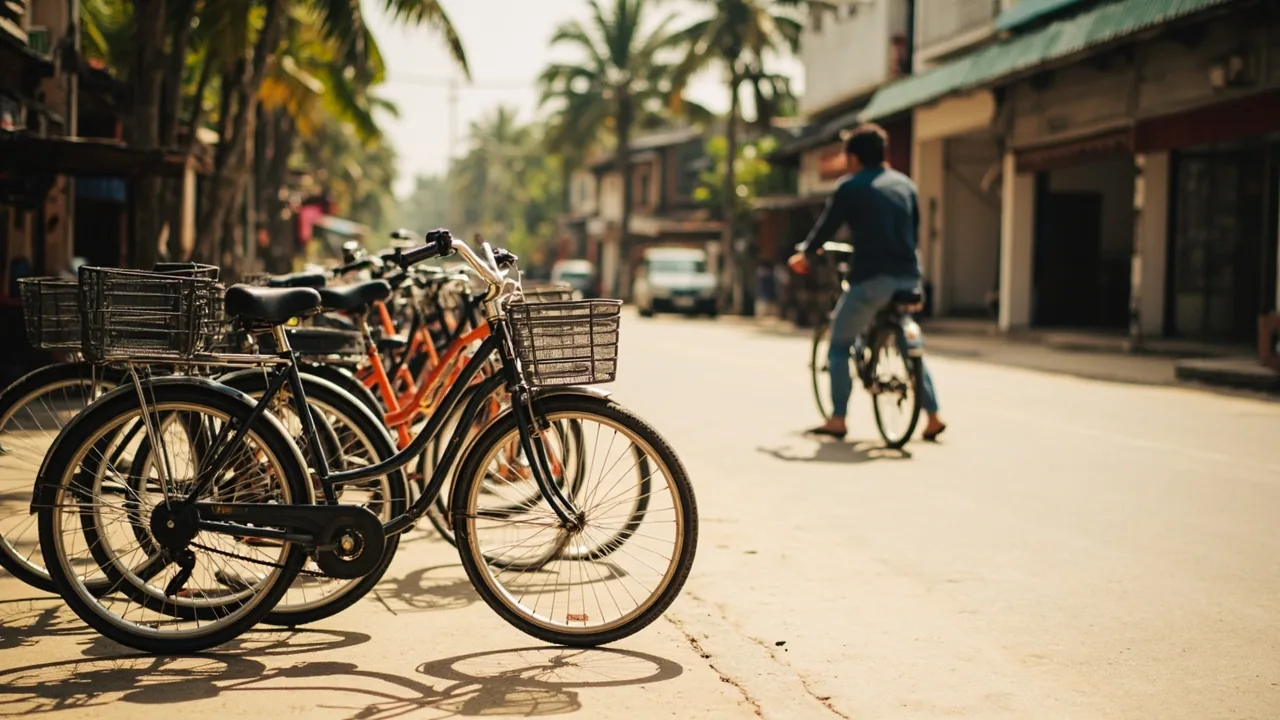
Cycling Tours to Siem Reap (2026)
If you are hunting for a siem reap niche activity that is more than temple-hopping, this one fits. A guided point-to-point ride from Sihanoukville or Kampot to Siem Reap runs 6 to 8 days, costs roughly ₹81,943 (~850 USD) to ₹134,965 (~1,400 USD) for the whole package, and ends with a sunrise at Angkor Wat. For context on what the rest of a multi-country Indochina loop costs, see our SE Asia trip cost from India breakdown. Prices and routes on this page were. Planning the wider region? Our Southeast Asia backpacking hub covers the full multi-country route.
What Is a Siem Reap Cycling Tour, Exactly?
A Siem Reap cycling tour is a guided or self-guided bike ride through the Cambodian countryside, usually on a touring or hybrid mountain bike with panniers, mechanical support, and a support vehicle trailing the group. Multi-day versions are point-to-point rides that start at the coast (Sihanoukville or Kampot) and finish in Siem Reap, passing through rural villages, rice paddies, pagodas, and the occasional pepper farm. Single-day versions stay within an hour of Siem Reap and loop through floating villages, lotus fields, and temple-adjacent countryside. This guide covers the practical route, cost, and booking steps for travellers treating it as their siem reap niche activity of choice, and a rewarding one at that, if you like slow travel..
Quick Answers
| What | Answer | Price (INR) |
|---|---|---|
| Multi-day coast-to-Siem-Reap ride | 6 to 8 days, guided, with support van | ₹81,943 (~850 USD) to ₹134,965 (~1,400 USD) |
| Single-day Siem Reap countryside loop | 25 to 45 km, lunch included | ₹3,374 (~35 USD) to ₹6,266 (~65 USD) |
| Self-guided day ride (bike rental) | Hybrid or mountain bike, full day | ₹771 (~8 USD) to ₹1,446 (~15 USD) |
| Best months to ride | November to February (dry season) | , |
| Typical group size | 4 to 12 riders | , |
| Booking platform | GetYourGuide or direct operator | , |
At current rates (1 USD = ₹96.33, 1 KHR = ₹0.0238).
Step-by-Step: How to Book and Ride Coast to Siem Reap
Step 1: Pick your version (point-to-point vs. Siem Reap-based loop)
The first decision is whether you want the multi-day coast-to-Siem-Reap ride, or a 1 to 2 day loop based in Siem Reap itself. Travellers with 7 to 10 days choose the point-to-point. Travellers who already flew into Siem Reap and want one active day pick the loop.
- Point-to-point (coast to Siem Reap): 6 to 8 days, 40 to 70 km per day, full vehicle support, accommodation and most meals included.
- Siem Reap loop (1 to 2 days): 25 to 45 km per day, lunch included, return to the same guesthouse.
Step 2: Pick your month (this matters more than the operator)
Cambodia has two seasons: dry (November to February) and wet (May to October). Cycling in the wet season is technically possible but miserable, with red mud on the clay roads and 90% humidity. November through February is the sweet spot. December and January book out 4 to 6 weeks ahead because of European Christmas tours.
Subodh’s Pro Tip: If your dates are flexible, aim for the first two weeks of November or the last two weeks of February. You get dry roads, fewer tourists, and operators sometimes drop group prices to fill the bike.
Step 3: Book the tour (and read the small print)
Booking notes that apply across operators on this route:
- The coast-to-Siem-Reap route is usually run with hybrid bikes, a support van carrying your big bag, and a Cambodian guide with strong English.
- Mid-range tours often focus on family-run Khmer restaurants for lunch rather than tourist cafes.
- Some operators cater to travellers from India and South-East Asia and may have a Hindi or Tamil-speaking guide available on request; confirm availability at the time of booking.
Book direct on the operator’s website, or browse the GetYourGuide Siem Reap cycling listings if you want a pay-later or cancellable reservation. For the multi-day point-to-point, expect to pay 30% to 50% deposit upfront via Wise or bank transfer, with the balance in USD cash on arrival.
Step 4: Get your Cambodia visa before you fly
You can ride into Siem Reap from the coast, but you still need to enter Cambodia legally first. Indian passport holders can apply for an e-visa online at evisa.gov.kh before they fly. The e-visa is what most cyclists pick because it lets you skip the visa counter when you land in Sihanoukville tired and ready to ride.
- E-visa fee: ₹2,892 (~30 USD) plus a ₹578 (~6 USD) processing fee, total ₹3,471 (~36 USD).
- Processing time: 3 business days, sometimes faster.
- Validity: 90 days from issue, single entry, 30-day stay.
⚠️ This changes often. Check evisa.gov.kh before paying, and use only the official .gov.kh domain, not the dozens of .com sites that charge double.
Step 5: Sort your money before you fly
Cambodia runs on USD cash for almost everything. You carry it, you hand it over, you get change in riel. ATMs in Sihanoukville and Siem Reap charge ₹482 (~5 USD) per withdrawal, so withdraw the maximum (₹19,281 (~200 USD) to ₹48,202 (~500 USD)) once and stop. For the bigger picture on carrying and converting money abroad from India, see our carry money India abroad primer.
- Forex card: A Niyo or Fi card loaded with USD works at most ATMs with no foreign transaction fee, but ₹482 (~5 USD) ATM fee still applies. Wise works the same way.
- UPI: Does not work in Cambodia. Do not budget for it.
- Cash: Carry ₹38,561 (~400 USD) to ₹57,842 (~600 USD) in clean, unfolded USD bills for the first week. Smaller bills (₹96 (~1 USD)) are useful for tipping guides.
Step 6: Pack for the ride, not for the city
Most operators give you a packing list, but the short version below is tuned for the clay-road sections between Kampot and Siem Reap. For a broader checklist, our packing list for SE Asia covers the rest of the kit.
- Padded cycling shorts (one pair is enough, hand-wash overnight).
- Lightweight rain jacket (December to February is dry, but a freak shower happens).
- Buff or bandana for dust on the clay roads.
- Sunscreen SPF 50, refillable water bottle, electrolyte sachets.
- A small daypack for the support van so you can leave your big bag in transit.
Operators supply the bike, helmet, panniers, water bottles, and a basic repair kit. Bring your own clip-in pedals if you have a fit preference.
Step 7: Ride, eat, and acclimatise
Multi-day tours do 40 to 70 km per day with a long lunch stop and a cultural visit in the afternoon (a pagoda, a pottery village, a rice-paper workshop). Mornings start at 6:30 AM to avoid the 11 AM heat, and you usually finish by 2 PM.
Lunch is usually at a family-run Khmer restaurant on the route, with dishes like bai sach chrouk (grilled pork over rice), lok lak (stir-fried beef in Kampot pepper sauce), and kuy teav (rice-noodle soup). On rest days you can usually swap to a vegetarian Khmer set. Two of the better spots cyclists end up at on the Siem Reap side are:
- MAOM Khmer Cuisine (Authentic Khmer cuisine with traditional flavours and local ingredients. The fish amok and the Khmer curry are what cyclists usually order after a long ride.)
- Street Three Eatery Siem Reap (Street food-inspired menu with Asian dishes. Travellers report it is the easiest place in town to find a quick, affordable Khmer set lunch between two temple visits.)
For Indian food when the rice-and-fish routine gets old, Paratha House & Academy Siem Reap has the Hyderabadi dum biryani and paratha rolls cyclists tend to crave by day four, and Dakshin’s restaurant Siemreap does a clean South Indian thali that vegetarians tend to prefer.
Step 8: End in Siem Reap, then add a temple day
Most point-to-point tours finish in Siem Reap on day 6, 7, or 8 with a rest evening at a guesthouse near Pub Street. The next morning is sunrise at Angkor Wat, which you can book as a half-day add-on through your operator or directly on GetYourGuide.
A few standouts Indian travellers end up booking:
If you have one extra day after the ride, the City Walking Tour is the better add-on than another temple, because it covers the artisan quarter, the old market, and a couple of cafés that cyclists with sore legs appreciate.
Common Mistakes Indians Make
Mistake 1: Booking a tour in monsoon season to save money
What people do wrong: They book a July or August tour because the operator is offering 30% off. What happens: The clay roads turn to mud, support vans get stuck, two of the seven riding days get cut, and the guide offers refunds for the missed days that never arrive. How to avoid it: Stick to November to February. If your trip is fixed for the wet season, book Social Cycles in Phnom Penh instead of the coast ride, because the roads around Phnom Penh hold up better.
Mistake 2: Carrying INR and expecting to exchange at the border
What people do wrong: They bring Indian rupees because they heard Cambodia is “flexible” with currency. What happens: Cambodian money changers will not touch INR. You arrive with no usable cash and have to use a bad-rate airport ATM. How to avoid it: Carry USD from India. Withdraw from an Indian bank ATM at the airport using your forex card, or buy dollars from a licensed Indian money changer before flying.
Mistake 3: Skipping travel insurance for a multi-day bike ride
What people do wrong: They assume Cambodia is safe enough to skip insurance on a ₹96,404 (~1,000 USD) bike trip. How to avoid it: Buy SafetyWing before you fly. It covers cycling as a non-motorised activity and includes emergency evacuation, which matters on rural Cambodian roads. For a side-by-side of policies popular with Indian riders, see our travel insurance India SE Asia breakdown.
Mistake 4: Bringing a brand-new saddle
What people do wrong: They assume the operator’s saddle is fine and do not train. What happens: Day two, 50 km in, every rider in the group is walking up the hills. How to avoid it: Ride 200 to 300 km on the operator’s saddle type (usually a Giant or Trek stock saddle) in the month before your trip. Two long rides per week is enough.
Mistake 5: Assuming Pub Street is the centre of Siem Reap
What people do wrong: They book a hotel near Pub Street because every search result says so. What happens: They walk 15 minutes to the operator’s pickup point every morning, and they hear the Bass Nation-style EDM from the bars until 3 AM. How to avoid it: Stay in the Wat Bo area, which is quieter than staying in Pub Street itself.
What Most Guides Don’t Tell You
The support van is your friend, not your failure
Indian cyclists tend to feel guilty hopping into the support van on a hot day. The operators expect 10% to 20% of riders to take a half-day or full-day van ride during a 7-day tour, especially on the second day when the legs have not warmed up. If you feel cooked, get in. The point is to enjoy the countryside, not to prove anything.
Cambodia is flatter than you think
The coast-to-Siem-Reap ride is not a mountain tour. The total elevation gain over 6 days is around 800 to 1,000 metres, which is less than a single Ladakh day. The challenge is the heat, the humidity, and the long days in the saddle, not the climbing. If you can ride 40 km at home without dying, you can finish the tour.
Your Indian SIM will roam, but slowly
Indian Jio and Airtel roaming technically works in Cambodia, but the speeds are 2G-ish and the per-day charge adds up fast (₹289 (~3 USD) to ₹482 (~5 USD) per day depending on plan). A local Cambodian SIM from Cellcard or Smart costs ₹482 (~5 USD) for 30 days of 4G data, which is enough for Google Maps, Grab, and WhatsApp. Pick one up at the Phnom Penh or Siem Reap airport on arrival.
The off-the-beaten-path stops are real, but the operators rotate them
Every operator lists a “village visit” or “artisan workshop” stop. These rotate seasonally because the villages get tired of 30 tourists a week. The ones currently worth asking about are the lotus silk farms outside Siem Reap, where you can watch weavers pull silk from lotus stems by hand. Book Siem Reap Lotus Silk Farm - Lake Experience tour if your operator does not include one in the route.
Border checkpoints along the coast route are routine, not scary
Some riders worry about military or police checkpoints on the rural roads. Travellers report these are routine traffic stops where the guide handles everything in two minutes, and you will be waved through without showing a passport. Do not let the idea of a “checkpoint” put you off the tour.
Safety Alert: Cambodia is politically stable for tourists, but the MEA travel advisory is updated periodically. Before you ride, check the current advisory at mea.gov.in and the destination’s own advisories. For day-of routing, ask your operator’s guide, who is trained on the current local situation and will reroute the group if a particular stretch becomes unsafe.
FAQ
Is the coast-to-Siem-Reap ride suitable for beginners?
Yes, if you can ride 30 to 40 km on flat ground at home without rest. The tour is more about endurance than technical skill. The support van is always behind you, so you can hop in for any stretch that feels too much.
Can I do the ride without a guide?
Technically yes, but practically no. Self-guided cycling in rural Cambodia means carrying your own bike, finding your own food, navigating unmarked clay roads, and dealing with the occasional aggressive dog. The guided tour exists because the logistics are hard, and the value is in the guide’s local knowledge, not just the bike.
How fit do I need to be?
Fit enough to ride 50 km on back-to-back days in 30°C heat. If you currently run 5 km twice a week or cycle on the weekends, you can finish the tour with a month of prep. The operators do not screen riders, so the bar is “don’t collapse.”
What is the food like on tour?
Cambodian home cooking, eaten family-style at small Khmer restaurants on the route. Rice, grilled fish or pork, a clear soup, and a vegetable stir-fry are standard. Vegetarian options are available at every stop if you ask a day ahead. The one thing most riders miss is spicy Indian food, which is why the Indian restaurants in Siem Reap exist.
Can I extend the ride to Phnom Penh?
Yes, most operators offer a Phnom Penh-to-Siem-Reap version (4 days, 220 km) for travellers who do not want the full coast ride. It costs less (₹53,022 (~550 USD) to ₹77,123 (~800 USD)) and uses the same support setup.
When should I book?
At least 6 weeks ahead for December, January, and February departures. November and March tours can usually be booked 2 to 3 weeks ahead. Solo riders can sometimes join a group departure on short notice, which is the cheapest way in.
Do I need to speak Khmer?
No. Every guide on these tours speaks English, and the better ones speak a few phrases in Hindi, Tamil, or Chinese. You will get by with English and a smile.
Subodh’s Take
Cycling from the Cambodian coast to Siem Reap is the kind of trip Indian backpackers find by accident and then tell their friends about for years. It is not the cheapest way to see Cambodia (a bus costs ₹1,446 (~15 USD)), but it is the slowest, the most human, and the only one that lets you roll into Angkor Wat having earned the sunrise. Whatever you pick, do it in November to February, carry USD from India, and skip Pub Street for the Wat Bo area when you finally land in Siem Reap. To size up the day-to-day spend in neighbouring Thailand for comparison, our average spend in Thailand per day piece is a useful cross-check.
Where to Stay
Most cyclists base themselves in the Wat Bo area, which is closer to the standard morning pickup point than staying in Pub Street itself. If you are weighing hostel options, our hostel etiquette guide covers dorm-room basics before you book.
