Getting Around Myanmar: Buses, Trains, Flights & Local Transport Explained
The Myanmar transport system is a strange patchwork in 2026. Domestic flights still work on most major tourist corridors, the Yangon. Mandalay railway still runs (slowly), and the highway bus network is the backbone of overland travel. What does NOT work reliably is the ride-hailing app scene: Grab has thinned out across most of the country after 2024, and the big-name alternatives keep changing their names and service zones. Indian travellers used to Grab in Bangkok or Hanoi will feel the gap. The good news is that the road transport options between cities are still well-documented, ticket prices are predictable, and the local options (trishaws, motorbikes, taxis) still operate on the ground. Just plan every long-distance leg in advance, and assume you’ll pay cash for almost everything. For related planning, see our guides on Sea Backpacking Hub and Yangon Airport Car Rental.
This guide covers what moves in Myanmar right now: domestic flights on the Yangon. Bagan. Mandalay. Inle triangle, the railway, long-distance buses (VIP, ordinary, sleeper), the Yangon airport taxi scene, ride-hailing, motorbike rental realities, and the trishaw-and-taxi options that still work in central Myanmar. You may also find Yangon to Bagan Sleeper Bus Guide useful for this trip.
Quick Answers
| What | Answer | Price (INR) |
|---|---|---|
| Cheapest way Yangon to Bagan | Ordinary highway bus, 9–10 hours | ₹1,445 (~15 USD) |
| Fastest way Yangon to Bagan | Domestic flight, ~1 hour 20 minutes | ₹2,500-₹5,000 (~$25.95-$51.90) |
| Yangon to Mandalay overnight bus | VIP/sleeper bus, 8–9 hours | ₹1,734 (~18 USD) |
| Yangon airport to downtown taxi | Official airport taxi counter | ₹1,156 (~12 USD) |
| Local ride-hailing status (2026) | Grab coverage reduced; local apps only in Yangon | , |
Price note: 1 USD = ₹96.5289 at current rates. All on-the-ground transport prices below are in USD or Myanmar Kyat (MMK) only. See also: How to Get From Yangon to Bagan.
Domestic Flights: The Fastest Way Between Tourist Hubs
For Indian travellers doing the Yangon → Bagan → Mandalay → Inle Lake loop, domestic flying is the default. The highway network is slow, the trains are scenic but slow, and bus overnighters eat a full travel day. For related planning, see our guide on Yangon to Bagan Flight Schedule.
The three carriers that matter are Myanmar National Airlines (the flag carrier, code UB), Air KBZ (code 7Y), and Golden Myanmar Airlines (code Y5). All three sell tickets on the Yangon. Nyaung U (Bagan), Yangon. Mandalay, Yangon. Heho (for Inle Lake), and Mandalay. Heho routes. Schedules shift, but the route map has stayed roughly the same for a decade.
Yangon to Bagan is the most frequent route, with multiple daily flights on each carrier. Yangon to Heho tends to be 1–2 flights daily. Mandalay to Heho is the shortest sector (under 30 minutes in the air) and worth flying if your time is tight. Prices fluctuate; peak season (November. February) runs higher, monsoon (June. September) drops.
Subodh’s Pro Tip: Book Yangon. Bagan and Yangon. Heho at least a week ahead in season. The Yangon. Mandalay expressway has eaten some of the flight demand on that corridor, so Mandalay flights often have seats 2–3 days out. Carry printed confirmation; the e-ticket PDF on your phone has been enough at Yangon and Mandalay airports, but smaller airports like Nyaung U have asked for paper.
Myanmar’s e-visa is the only reliable entry option for Indian passport holders (₹4,817 (~50 USD), single entry, up to 28 days, applied through evisa.moip.gov.mm). VoA is suspended. The political and security situation is highly variable: most Indian travellers should check the current MEA advisory at mea.gov.in before booking any Myanmar trip in 2026, and treat the e-visa fee as sunk cost until you’ve decided you’re going.
The Yangon. Mandalay Railway
The railway is one of the great slow-travel experiences left in Southeast Asia. The Yangon. Mandalay line takes roughly 14–16 hours end to end, depending on the train number, and trains are still steam-era slow on the older rolling stock. The new express services are faster but cost more.
For backpackers, the upper-class sleeper on Train 11 (Yangon → Mandalay, overnight) or Train 12 (return) is the classic. The upper berth gives you a comfortable bed, the lower berth is fine for taller travellers, and the dining car does surprisingly edible rice-and-curry sets. The train stops at major junctions including Bago, Naypyidaw, and Thazi.
Tickets sell out in high season (December. January, around the Thingyan water festival in April). Book at the station counter 1–3 days ahead, or through a Yangon travel agent.
Safety Alert: The Mandalay. Muse railway line (toward the Chinese border at Ruili) has been affected by northern Shan State fighting multiple times in recent years and remains unreliable for foreign travellers. Stick to the Yangon. Mandalay mainline and the Yangon. Bagan branch services if you’re going by train.
The rail map is also a useful Myanmar transportation map reference in itself: the lines out of Yangon fan north to Mandalay, west toward Pathein, and there’s a branch to Bagan via a junction at Nyaung Shwe. If you understand which lines exist, planning a multi-stop trip gets much easier. For visual reference and current schedules, cross-check with the official Myanmar Railways notice board at Yangon Central station.
Long-Distance Buses: The Highway Network
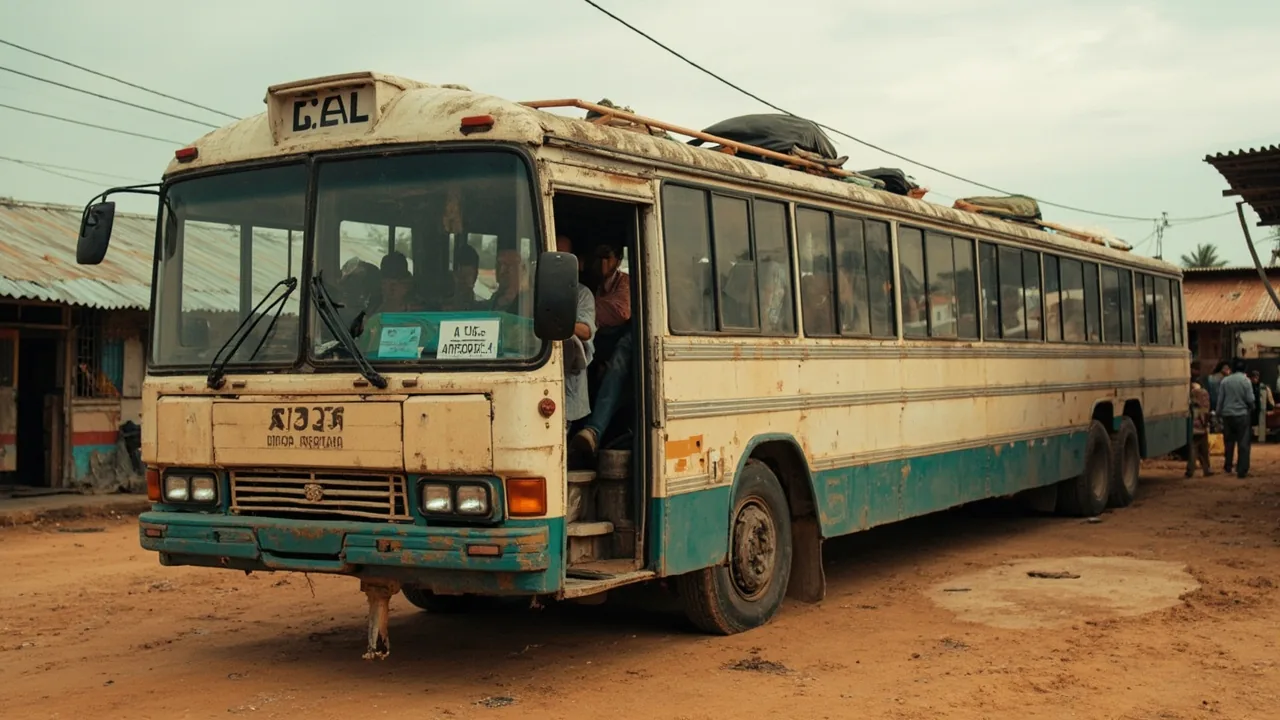
Myanmar’s highway bus network is the workhorse of the transport system. The Yangon. Mandalay Expressway opened in stages through the 2010s and cut Yangon. Mandalay road time to about 8–9 hours by bus, depending on stops. The Yangon. Bagan corridor runs overnight, mostly on regular highways (not the expressway), and takes 9–10 hours.
Major bus operators on these routes include JJ Express, Elite, and a handful of smaller companies. Most overnight buses on the Yangon. Mandalay expressway are now VIP class: air-con, reclining seats that lean back almost flat, a small bottle of water, and a single rest stop. Sleeper buses (proper flat beds, not just recliners) run on the Yangon. Bagan route.
Booking: you can book through the operator’s office in Yangon, a Yangon-based travel agent, or through 12go. For current schedules and seat selection, Find rides on 12go is the most reliable aggregator.
Practical seat tip: on overnight Yangon. Bagan buses, the back-left sleeper pod tends to be smoother (further from the engine, fewer gear changes from the driver). For the expressway VIP buses to Mandalay, the front rows get slightly more legroom.
Yangon Airport to City: Taxis and the Ride-Hailing Gap
Yangon International Airport (RGN) is the main international gateway. It’s about 30–45 minutes from downtown depending on traffic, and the official airport taxi counter at arrivals charges a flat fare that matches the canonical ₹771-₹1,156 (~8-12 USD) range. Pay at the counter, take the receipt, hand it to the driver. This is the safest option and avoids the taxi touts who hang around outside.
Grab was the ride-hailing app of choice through 2023 and early 2024. Coverage has since thinned dramatically. In 2026, you’ll mostly find Grab working for rides within central Yangon (around downtown, the Bogyoke area, and Bahan), but drivers are scarce at the airport and unreliable in the evenings. Outside Yangon, Grab is largely non-functional in tourist cities.
The practical workaround is to ask your hotel or guesthouse to arrange an airport pickup for a similar flat fare, or book a taxi through the airport counter. For Mandalay airport (MDL), the same airport taxi counter system applies, and there’s no working ride-hailing app at all in 2026.
For local Yangon rides during the day, the older taxi companies (Hello, Elite, and a few smaller ones) still answer phone calls and WhatsApp messages. Ask your guesthouse for a number. Cash in Myanmar Kyat is the only payment option.
Mandalay, Bagan, and Inle: Local Transport on the Ground
Mandalay has the most usable public transportation of any Myanmar tourist city outside Yangon. Motorbike taxis (called “myo ha”), trishaws (bicycle rickshaws in the old city), and small private taxis are everywhere. There’s also a working municipal bus network, but it’s slow and the route maps are mostly in Burmese; ask locals at your guesthouse for the right number.
Bagan (the Nyaung U area) is the one place in Myanmar where motorbike rental is genuinely useful for tourists. The temple plain is huge, scattered across a 40-square-kilometre area, and the easiest way to cover it is your own bike. Rentals are usually 8,000–15,000 MMK per day for a small automatic scooter, or 15,000–25,000 MMK for a 250cc manual geared bike. You’ll leave your passport as deposit at most shops. Carry your motorbike licence from India if you have one, but enforcement is light in Bagan compared to Thailand.
Inle Lake / Nyaung Shwe has a different setup: the lake itself is covered by longtail boats, and the town of Nyaung Shwe is small enough to walk. Bicycle rental (2,000–5,000 MMK per day) is the standard way to reach nearby villages, wineries, and the canal boat pickups.
Safety Alert: Motorbike rentals in Bagan and around Inle are far less regulated than in Thailand or Vietnam. Insurance coverage is zero. If you crash, you pay for everything yourself and your travel insurance may not respond because Myanmar isn’t on every insurer’s active coverage list. Confirm Myanmar is in your policy’s covered-country list before renting. SafetyWing covers Myanmar; many European and US backpacker policies exclude it.
Where to Eat: Burmese Food and the Indian/Veg Fix
Between buses, trains, and flights, you’ll eat at least two meals a day on the road. Burmese food is rice-and-curry heavy, often with a meat or fish element, but pure-veg options exist in tourist zones.
For proper Burmese plates, the reliable Yangon stops are places like Unique Myanmar Restaurant (around the downtown area, 4.2 rating), the Shwe Myanmar (1) branch restaurants serving traditional rice-and-curry sets, and Aung Thu Kha Traditional Myanmar Food House if you want a family-style local setting without a tourist markup. A bowl of mohinga (the fish-noodle breakfast soup) runs about 2,500–4,000 MMK at a local stall, and a rice-and-curry plate with three sides is 4,000–6,000 MMK.
For the Indian/veg fallback, The Moon Vegetarian Restaurant (Yangon, 4.4) is the most consistent pure-veg Burmese option. In Mandalay, Unique Mandalay Tea Room serves light Burmese-Chinese snacks and tea, and Izakaya AKIMOMI Mandalay Branch (5.0 rating) is the unexpected find: an authentic Japanese izakaya in Mandalay, useful when you need a non-rice meal.
If you’re in Bagan or Inle, every guesthouse in Nyaung U and Nyaung Shwe can direct you to a veg-friendly spot within walking distance. The standards are simpler than Yangon, but a plate of fried rice with egg plus a side of vegetables is universally available.
Getting Connected: SIM and eSIM
Working data matters for everything from booking overnight buses to checking Yangon flight delays. The two main physical SIM options are MPT (Myanmar Posts and Telecommunications) and Telenor Myanmar (now rebranded as Atom in some regions). MPT tourist SIMs at Yangon airport run about 15,000–20,000 MMK with a few GB of data; Telenor/Atom tourist SIMs are similar but with better 4G coverage in tourist areas.
You need your passport to register either SIM. Activation is usually instant at airport counters. If you’d rather skip the airport queue and the Myanmar-specific SIM process, Get Nomad eSIM gives you regional Southeast Asia data coverage you can set up before flying.
Safety Alert: Mobile coverage drops sharply in conflict-affected states (parts of Shan, Kachin, Rakhine, Chin). Don’t expect data in those areas even with a local SIM, and reconsider travel there entirely.
Common Transit Mistakes Indians Make
Mistake 1: Assuming Grab works everywhere in Myanmar the way it does in Bangkok. What happens: you wait 25 minutes for a car that never comes, then pay double to a tout taxi. How to avoid it: book airport pickups through your guesthouse, use the airport taxi counter, and treat any Grab booking outside central Yangon as a bonus if it works.
Mistake 2: Leaving your actual passport as motorbike rental collateral in Bagan. What happens: passport gets held for 24 hours while you wait for the shop to open the next day, and if anything goes wrong with the bike you can’t leave the country until it’s sorted. How to avoid it: ask if a photocopy plus a cash deposit (typically 50,000–100,000 MMK) is acceptable. Most shops will agree.
Mistake 3: Taking the cheap “ordinary” Yangon. Mandalay bus expecting VIP quality. What happens: the ordinary bus stops at every town, has no AC, and takes 14 hours. How to avoid it: pay the VIP fare on the expressway, it’s about 30–40% more but cuts 5 hours off the trip.
Mistake 4: Flying into Heho without checking the Inle Lake boat schedule. What happens: you land at 4pm, miss the last boat transfer to Nyaung Shwe, and end up paying for a 45-minute taxi instead. How to avoid it: book a flight that arrives before 3pm, or pre-arrange a taxi through your guesthouse.
Mistake 5: Treating Myanmar as a Bangkok-style destination for short stays. What happens: flights and buses run less frequently, and one missed connection blows a full day. How to avoid it: add buffer days to your itinerary, especially on the Bagan → Inle → Yangon return chain.
FAQ
Is Grab still working in Myanmar in 2026? In Yangon’s central districts, yes, though driver availability is patchy. In Mandalay, Bagan, Inle, and Ngapali, no. Use guesthouse-arranged taxis and the airport counters instead.
How long is the Yangon. Mandalay bus journey? On the expressway, 8–9 hours by VIP bus. The ordinary highway bus is 12–14 hours with more stops. Trains are 14–16 hours.
Can I take the train from Yangon to Bagan? Not directly. There’s a branch from the main Yangon. Mandalay line at a junction, and the combined journey via a connection at Thazi takes 18+ hours. Fly or take the overnight bus instead.
What is the Myanmar e-visa fee for Indian passport holders? ₹4,817 (~50 USD) for a single-entry e-visa, valid up to 28 days, applied only through evisa.moip.gov.mm. VoA is suspended.
Is it safe to travel overland from Yangon to Mandalay right now? The Yangon. Mandalay expressway is the most stable overland corridor and is widely used by foreign tourists. Northern routes toward the Chinese border are not. Check the MEA advisory at mea.gov.in and your government’s current advisory before departure.
Subodh’s Take
Myanmar’s transport system still works, but it works the way it did before ride-hailing apps dominated Southeast Asia: book long-distance legs in advance, pay cash, and build in buffer days. The Yangon. Bagan flight is one of the best-value domestic flights in the region at under 1.5 hours for the price of a Thai domestic hop. The Yangon. Mandalay train is worth doing once for the experience, not for the speed. Skip Grab expectations outside central Yangon, and you’ll have a smooth trip.
