Yangon to Bagan Sleeper Bus: The Honest Guide for Budget Travelers Who Hate Paying for Flights
The Yangon to Bagan overnight bus is the cheapest way to cover Myanmar’s most famous overland corridor, and flying is faster and easier, no question. This guide is for budget travelers weighing that trade-off. For related planning, see our guide on Sea Backpacking Hub.
A few honest caveats before we start: Myanmar’s tourist infrastructure is thinner than Thailand’s or Vietnam’s, and the situation has been volatile through 2025 and into 2026. Check the current MEA travel advisory on mea.gov.in and the Myanmar Ministry of Hotels and Tourism site before you commit. The Yangon to Bagan corridor is well-trodden and considered one of the safer long-distance routes, but conditions on the ground shift faster than any guide can keep up with. Plan with that in mind.
Quick Answers
| What | Answer | Price (INR) |
|---|---|---|
| Sleeper bus ticket (Yangon to Bagan) | ₹771-₹1,445 (~8-15 USD), VIP class is ₹1,156-₹1,445 (~12-15 USD) | ₹771-₹1,445 (~8-15 USD) |
| Journey time | 7-9 hours overnight, usually 20:00 to 04:00-05:00 | |
| Main departure terminal | Dagon Ayeyar Highway Bus Station (south Yangon) | |
| Arrival in Bagan | Bagan-Nyaung Shwe bus terminal, then tuk-tuk to guesthouse | |
| Bus classes available | Ordinary, Express, VIP (with proper flat sleeper berth) |
Prices above convert at current rates (1 USD = ₹96.53). The bus ticket range of 8-15 USD comes from current operator pricing on the ground, with VIP at the top of that range.
Why Take the Bus Instead of Flying
A one-way Yangon to Bagan flight on airlines like Air KBZ, Myanmar National Airlines, or Mann Yadanarpon runs roughly ₹3,372-₹5,299 (~35-55 USD) if you book a few days ahead through a local agent, sometimes cheaper if you catch a promo. The sleeper bus does the same journey for ₹771-₹1,445 (~8-15 USD). That’s a savings of ₹2,408-₹4,335 (~25-45 USD), which in Myanmar goes a long way: two nights in a decent Bagan guesthouse, three days of e-bike rental to loop the temples, and most of a week of dal-chawal at the local Indian spots if you pace yourself.
The trade is real: you lose 7-9 hours, you arrive groggy, and on rough stretches of the highway the ride can be bumpy. If you have limited days in Myanmar and Bagan is the priority, fly. If you’re on a longer loop with time to spare and want to keep the daily spend low, the bus is the smarter call. Many travelers do the bus on the way there to save money, then fly out of Bagan to their next stop.
Which Bus Terminal in Yangon
The Yangon to Bagan sleeper bus leaves from Dagon Ayeyar Highway Bus Station in the south of the city, near Dagon Township. The older “Highway Bus Station” in the center (near Aung Mingala) does run some Bagan services too, but most VIP operators and the highest-frequency departures are at Dagon Ayeyar. Get there by 18:30 if your bus is listed for 19:00 or 20:00. The terminal is large, the signage is mostly in Burmese script with some English, and the booking offices cluster around the main hall entrance.
Tuk-tuks run the route from central Yangon to Dagon Ayeyar for around 6,000-8,000 MMK; ride-hailing apps are unreliable in Myanmar due to payment and network restrictions, so plan for a metered or negotiated tuk-tuk instead. Allow 30-45 minutes from downtown in evening traffic, more if it’s raining. If you’re staying in the backpacker area near Shwedagon Pagoda or around 19th Street in Chinatown, budget an hour door-to-door. For more on local Yangon transport including car rentals, see our Yangon airport car rental guide and the rent tuk-tuk Yangon tourists guide.
Subodh’s Pro Tip: Take a photo of your bus operator’s office counter and the bus number plate before you walk away from the booking desk. The terminal gets chaotic at boarding time, and operators sometimes shuffle berth assignments between booking and departure. Having the plate number lets you find the right bus fast when 200 locals and 15 tourists are all queueing at once.
Bus Classes: Ordinary, Express, VIP
Myanmar’s long-distance buses split into three classes that matter for this route:
Ordinary is the cheapest tier and the one to avoid for an overnight run. Padded seats that recline to maybe 140 degrees, no individual reading light, shared USB ports (if any), and the toilet situation is whatever roadside stop the driver chooses. Save this class for short daytime hops, not for sleeping.
Express is a real step up. Reclining seats that go nearly flat, individual blankets on overnight runs, and a slightly higher price. Fine if you’re a light sleeper and just need horizontal for 6 hours.
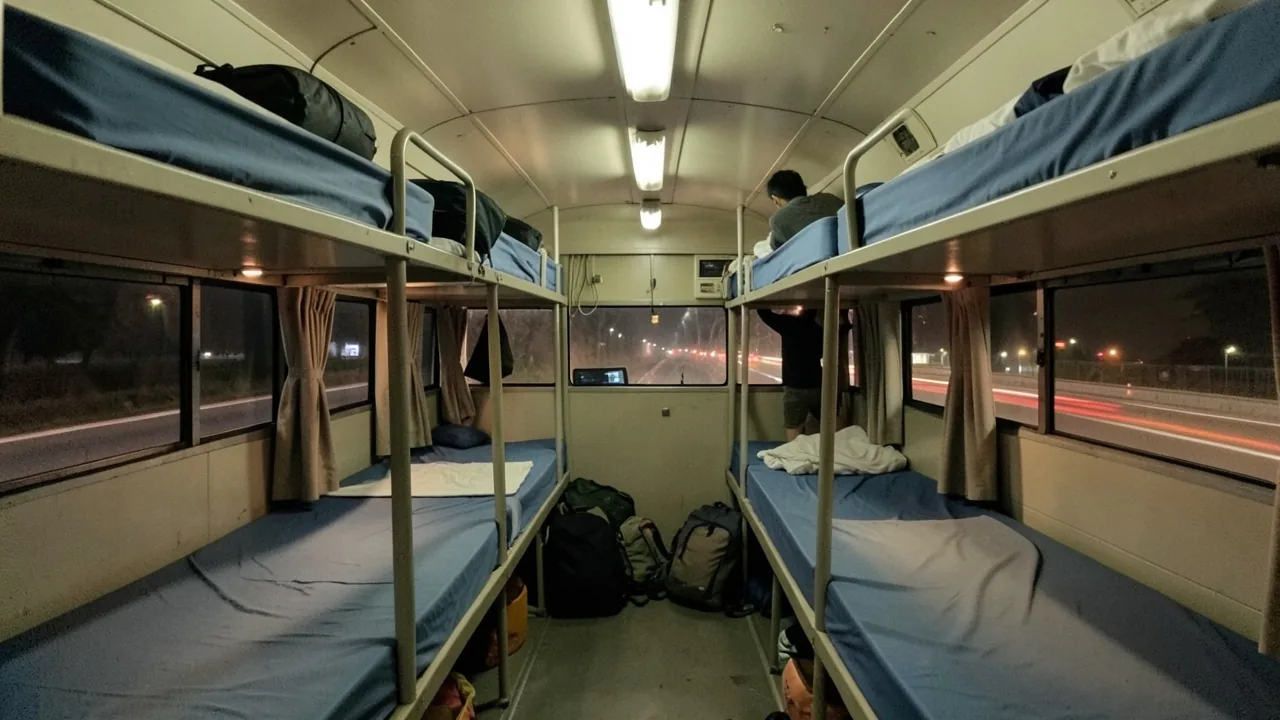
VIP is what you want for this overnight run. A proper flat sleeper berth (either single or double bunk layout, depending on the operator), individual reading light, a small bottle of water, sometimes a snack box, and cleaner blankets. The buses are newer and the drivers tend to drive more carefully on rough patches. This is the ₹1,156-₹1,445 (~12-15 USD) tier. The double-bunk VIP sleeper is the most common layout: two rows of bunks on each side, with a curtain you can pull across for privacy. The lower bunk is easier to get in and out of (good for the bathroom trips), the upper bunk is quieter but requires a small climb.
For most Indian travelers on this route, VIP is the right call. The price difference between VIP and ordinary on this corridor is small in absolute terms, and you arrive functional instead of wrecked.
What the Cabin Looks Like
The VIP sleeper on Yangon to Bagan routes is air-conditioned hard, sometimes too hard. Bring a long-sleeve layer even in the dry season. The berth mattress is firm, narrower than a Western single bed but fine for a backpacker. You get a thin blanket and a small pillow. There’s usually a small personal light and a phone-charging point (sometimes a working USB, sometimes a 12V socket that needs your own car charger).
The aisle is narrow. If you’re over 6 feet tall, the upper bunk fits you but the lower bunk’s foot clearance is tight. There are no individual TVs on this route like there are on Vietnamese sleeper buses. What you do get is a decent window view of the dry zone countryside through Mandalay Region.
The bathroom at the back of the bus exists, sometimes works, sometimes doesn’t, and the stop-and-go answer on a 7-9 hour run is the same as every other Southeast Asian sleeper bus: bring your own toilet paper, hand sanitizer, and plan around the 1-2 official food stops rather than trusting the onboard toilet.
Booking the Ticket
Three realistic options for Indian travelers:
At the bus terminal in person is the simplest. Walk into Dagon Ayeyar the day before or earlier in the day of departure, find your operator’s counter (most are clustered near the entrance), pay cash in MMK, and walk out with a printed ticket. Staff at the main counters usually speak enough English to confirm the destination, departure time, and berth class. Pay in Myanmar Kyat if you can: rates quoted in USD at the counter are sometimes marked up by 10-15% over the kyat rate.
Through your Yangon guesthouse is the easiest if you don’t want to navigate the terminal solo. Most guesthouses in the backpacker belt will book on your behalf for a small markup (1,000-2,000 MMK). Worth it if you’re short on time or new to Myanmar.
Online via 12go is hit-or-miss for the Yangon to Bagan corridor specifically. 12go is excellent for Vietnamese and Thai buses, but Myanmar coverage is patchier and some VIP operators don’t list on the platform. For longer multi-leg trips in the region, 12go is one option to compare schedules, but for this specific Yangon to Bagan corridor, in-person or guesthouse booking usually gets you a better price and a confirmed berth.
Pay in MMK cash. Cards are almost never accepted at the bus terminal, and ATMs in Yangon can be temperamental. Carry enough kyat for the ticket plus buffer for food stops and tuk-tuk at the Bagan end.
Food Stops and What to Eat
The bus pulls over twice on the run, usually once around midnight (around 80 km out of Yangon) and once around 03:00 (closer to the halfway point). Both stops are basic roadside teashops with rice and noodle dishes, boiled eggs, tea, coffee, and instant noodles. Prices are cheap by Southeast Asian standards: a bowl of Mohinga (the fish noodle soup that’s the national dish) runs 1,500-2,500 MMK, tea is 500 MMK, and instant noodles are 1,000 MMK.
If you’re vegetarian or need Indian food, the stops are not your friend. Mohinga is fish-based, and most of the side dishes contain meat or fish sauce. Pack your own snacks for the bus: biscuits, peanuts, dried fruit, and a packet of Maggi if you can find a flask of hot water at a stop. Once you arrive in Bagan, the Burmese spots above are the realistic choice for a meal after the bus.
Arrival in Bagan
The bus pulls into the Bagan bus terminal (officially called Bagan-Nyaung Shwe, though it’s not near Nyaung Shwe/Inle Lake — the name is a quirk of Myanmar’s terminal naming), a few kilometers outside Old Bagan. From the terminal, you have three realistic options to reach your guesthouse:
- Tuk-tuk to Old Bagan or New Bagan: 5,000-8,000 MMK for a shared tuk-tuk with other bus arrivals, more if you want the whole vehicle to yourself. Most guesthouses will arrange a pickup in advance if you message them the night before.
- Motorbike taxi: 3,000-5,000 MMK if you’re traveling light and don’t mind riding pillion with a stranger.
- Pre-arranged guesthouse transfer: the smoothest option. Most Bagan guesthouses in the ₹1,445-₹2,408 (~15-25 USD) range offer a free or low-cost pickup if you’re staying 2+ nights.
Safety Alert: The road out of the Bagan bus terminal at 04:00-05:00 AM is poorly lit, and tuk-tuk drivers occasionally inflate prices for groggy arrivals. Agree on a price before you get in, or have your guesthouse confirm the pickup in writing the night before.
Safety for Solo Female Travelers
The Yangon to Bagan VIP sleeper is one of the safer overnight bus options in mainland Southeast Asia. Drivers and conductors are professional, the buses are well-lit at boarding, and the terminal has a visible police presence. The VIP berths have curtains you can pull for privacy. Solo female travelers, including Indian women, commonly use this route without incident.
A few practical tips that apply regardless:
- Book the lower berth. It’s easier to access at night and you don’t have to navigate a narrow aisle in the dark.
- Carry your valuables (passport, cash, phone, camera) in a small bag that stays with you on the berth, not in the overhead bin.
- Keep a headlamp or your phone’s flashlight within reach for the bathroom trip.
- Tell your guesthouse your bus operator, departure time, and expected arrival. Most will track it roughly and check on you if you don’t show.
- Trust your gut on the bus. If a seatmate is being pushy or inappropriate, move berths. The conductor can re-seat you. If the conductor won’t help, get off at the next food stop and find another bus.
The same caveats around Myanmar’s broader situation apply. Check current advisories, register with the Indian embassy if you’re going to be in the country more than a week, and have a clear exit plan.
Bagan vs Flying: Honest Pros and Cons
| Factor | Sleeper Bus | Flight |
|---|---|---|
| Cost | ₹771-₹1,445 (~8-15 USD) | ₹3,372-₹5,299 (~35-55 USD) |
| Time | 7-9 hours overnight | 1h 10m flight + 1.5h airport overhead |
| Comfort | VIP berth, narrow but flat | Padded seat, 1h flight |
| Arrival state | Groggy, 04:00-05:00 AM | Awake, midday if you book right |
| Flexibility | Multiple departures daily | Limited flight times |
| Scenery | Dry zone, small towns, occasional river views | Cloud cover mostly |
| Best for | Budget travelers, time-flexible backpackers | Short-trip travelers, families, anyone time-poor |
The sleeper wins on cost by a wide margin and on flexibility. The flight wins on time, comfort, and arrival state. If Bagan is the highlight of a 5-day Myanmar trip, fly. If Bagan is week 3 of a longer overland loop, bus it.
Common Mistakes Indians Make on This Route
Booking ordinary class to save ₹289 (~3 USD): not worth it. The recline is shallow, the bus is louder, and you arrive wrecked. Spend the extra and get VIP.
Not bringing warm layers: the AC runs cold. Even in March and April (the hot season) the cabin drops to a chill that surprises people who packed for Yangon’s 38°C daytime heat.
Trusting onboard toilet expectations: don’t. Plan around the food stops, bring your own toilet paper, and don’t drink a liter of water right before boarding.
Paying in USD without negotiating the rate: counters that quote in USD often build in a 10-15% margin. Pay in kyat at the prevailing rate and you’ll usually do better. Rates quoted in USD at counters in Myanmar are sometimes marked up over the kyat rate; pay in kyat when you can.
Leaving the terminal without confirming the bus number and platform: the Dagon Ayeyar terminal is large and the signage is patchy. Get the operator name, bus number, and platform from the booking desk and walk to the bus yourself rather than following the crowd.
Not telling the guesthouse the arrival time: Bagan guesthouses are spread out, and showing up at 05:00 without warning can mean a 30-minute wait in the dark for a tuk-tuk. Message ahead.
What to Do Once You Arrive in Bagan
You’ll have a full day to recover and start exploring. The two main things to do in Bagan are the temple loop (hundreds of pagodas across a 40 sq km plain, best done by e-bike rental for around 5,000-8,000 MMK per day) and the sunset view from a designated hilltop platform (free, crowded at peak season, get there by 16:00 in dry season).
For meals once you arrive in Bagan, Top Star Restaurant Bagan (rated 5/5, panoramic pagoda views) and TS Bagan Restaurant (rated 4.7/5, authentic Burmese cuisine) are solid local picks. If you need vegetarian options, The Moon Vegetarian Restaurant has you covered.
If you have a half-day in Yangon before heading out, Check Yangon Water Boom tours on GetYourGuide or Check Climb O’ Clock Premier Climbing Gym on GetYourGuide to burn energy before a long bus ride.
Frequently Asked Questions
How much is the Yangon to Bagan sleeper bus in kyat? The VIP tier runs 35,000-60,000 MMK at current rates. Ordinary is 25,000-35,000 MMK. Express falls between. The VIP tier converts to roughly ₹840-1,430 (based on 1 USD ≈ ₹96.53 and 1 MMK ≈ ₹0.0239 at time of writing).
What time does the Yangon to Bagan sleeper bus leave? Most VIP departures are scheduled between 19:00 and 21:00, with arrival in Bagan between 04:00 and 05:00 the next morning. There are also a few daytime express buses (8-9 hours) that depart mid-morning if you don’t want to overnight.
Is the Yangon to Bagan overnight bus safe? The VIP tier on the main highway corridor is considered safe, including for solo female travelers. Take normal precautions: lower berth, valuables on your person, headlamp for bathroom trips, and have your guesthouse expecting you.
Where does the bus arrive in Bagan? The Bagan-Nyaung Shwe bus terminal, a few km from Old Bagan. You’ll need a tuk-tuk or pre-arranged guesthouse pickup to reach your accommodation.
Should I book the bus in advance? In high season (November to February), yes, especially for the lower berth in VIP. In low season (June to October, monsoon), walk-ups usually work but you’ll have less choice of operator and departure time.
Can I pay for the bus with a forex card or Indian Rupee? No. The bus terminal is cash-only in Myanmar Kyat. Bring enough kyat from a Yangon ATM. ATMs from CB Bank, KBZ Bank, and AYA Bank usually accept international Visa and Mastercard.
Is there a direct bus from Yangon airport to Bagan? Not reliably. Most long-distance buses leave from the city terminals (Dagon Ayeyar or the central Highway Bus Station). If you’re flying in, plan to spend at least one night in Yangon before catching the overnight bus. For airport logistics, see our Yangon International Airport (RGN) guide.
Getting Connected in Myanmar
Data on the bus is patchy: you’ll get 3G/4G through most of the corridor but it’ll drop out in dead zones between towns. Grab a local SIM at Yangon airport on arrival from operators like Ooredoo or Mytel. The tourist SIM at the airport counter runs around 5,000-7,000 MMK for 7 days with a few GB of data. If you prefer an eSIM you set up before flying, Nomad eSIM offers Myanmar coverage on regional plans.
For broader Myanmar overland travel, including Mandalay, Inle, and the southern coast, see our Myanmar corridors explained guide and the Yangon to Mandalay bus guide.
For the regional context and budget benchmarks, our extreme budget travel guide for Southeast Asia puts Myanmar numbers alongside the rest of the region.
Subodh’s Take
If you’ve got time and you’re watching every dollar, the Yangon to Bagan sleeper bus is the right call. VIP class, lower berth, cash in kyat, layers for the AC, and you’ll wake up at the gates of Bagan with most of your flight money still in your pocket. If you’re time-poor or this is your one shot at Bagan on a short Myanmar trip, fly and don’t feel bad about it. The bus is a tool, not a badge.
