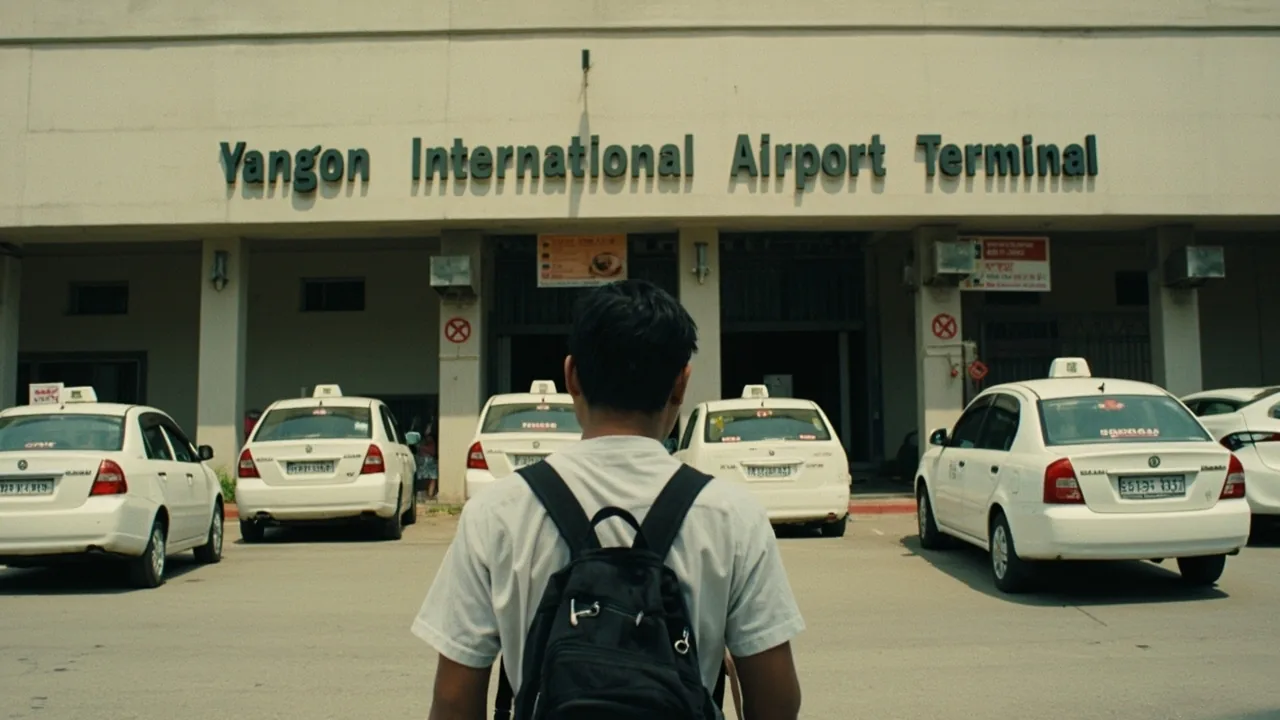
Getting Around Myanmar on a Budget: Yangon Airport to City, Yangon. Bagan Bus vs Train & More
Myanmar is one of the cheapest countries in Southeast Asia to move around in once you get past the visa (₹4,817 (~50 USD) e-visa, applied at evisa.moip.gov.mm, 28 days, single entry), but the country’s transport is unusual enough that a lot of Indian backpackers burn their first day figuring out what works. The Yangon airport transfer is the first hurdle, the Yangon. Bagan and Yangon. Mandalay routes are the next, and the eastern routes to Hpa An and Inle are where the bus-class math matters. This guide covers all four with realistic 2026 prices and the actual bus class names you’ll see at the counter. For related planning, see our guides on Sea Backpacking Hub and Myanmar Itinerary for Indian Backpackers.
One note before we start: Myanmar’s safety situation is highly variable and changes faster than any guidebook can keep up with. Most Indian travellers should check the current MEA advisory at mea.gov.in before booking, and the Myanmar government’s own advisory site for the regions on your route. This guide covers transport that is generally running, not a safety endorsement of any specific region. You may also find Cheap Hotels in Mandalay Myanmar useful for this trip.
Subodh’s Pro Tip: The single biggest mistake Indian backpackers make in Myanmar is treating it like Thailand. Myanmar is slower, roads are patchier, and “VIP bus” means something different in Yangon than it does in Bangkok. Read the class names, not the marketing. See also: Doing Laundry on the Road Self Service Hand Wash Shop Guide for Backpackers in Southeast Asia.
Quick Answers
| What | Answer | Price (INR) |
|---|---|---|
| Cheapest Yangon airport to city transfer | YBS airport shuttle bus, route number printed on the side of the bus, runs from just outside arrivals | ₹100 (~$1.04) |
| Yangon to Bagan by bus (overnight, VIP class) | 9-10 hours, air-con sleeper | ₹670-1,250 (~8-15 USD) |
| Yangon to Bagan by train (overnight) | ~17 hours, slower but scenic, sleeper berth | ₹670-1,250 (~8-15 USD) |
| Yangon to Mandalay by bus | 8-9 hours, daytime VIP or overnight sleeper | ₹835-1,500 (~10-18 USD) |
| Mandalay to Yangon overnight bus (return) | Same operator pool, similar price, book a day ahead at the station counter | ₹835-1,500 (~10-18 USD) |
A note on money: Myanmar uses the kyat (MMK). 1 MMK is roughly ₹0.048 right now, or 1 INR ≈ 21 MMK. Prices throughout this guide are written in MMK on the ground, with USD where operators quote in USD (most long-distance buses do). For related planning, see our guide on Travel Insurance Claims Guide How to File Get Your Claim Approved.
Yangon Airport to City Centre (YBS Route)
Yangon International Airport (RGN) is about 14 km north of downtown. Three reasonable options exist, ordered by price:
1. YBS Airport Shuttle Bus (cheapest)
The Yangon Bus Service (YBS) runs a dedicated airport shuttle route. The route number is printed on the front and side of the bus, and the airport version is a dedicated airport service rather than the city YBS lines you see on numbered city routes. The pickup is from the public transport area just outside the arrivals hall, not from the kerb where taxis idle. The fare is around 500 MMK, payable in cash to the conductor on board, and the bus terminates at a central Yangon point where you can grab a Grab or a city taxi onward.
For Indian backpackers arriving on a late flight, this is the cheapest honest option and costs about ₹100 (~$1.04). The catch: it doesn’t run 24 hours. If your flight lands after the last service (typically late evening), you’ll need a taxi.
2. Airport Taxi (fixed counter, official)
There’s a taxi counter inside arrivals with fixed-price tickets to various parts of the city. Prices are roughly ₹771-₹1,156 (~8-12 USD) depending on your drop-off point in downtown Yangon (Sule Pagoda area, Chinatown, the lake area all have slightly different rates). Pay at the counter, hand the slip to the driver at the rank. This is the safest option for night arrivals and avoids the unofficial touts who approach you in the terminal.
3. Ride-hailing (Grab)
Grab operates in Yangon and the airport pickup area is signposted. Fares to the city centre are similar to the taxi counter, sometimes a touch cheaper if surge isn’t active. The advantage is the price is locked in the app, no bargaining, and the route is tracked.
Subodh’s Pro Tip: Skip anyone who approaches you inside the terminal offering a taxi. Walk past the touts, go to the official taxi counter or the Grab pickup area. The tout price is usually 2-3x the official rate, and if you refuse at the car they’ll get aggressive about it.
Yangon to Bagan: Bus vs Train
This is the question every Indian backpacker in Yangon asks. The honest answer is: the bus wins on price-to-time for most people, the train wins if you want the experience and don’t mind losing a day.
Bus (overnight, the standard choice)
The Yangon to Bagan overnight bus is the default option and it’s a good one. Operators run VIP air-con sleepers, around 9-10 hours, departing Yangon in the evening and arriving Bagan early morning. Prices are quoted in USD at the counter: ₹771-₹1,445 (~8-15 USD) depending on operator and class. The top berths in the sleeper cabin are usually a dollar or two cheaper than the bottom berths.
The buses are functional, the seats recline almost flat, and a blanket is usually provided. Bring water and snacks. The road is paved the whole way, the bus stops twice for meals and toilet breaks. Bagan’s bus station is on the edge of town, a short tuk-tuk or motorbike-taxi ride from Old Bagan or Nyaung Shwe.
Train (overnight, scenic option)
Yangon to Bagan by train is around 17 hours, overnight, with sleeper berths available. The price is similar to the bus (₹771-₹1,445 (~8-15 USD)), but you trade time for the experience: rural Myanmar at dawn from a train window is genuinely something you’ll remember.
The trade-off: trains are slower, less reliable on schedule, and the upper berth is a hard shelf. Indian backpackers who take the train mostly do it for the scenery and the photo ops. If your Myanmar trip is 10 days or less, take the bus and spend the saved day in Bagan.
Subodh’s Pro Tip: Book the bus a day ahead at the station counter, not online. Most Yangon bus operators don’t have reliable English-language booking sites, and the “online” booking portals tend to be either third-party resellers adding a markup or outright broken. Walk in, pay cash, get a paper ticket.
Mandalay to Yangon Overnight Bus
The Mandalay. Yangon route is well-served and runs both ways. From Mandalay, buses leave in the evening and arrive Yangon early morning, 8-9 hours, VIP air-con sleeper, ₹963-₹1,734 (~10-18 USD) depending on operator and berth. The Mandalay end departs from a bus terminal a short ride from the city centre.
For Indian backpackers finishing a Bagan-Mandalay-Inle loop and heading back to fly out of Yangon, this is the standard final leg. Book at the Mandalay station counter the day before. Same operator pool as the Yangon-Bagan route, similar service quality.
A common mistake: assuming the bus drops you at Yangon airport. It drops you at the central Yangon bus station. Budget an extra 30-45 minutes and a 5,000 MMK tuk-tuk to get to the airport from there.
Hpa An to Yangon Transport
Hpa An is the eastern Myanmar backpacker base, famous for its limestone karst scenery and caves. From Hpa An to Yangon the options narrow.
Bus (the only practical option)
There’s no train to Hpa An. Buses run Hpa An to Yangon, around 8-9 hours depending on the road and the border-region traffic, daytime departures. Prices are in the same range as other long-distance routes: ₹771-₹1,445 (~8-15 USD). The road from Hpa An passes through Karen State, and the security situation on this corridor has been variable. Check the current MEA advisory before committing to this route.
Safety Alert: Some eastern and northern Myanmar regions have seen active conflict at various points. The Hpa An corridor in particular has had road disruptions. Before booking any eastern route, check the current MEA travel advisory at mea.gov.in and ask at your hostel what travellers have seen in the last week. Trains and main highways are usually the safer options; remote rural roads are not.
SIM Cards and Connectivity
For staying online in Myanmar, the two main operators are MPT and Ooredoo, both offering tourist SIMs. The 7-day tourist SIM is around ₹289 (~3 USD) for roughly 5GB of data, available at Yangon and Mandalay airport counters on arrival. You’ll need your passport and a photo. The airport price is fixed; don’t let anyone in the arrivals hall quote you a higher “activation” fee on top.
Buying in the city is the same SIM, same price, often at a small discount if you walk into an MPT or Ooredoo store rather than the airport counter. You’ll need your passport and a local address (your hostel name is fine).
ESIM support in Myanmar is limited. MPT has rolled out partial eSIM support but coverage is patchy, and most Indian travellers end up on a physical SIM. For a fallback eSIM option that works in Southeast Asia more broadly, Get Nomad eSIM covers regional data including Myanmar on most plans.
Subodh’s Pro Tip: Buy at the airport counter on arrival. Yes, the price is the same as in the city, but the airport counter queues are short and you walk out of arrivals with data working. Trying to do this later at a city store means an extra trip, a form in Burmese, and the same price.
Local Scams to Watch Out For
1. The “official” airport taxi tout
Inside Yangon arrivals, men in shirts will approach you claiming to be from the “official airport taxi service.” They aren’t. The real airport taxi is the counter inside the hall with a printed price list. The tout will quote 2-3x the official rate and refuse to use the meter.
2. The Bagan e-bike “deposit” scam
In Bagan, motorbike and e-bike rental shops will sometimes claim a small scratch as pre-existing damage and hold your deposit. Photograph the bike from every angle before handing over your passport or deposit. This is standard practice but the disputes are common enough that the photo step is non-negotiable.
3. The Mandalay tuk-tuk “tour” markup
In Mandalay, tuk-tuk drivers will offer a “full day tour” of the main sites for a price that sounds reasonable. The catch is they take you to gem shops and tailoring stores for commission, and the “tour” becomes 3 hours of sites and 3 hours of shops. Set the itinerary yourself, in writing, and agree a price for the route not the day.
4. Yangon hotel “rates are wrong”
A handful of budget guesthouses in Yangon have been known to quote a higher room rate on arrival than the one you booked online, claiming the booking didn’t go through. Pull up your booking confirmation on your phone before walking in.
Haggling and Market Etiquette
Haggling is expected at markets (Bogyoke Market in Yangon, the morning markets in Mandalay) but the rules are different from Bangkok or Delhi. Start at 60-70% of the asking price for non-food items (lacquerware, longyi, gems, jade), settle around 80-85% if the seller is engaging. For food stalls and small tea shops, don’t haggle, the price is fixed and the markup is already small.
Fixed-price shops (the air-con ones with a glass counter) don’t haggle. Don’t try. Convenience stores and supermarkets never haggle. The “tour price” at a pagoda is fixed, pay it.
A useful Burmese phrase: “Mya shi lar byar” (how much is this). The number you hear is the start of the negotiation, not the end.
Essential Language and Cultural Taboos
Burmese has a different script, but a few spoken words will get you a long way:
- Mingalaba (hello)
- Kyei zu tin pa de (thank you, formal)
- Myo shi lar (how much)
- Kaung myar (too expensive)
Cultural rules that matter for transport and street safety:
- Shoes off at every pagoda, monastery, and temple floor. Carry cheap slip-ons.
- Shoulders and knees covered at religious sites. A longyi (the Burmese sarong) works for both genders and solves both problems.
- Never point your feet at a Buddha image. When sitting on temple floors, tuck legs under you or sit on a side bench.
- Don’t touch anyone’s head, including children’s. It’s the most sacred part of the body in Burmese culture.
- The royal family and Buddha images are not subjects of jokes. Burmese people are generally tolerant of tourists stumbling through cultural rules, but a small effort goes a long way.
Common Street Mistakes Indians Make
Mistake 1: Trusting the first “tour desk” in Yangon
What happens: You walk out of your hostel and the first shop on the corner offers bus tickets. The price is inflated, the bus may not exist at that operator, and the “ticket” is sometimes a handwritten note that won’t be honoured at the station.
Fix: Book at the actual bus station counter, or use a hostel-recommended operator. Your hostel will know which companies are running this week.
Mistake 2: Carrying all cash in one wallet
What happens: Pickpocketing is uncommon in Myanmar but the loss of one wallet in a country with limited card acceptance means a real problem.
Fix: Split cash into two places (a money belt and a wallet), keep your passport in the hostel’s safe or a locked bag, photograph your passport and visa on your phone before you leave the hotel.
Mistake 3: Losing temper in public over a fare dispute
What happens: In Burmese culture, losing your temper publicly is a serious loss of face for both parties, and the dispute escalates rather than resolves. Yangon taxi drivers will stop the car and ask you to get out.
Fix: Stay calm, pay the agreed fare, move on. The next driver will be fine. Travellers report that polite persistence gets you further than volume in Myanmar, more than in most of Southeast Asia.
Mistake 4: Assuming everything is negotiable
What happens: You try to haggle on a bus ticket, a meal, or a museum entry fee and the seller gets offended. Prices for services and food are usually fixed; only market goods and motorbike rental are haggling territory.
Fix: Ask first. If the price is quoted without any preamble, it’s probably fixed.
FAQ
Is the YBS airport shuttle running at night?
No. The last service is typically early evening. If your flight lands late, the airport taxi counter or Grab is the realistic option.
Can I use UPI or Indian forex cards in Myanmar?
Indian forex cards (HDFC, ICICI, Axis) work at some Yangon ATMs and a handful of hotels, but acceptance is patchy and most of Myanmar is cash-only. UPI does not work in Myanmar. Carry USD in clean, unfolded notes, exchange at the airport or a Yangon bank branch.
How long does the Yangon to Bagan bus take?
9-10 hours is the honest estimate. The road is paved but slow-moving, and the bus stops twice. Some operators quote 8 hours and deliver 11, plan conservatively.
Is the Mandalay to Yangon overnight bus safe for solo female travellers?
Yes, in the sense that the bus operators are the same established companies running the Yangon-Bagan route and the cabins are shared by gender only on the better operators. Travellers report normal service. Sit on the lower berth, keep your bag with you, the usual precautions.
Should I book Yangon to Bagan in advance?
For the VIP sleeper class during peak season (November-February), book a day or two ahead at the station counter. Off-season, walk-ups are fine.
Can I take a boat from Mandalay to Bagan?
Yes, the slow boat on the Irrawaddy runs Mandalay to Bagan, around 9-10 hours downstream. It’s scenic and a real experience but is a different decision from the bus, not a substitute. Most Indian backpackers who try it report enjoying it but say they wouldn’t do it twice.
What happens if I miss my e-visa date for re-entry?
You don’t re-enter on the same visa. Myanmar e-visas are single entry. If you leave the country, you need a new e-visa to come back, which means another ₹4,817 (~50 USD) fee at the same portal.
Subodh’s Take
Myanmar rewards the traveller who’s prepared to move slower and accept that the bus will leave when it leaves, the train will run when it runs, and the airport shuttle is the cheapest option for one specific reason: it’s the only one whose price is honest on the side of the bus. Budget an extra half-day per long-distance transfer compared to Thailand, keep enough USD cash to cover a backup taxi or a night in Yangon if a bus cancels, and check the MEA advisory before committing to any eastern or northern route. For everything else, this guide should get you from the airport to Bagan without burning a day on research.
