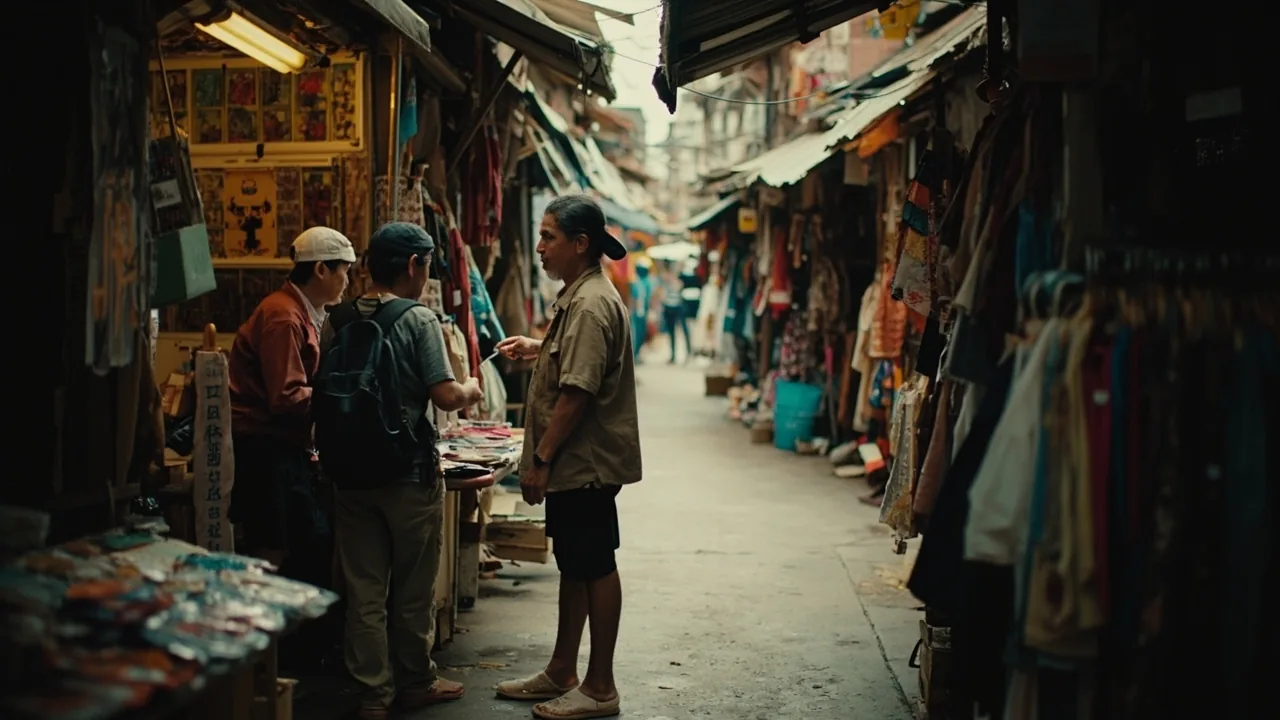
Haggling Guide: Street-Smart Negotiation Tactics for Southeast Asia Markets (2026)
Haggling is the default at markets, night bazaars, and tuk-tuk stands across Southeast Asia. The first price a vendor quotes is rarely final, and walking away after a counteroffer is normal. This guide covers tactics, scripts, and body language that work from Bangkok Chatuchak to Hanoi’s Old Quarter. Planning wider? Our Southeast Asia backpacking hub covers the full multi-country route.
What Is a Haggling Strategy (and Why It Matters Here)?
A haggling strategy is a planned approach to price negotiation, where the buyer and seller trade offers back and forth until they agree on a number neither side loves but both can live with. In Southeast Asia, haggling is the default at any market stall without a printed price tag, every night bazaar in Thailand, most souvenir shops in Vietnam and Laos, and even some tuk-tuk and boat rides that lack a meter. Knowing the rules saves you 30 to 60 percent on most purchases and turns a stressful confrontation into something closer to a game. For daily budget breakdowns, see our ₹5,000/day SE Asia budget guide.
Quick Answers
| What | Answer | Price (INR) |
|---|---|---|
| Typical opening discount at a market | 40 to 60 percent off first quote | , |
| Vendors who won’t haggle | Convenience stores, supermarkets, malls, fixed-price shops | , |
| Best currency to haggle in | Local currency (THB, VND, LAK, KHR, IDR) | , |
| Rule of thumb for souvenirs | Offer 30 to 40 percent of asking price | , |
| Walk-away rule | Always be ready to leave; most vendors will call you back | , |
Step-by-Step: The Haggling Playbook
Step 1: Know the Real Price Before You Open Your Mouth
Before you haggle, you need an anchor. Walk past the stall first and listen to what other tourists pay, or check the price of the same item at a fixed-price shop nearby. In Chatuchak Weekend Market in Bangkok, for example, a printed cotton shirt runs ₹715-₹1,001 (~250-350 THB or ~$7.42-$10.39) at the official stalls; if a vendor on the outer ring quotes you ₹2,287 (~800 THB or ~$23.74), you now know the real range. Travellers report that this single step saves more money than any clever line.
Step 2: Counter at 30 to 40 Percent of the First Quote
When the vendor opens at ₹2,859 (~1,000 THB or ~$29.68), you counter at ₹858-₹1,144 (~300-400 THB or ~$8.90-$11.87). This feels rude in India, where the first counter is usually closer to 80 percent of asking, but in Southeast Asia the opening number is fictional. Vendors expect a low counter and build their profit margin around it. If they open at ₹1,429 (~500 THB or ~$14.84), you counter at ₹429-₹572 (~150-200 THB or ~$4.45-$5.94).
Step 3: Use the “Walking Away” Move
After two or three rounds, say “maybe later” and start to leave. About 70 percent of the time, the vendor will call you back with a lower number. This is the single most reliable tactic in Southeast Asia. Don’t fake it badly though; vendors read body language, and a hesitant shuffle won’t trigger the call-back. Turn your shoulders away and keep walking.
Step 4: Bundle for Bigger Discounts
Buying one singlet? The discount is small. Buying three? Now you have use. Say “I take three, you give better price.” Bundle negotiation works everywhere from Luang Prabang night market to Siem Reap’s Pub Street. Travellers report bundles getting 50 to 60 percent off versus 30 to 40 percent for singles.
Step 5: Pay in Local Currency, Exact Notes
Never haggle in USD and never hand over a ₹2,859 (~1,000 THB or ~$29.68) note for a ₹715 (~250 THB or ~$7.42) purchase expecting change. Vendors “run out of change” conveniently. Use small local notes and count what you hand over. This is also why carrying a forex card alone won’t work for markets; you need cash in the local currency. See our carry money abroad from India guide for the smart split. Check our SE Asia packing list for what to bring.
Step 6: Smile, Stay Friendly, Don’t Get Personal
The haggling is a game. If you get angry, the vendor shuts down and the price goes up. If you insult the goods, the same. Keep your tone light, laugh at bad jokes, and the discount usually follows. Southeast Asian market culture rewards patience and a friendly face.
Step 7: Walk When the Numbers Don’t Meet
If your target price and their floor don’t overlap after three rounds, walk. Don’t sulk, don’t glare, just leave. There are usually three other stalls within fifty metres selling the same thing. Walking is your strongest move and you should be ready to use it every single time you start a negotiation.
Common Mistakes Indians Make
Mistake 1: Haggling Where There’s No Haggling
Trying to negotiate at a 7-Eleven, a mall, a Tesco Lotus, or any shop with a printed barcode price tag. The cashier literally cannot change the price, and you’ll just embarrass yourself. The rule: if there’s a price tag, pay it. If there isn’t, you can haggle.
Mistake 2: Showing Too Much Eagerness
Asking “how much for this one?” before you’ve even picked it up, or telling the vendor it’s exactly what you were looking for. Anything that signals “I will buy this” kills your use. Touch three similar items, put two back, and only pick up the one you want at the end. The longer you hold it without buying, the more negotiating room you have.
Mistake 3: Quoting Prices in Rupees
Indian travellers sometimes try to convert mentally and quote in INR. “Two hundred rupees” at a Bangkok stall makes the vendor’s eyes glaze over. Always quote in the local currency. At current rates, 1 THB is about 2.87 INR, so a 300 THB shirt feels like ₹860 (~$8.93) to you but needs to be discussed as ₹858 (~300 THB or ~$8.90) to the vendor.
Mistake 4: Handing Over the Money Before Agreeing on a Price
Pulling out a ₹1,429 (~500 THB or ~$14.84) note before you’ve closed the deal is a green light for the vendor to grab it and call it done. Always agree on the number verbally first, count your cash, then hand it over.
Mistake 5: Haggling With Tuk-Tuks Using the Same Tactics as Markets
Tuk-tuks and motorbike taxis are a different game. The scam is usually in the destination, not the price. Our tuk-tuk scam guide covers this in full, but the short version: agree on the fare, confirm the route by name, and use Grab or Bolt apps wherever they work.
Country-Specific Tactics
Thailand
Bangkok’s Chatuchak, Chiang Mai’s Saturday and Sunday Walking Streets, and Phuket night markets are haggling ground zero. The standard move is the 30-40-percent counter, the walk-away, and bundling. Thai vendors are friendly and rarely offended; they haggle as a social ritual more than a confrontation.
Vietnam
Hanoi’s Old Quarter night market, Hoi An’s lantern-lit streets, and Ho Chi Minh City’s Ben Thanh Market are the major haggling spots. Vietnamese vendors start much higher than Thai ones, sometimes at 3 to 4 times the eventual price. The walk-away is essential here because the markup is so heavy. Travellers report getting quoted ₹734 (~200,000 VND or ~$7.62) for an item they eventually paid ₹220 (~60,000 VND or ~$2.29) for after three rounds and a walk-away.
Laos
Luang Prabang night market is the most touristy haggling scene in Laos. Vendors are soft negotiators compared to Vietnam; a polite counter usually works. The pace is slower, the English is more limited, and calculator haggling (where you and the vendor both tap numbers into calculators) is the norm.
Cambodia
Phnom Penh’s Russian Market and Central Market, plus Siem Reap’s Pub Street and Old Market, are the spots. Khmer vendors often quote in USD because of the dollarised economy; you can haggle in USD without conversion issues. The markups are similar to Vietnam.
Indonesia
Bali’s Ubud Art Market and Sukawati Art Market are famous for aggressive haggling. The opening prices can be 5 to 10 times the eventual price. The walk-away works here more than anywhere else, almost every vendor will call you back at a much lower number. Travellers report walking away from a ₹2,690 (~500,000 IDR or ~$27.92) quoted scarf and getting called back at ₹807 (~150,000 IDR or ~$8.38) within ten steps.
Malaysia
Kuala Lumpur’s Petaling Street and Jonker Street in Melaka are the haggling zones. Malaysia is the most “Asian-Indian-shop” friendly of the bunch, with vendor style resembling Indian bazaars. Vendors are less aggressive but still expect a counter.
What Most Guides Don’t Tell You
Gotcha 1: The “Friend Discount” Is Still a Markup
Vendors often drop the price after two minutes of small talk and say “OK friend price, special for you.” This is a script, not a favour. The “friend price” is usually still 30 to 50 percent above what locals pay. Politely counter one more time.
Gotcha 2: Calculator Haggling Works in Your Favour
In Vietnam, Laos, and Cambodia, vendors will hand you a calculator and let you type your offer. Type your real number, not a “feeler” number halfway between your offer and theirs. The calculator removes the social pressure of saying the number out loud.
Gotcha 3: The Last Stall of the Night Gets Cheaper
Around 30 minutes before closing, vendors who haven’t hit their target start offering deeper discounts to clear inventory. If you’re flexible on time, a 9:30 PM shopping run can net 20 to 30 percent more savings than the 7 PM run. This is especially true at Luang Prabang, Hoi An, and Chatuchak.
Gotcha 4: Don’t Haggle on Souvenirs You’re Giving as Gifts for the Price Alone
If you only care about the dollar amount and not the item, haggle hard. If you care about the specific piece (a particular carving, a particular fabric), the relationship with the vendor matters for quality. Pick your battles.
Gotcha 5: Group Haggles Get Worse Discounts, But Only in Groups
Travellers report that vendors react differently to a solo haggler versus a couple versus a group of four. Solo gets friendly service and average discounts. Couples get the standard “couple price” which is sometimes worse than solo. Groups of three or four get the deepest bulk discounts. If you’re a solo traveller, find another solo traveller at the hostel and pair up for the bulk discount.
FAQ
What does "haggling strategy meaning" refer to in practice?
It refers to having a planned approach before you start negotiating: knowing your target price, your walk-away price, and the moves you'll use (counter, bundle, walk away). Without a strategy, you'll either overpay or walk away from a deal you should have taken.Is haggling rude in Southeast Asia?
No. At any stall without a printed price, haggling is the default and expected. Not haggling can confuse the vendor. The exception is anywhere with a printed barcode tag, supermarkets, malls, and chain stores. There, the price is fixed.How much should I counter at first?
Start at 30 to 40 percent of the first quote. So if the vendor opens at ₹2,859 (\~1,000 THB or \~$29.68), you counter at ₹858-₹1,144 (\~300-400 THB or \~$8.90-$11.87). The vendor will laugh or shake their head, then counter back around 70 to 80 percent of their opening. From there, meet in the middle.Can I haggle in tuk-tuks and taxis too?
Only on unmetered tuk-tuks and motorbike taxis. For metered taxis, the meter is the price. For Grab and Bolt, the app sets the price. For unmetered tuk-tuks, agree on the fare before you get in, confirm the destination by name, and expect to pay ₹143-₹429 (\~50-150 THB or \~$1.48-$4.45) for short hops. See our [tuk-tuk scam guide](/guide/tuk-tuk-scam-guide/) for the full breakdown.What if the vendor gets aggressive or follows me after I walk away?
Walk into a nearby shop, a 7-Eleven, or any crowded area. Don't engage further. Persistent follow-ups after a walk-away are rare but they happen, mostly in Bali's Ubud Market and some Bangkok tourist traps. A firm "no thank you" in English usually ends it.Should I haggle at restaurants or street food stalls?
No. Food stalls and restaurants have set prices, even if there's no menu. The food is cheap enough already, and haggling over a ₹114 (\~40 THB or \~$1.19) pad thai is culturally off. Save your haggling energy for souvenirs, transport, and tailor services.Closing: Subodh’s Line
Haggling feels weird the first three times. By the tenth time, it’s the most fun part of the day. Set your target, walk away at least once, and remember that the worst outcome is paying the asking price, which is still cheaper than most things in India.