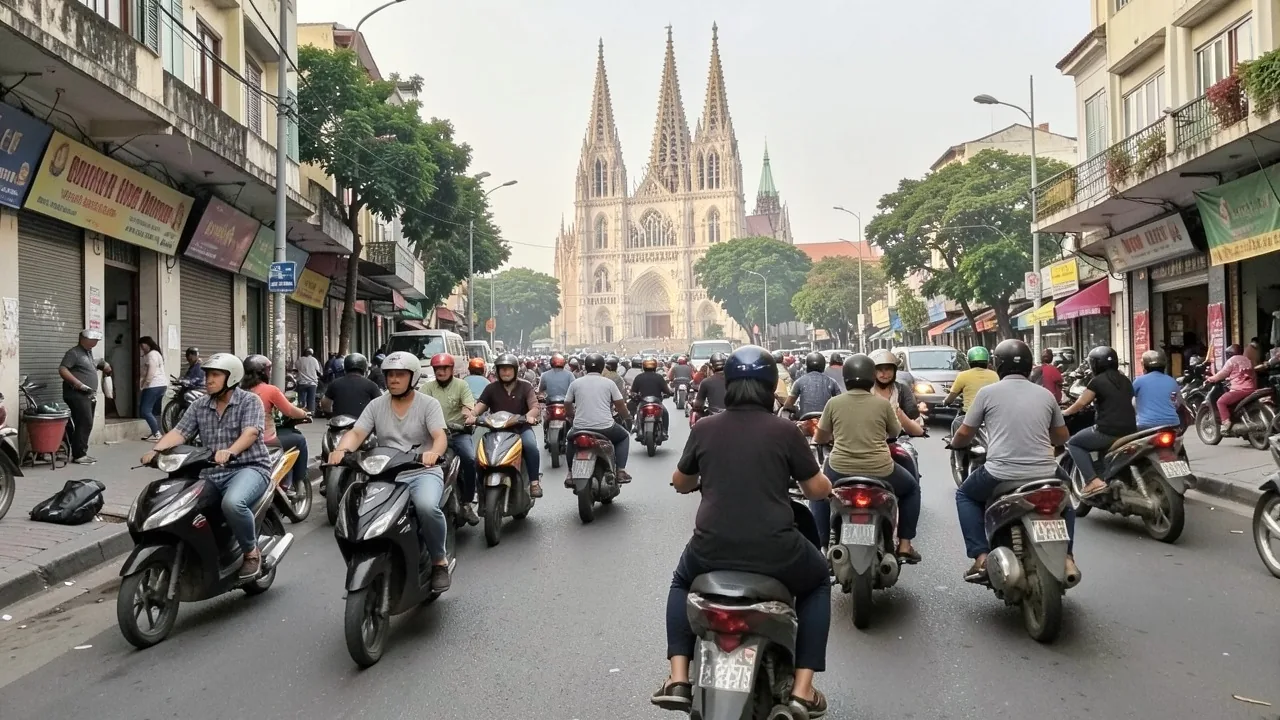
Ho Chi Minh City (Saigon): Controlled Chaos
Saigon is Vietnam at full volume. Eight million scooters, French colonial façades, bowls of pho at 7 a.m., and the rest of your trip suddenly feels slow. Indian backpackers either love it on day one or wilt by day three. The trick is knowing which district to base yourself in, which SIM to buy, and how to read the traffic before it reads you. For related planning, see our guide on Sea Backpacking Hub.
Quick Answers
| What | Answer | Price (INR) |
|---|---|---|
| Best area to stay | District 1 (backpacker core, walkable) or District 4 (cheaper, still central) | , |
| Daily backpacker budget | ₹3,488-₹5,508 (~950,000-1,500,000 VND or ~$36.21-$57.17) | ~₹3,500 (~$36.33) |
| Cheapest dorm bed | 150,000 VND/night | ₹500 (~$5.19) |
| Vietnam e-visa fee | ₹2,408 (~25 USD), 90 days, apply 3+ days before | ~₹2,413 (~$25.05) |
| Must-do activity | War Remnants Museum + Cu Chi Tunnels combo | ₹918 (~250,000 VND or ~$9.53) |
Subodh’s Pro Tip: District 1 sleeps are overpriced for what you get. A 10-minute Grab bike ride across the river to District 4 cuts your dorm cost nearly in half and you still walk to Bến Thành Market in 20 minutes. You may also find Vietnam Motorbike Laws Explained useful for this trip.
How to Get There (From the Previous City on the Trail)
Most travellers arrive in HCMC after Da Nang or Mui Ne. The Bangkok-to-Saigon flight is the classic cheap entry if you’re flying in from Thailand. See also: Ha Long Bay.
| From | Mode | Duration | Price | Book |
|---|---|---|---|---|
| Da Nang | Sleeper bus | 18-20h | ₹1,285-₹1,836 (~350,000-500,000 VND or ~$13.34-$19.06) | Book on 12go |
| Mui Ne | Local bus | 5-6h | ₹734-₹1,028 (~200,000-280,000 VND or ~$7.62-$10.67) | Book on 12go |
| Bangkok | Flight | 1h 30m | ₹8,863 (~92 USD) | Book on 12go |
| Phnom Penh | Bus (overland) | 6-7h | ₹1,028-₹1,395 (~280,000-380,000 VND or ~$10.67-$14.48) | Book on 12go |
The sleeper bus from Da Nang is the move if you want the full Banana Pancake Trail experience: horizontal beds, a 2 a.m. Rest stop with strong coffee, and you save a night’s accommodation. The cheap seats on VietJet or AirAsia from Bangkok run ₹3,000-₹4,500 (~$31.14-$46.71) one-way if you book a week ahead, and it’s the fastest way to skip the overland grind. For related planning, see our guide on Ninh Binh.
Subodh’s Pro Tip: Avoid “VIP” bus operators selling tickets for 600,000+ VND at your hostel. The standard sleeping-bus is the same chassis, the same driver, and roughly 40% cheaper. Book on 12go or at the operator’s actual counter the day before. You may also find Da Nang useful for this trip.
Where to Stay
District 1 is the obvious pick but it is also the most expensive part of HCMC for budget beds. District 4 (across the canal) and the Bùi Viện / Phạm Ngũ Lão fringe give you the same walkability for noticeably fewer dong.
| Hostel / Guesthouse | Cost/night | Vibe | Book Here |
|---|---|---|---|
| City Backpackers Hostel | ₹918 (~250,000 VND or ~$9.53) | Social, rooftop, walking distance to Bùi Viện | Check prices |
| O Tinh House | ₹1,028 (~280,000 VND or ~$10.67) | Capsule bunks, calm crowd, near District 4 | Check prices |
| Saigon Authentic Alley Hostel & Tours | ₹808 (~220,000 VND or ~$8.39) | Local tours, small dorms, friendly owner | Check prices |
| Rovina | ₹734 (~200,000 VND or ~$7.62) | Quiet alley, AC dorms, good for sleepers | Check prices |
| The Like Hostel and Cafe | ₹955 (~260,000 VND or ~$9.91) | Cafe downstairs, pod bunks, social nights | Check prices |
| The Common Room Project | ₹1,175 (~320,000 VND or ~$12.20) | Industrial design, daily events, slightly pricier | Check prices |
| My pick: Saigon Authentic Alley Hostel for the first two nights (tours desk, real local intel), then The Common Room Project if you want a few nights of music and meet-ups. Both sleep clean and both have working AC, which in HCMC is not optional. |
What to Eat
Vietnamese food is one of the most vegetarian-friendly cuisines in Southeast Asia once you know the right phrases. Pho, banh mi, and most of the rice-and-veg dishes at local spots work with “không thịt” (no meat) and “chay” (vegetarian). The harder part is the pork-heavy southern default. Most street-side broths and clay pot dishes lean on pork fat for flavour, so vegetarian Indian travellers should default to veg-marked spots or the Indian restaurants in District 1.
Subodh’s Pro Tip: Walk into any pho stall and say “pho chay” instead of “pho bo.” That single word swap gets you a vegetarian version that uses the exact same broth technique, and you’ll usually pay ₹18-₹37 (~5,000-10,000 VND or ~$0.19-$0.38) less than the beef version.
Local & Regional
- Pho bo / pho chay: ₹147 (~40,000 VND or ~$1.52) a bowl. The benchmark Saigon breakfast. Best at the unmarked stalls on Phạm Ngũ Lão where locals line up before 8 a.m.
- Banh mi: ₹55-₹92 (~15,000-25,000 VND or ~$0.57-$0.95). The crispy baguette sandwich that Vietnam invented. Leslie’s Deli Saigon does a sourdough upgrade for ₹165 (~45,000 VND or ~$1.72) if you want the Instagram version with pate and pickled carrots.
- Bun cha: ₹129 (~35,000 VND or ~$1.33) at XO Tours’ food walks. Grilled pork meatballs over rice noodles with fish sauce dip. Skip if you’re vegetarian.
- Com tam (broken rice): ₹129-₹184 (~35,000-50,000 VND or ~$1.33-$1.91). Rice plate with grilled pork, egg, and pickled veg. Cheap and filling. The BBQ pork belly version is what HCMC is known for.
- Banh xeo: ₹147-₹220 (~40,000-60,000 VND or ~$1.52-$2.29). Crispy turmeric crepe with shrimp and bean sprouts. The vegetarian version exists but the flavour drops noticeably.
Indian / Veg-Friendly
- Shri Natraj Indian Cuisine (District 1): North Indian curries and tandoori. Family-friendly, mid-range. Dal makhani around ₹441 (~120,000 VND or ~$4.57), butter chicken ₹551 (~150,000 VND or ~$5.72).
- Saffron Indian Restaurant (District 1): Both North and South Indian, refined setting. Idli and dosa for ₹294-₹367 (~80,000-100,000 VND or ~$3.05-$3.81), thali for ₹661 (~180,000 VND or ~$6.86).
- Tanishq Indian Vegetarian Restaurant (District 1, near Bùi Viện): Strict vegetarian, mostly South Indian. Dosa around ₹257 (~70,000 VND or ~$2.67), thali around ₹404 (~110,000 VND or ~$4.19). This is the spot when you need a clean, reliable veg meal after three days of “maybe this broth was vegetarian.”
What to Do
Five things, ranked by what gives you the most Saigon in the shortest time. Skip the rest unless you have a week here.
-
War Remnants Museum (₹147 (~40,000 VND or ~$1.52), 2-3 hours). The single most important stop in HCMC. Photograph exhibits are graphic. The preserved guillotine and the “tiger cages” section are not easy to look at, but they are essential context for the rest of the country. Plan a quiet evening after. See War Remnants Museum tours on GetYourGuide
-
Cu Chi Tunnels (half-day trip, ₹918-₹1,652 (~250,000-450,000 VND or ~$9.53-$17.15) with transport). The 250-km underground network used during the war. Book through your hostel or on Klook/Viator. Combine with the War Remnants Museum for a full-day “context tour.” The firing-range add-on costs extra and is genuinely unsettling in 2026, so decide before you go whether that’s a yes for you.
-
Walk the Nguyen Hue Walking Street at night (free, 30-60 min). The pedestrian boulevard with the giant Ho Chi Minh statue at one end, the People’s Committee building lit up at the other, and the kind of crowd density that makes you feel the city’s actual weight. Go between 7-9 p.m.
-
Open-air jeep tour (1.5-2 hours, ₹2,203-₹3,305 (~600,000-900,000 VND or ~$22.87-$34.30) per jeep). This is what Reddit keeps recommending and it earns the buzz. Women-led, mostly, in restored army jeeps that take you through the backstreets no tuk-tuk would bother with. The Saigon Adventure tour, Book via GetYourGuide. Saigon Adventure tours on GetYourGuide
-
Bến Thành Market (free entry, 1-2 hours). Souvenirs, fake Rolexes, and the actual best spot to people-watch if you grab the noodle stall in the back corner. Negotiate hard, start at 40% of the asking price.
Honourable mentions: Saigon Zoo & Botanical Gardens if you want a half-day reset from the scooter noise. The Saigon Skydeck for the view (₹734 (~200,000 VND or ~$7.62), skip if you’ve been to any other southeast-Asian skyscraper deck in the last month). Statue of Ho Chi Minh at the front of the People’s Committee building is a 10-minute photo stop, not a destination.
Subodh’s Pro Tip: Reddit’s HCMC subreddit keeps repeating this and it’s right: do the War Remnants Museum in the morning, then process the Cu Chi Tunnels in the afternoon. Doing them on separate days drains the impact. Doing them together makes the whole 20th-century context click.
Getting Connected
The two Vietnamese carriers you’ll see are Viettel and Mobifone. Both sell a 14-day tourist SIM for ₹477 (~130,000 VND or ~$4.96) at the airport counter. Walk one minute past the airport SIM booth to any in-town Viettel or Mobifone shop and the same SIM drops to around ₹367 (~100,000 VND or ~$3.81), but the airport version is fine if you don’t want to deal with finding the shop.
If you want to land online before you even leave baggage claim, skip the airport queue entirely and grab an eSIM before you fly. Get Nomad eSIM runs around ₹867 (~9 USD) for 5 GB for 30 days, activates on arrival, and means no one at the airport asks for your passport twice.
Subodh’s Pro Tip: Don’t bother with a tourist SIM if your trip is shorter than 5 days. Both carriers offer 3-day data-only SIMs for ₹184 (~50,000 VND or ~$1.91) at any 7-Eleven in District 1. Same coverage, half the cost.
Free WiFi at every hostel, every cafe, and most restaurants in District 1 is workable for maps and WhatsApp but slow for video calls. The Grab app, however, eats data, so a SIM or eSIM is not optional.
Daily Budget Breakdown
HCMC sits in the middle of the Vietnam backpacker budget curve. It’s more expensive than Hanoi and Hoi An for accommodation, comparable for food, but transport within the city is genuinely cheap because of the Grab bike culture.
| Category | Budget/day |
|---|---|
| Dorm bed | ₹551-₹1,212 (~150,000-330,000 VND or ~$5.72-$12.58) |
| Food (3 meals) | ₹441-₹661 (~120,000-180,000 VND or ~$4.57-$6.86) |
| Local transport (Grab bike, bus) | ₹184-₹367 (~50,000-100,000 VND or ~$1.91-$3.81) |
| Activities (museum + sightseeing) | ₹220-₹441 (~60,000-120,000 VND or ~$2.29-$4.57) |
| Misc / drinks | ₹294-₹551 (~80,000-150,000 VND or ~$3.05-$5.72) |
| Total (budget) | ₹1,836-₹2,938 (~500,000-800,000 VND or ~$19.06-$30.49) |
| Total (mid-range) | ₹3,488-₹5,508 (~950,000-1,500,000 VND or ~$36.21-$57.17) |
The “real spent” number from travellers is around 950,000-1,500,000 VND/day once you add a couple of cocktails at The View Rooftop Bar and an organised Cu Chi trip. Most of the Vietnam cost-savings get eaten in Saigon because it’s the place travellers treat themselves.
Exchange rate at time of writing: 1 INR = ~270 VND. So 100,000 VND ≈ ₹370 for quick mental math.
Visa / Entry Notes
Vietnam issues e-visas to Indian passport holders. No visa-on-arrival, no separate sticker, no embassy visit.
- Fee: ₹2,408 (~25 USD), paid online at the time of application.
- Max stay: 90 days, multiple-entry allowed.
- Lead time: Apply at least 3 days before travel, 7 days recommended.
- Photo: 4x6 cm white background, taken within 6 months, passport format.
- Apply here: https://evisa.xuatnhapcanh.gov.vn
The portal occasionally processes in 2 days, occasionally in 5. Plan for a week. Travellers who applied on Friday and flew Sunday got through, travellers who applied on Tuesday and flew Saturday had to reschedule. Don’t gamble on the tight window.
Common Mistakes
-
Skipping the War Remnants Museum because it’s “depressing.” It is depressing. It is also required reading for the rest of your Vietnam trip, and not going makes the Cu Chi Tunnels bizarre and the modern politics opaque. Set aside 3 hours, eat well afterwards.
-
Exchanging money at the airport or at the gold shops in District 1. Both are bad rates. Use a bank branch (Vietcombank, BIDV) inside a real bank building, or pull dong from an ATM that does not charge a foreign transaction fee. The HANET ATM locator app shows which ATMs in your area are fee-free.
-
Crossing the street by walking the same pace you would in India. Stop. Look. Step into the scooter stream at a consistent speed and the scooters flow around you. Pausing, reversing, or running makes it worse. There is no safe alternative, just the controlled-chicane technique locals use.
Subodh’s Safety Alert: District 1’s Bùi Viện strip has the same petty-theft profile as any major backpacker drag (Bangkok Khao San, Phuket). Phone snatches off scooters happen, mostly at night. Don’t walk with your phone out near the road after 11 p.m., and use the crossbody bag with a clipped pocket, not the open tote. The bar crawls themselves are safe, the grab-and-go of an unlocked phone is the risk.
Where to Go From Here
| Destination | Mode | Duration | Price | Book |
|---|---|---|---|---|
| Hanoi | Flight | 2h 10m | ₹8,863 (~92 USD) | Book on 12go |
| Siem Reap | Flight | 1h 20m | ₹9,152 (~95 USD) | Book on 12go |
| Phnom Penh | Bus | 6-7h | ₹1,028 (~280,000 VND or ~$10.67) | Book on 12go |
| Sihanoukville | Bus | 14h | ₹3,305 (~900,000 VND or ~$34.30) | Book on 12go |
| Mekong Delta (Cần Thơ) | Bus | 4h | ₹734 (~200,000 VND or ~$7.62) | Book on 12go |
Most travellers leave HCMC in one of three directions: Hanoi by air to keep the loop moving, Siem Reap by air if they came in via the airport and want to extend into Cambodia, or Cần Thơ by bus for the Mekong Delta homestay before they fly out.
Subodh’s Pro Tip: Long-distance sleeper buses from HCMC’s Mien Tay station are reliable and ₹1,000 (~$10.38) cheaper than the equivalent tour-booked minibus. Go to the station, walk up to the operator counter, and book the same bus your hostel would sell you for half the markup.
FAQ
Is Ho Chi Minh City safe for solo Indian women?
District 1, District 3, and the tourist drags in District 4 are safe at all hours. Backpacker bar areas get handsy after midnight, especially around Bùi Viện street: avoid the cover-charge-only drinks-on-the-table joints where locals mix with tourists. Solo female travellers I’ve heard from report fewer issues here than in Bangkok or Bali. Standard city-walking sense, no more needed.
Can I get Indian food in Ho Chi Minh City?
Yes. Shri Natraj, Saffron, and Tanishq are the three names Indian backpackers use. Tanishq is fully vegetarian and the cleanest option. Most Indian restaurants cluster in District 1, walkable from the Bùi Viện area in 15 minutes.
How many days do you need in HCMC?
Three full days covers the museum, the Cu Chi trip, and one half-day jeep tour plus a day to eat your way around Districts 1 and 4. Five days lets you add the Mekong Delta overnight. More than that and the city’s noise-to-content ratio shifts against you.
Is the Saigon airport closer than Hanoi's for Indian arrivals?
Direct flights from Delhi and Mumbai to Tan Son Nhat (HCMC) are slightly cheaper on VietJet and IndiGo than flights to Noi Bai (Hanoi), but it depends on the day. Most Indian backpackers fly into one or the other and overland between them. The flight length is roughly the same.
Do Indians need a Vietnam visa in advance?
Yes, an e-visa. Apply at the official portal at least 3 working days before departure, pay ₹2,408 (~25 USD) online, and print the approval letter. No visa-on-arrival for Indian passport holders in 2026. The whole process is on the official portal, not through any third-party “visa service.”
What is the cheapest way to get around HCMC?
Grab bike (motorbike taxi via app) within the city. The city grid is tight, traffic is bad, but bikes weave. For District 1 to District 1 you pay ₹37-₹92 (~10,000-25,000 VND or ~$0.38-$0.95). For longer hops to District 2 or the airport, use Grab car. Avoid unmarked taxis.
Is HCMC worth visiting or should I skip straight to Hanoi?
If you only have 7-10 days in Vietnam, HCMC gets two nights and Hanoi gets the rest. If you have 14+ days, HCMC earns three full days, especially the Cu Chi + museum day. The food and the jeep tours are HCMC’s actual reason for being on the trail, not the nightlife.
Subodh’s Take
HCMC is the city I’d send first-timers to for their first taste of Vietnam, but only for three days, not a week. The War Remnants Museum and the Cu Chi Tunnels are the only must-do cultural stops between Bangkok and Hanoi, and the food scene rewards even an Indian vegetarian’s two-day appetite. After day four you’ll start to feel the city’s weight, the second-best skylines and the second-best street-food districts fade, and you’ll want out. Treat it as the loud, short, important stop it is.