Luang Prabang Travel Tips: Stuff Nobody Tells You Before You Go (2026)
Luang Prabang is gentle, slow, and old-world, which is exactly why first-timers keep stepping on landmines nobody warns them about. This guide fixes the common mistakes Indian travellers make on their first visit. See also: Sea Backpacking Hub and Vang Vieng Things to Do.
Quick Answers
| What | Answer | Price (INR) |
|---|---|---|
| Visa for Indians | Visa-on-arrival at Luang Prabang airport | ₹2,500-₹4,170 (~30-50 USD) |
| Best time to visit | November to February (dry, cool) | , |
| Currency | Lao Kip (LAK); USD and THB widely accepted | 1 INR ≈ 232 LAK right now |
| Curfew | Unofficial 10pm to 11pm (most shops close by 10pm) | , |
| Daily budget (backpacker) | ₹430-₹859 (~100,000-200,000 LAK or ~$4.46-$8.92) | ~₹430 (~$4.46) to ~₹860 (~$8.93) |
| SIM card | Unitel tourist 15GB at airport or any Unitel shop | ₹107 (~25,000 LAK or ~$1.11) |
| Alms ceremony | Daily 5:30am to 6:30am on the main street | Free to watch |
| Main temple etiquette | Shoulders + knees covered, shoes off | , |
| Slow boat from Huay Xai | 2 days via Pak Beng, classic Mekong route | ₹1,074-₹1,331 (~250,000-310,000 LAK or ~$11.15-$13.82) |
What Nobody Tells You About Luang Prabang
Luang Prabang is a UNESCO World Heritage town in northern Laos, tucked between the Mekong and the Nam Khan rivers. It’s compact, walkable, and has more wats per square kilometre than anywhere else in Southeast Asia. The pace is slow, the food is gentle on the stomach, and the rules are stricter than Bangkok or Hanoi. Most guides skip those rules, which is exactly why they matter. You may also find Vang Vieng Things to Do Reddit and Luang Prabang Weather by Month useful for this trip.
This article is built around the questions Indian backpackers ask in group chats before their first Luang Prabang trip. Use it as a checklist the night before, not after the fact.
Alms Ceremony Etiquette (Tak Bat): The Big One
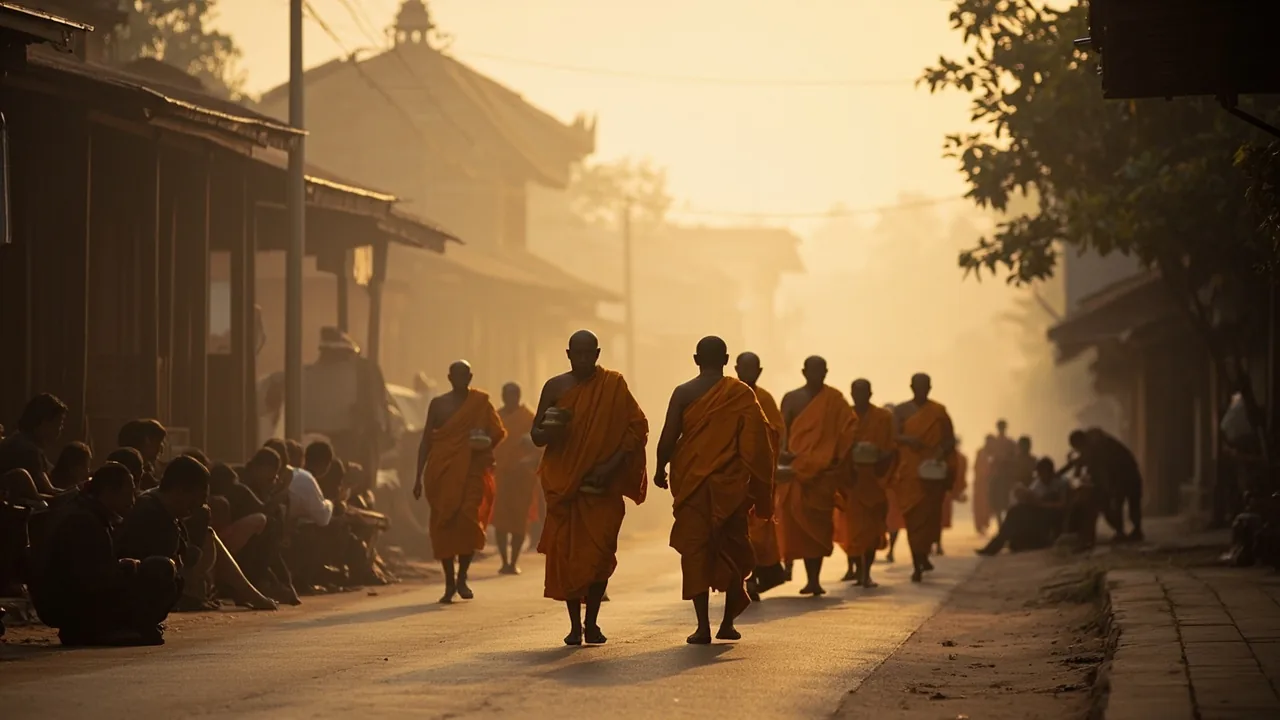
The dawn alms ceremony (Tak Bat) is the single most googled Luang Prabang topic for Indians, and the single most misbehaved-at. Hundreds of monks walk silently through the old town at sunrise collecting sticky rice. If you’ve been to a temple at home, the parallel is obvious. Treat it the same way.
The rules, plain:
- No flash photography. No flash video. No selfie flash on your iPhone.
- No standing in the monks’ path. Sit low, against a wall, on your heels.
- No touching the monks. No handing anything directly to a monk (women especially must not).
- Bare shoulders and covered knees. Same dress code as a temple visit.
- No loud talking, no giggling, no pointing.
The India parallel: this is gupt daan in reverse. You’re witnessing monks receive offerings; you’re not the centre of it. If you’ve ever taken your shoes off at a gurudwara and sat on the floor during langar, the etiquette is identical. Watch with respect, not with a phone raised in front of your face.
Subodh’s Pro Tip: A few cafés along the main ceremony street sell sticky rice baskets for ₹43-₹86 (~10,000-20,000 LAK or ~$0.45-$0.89). Buying from them supports locals and lets you participate properly. Tourists who brought mango slices from their hotel buffet are the reason the monks don’t eat rice anymore.
The Curfew (And What It Means)
Luang Prabang’s old town has an unofficial curfew of about 10pm to 11pm. Many guesthouses lock their gates around 10pm to 11pm and hand you a key. Loud music after 10pm invites a polite knock from a local. Yes, even if you’re in a hostel common room.
Practical impact:
- Plan dinner by 9pm if you want a proper sit-down meal.
- Stock water and snacks at a 7-Eleven or Mini Big C before 10pm.
- If you want late drinks, look for spots outside the old town core.
- Travellers report noise complaints from guesthouses more than from police.
Safety Alert: The curfew is not enforced by armed guards. It’s social pressure and a Lao cultural norm around respecting the town’s status as a UNESCO heritage site. Don’t try to argue your way past a guesthouse owner at 11:30pm. Smile, apologise in English, sleep.
Tuk-Tuk Pricing: The Only Negotiation You’ll Have
Inside the old town, almost everything is walkable. Outside it (to the bowling alley, the elephant camps, Kuang Si Falls), you need a tuk-tuk. Prices are quoted in LAK, or USD depending on what the driver thinks you’ll pay.
Realistic negotiated fares:
| Route | Negotiated fare | Notes |
|---|---|---|
| Old town to night market (within town) | ₹215-₹430 (~50,000-100,000 LAK or ~$2.23-$4.46) | ~₹215 (~$2.23) to ~₹430 (~$4.46), fully negotiable |
| Old town to Kuang Si Falls | ₹644-₹859 (~150,000-200,000 LAK or ~$6.69-$8.92) per tuk-tuk (round trip) | ~₹645 (~$6.70) to ~₹860 (~$8.93); ask if entry is included |
| Old town to airport | ₹344-₹515 (~80,000-120,000 LAK or ~$3.57-$5.35) | ~₹345 (~$3.58) to ~₹515 (~$5.35) |
| Old town to bowling alley / Phousi Hill | ₹129-₹258 (~30,000-60,000 LAK or ~$1.34-$2.67) | ~₹130 (~$1.35) to ~₹260 (~$2.70), short hop |
Tricks drivers use:
- Quoting in THB (which sounds cheap to Indians). Always ask: “LAK or baht?”
- Saying the price is “per person” when it’s “per tuk-tuk.” Establish this first.
- Adding “tip” or “fuel” after the ride. Settle the total before you sit down.
- Quoting high then “discounting” when you push back. Same final number as starting lower.
Subodh’s Pro Tip: At current rates (1 INR ≈ 232 LAK), 100,000 LAK = ₹430. Many Indian travellers overpay because LAK sounds like a smaller number than ₹. Convert before you say yes, or you’ll hand over what feels like “a few thousand kip” and accidentally tip 500%.
For longer trips (Vang Vieng, Vientiane), use Book on 12go. The buses and minivans on 12go are cheaper than any tuk-tuk deal you’ll get on the street, and you don’t have to negotiate in a language you don’t speak.
ATM Withdrawal Fees: The Quiet Budget Killer
Luang Prabang’s BCEL and Lao Development Bank ATMs charge ₹86-₹107 (~20,000 LAK or ~$0.89-$1.11) per withdrawal for foreign cards. That’s roughly 4% of a typical ₹2,148 (~500,000 LAK or ~$22.29) pull. Most Indian forex cards (HDFC, ICICI, Axis) add another 1% to 3% on top.
Three rules that save money:
- Withdraw the maximum the ATM allows (usually ₹8,621 per maximum withdrawal) to dilute the flat fee.
- Always choose “without conversion” at the ATM. Let your home bank do the conversion. If the ATM offers to convert to INR at a “great rate,” it’s a 5% to 8% markup.
- Carry ₹19,268-₹28,902 (~200-300 USD) in cash as backup. USD is accepted almost everywhere in Luang Prabang at decent rates, including for tuk-tuk rides.
The hidden one: some travellers withdraw THB from ATMs and assume it’s cheaper. It isn’t. BCEL still charges the ₹86-₹107 (~20,000 LAK or ~$0.89-$1.11) fee, just debited in baht. Pull in LAK.
Dress Codes for Temples: Same Rules as India
Luang Prabang has more than 30 wats. The dress code is enforced strictly, especially at Wat Xieng Thong, Wat That Luang, and the Royal Palace Museum. Both men and women are expected to cover shoulders and knees. Shoes and socks come off at every doorway. Hats come off inside prayer halls. For temple etiquette across the region, see Temple Etiquette in Southeast Asia.
If you’ve ever queued at a Somnath or Tirupati temple with a dupatta ready, you already know what to do. Luang Prabang’s check is the same: anyone in shorts above the knee or sleeveless tops gets pointed at the exit.
Specific to Luang Prabang:
- Wat That Luang and Wat Sibounheuang sometimes provide sarongs at the entrance for free or a small ₹21 (~5,000 LAK or ~$0.22) deposit. Use them rather than arguing with the gate keeper.
- Photography of Buddha statues is allowed but never with your back to a Buddha. If you’ve ever been told not to pose with your back to a deity at a temple in India, this is the same rule.
- The Royal Palace Museum closes for about 90 minutes at lunchtime (roughly 11:30am to 1pm). If you walk over at noon, you’ll find the gates shut.
What Most Guides Don’t Tell You
1. The slow boat from Huay Xai is two days, not one. The “2-day Mekong slow boat” includes an overnight in Pak Beng, a small town halfway down the river with limited accommodation. Pack a dry bag with toiletries and a change of clothes for the Pak Beng stop. The boat itself is mellow; the Pak Beng hostel quality is not. Bring earplugs.
The official 12go price for the slow boat runs ₹1,074-₹1,331 (~250,000-310,000 LAK or ~$11.15-$13.82), depending on the operator and whether you book a basic or upper deck seat. Book ahead in peak season (November to February).
2. Kuang Si Falls is not a 30-minute walk from town. It’s 30km south. Tuk-tuks quoted ₹644-₹859 (~150,000-200,000 LAK or ~$6.69-$8.92) round trip. If someone offers “₹215 (~50,000 LAK or ~$2.23) one way,” they mean it: you pay another 100,000 to come back. Negotiate round trip.
3. The night market has fixed prices, but the day market doesn’t. Sacks of Lao coffee, textiles, and handicrafts at the night market are mostly fixed (a polite “too expensive” still works), but the morning market around Phousi Hill will try to charge foreign tourists five times the local rate. Ask a guesthouse owner what they pay before you buy.
Step-by-Step: First 48 Hours in Luang Prabang
Day 1 morning: Land at Luang Prabang International Airport. Visa-on-arrival counter before immigration (₹2,500-₹4,170 (~30-50 USD), exact change, no torn bills). Stamps take 5 to 10 minutes.
Day 1 afternoon: Walk to your hostel (most are within 1km of the airport). Drop bags. Buy a Unitel tourist SIM at the airport counter or any Unitel shop in town. ₹107 (~25,000 LAK or ~$1.11) for 15GB, valid 8 days. If you’d rather skip the queue, Get Nomad eSIM and activate before you fly.
Day 1 evening: Walk the night market on the main street. Eat laap (minced meat salad) at Redbul Restaurant & Bar or grab a Lao coffee cocktail at Breeze Bar By Best cafe for sunset views.
Day 2 early morning: Alms ceremony. Sit low, silent, no flash. 30 minutes is enough.
Day 2 morning: Royal Palace Museum (closed 11:30am to 12:30pm for lunch; otherwise open 8am to 11:30am and 1pm to 4pm). Then walk to Wat That Luang, which sits right behind the palace.
Day 2 afternoon: Tuk-tuk to Kuang Si Falls. Swim in the lower pools. Bring a towel.
Day 2 evening: Sunset climb up Phousi Hill (328 steps). The view from the top is the most-photographed in Luang Prabang, and for good reason.
Day 3: Half-day trip. The Living Land Company rice farming experience is the best educational stop in town. For something more unusual, the Elephant Conservation Center office runs ethical half-day programs. Manifa Elephant Camp is another option if Living Land is full.
What to Eat (And Where)
Local food, real spots:
- Two Little Birds Cafe for the coconut pancakes and riverside breakfast. Gets busy by 9am, so go early.
- Redbul Restaurant & Bar for laap and sticky rice, the Lao national dish combo. Live traditional music in the evenings.
- Breeze Bar By Best cafe for the Lao coffee cocktails at sunset. Perched on a hill with a panoramic terrace.
- The Pizza Luang Prabang for a Western break if you’ve had enough rice for one trip. Tasty and casual.
Indian food (when you need a dal-chawal fix):
- M&M Restaurant Indian Halal Food for Punjabi thalis. The chicken butter masala and dal makhani come closest to home flavours.
- Fathima Indian & Malaysian Halal Restaurant for South Indian breakfasts. Chicken rogan josh with paratha under ₹482 (~5 USD) per person is the real deal.
- Chennai Restaurant for South Indian dosa and idli when you wake up at 4am before the alms ceremony and need something familiar.
Subodh’s Pro Tip: All three Indian restaurants are halal. Vegetarian options are available at each, but call ahead or ask in person because the menu leans meat. Strict-veg travellers should confirm before sitting down.
Common Mistakes Indians Make
Mistake 1: Reaching into the alms ceremony bowl with bare hands or touching rice the monk hasn’t yet collected. Even if locals do it casually, foreign tourists are held to a stricter standard. Sit, observe, do not interact.
What happens: monks will walk past you, the local guides will tell you off, and a few elders will give you the look. Not a catastrophe, but preventable.
How to avoid it: don’t participate unless you’ve bought sticky rice from the designated sellers, and even then, only put a small amount in your palm, hand low, and don’t lean forward into the procession.
Mistake 2: Treating the curfew as a suggestion and playing music in a hostel common room after midnight. Guesthouse owners in Luang Prabang have zero tolerance for this. You’ll get asked to leave.
What happens: police are called rarely, but you’ll be asked to leave the same night, with no refund.
How to avoid it: respect the rule, finish any socialising by 10:30pm, and use headphones inside.
Mistake 3: Paying tuk-tuk drivers in THB because the conversion seems familiar. THB is accepted, but the conversion rate drivers use is always in their favour, not yours. LAK is the only currency where you’ll get a fair deal.
What happens: you think is ~₹860 (~$8.93), the driver thinks it’s ~₹1,300 (~$13.49) in LAK equivalent, and you overpay by 30% to 40%.
How to avoid it: always pay in LAK, ask the driver to confirm the price in LAK first, and convert mentally before saying yes.
Mistake 4: Withdrawing small amounts because “fees are scary.” Each ATM hit costs ₹86-₹107 (~20,000 LAK or ~$0.89-$1.11). Three small withdrawals cost more than one big one.
What happens: your forex card gets flagged for “unusual activity” by your home bank and gets frozen.
How to avoid it: one big withdrawal, alert your bank before you fly, and keep ₹19,268-₹28,902 (~200-300 USD) cash backup.
Mistake 5: Wearing shorts and tank tops into Wat Xieng Thong or the Royal Palace because “it’s hot.” It’s hot everywhere in Southeast Asia. You still cover up.
What happens: guards at the gate will turn you around or hand you a sarong to wrap. The fee is small, the embarrassment isn’t.
How to avoid it: pack one pair of long trousers or a long skirt and one shawl/dupatta. Both fit in a daypack and solve every temple-dress-code problem in Luang Prabang.
FAQ
Is Luang Prabang safe for solo Indian travellers? Yes. It’s one of the safest small towns in Southeast Asia for solo travellers, including solo women. Petty crime is rare. The main safety points are the temple dress code and the unofficial curfew, both covered above. For current advisory context, check the Indian MEA travel advisory at mea.gov.in before you fly.
Do I need a visa for Luang Prabang from India? Yes. Indian passport holders get visa-on-arrival at Luang Prabang International Airport for ₹2,500-₹4,170 (~30-50 USD), valid 30 days, single entry. Carry exact USD; torn bills and small change are refused. Visa rules change, so verify at the official Lao e-visa portal before you fly.
Can I use Indian rupees in Luang Prabang? No. Only Lao Kip (LAK), Thai Baht (THB), and US Dollars (USD) are accepted at shops, restaurants, and tuk-tuks. Use ATMs or forex cards for LAK, and bring USD cash as backup.
How many days do I need in Luang Prabang? Three full days covers the alms ceremony, the night market, Wat Xieng Thong, the Royal Palace, Phousi Hill, Kuang Si Falls, and a half-day farm or elephant experience. Two days is rushed but doable. Five days is relaxed and lets you slow down, which is what Luang Prabang is built for.
Is vegetarian food easy to find? Indian restaurants in town are halal and serve veg dishes, but the menus lean meat. Strict-veg travellers should ask in person. Local Lao restaurants serve vegetarian-friendly sticky rice, fruit, and stir-fried vegetables if you order around the meat. Bring snacks from India if you have a strict diet.
What is the best way to get to Luang Prabang from Vang Vieng or Vientiane? Buses and minivans from Vientiane cost roughly ₹430-₹644 (~100,000-150,000 LAK or ~$4.46-$6.69) and take 9 to 11 hours. Vang Vieng to Luang Prabang is 7 to 9 hours via Vientiane, slightly cheaper. Book via 12go for fixed prices and confirmed seats.
Can I take a tuk-tuk from Luang Prabang to Kuang Si Falls? Yes, expect ₹644-₹859 (~150,000-200,000 LAK or ~$6.69-$8.92) round trip (~₹645 to ~₹860). Negotiate the round trip price before you leave, not at the falls when you have no other option.
Where to Stay (Quick Note)
This article isn’t a hostel guide, but for context: most Luang Prabang hostels and guesthouses sit inside the UNESCO old town, within walking distance of the night market, the Royal Palace, and Phousi Hill. A typical dorm bed runs ₹344-₹644 (~80,000-150,000 LAK or ~$3.57-$6.69), and a private double runs ₹644-₹1,503 (~150,000-350,000 LAK or ~$6.69-$15.60). The town is small enough that location matters more than star rating.
Subodh’s Take
Luang Prabang rewards travellers who slow down. The mistake I see most often from Indian backpackers is treating it like Bangkok: racing between sights, haggling hard, eating at the first thali spot you find. The town doesn’t respond well to that energy. Sit longer at the café, watch the alms ceremony without a phone in your hand, ask the tuk-tuk driver his name, and tip in LAK even if he quotes you in baht. The best Luang Prabang experience is the one where you stop trying to improve and just walk slowly between wats.
