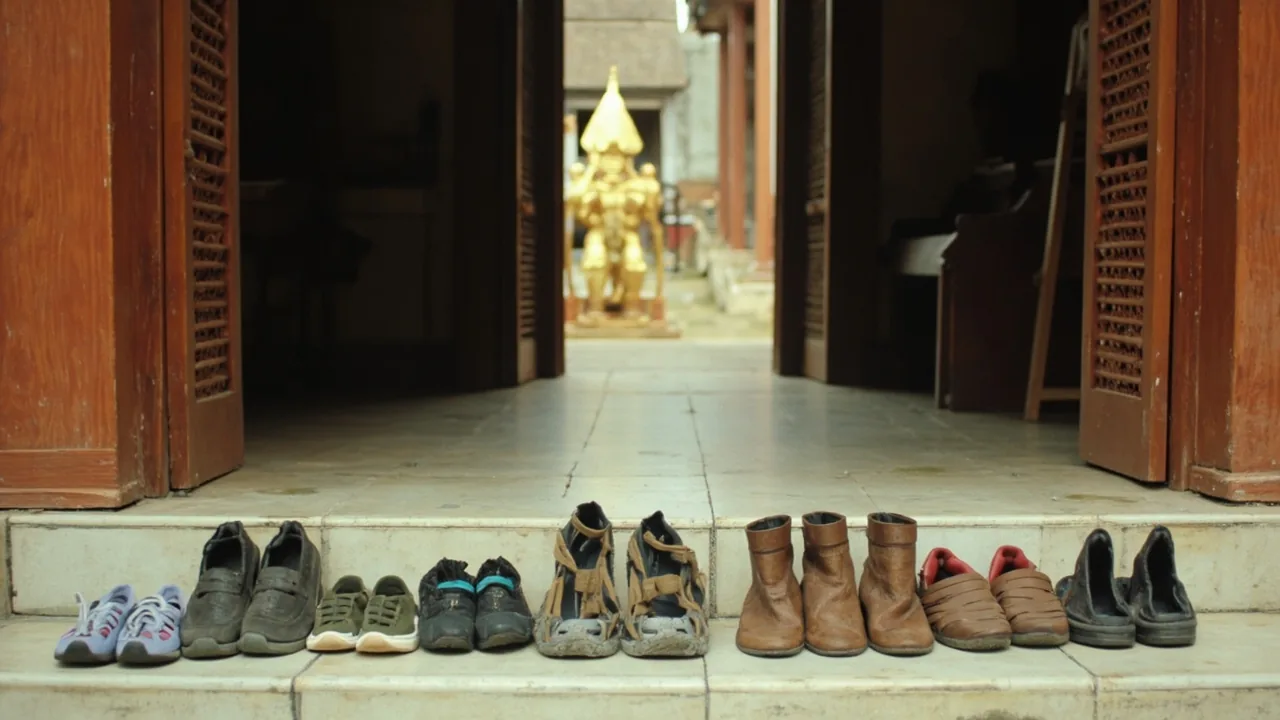
Temple Etiquette in Southeast Asia: A Country-by-Country Guide for Backpackers
Indian backpackers across Southeast Asia land at their first temple within 48 hours of arriving in Bangkok, Hanoi, or Siem Reap, and almost every one of them gets at least one thing wrong. This guide breaks down dress codes, bowing, donations, and photography bans country by country. See also Sea Backpacking Hub and Packing List for SE Asia.
Subodh’s Pro Tip: Buy a cheap oversize scarf or shawl in India before flying out. Costs ₹200-₹300 (~$2.08-$3.11), saves you at every temple where shoulders and knees must be covered. You may also find Average Spend in Thailand Per Day useful for this trip.
What Is “Temple Etiquette”?
Temple etiquette is the set of dress, behaviour, and ritual rules that visitors follow at religious sites. In Southeast Asia, three traditions run side by side: Theravada Buddhism (Thailand, Laos, Cambodia, Myanmar), Mahayana Buddhism with strong Confucian ritual (Vietnam), and Hindu-Buddhist temple culture shared with India. Each has its own dress code, foot protocol, and donation customs. Getting them right is mostly about reading the room: shoes off where shoes are off, head uncovered where heads are uncovered, voice low where people are praying.
Japan, while not in Southeast Asia, shows up constantly in Indian backpacker searches alongside SEA, so it is included at the end with the specifics around clapping, offering, and bowing at Shinto shrines.
Quick Answers: Temple Rules at a Glance
| What | Answer | Price (INR) |
|---|---|---|
| Shoes off? | Yes, always (Thailand, Vietnam, Laos, Cambodia, Japan) | Free, just remove them |
| Shoulders covered? | Yes in SEA; no strict rule in Japan | Free, wear a shawl or long sleeve |
| Knees covered? | Yes in SEA; no strict rule in Japan | Free, carry a sarong for rentals at major wats (₹57-₹114 (~20-40 THB or ~$0.59-$1.19)) |
| Head covered? | No, removing headwear is expected | — |
| Point feet at Buddha? | Never, universal offence across all traditions | — |
| Touch monk? | No (women) in Thailand, Laos, Cambodia | — |
| Photo inside? | Most temples ban it; some Vietnamese pagodas allow it | — |
| Typical donation (Thailand) | Small offering at the box | ₹57-₹286 (~20-100 THB) |
| Typical donation (Vietnam) | Incense sticks + offering | ₹37-₹184 (~10,000-50,000 VND) |
| Typical donation (Laos) | Standard offering | ₹43-₹215 (~10,000-50,000 LAK) |
| Typical donation (Cambodia) | Standard offering | ₹48-₹238 (~2,000-10,000 KHR) |
| Typical donation (Japan) | 5 yen coin (go-en) | ~₹3 (~5 yen or ~$0.03) |
Donation amounts assume small-box / general offering. Special ceremonies and monk-led blessings have different ranges; details below.
Thailand: The Most Photographed and the Most Restrained
Thailand’s temples (called wat) look like the free-for-all tourist photo backdrops from Instagram, but the rules inside are strict, and they are enforced at the major sites.
Dress code: Shoulders covered, knees covered, shoes off before any raised platform. Most major wats in Bangkok and Chiang Mai rent sarongs at the entrance for ₹57-₹114 (~20-40 THB or ~$0.59-$1.19) if you forgot the shawl.
Inside the ordination hall (ubosot): Sit with feet tucked behind you, never pointing at a Buddha image. Women must not touch a monk or hand anything directly to one (the ro phi tradition of indirect passing through a male intermediary, or placing the item on a cloth, applies).
Photos: Outside, fine. Inside the ubosot, almost always banned. Wat Phra Kaew (Temple of the Emerald Buddha) in Bangkok has zero-tolerance signage in multiple languages. Do not test it.
Donations: Drop a 20, 50, or ₹286 (~100 THB or ~$2.97) note into the box, or buy a bundle of incense and three lotus bud offerings for around ₹143-₹286 (~50-100 THB or ~$1.48-$2.97) total.
Talking point: At Wat Pho in Bangkok, the ticket desk accepts ₹572 (~200 THB or ~$5.94) for foreigners. The etiquette signs in Thai and English at the entrance explicitly ban shoes on the raised platform and forbid pointing feet at any Buddha image.
Safety Alert: Tattoos with Buddha imagery are fine in Thailand. Same for visible tattoos of Ganesh, Vishnu, or any Hindu deity. Local law protects religious imagery from commercial defacement, not personal wear.
Vietnam: Looser, but the Pagodas Vary
Vietnam’s Buddhist pagodas (called chùa) follow Mahayana Buddhist rules, which are visibly relaxed around tourist pagodas but more strict at active temples where monks live.
Dress code: Shoulders and knees covered, shoes off at the threshold. Vietnam has more “active monastery” pagodas than Thailand, so noise levels and behaviour expectations are tighter than Thai tourist wats.
Inside the main hall: Shoes off before crossing the raised wooden threshold. Sit with feet tucked. Do not point at statues or turn your back to a Buddha to take a selfie.
Photos: This is where Vietnam is more forgiving. Tran Quoc Pagoda in Hanoi permits outdoor photos freely. Inside the main hall, the rule is still no flash. At the Jade Emperor Pagoda (Hanoi), the back room with the preserved turtles and offerings is photography-restricted.
Donations: ₹37-₹184 (~10,000-50,000 VND or ~$0.38-$1.91) in the box. At some pagodas, you’ll find a caretaker selling incense sticks for ₹37-₹73 (~10,000-20,000 VND or ~$0.38-$0.76). Three sticks is standard, light them at the burner outside.
Indian traveller specifics: Vietnam has few Indian visitors compared to Thailand. Vegetarian food inside temple grounds is rare; if you plan to spend a full day at a pagoda complex, eat before you arrive. Packing list for Southeast Asia covers what to bring in your daypack for pagoda visits.
Laos: The Quietest and the Most Consistent
Laos is overwhelmingly Theravada Buddhist, and the etiquette in Luang Prabang, Vientiane, and Vang Vieng is consistent across the country. The rules are not negotiable, even at heavily visited tourist sites.
Dress code: Shoulders and knees covered at every active temple. Haw Phra Kaew (Vientiane) and Wat Xieng Thong (Luang Prabang) both enforce this. Sarong rental is available at major sites for around ₹43-₹86 (~10,000-20,000 LAK or ~$0.45-$0.89).
Shoes: Off at every door. Not just at the ubosot, at any covered hall. Laotian temples have more thresholds than Thai ones because the compound layout uses smaller connected buildings.
Inside the hall: Sit with feet pointing away from Buddha images. Do not raise your feet when seated (pointing the soles at anything sacred is the universal Southeast Asian offence). Women should not touch monks or hand them anything directly.
The alms-giving ceremony (Tak Bat) in Luang Prabang: This is a daily dawn ritual where monks walk through the streets collecting sticky rice from kneeling residents. Tourists participate by buying a packet of sticky rice (around ₹43-₹86 (~10,000-20,000 LAK or ~$0.45-$0.89)) from the morning market, kneeling, and placing it in the monk’s bowl without touching the monk or the bowl. Camera flash is banned. Standing above the monks while photographing is considered disrespectful. The official Luang Prabang tourism office publishes the rules every year; check before you go.
Donations: ₹43-₹215 (~10,000-50,000 LAK or ~$0.45-$2.23) is the standard range. The boxes often look empty because locals drop small bills, not tourists dropping ₹9,634 (~100 USD) notes (a real problem at the most-visited Luang Prabang wats).
Luang Prabang weather note: During the rainy months (May-October) some wats limit access to certain halls for preservation. Check Luang Prabang weather by month before planning heavy temple days.
Cambodia: Similar to Thailand, Stricter at Angkor
Cambodian temple etiquette mirrors Thai practice almost exactly (Theravada Buddhism, same regional tradition), with two notable additions specific to Angkor.
Dress code: Shoulders and knees covered. The APSARA authority that manages Angkor publishes this rule every year in its visitor guidelines. Enforcement is visible: guards at Angkor Wat turn visitors back at the second-level climb if their shoulders are showing.
Shoes: Off at every active temple. At Angkor, this applies to the inner sanctuaries, not the outer galleries and most photo platforms. Wear shoes you can slip off fast; you’ll do this 8-15 times a day if you do a full temple pass.
Inside Angkor Wat: The central tower climb (Bakan sanctuary) requires shoulders and knees covered, shoes off, and a quiet voice. Photos are allowed but flash is not. The lower galleries have carved Apsara reliefs that visitors commonly photograph; flash damages the stone over time and is enforced.
The “two palms together” gesture: Cambodians and Thais use the sampeah (Cambodia) and wai (Thailand) as a sign of respect. Hands at chest level, slight bow. Use it when greeting monks, temple staff, and elders. It costs nothing and earns visible goodwill.
Donations: ₹48-₹238 (~2,000-10,000 KHR or ~$0.49-$2.47). The official Angkor ticket is ₹3,565 (~37 USD) for a one-day pass, ₹5,973 (~62 USD) for three days; this is the only price you pay at the main complex, and donations inside are separate.
Subodh’s Pro Tip: Carry small KHR notes specifically for temple donations. Cambodian riel notes in 1,000 and 2,000 denominations work for donation boxes; USD is accepted at the Angkor ticket counter but is awkward to drop in a small offering box.
Japan: Shrines and Temples, Side by Side
Japan is not in Southeast Asia, but Indian backpackers regularly search temple etiquette questions that include Japan, especially around Shinto shrines and the proper offering amount in yen. This section answers those questions directly.
Shoes: Off at the genkan (entrance step) of every shrine and temple. Slippers are provided in some Buddhist temple buildings. At shrine prayer halls, shoes off, then you step up to the offering box.
At a Shinto shrine (the common one):
- Approach the temizuya (water basin) on the left or right.
- Take the ladle with your right hand, fill it, rinse your left hand, switch hands, rinse your right hand.
- Pour a little into your left palm, rinse your mouth (do not drink directly from the ladle), then rinse your left hand again.
- Stand the ladle upright so the remaining water runs down the handle.
- Walk to the main hall, drop a 5-yen coin (the go-en pun means “good fortune”) in the saisen box.
- Bow twice, clap twice (the answering-the-gods gesture), make a silent wish or prayer, bow once more.
The clapping is the part every Indian traveller asks about. At Shinto shrines you clap twice; at Buddhist temples you do not clap. The Buddhist temple ritual is bow, no clap, silent prayer. Getting these reversed is a small but visible error to anyone watching.
Donation amounts:
- 5 yen is the most common offering at any shrine. The word go-en (五円) sounds like go-en (御縁), meaning “honourable connection” or “good fortune.”
- 10 yen, 50 yen, 100 yen are all acceptable. The trick is no 10-yen coin (the word tou-en sounds like tōen, meaning “far away,” a bad pun).
- For a formal blessing or omamori (amulet) purchase, prices are 300-1,000 yen.
- For an actual goshuin (calligraphy stamp book entry) at the shrine office, around 300-500 yen.
Speaking voice: Quiet. No phone calls. No flash photography inside any prayer hall.
Indian temple visitors in Japan: There are a handful of ISKCON-affiliated temples and a few Hindu shrines in Tokyo. Visitors from India find them far more relaxed than SEA Buddhist sites. The rules for Indian temples (including ISKCON temples) are below.
Indian Temples and ISKCON: What Indian Travellers Already Know
This section is for Indian backpackers who grew up with temple-going and want the cleanest answer on temple etiquette when visiting Indian-affiliated spaces abroad.
Indian temple etiquette (universal):
- Remove shoes before entering any sanctum or hall.
- Wash hands and (in many traditions) rinse feet at the entrance.
- Cover head when entering a temple sanctum, especially in Hindu temples in North India. South Indian temples and ISKCON temples in India generally do not require head covering, but a dupatta or scarf is always safe.
- Do not point feet at the deity or at a priest performing rituals. Sit cross-legged or with one leg tucked under.
- Women during menstruation: in orthodox traditions you should not enter the sanctum. ISKCON policy allows entry but asks visitors to follow the temple’s specific local rule.
- Photography inside sanctum: most Indian temples ban it. ISKCON temples typically allow photography in the main hall but not during the abhishekam (deity bathing ritual).
ISKCON-specific rules (applies in India and overseas):
- Vegetarian food is the default. Some ISKCON temples serve sanctified midday meals (prasadam) to visitors for free or by donation.
- No leather items (belts, wallets) on the person when entering the temple hall. This is an absolute rule at every ISKCON temple worldwide.
- No alcohol or tobacco on temple grounds for at least 24 hours before visiting.
- The Hare Krishna maha-mantra is chanted publicly; visitors may stand and listen without participating.
Indian travellers who have been to SEA and back: you will notice SEA Buddhist temples are stricter about shoes than most Indian temples (where inner sanctum shoe-off is normal). You will notice Indian temples are stricter about dress than most tourist-friendly Buddhist wats. Carry the stricter rule into both.
Common Mistakes Indian Backpackers Make at SEA Temples
-
Keeping shoes on at the wrong threshold. The rule in Thailand, Laos, and Cambodia is “off at the outer edge of the raised platform,” not “off at the inner sanctum.” You will see Indian travellers walking on the raised marble with shoes still on. Remove them earlier, not later.
-
Wearing shorts under a long-sleeve shirt. Shoulders covered but knees showing is still a violation at every major temple. The shawl-around-the-waist trick works in Thailand, less so at Angkor where guards check explicitly.
-
Touching a monk’s shoulder to pose for a photo. Even friendly contact is forbidden for women in Theravada countries. Men can shake hands with a monk but should not initiate.
-
Clapping at a Buddhist temple in Japan. The two-clap rule is Shinto, not Buddhist. Indian travellers who saw shrine etiquette on YouTube often clap at temples too. Don’t.
-
Dropping a 500-yen coin at a Shinto shrine. 5 yen is the cultural default. Bigger coins are fine but signal tourist behaviour, not reverence.
-
Sitting with feet pointing at the Buddha image. Universal offence across all SEA Buddhist traditions and Japanese Buddhism. Tuck feet behind you.
-
Using flash on carved reliefs. At Angkor, Bagan, and many Japanese temples, the staff will warn you. The damage over decades is real, and the rule is enforced.
What Most Guides Don’t Tell You
The “tourist entrance” vs “real entrance” issue. At heavily visited temples (Wat Pho, Angkor Wat, Senso-ji in Tokyo), there is often a staff-monitored tourist entrance and a quieter monks-and-worshippers entrance. Going through the tourist entrance is fine and signs direct you there, but locals use the side door. Don’t try to use the side door yourself; the staff will redirect you.
Donation boxes are not ATMs. Drop what feels reasonable for a temple visit, not what you think a “ticket” would cost. A 500-yen coin at a small neighbourhood shrine is fine; a 100-yen coin at Angkor Wat is also fine. The box is for offerings, not entry fees.
Photography bans are often unenforced but real on the signage. The ₹572 (~200 THB or ~$5.94) fine for photography inside Wat Phra Kaew is published but rarely collected. This does not mean it is fine. Take the posted rule as binding.
Some temples close during Buddhist holidays. Thailand, Laos, Cambodia, and Myanmar all have major Buddhist holidays where temple grounds are closed to visitors or restricted to worshippers. The Thai lunar calendar and the regional calendar differ slightly. Check the embassy or tourism office notice before you go.
You can be asked to leave. This is rare but it happens, mostly for dress code violations at major wats. The guards do not enjoy sending you back. Take the rule seriously.
Safety Alert: For country-specific safety advisories that may affect temple visits (political protests near religious sites, regional unrest, etc.), check the Indian Ministry of External Affairs travel advisory at mea.gov.in before departure. The country-level pages are updated regularly and include specific notes about religious sites.
FAQ
Can I enter a Buddhist temple in Thailand if I have a Buddha tattoo?
Yes. Thai law protects religious imagery from commercial use (printing Buddha on T-shirts for sale, for example), not personal wear. Visible Buddha tattoos, Ganesh tattoos, and Hindu deity tattoos are normal on tourists in Bangkok, Chiang Mai, and the islands.
How much should I donate at a Shinto shrine in Japan?
5 yen is the culturally correct amount. The pun between go-en (五円, five yen) and go-en (御縁, good fortune) is the reason. 10 yen is avoided because tōen (遠縁) sounds like “far away.” Larger denominations are accepted but signal tourist behaviour.
Do I have to cover my head at an Indian temple abroad?
For North Indian Hindu temples (especially ISKCON temples), yes, head covering is standard. For South Indian temples abroad, head covering is generally not required. Carry a scarf either way. It costs nothing and removes ambiguity.
Can women touch a monk in Thailand, Laos, or Cambodia?
No. Women should not touch a monk, hand a monk anything directly, or sit next to a monk on a bus or train (a real rule in Thai public transport, not just temples). For offering items, place them on a cloth or pass them through a male intermediary.
Where is photography banned inside SEA temples?
Almost every major temple bans flash photography inside the main hall and explicitly bans photography at the inner sanctuary. Wat Phra Kaew (Bangkok), Wat Pho main hall, all ubosots in Laos, and the inner sanctuary of Angkor Wat are the strictest. Outside areas are generally fine, with the usual “no drone without permit” rule.
Is there a vegetarian Indian restaurant near major temples?
In Bangkok’s old town (near Wat Pho) and in Chiang Mai’s old city, yes. Outside tourist centres in Laos, Cambodia, and Vietnam, vegetarian options at temple-adjacent restaurants are rare. Eat before you go.
How do I get from Bangkok to Siem Reap for the major temple sites?
The Bangkok-Siem Reap overland route is well-trodden. Book the bus or flight on 12go ahead of time during peak season (Nov-Feb).
Subodh’s Take
Temple etiquette is mostly just three things done well: shoulders and knees covered, shoes off at the threshold, voice low. Get those right and 90% of the rules take care of themselves. The remaining 10% is country-specific (women and monks in Theravada countries, clapping at Shinto shrines in Japan, head covering in North Indian temples abroad) and those are the rules this guide is built to clear up. Don’t overthink it, don’t skip the donation box, and remember that the people watching you most closely are the other visitors, not the monks.
- Subodh
