Mount Kinabalu, Scuba Diving & Monkey Bites: Malaysia Adventure Safety Guide for First-Timers
Malaysia is one of the safer adventure destinations in Southeast Asia. This guide covers hiking mount kinabalu safety tips for beginners, scuba diving risks, and monkey bites. All three are avoidable with prep that costs you an afternoon in India before you fly. For related planning, see our guide on Sea Backpacking Hub.
This guide focuses on the adventure side of Malaysia, not the city-side (covered in our is Malaysia safe for Indian travelers guide). It’s written for first-timers who have never hiked at altitude, never worn a tank, and have never had to think about whether a macaque might bite them. If that sounds like you, read this twice before you book your flight.
Subodh’s Pro Tip: Book Kinabalu climbing permits and your dive course before you leave India. Both run on limited daily quotas and walk-in spots in July/August (peak season) routinely sell out 3-4 weeks ahead. Same for Mount Kinabalu’s famous Via Ferrata, which is weather-dependent and capped at 140 climbers per day.
Quick Answers
| What | Answer | Price (INR) |
|---|---|---|
| Mount Kinabalu climbing permit (timpohon gate) | 1 climber, 1 summit attempt, includes guide | ₹8,246 (~350 MYR or ~$85.60) |
| PADI Open Water certification (3-4 days, Perhentians) | Course + manual + 4 boat dives | ₹25,917 (~1,100 MYR or ~$269.02) |
| Hospital outpatient visit (private, Kuala Lumpur) | Consultation only, no procedure | ₹3,534 (~150 MYR or ~$36.68) |
| Rabies post-bite vaccine series (Indian clinic reference) | Full PEP course, 4 doses | ₹2,400 (~$24.91) |
| Travel insurance (SafetyWing, monthly) | Indian traveler, ASEAN coverage | 5,900 |
Mount Kinabalu’s summit trail involves 2,100 m of vertical gain across 8.7 km. Most fit Indian walkers in their 20s clear it without issue. The problem is the descent on tired legs, not the climb.
The Real Risks (What to Worry About)
Ranked by how often Indian backpackers hit them.
| Risk | Likelihood | Impact | How to Avoid |
|---|---|---|---|
| Altitude sickness / exhaustion on Mount Kinabalu summit | High | Moderate | Acclimatize 1 night in Kundasang (1,900 m) before attempting the 4,095 m peak. Hydrate. Skip the morning alcohol. |
| Monkey bites at Bukit Bendera, Penang Hill, or Bako | Moderate | High | Don’t feed them. Don’t hold food in your hand. Don’t make eye contact. If one climbs on you, drop whatever it’s after and back away slowly. |
| Decompression sickness / ear barotrauma from uncertified dives | Moderate | Severe | Book with a PADI/SSI-certified shop only. Check their dive computer logs. Refuse “fun dives” past 18 m without certification. |
| Dengue fever | Moderate | High | DEET 30%+ repellent daily. Long sleeves after dusk. Mosquito nets in hostels. |
| Slip-and-fall on wet trails (rainforest boardwalks) | Moderate | Low | Non-slip hiking shoes with grip. Walk slowly on wet wood/metal. Skip the trail right after rain. |
| Sunstroke / heat exhaustion on Perhentian or Langkawi beaches | Moderate | Moderate | SPF 50+ reapplied every 2 hours. 2 L water minimum. Hat with neck flap. |
| Violent crime | Low | Severe | Standard city awareness. Bukit Bintang and Chinatown at night: stay in well-lit areas. |
| Rabies from stray dog bite (rare but real in Sabah) | Low | Severe | Avoid stray dogs in Kota Kinabalu. If bitten, scrub wound 15 minutes with soap, then seek rabies PEP within 24 hours. |
For the broader picture, including street food and city-level scams, our Malaysia street food safety guide and scams and drug laws cover the rest.
Mount Kinabalu: What Kills Trips (and How to Avoid It)
Mount Kinabalu is 4,095 m. The trail starts at 1,866 m. That’s 2,229 m of vertical gain across 8.7 km to Laban Rata (the rest house at 3,272 m), then another 2.7 km and 800 m of vertical to Low’s Peak. Most of the trouble happens not on the summit push but on three specific things Indian first-timers underestimate.
1. Altitude sickness above 3,000 m
Symptoms hit between 6-24 hours after ascent: splitting headache, nausea, dizziness, loss of appetite. About 30-40% of trekkers report mild symptoms. Severe cases (HACE/HAPE) are rare but real. The summit is at 4,095 m, technically borderline for altitude issues, but the speed of ascent (you sleep at sea level in Kota Kinabalu and try to summit in 36 hours) makes symptoms worse.
The fix: Spend 1 night in Kundasang or the Mesilau area before attempting the climb. Kundasang sits at 1,900 m. One night there cuts your acute mountain sickness risk meaningfully. Hydrate: 3-4 L of water on summit day. Skip the pre-climb beer session.
2. The descent, not the climb
Every trekker I know who has had a problem on Kinabalu had it on the way down. Your knees take 5x body weight per step on descent. By km 5, your quads are shaking. By km 7, you’re holding the handrail with both hands. Indian backpackers who skip leg prep (lunges, squats, stairs with weight) often end the descent on a stretcher with no injury, just dead legs.
The fix: Train stairs or hills with a 10 kg backpack for 2-3 weeks before flying. Bring trekking poles. Take ibuprofen 30 minutes before descent starts. Plan the day so summit is reached by 9-10 AM, giving you full daylight for the down trip.
3. The weather window
Kinabalu’s summit is shrouded in cloud 60% of the time. The 2-3 AM summit start exists specifically to catch sunrise above the cloud line. Rain closes the trail. The Via Ferrata (the famous fixed-cable climb on the return) shuts down in sustained rain or wind above 40 km/h. Book a climb that has 2 buffer days in case weather scrubs day 1.
Subodh’s Pro Tip: The summit fee of 350 MYR buys you entry, the guided climb (mandatory), and conservation. It does NOT include the Via Ferrata (₹8,246-₹10,602 (~350-450 MYR or ~$85.60-$110.05) extra), the rest house bed (₹5,655-₹8,953 (~240-380 MYR or ~$58.70-$92.93) depending on room), or the certified mountain guide tip (₹1,178 (~50 MYR or ~$12.23) standard). Budget ₹23,561-₹28,273 (~1,000-1,200 MYR or ~$244.56-$293.48) all-in for a 2-day, 1-night standard climb without Via Ferrata.
Gear List for Kinabalu (and the Cameron Highlands)
The competitive gap on this topic is real: most beginner pages skip the specifics. Here’s what matters.
For Kinabalu summit climb (4,095 m):
- Layered clothing, not one thick jacket. At base (1,866 m), expect 22-26°C and humid. At Laban Rata (3,272 m) overnight, expect 8-12°C. At Low’s Peak (4,095 m), expect 4-8°C with wind chill. You need 3 layers: a moisture-wicking base (merino or synthetic, NEVER cotton), a mid-layer fleece, and a waterproof/windproof shell. Skip down jackets in heavy rain; they collapse when wet.
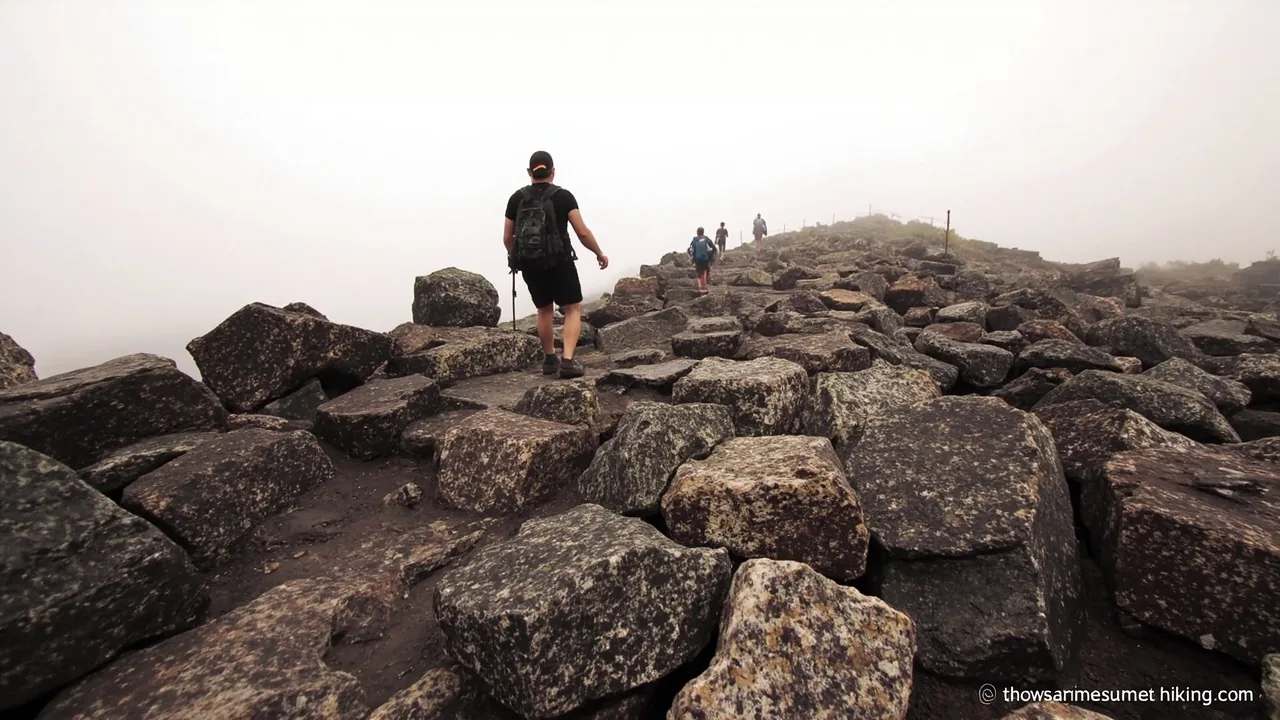
- Non-slip hiking shoes with ankle support. The granite slabs near the summit get wet and slippery. Trail runners work for fit trekkers. Cheap sneakers do not. Break them in for 2 weeks before flying; new blisters + 16 km of trail = a trip-ending foot injury.
- Trekking pants, not jeans. Wet jeans weigh 3 kg and chafe your thighs raw on descent. Convertible zip-off pants are ideal: trail-ready by day, shorts in town. Quick-dry fabric only.
- Rain jacket with sealed seams. Afternoon rain hits Kinabalu 4-5 days a week, even in dry season (Feb-Aug). A ₹18,849-₹35,342 (~800-1,500 MYR or ~$195.65-$366.85) GoreTex-style jacket pays for itself the first time it doesn’t soak through. Pack cover alone isn’t enough.
- Headlamp with red mode. The 2 AM start is in full dark. A phone torch isn’t bright enough for granite steps. A ₹1,178-₹2,356 (~50-100 MYR or ~$12.23-$24.46) headlamp from Decathlon works; Petzl/Silva are overkill for one climb.
- Trekking poles. Most underrated piece of kit. Saves your knees on the descent more than any other single item. Rent at Timpohon gate for 20 MYR/day or buy collapsible ones for ₹1,885 (~80 MYR or ~$19.57) at any outdoor shop in KK.
For Cameron Highlands day hikes:
- Same non-slip shoes.
- Light rain jacket (afternoon showers are routine).
- Long-sleeve top (leeches in jungle trails below 1,500 m, especially after rain).
- Insect repellent with DEET 30%+.
Scuba Diving: The Health Requirements Nobody Mentions
PADI Open Water is the standard first certification. It’s safe for healthy adults. It is not safe for everyone, and dive shops in Malaysia are not required to refuse you outright for certain conditions, but the reputable ones will.
Medical questionnaire (mandatory before any dive course)
You’ll be asked to confirm/deny:
- Asthma or wheezing in the last 12 months
- Heart disease, chest surgery
- Diabetes (controlled is usually fine; insulin-dependent needs doctor clearance)
- Epilepsy or seizures
- Pregnancy
- Recent surgery or ear infections
- Sinus congestion on the day of the dive
Be honest. Decompression sickness (the bends) and arterial gas embolism (lung overexpansion) can kill. Most dive shops ask you to sign a medical statement and acknowledge that misrepresenting conditions voids their liability.
Ear equalization
The #1 problem first-timers hit. As you descend, pressure builds in your middle ear. If you don’t equalize (pinch nose, gentle blow), your eardrum ruptures. This cancels the dive day and risks permanent hearing damage. Practice equalizing on the plane ride over: pinch your nose and swallow/yaw at the same time. If it doesn’t “click,” you have a cold or sinus block. Don’t dive with a blocked nose.
Shop selection
Book with a PADI or SSI Gold dive center. Both certifications are globally recognized. Avoid uncertified “fun dive” shops on the islands. Red flags: no visible dive computer logs on the boat, no instructor-to-student ratio of 1:4 or better, no boat briefing before departure. Reputable centers cost ₹23,561-₹28,273 (~1,000-1,200 MYR or ~$244.56-$293.48) for Open Water certification; bargain-basement shops under ₹18,849 (~800 MYR or ~$195.65) cut corners.
Monkey Bites and Rabies in Malaysia
Malaysia is one of the few Southeast Asian countries with ongoing rabies risk, almost entirely in Sarawak (since 2017) and parts of Sabah. Peninsular Malaysia and Langkawi are considered rabies-free in animals, but macaques at Bukit Bendera (Penang Hill), Bako National Park (Sarawak), and the Perhentian island trails can and do bite.
The actual risk
Macaques bite when you:
- Hold food in plain sight
- Try to take a selfie at close range
- Make sudden movements near juveniles
- Wear shiny jewelry (they grab)
What to do if bitten
- Wash the wound under running water with soap for 15 minutes. Not 30 seconds. Fifteen minutes. This single act reduces rabies transmission by up to 90%.
- Apply iodine or alcohol if available.
- Seek medical care within 24 hours. Indian travelers: most Malaysian government hospitals stock rabies immunoglobulin (RIG) and the vaccine series (4 doses over 14 days, days 0, 3, 7, 14).
- Report to the Indian High Commission in Kuala Lumpur so your records are on file in case follow-up treatment is needed in India.
Subodh’s Pro Tip: Pre-exposure rabies prophylaxis (2 doses, days 0 and 7) is available in India for ₹500-₹700 (~$5.19-$7.27) per dose. If you’re planning extensive jungle or monkey-prone activities (Bako, Kinabalu, Bukit Bendera), get it before flying. It buys you 24 extra hours of medical buffer if something happens.
Beach and Water Safety
Perhentian, Redang, Tioman, and Langkawi have strong currents and box jellyfish in season. Most beaches are safe in calm weather (April-September on the east coast, November-March on the west coast, with monsoon reversal in between).
- Never swim drunk. About 70% of sea drownings in Malaysia involve alcohol.
- Check flag colors. Green = safe, yellow = caution, red = no swimming. Beach signs are in Bahasa but the colors are universal.
- Jellyfish stings. Box jellyfish are present east coast islands (Perhentian, Redang) March-July. Wear a stinger suit if provided. Vinegar neutralizes the sting; urine does not.
- Rip currents. If caught, swim parallel to shore, not against the current. Most rips are 5-15 m wide and you can exit in 30-60 seconds of side-swimming.
What to Do If Something Happens
The practical three-step system that works for most adventure incidents in Malaysia.
For a fall or injury on the trail
- Stop. Assess: can you put weight on it? Can you move fingers/toes? If no, stay put.
- Signal: 3 of anything (whistle blasts, torch flashes, shouts). Pause. Repeat. International distress.
- Call: Malaysia’s general emergency line is 999 (police/ambulance). Tourist police in KL is 03-2149-6590. If you have eSIM data, Grab works in most cities to call a ride to the nearest hospital.
For a scuba incident
- Stop ascending. Hold your breath only if mid-breath; otherwise breathe normally.
- Signal your buddy. Make eye contact, share your regulator.
- Surface slowly (max 9 m/min). Breathe normally.
- Get to a chamber. Hyperbaric chambers are at Lumut Naval Base (Perak) and KK Specialist Hospital (Sabah). Costs for treatment run ₹117,805-₹353,415 (~5,000-15,000 MYR or ~$1,222.82-$3,668.45) without insurance. This is exactly why SafetyWing matters: see below.
For theft or lost passport
- File a police report within 24 hours. Required for any insurance claim and for getting an emergency travel document from the Indian embassy.
- Contact the Indian High Commission in Kuala Lumpur for emergency passport issuance.
- Keep digital copies of all documents: passport, visa, insurance, vaccination card. WhatsApp them to a family member and email them to yourself before flying.
Indian-Specific Considerations
Medicine equivalents
| Indian brand | Malaysian equivalent | Used for |
|---|---|---|
| ORS / Electral | ORS sachets at any pharmacy | Dehydration, food poisoning |
| Crocin (Paracetamol 500 mg) | Panadol | Fever, mild pain |
| Moxikind-CV (Amoxicillin) | Augmentin (prescription only) | Bacterial infections |
| Pantocid (Pantoprazole) | Nexium (over the counter) | Acidity, reflux |
| Metrogyl (Metronidazole) | Flagyl (prescription) | Diarrhea, parasites |
Indian High Commission contact
- Address: Suite 22.02, Level 22, Menara Standard Chartered, 30 Jalan Sultan Ismail, 50250 Kuala Lumpur
- Phone: +60-3-2613-0000 (general), +60-3-2613-0019 (consular emergencies)
- Email: [email protected]
For the full embassy + hospital list, see our emergency contacts guide.
Travel insurance: what Indian travelers need
Standard backpacking insurance covers most things. For Malaysia specifically, confirm your policy covers:
- Scuba diving to 30 m (some policies cap at 18 m or exclude certification dives)
- Mountaineering below 4,500 m (Kinabalu summit at 4,095 m is fine; anything higher needs a mountaineering add-on)
- Emergency medical evacuation (chamber transfer costs ₹1,926,780 (~20,000 USD)+)
- Trip interruption (flight cancellation due to illness)
Getting Connected
Working data is the fastest way to pull up an embassy number, call a Grab to hospital, or check weather windows on Kinabalu. Get a local SIM (DIGI, Maxis, Celcom, or U Mobile; tourist SIMs run ₹707-₹1,178 (~30-50 MYR or ~$7.34-$12.23) for 30 days with 30-50 GB) or use an eSIM you can scan on landing: Get Nomad eSIM. Both work across Peninsular Malaysia; Sabah/Sarawak coverage is identical on DIGI and Maxis. Skipping SIM setup on arrival is the #1 reason Indian backpackers get stranded at KLIA at midnight with no Grab and no map.
FAQ
Is climbing Mount Kinabalu safe for someone who has never hiked before?
Yes, with caveats. The trail is well-marked, has mandatory guides, and the granite steps near the summit have railings. Most fit Indian walkers in their 20s and 30s clear it without issue. The two failure modes are: (1) underestimating the altitude and developing acute mountain sickness, mitigated by spending a night in Kundasang first, and (2) knees giving out on the descent, mitigated by trekking poles and pre-trip training. If you can climb 50 flights of stairs with a 10 kg bag without stopping, you’re fine.
Do I need a yellow fever vaccine for Malaysia?
Only if you’re arriving from a yellow fever country (most of sub-Saharan Africa, parts of South America). Indian passport holders flying direct from India to Kuala Lumpur do NOT need yellow fever vaccination. Recommended vaccines for Malaysia from India are hepatitis A, hepatitis B, typhoid, and Japanese encephalitis if you’re doing rural Sabah/Sarawak. Full breakdown in our Malaysia vaccination guide.
What is the best time of year to climb Mount Kinabalu?
February to April is the dry window with the most clear summit days. May-August is drier than September-January but afternoon rain is common. Avoid November-January if possible: monsoon, leeches on lower trails, frequent Via Ferrata cancellations. Book 3-4 months ahead for February-April dates; permits cap at about 140 Via Ferrata climbers per day.
Can I do scuba diving without a certification in Malaysia?
Yes: most shops offer a “Resort Dive” or “Intro Dive” intro course. You’re limited to 12 m depth, no decompression credit, and direct supervision. The medical questionnaire still applies. If you want to dive deeper or rent tanks unsupervised later, do the full PADI Open Water course (3-4 days, ₹25,917 (~1,100 MYR or ~$269.02) typical). Never let a shop push you past your training depth or skip the briefing.
Is tap water safe to drink in Malaysia?
No. Drink bottled, filtered, or boiled water only. Ice in tourist restaurants is usually from commercial ice makers (safe); street stall ice is usually also commercial but verify it’s hollow-tube ice, not solid blocks. Brush teeth with bottled water if your stomach is sensitive. Most Indian travelers are fine with bottled water throughout the trip.
Are the monkeys at Bukit Bendera dangerous?
Mostly to your phone, food, and dignity. They rarely bite without provocation (food in hand, sudden movements, selfie attempts). The bites that do happen are usually superficial scratches. But macaques can carry rabies and tetanus, so any bite warrants medical review within 24 hours. The fix: don’t feed them, don’t hold food, keep your backpack zipped, and never make eye contact at close range.
How much cash should I carry for a 2-week Malaysia adventure trip?
Roughly ₹18,849-₹28,273 (~800-1,200 MYR or ~$195.65-$293.48) covers most small expenses after hotels: trail permits, dive course deposit, local buses, entry fees. Card acceptance is excellent in cities and dive shops; cash matters more for rural areas (Kundasang, Bako park, Cameron Highlands trail guides). Carry ₹4,712 (~200 MYR or ~$48.91) in small notes for monkey-induced peace-of-mind donations and park entry fees.
