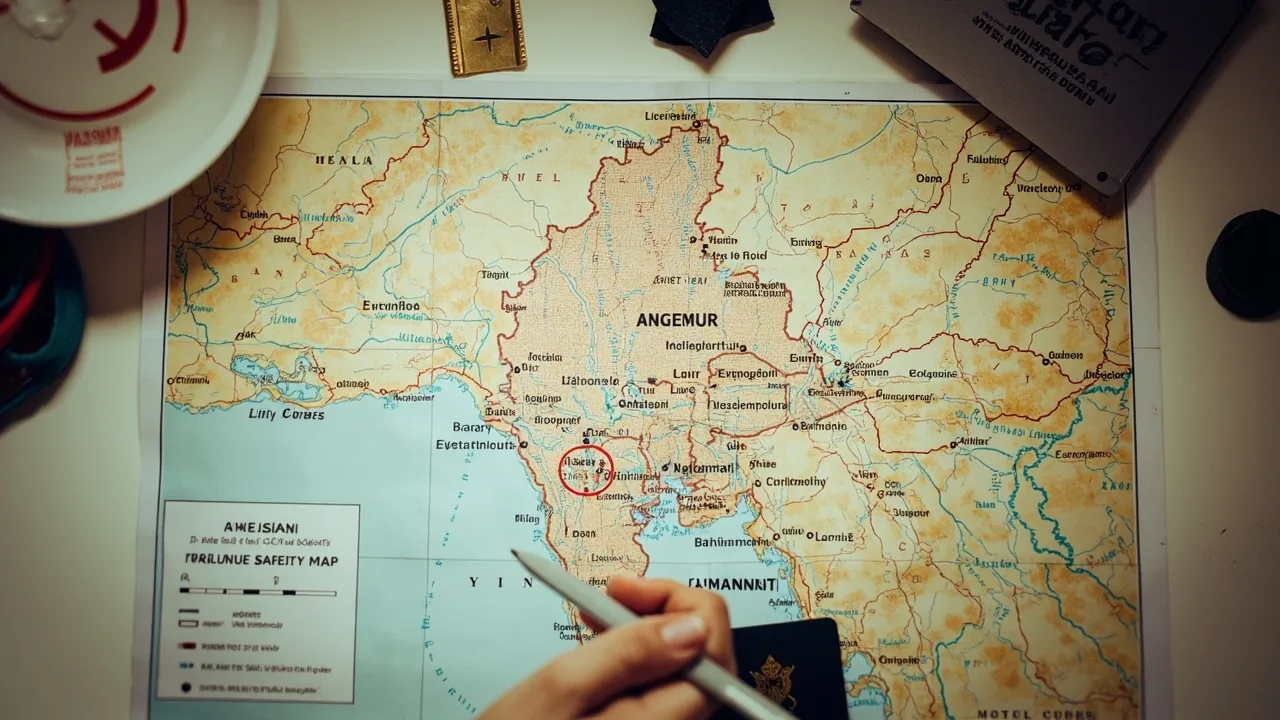
Myanmar Safety Guide 2026: Risks, Scams, and Emergency Info for Indian Travelers
Myanmar is not a normal destination right now. The country has been in an active civil conflict since February 2021, parts of the country are under military control, parts are not, and the situation on the ground shifts by the month. Telling you “Myanmar is safe, just use your common sense” would be dishonest. Telling you “Never go, it’s a warzone” would also be dishonest, because Indian travellers do still visit Yangon and a handful of other areas, and the experience for most of them is not what the worst-case headlines suggest. This guide walks you through what is happening, what the realistic risks are, what the scams look like, and the embassy and emergency contacts you need in your phone before you fly. For related planning, see our guides on Sea Backpacking Hub and Street Food Tap Water Myanmar Indian Tourist Safety.
The single most important thing you can do right now: check the current Indian Ministry of External Affairs travel advisory for Myanmar before you book anything. The situation changes, advisories are updated, and the decision about whether to go is one you should make against the most recent official line, not against a blog post. Mea.gov.in is the page you want.
Subodh’s Pro Tip: A valid Myanmar e-visa is 50 USD (about ₹4,826 at the current rate of 1 USD = ₹96.53), valid for 28 days, single entry, applied through the official portal at evisa.moip.gov.mm. There is no visa-on-arrival right now. Apply at least 2 weeks before your flight.
Quick Answers
| What | Answer | Price (INR) |
|---|---|---|
| Is Myanmar safe for Indian tourists in 2026? | Partially safe, with major caveats. Yangon and a few tourist areas are generally calm, but the country is in active conflict and many regions are off-limits. Check the MEA advisory before booking. | , |
| Current Myanmar travel advisory for Indians | Level 2 (Yellow): Reconsider travel. MEA advises against non-essential travel to several states. | , |
| e-Visa fee for Indian passport holders | ₹4,817 (~50 USD), single entry, 28-day max stay | ~₹4,826 (~$50.09) |
| Indian Embassy in Yangon emergency contact | +95-1-391-219 / [email protected] | , |
| Myanmar general emergency number | 199 (police), 191 (fire), 192 (ambulance) | , |
The Indian Embassy in Yangon has been operating with reduced staffing since 2021. Consular services can be slow. Do not count on same-day passport replacements.
The Real Risks (What to Worry About)
Myanmar’s risk profile is unlike any other Southeast Asian country right now. Most of the usual Southeast Asia safety advice (scooter crashes, dengue, street food) still applies, but it sits on top of a base layer of political and security risk that does not exist in Thailand, Vietnam, or Laos. Here is the rank-ordered list.
| Risk | Likelihood | Impact | How to Avoid |
|---|---|---|---|
| Civil unrest, curfews, sudden closures | Moderate in Yangon, high in conflict states | Severe | Avoid all rallies, protests, and military checkpoints. Check news daily. Register with the Indian Embassy on arrival. |
| Getting caught in a conflict zone | Low in Yangon, high in border states | Catastrophic | Stick to Yangon, Bagan (check current access), Inle Lake area only. Avoid Rakhine, Chin, Kachin, Shan (eastern), Sagaing, and Karen/Kayin border regions entirely. |
| Internet blackouts and banking freezes | Moderate, intermittent | High | Carry enough USD cash for the entire trip. ATMs are unreliable; Visa/Mastercard acceptance is patchy. Screenshot important documents. |
| Scams and overcharging | High | Low. Medium | Use the rates in this guide as anchors. Negotiate taxis in advance. |
| Food and water sickness | Moderate | Low | Bottled water only, busy street stalls, standard food hygiene. |
| Violent crime against tourists | Low in tourist zones | Severe | Normal street awareness, no flashy jewellery, no late-night wandering alone. |
| Medical evacuation need | Low but real | Severe | Travel insurance with medevac is non-negotiable here. See the insurance section below. |
The first three rows are the ones that make Myanmar different from the rest of Southeast Asia. The rest of this guide covers the practical layer underneath.
Safety Alert: Several states in Myanmar are under active armed conflict between the military (SAC) and Ethnic Armed Organisations (EAOs) or People’s Defence Forces (PDFs). The Indian MEA explicitly advises against travel to Rakhine, Chin, Kachin, Sagaing, and parts of Shan and Kayah states. Yangon itself has had periodic curfews, internet shutdowns, and bomb blasts in public spaces. Do not treat Myanmar like Thailand.
Prevention and Preparation
This section is what you do in India before you fly. Myanmar rewards preparation more than almost any other destination because once you are there, your options narrow fast.
Travel insurance with medical evacuation is non-negotiable. Standard backpacker insurance is not enough for Myanmar. You need a policy that explicitly covers emergency medical evacuation to Bangkok or Singapore, because Myanmar’s private hospitals are functional in Yangon but the best care for serious issues requires getting out. SafetyWing’s nomad insurance works for Myanmar but read the policy for evacuation clause terms before buying.
Vaccines. The standard Southeast Asia set applies: Hepatitis A and B, Typhoid, Tetanus, Japanese Encephalitis (recommended for rural areas), and Rabies (considered for longer stays). Yellow Fever is only required if you are arriving from an endemic country. Carry your yellow fever certificate if you have been through Africa or South America recently. For the full kit, see our Myanmar vaccinations guide.
Cash in USD, in good condition. Myanmar’s banking system has been unstable. ATMs work sometimes, do not work other times. Visa and Mastercard acceptance is mostly limited to high-end hotels. Bring clean, undamaged ₹9,634 (~100 USD) bills. Torn or older-series notes get rejected at exchanges.
Digital backups of everything. Passport, visa, insurance, vaccine certificate, hotel bookings. Screenshot to phone, save to cloud, email to yourself, and share with a family member back in India via WhatsApp. If your phone is lost or seized at a checkpoint, you still have everything accessible from any device.
Register with the Indian Embassy on arrival. Email the consular section your passport details, hotel address, and travel dates. If something goes wrong (curfew, evacuation, hospitalisation), this is how they find you.
Get eSIM before flying. Physical SIMs at Yangon airport have been unreliable since 2021, with SIM registration requirements that can take hours. An eSIM is the faster option. Get Nomad eSIM lets you arrive connected without dealing with the airport counter.
City-by-City Scams and Gotchas
Myanmar’s scam scene is gentler than Bangkok’s or Hanoi’s, mostly because tourist numbers are way down and locals are grateful for the business. But there are patterns worth knowing.
Yangon:
- The “temple is closed today” scam. A driver tells you Shwedagon Pagoda or another major site is closed for a Buddhist holiday, then offers to take you to “better” shops where they get a commission. The temple is almost never closed. Check the official site yourself before you leave the hotel.
- Taxi meter refusal. Most Yangon taxis do not run meters. Negotiate the fare before getting in. A cross-town ride from downtown to the airport runs about ₹771-₹1,156 (~8-12 USD). Anything above that and you are being worked.
- The “no change” trick. Paying a small bill with a 20,000 MMK note and being told they have no change. Carry small denominations and break large notes at teashops and convenience stores.
Bagan (if accessible):
- E-bike rental scams. Photographers take the existing damage, then claim you caused it on return. Photograph the bike from every angle before leaving, including close-ups of any scratches. This is standard everywhere in Southeast Asia but is the single most common tourist complaint in Bagan.
- Sunrise balloon viewing touts. Anyone selling “discounted” balloon rides on the street is selling either a scam or a dangerous operation. The official operators (Balloons Over Bagan) are the only safe choice, and they sell only through hotels and the official site.
Mandalay:
- The “special ceremony” donation. Monks or apparent temple staff ask for a “donation” for a blessing, ceremony, or photo opportunity. Real monasteries do not solicit tourists this way. Polite decline and walk on.
- Jade market “investment” pitches. Mandalay’s jade market is fascinating, and touts will pitch you on “inside deals” with massive returns. Every one of these is a scam. Do not engage beyond browsing.
Inle Lake (if accessible):
- Boat price inflation. Standard full-day boat tours are negotiable. A common trick is quoting a per-person rate and then multiplying by everyone on the boat. Get the total price in writing before departure.
Subodh’s Pro Tip: Myanmar uses the Myanmar Kyat (MMK), but USD is the de facto currency for anything tourist-related (hotels, tours, e-visa fees, larger purchases). Kyat is used for street food, taxis, and small shops. The current rate is roughly 1 USD = 2100 MMK, so 1 INR ≈ 22 MMK right now. Carry both.
What to Do If It Happens
This section is where Myanmar differs from every other country we write about. Most travel emergencies are about losing a passport or twisting an ankle. In Myanmar, they can also be about curfews, internet blackouts, or being in the wrong place when something goes wrong.
If a curfew is announced: Stay where you are. Do not try to get back to your hotel. Hotels know about curfews and will accommodate guests who cannot leave. The Indian Embassy will issue guidance through their social channels and email.
If you are caught near a protest or military action: Walk away calmly in the opposite direction. Do not film, photograph, or take notes. Do not argue with soldiers or police. Show your passport if asked, nothing else.
If your passport is lost or stolen: Report to the nearest police station (dial 199). Get a written FIR or acknowledgment. Contact the Indian Embassy in Yangon at +95-1-391-219 or email. Embassy services are reduced but they do issue emergency certificates. For full embassy and hospital details, see our emergency contacts guide for foreigners in Myanmar.
If you have a medical emergency: Dial 192 for an ambulance, or go directly to a Yangon private hospital (we list the main ones in the emergency contacts guide linked above). For anything serious, you want to be evacuated to Bangkok. Your insurance company’s 24/7 emergency line is the number to call first. Bangkok Hospital Bumrungrad and Samitivej have Myanmar-specific patient transfer experience.
If your phone is lost or confiscated: Every digital backup you made before flying now matters. Email yourself your documents, use WhatsApp Web from a friend’s phone, or visit any cyber cafe in Yangon downtown to access cloud storage.
If you feel unsafe where you are: Trust the feeling. Move to a more populated area, return to your hotel, or contact the Indian Embassy.
Indian-Specific Considerations
Indians have a specific profile in Myanmar that is worth understanding before you land. The two countries share a long border, Buddhism is a major cultural connector, and the Indian community in Yangon is small but established. Most Indians report feeling welcome, but a few practical notes.
Indian food in Yangon. You will not go hungry. Punjabi-Q is a family-run tandoori grill house, popular with the Indian community, known for smoky tandoori and hearty vegetarian thalis. Lumbini Garden serves South Indian dosas, idlis, and rice dishes in a quiet setting. For a splurge, the international buffet at The Square @ Novotel runs ₹2,890-₹3,854 (~30-40 USD) per person (~₹2,900 to ₹3,860), with live cooking stations and reliable Indian options.
Burmese food worth trying. Mohinga (fish noodle soup, the national dish) at a teashop. Lahpet thoke (fermented tea leaf salad). Shan-style rice and noodles. Aung Thu Kha Traditional Myanmar Food House is a local favourite for straightforward, well-made Burmese dishes. For a quieter setting, MadameEm’s serves local dishes in a charming space. Nourish Cafe Yangon is the option when you want something lighter and healthier.
Medicine equivalents. Pharmacies in Yangon carry most basics. ORS, Paracetamol (commonly sold as “Paracetamol” or “Acetaminophen”), and Pantoprazole are widely available without prescription. Metronidazole (the antibiotic for Delhi belly, brand name Metrogyl in India) is also available over the counter but ask the pharmacist for “Metronidazole 400mg.” Rabies immunoglobulin is harder to source locally, which is why pre-trip vaccination matters.
SIM and connectivity. MPT, Ooredoo, and Telenor are the main operators. Tourist SIMs are available at Yangon International Airport but registration can take 1 to 2 hours and the queue is unpredictable. An eSIM you activate before flying is the cleaner option.
Indian Embassy in Yangon.
- Address: 545-547 Merchant Street, Yangon
- Phone: +95-1-391-219
- Emergency (after hours): +95-9-301-30219
- Email: [email protected]
- Working hours: Monday to Friday, 9:30 AM to 5:00 PM
The embassy has been operating with reduced staffing since 2021. Consular responses can take several days. Plan ahead.
FAQ
Is Myanmar safe to visit in 2026?
For Indian tourists, Yangon is the most viable destination and even there, the answer is “with caution, after checking the MEA advisory.” The country’s civil conflict has been ongoing since 2021, and while the situation in Yangon is calmer than in border states, curfews, internet shutdowns, and security incidents do happen. Most of the country’s tourism infrastructure (hotels, restaurants, sites) is still functional, but the safety floor is lower than anywhere else in Southeast Asia.
Can Indians get a Myanmar visa right now?
Yes. The e-visa is the only reliable option. It costs ₹4,817 (~50 USD), is valid for 28 days, single entry, and is applied for at the official Myanmar e-visa portal. Visa-on-arrival is currently suspended. Apply at least two weeks before your flight. For the full process, see our Myanmar visa guide for Indians.
Which parts of Myanmar should Indians avoid?
Rakhine, Chin, Kachin, Sagaing, and parts of Shan and Kayah states are under active conflict and the MEA advises against all travel there. Even regions like Bagan and Inle Lake that were major tourist draws before 2021 require checking current access status before you book, as access roads sometimes close with little notice. Yangon is currently the most stable major destination, though still subject to occasional curfews and security incidents.
Is travel insurance enough if something goes wrong in Myanmar?
Standard travel insurance covers medical emergencies and theft. For Myanmar, you specifically need a policy that covers emergency medical evacuation to Bangkok or Singapore, because Myanmar’s domestic healthcare, while functional for routine issues, cannot match Bangkok or Singapore for serious cases. Read the policy’s evacuation clause before buying. SafetyWing’s nomad insurance works for Myanmar but verify the evacuation terms.
What should I do if there’s a curfew or protest while I’m in Myanmar?
Stay where you are. Hotels accommodate guests during curfews. Avoid all protests, rallies, and military checkpoints. Do not film or photograph any security activity. The Indian Embassy in Yangon issues guidance through their email list and social channels; register with them on arrival so you receive these alerts.
Is Yangon safer than Mandalay or Bagan?
Yangon has been the most stable major city for Indian tourists, with the largest Indian community presence and the most established tourism infrastructure. Mandalay is also generally calm but is closer to conflict-affected regions and has more military presence. Bagan and Inle Lake access depends entirely on current conditions and can change quickly.
