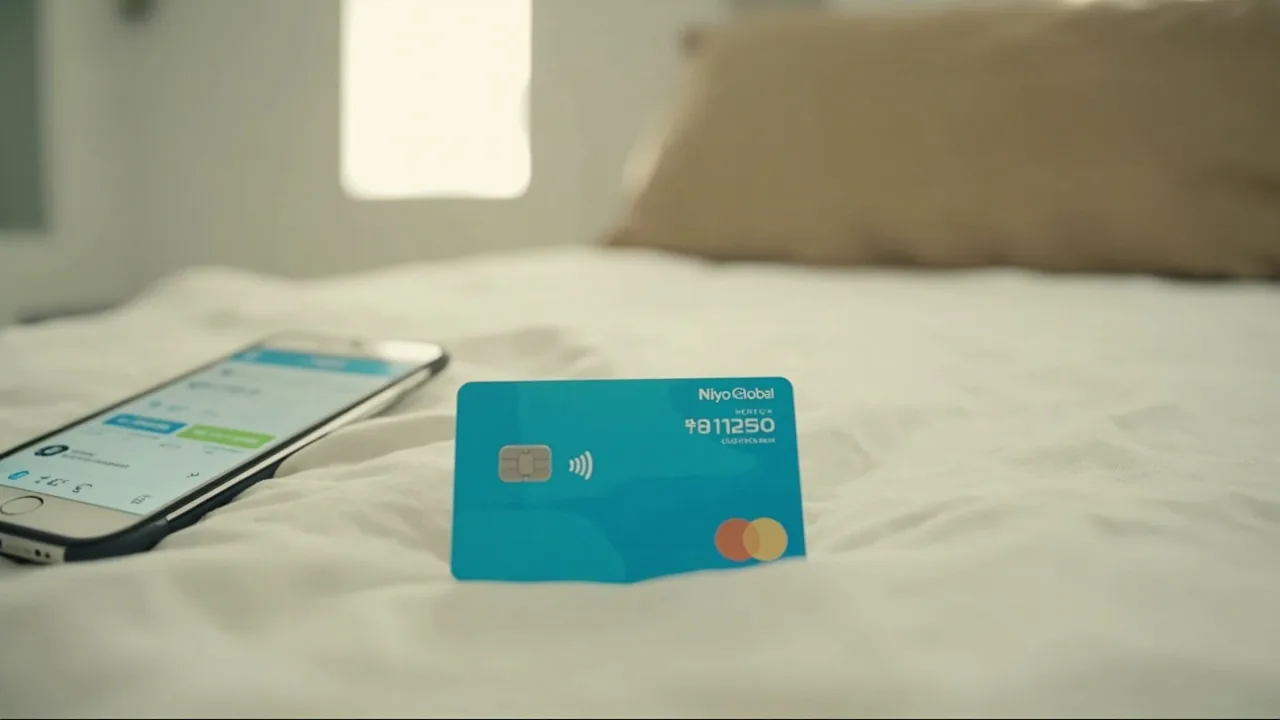
Niyo Global Card Review for SE Asia Travel
The Niyo Global Card is the cheapest card most Indian backpackers can hold in Southeast Asia. This Niyo card review travel guide covers zero forex markup, mid-market rates, ATM fees, limits, and how it compares to a traditional forex card. If you want one card for a multi-country trip, get the Niyo, top up before you fly, and use it everywhere a card is accepted.
This review is also where I do the head-to-head nobody else publishes cleanly. Niyo Global Card versus a traditional forex card (HDFC ForexPlus being the most common one Indians carry). Real ATM withdrawal fees, real cash-based use cases, real limits, and where each card wins.
Quick Answers
| What | Answer | Price (INR) |
|---|---|---|
| Best payment method | Niyo Global debit card | Zero markup, ₹100 (~$1.04) ATM fee abroad |
| Backup method | HDFC ForexPlus card | 2% to 3.5% markup on every swipe |
| Worst option | Airport exchange booth in India | 5% to 8% worse than mid-market |
| Niyo ATM fee in Thailand | Charged by local bank, not Niyo | ₹632 (~220 THB or ~$6.55) per withdrawal |
| Niyo daily ATM limit | Set by partner bank | ₹287,150 (~100,000 THB or ~$2,978.62) |
| Top-up limit | Niyo app, single transfer | ₹200,000 (~$2,074.61) per transaction |
| Card issuance fee | One-time | ₹500 (~$5.19)+ GST |
“Mid-market” means the actual rate between two currencies, the one Google shows. Most banks hide 2-4% inside “their rate,” which is how they make money.
How the Niyo Global Card Works
The Niyo Global Card is a Visa debit card issued in partnership with DCB Bank and SBM Bank India. You load Indian rupees from your domestic bank account into the Niyo app, the app converts INR to USD at mid-market rate (close to the rate Google shows, no markup), and the card spends in any currency Visa is accepted worldwide. When you withdraw from an ATM in Bangkok, the local bank charges a flat 220 THB fee (₹631 at current rates, 1 THB = ₹2.8691). Niyo adds zero on top.
Three mechanics matter most for a backpacker:
Forex markup is zero. Every swipe, every ATM withdrawal, every Tap to Pay, same rate. A traditional forex card like HDFC ForexPlus charges 2% to 3.5% markup on top of Visa’s base rate. On a ₹200,000 (~$2,074.61) trip, that’s ₹4,000 (~$41.49) to ₹7,000 (~$72.61) gone to bank profit. With Niyo, that money stays yours.
DCC (Dynamic Currency Conversion) is the silent killer. When you swipe at a Thai restaurant, the terminal sometimes asks “pay in INR or THB?” Always choose THB. If you pay in INR, the merchant’s bank applies its own terrible rate, often 5% to 7% worse than mid-market. The Niyo app shows the actual rate you got, so check it the first time you swipe. Travellers report being overcharged by ₹2,297 (~800 THB or ~$23.83) on a single dinner after accidentally tapping “INR.”
TCS still applies. Niyo is a forex card, so loading it counts under the RBI’s Liberalised Remittance Scheme. Each top-up above ₹7 lakh in a financial year attracts 20% TCS (Tax Collected at Source), refundable when you file your ITR. Loads under ₹7 lakh in a year carry 0% TCS for travel as of the 2024 budget update. Read TCS on international travel from India for the full breakdown before topping up large amounts.
Niyo Global Card vs Traditional Forex Card: Real Comparison
This is where I keep getting questions, so here it is head-to-head. HDFC ForexPlus is the forex card most Indians already own because HDFC forces it on you when you walk in for foreign currency. Niyo is the zero-markup challenger.
| Feature | Niyo Global | HDFC ForexPlus |
|---|---|---|
| Forex markup | 0% | 2% to 3.5% |
| Card issuance fee | ₹500 (~$5.19)+ GST | ₹100 (~$1.04) to ₹500 (~$5.19) |
| Annual fee | ₹0 | ₹100 (~$1.04) to ₹500 (~$5.19) |
| ATM withdrawal fee (India) | ₹0 | ₹0 to ₹100 (~$1.04) |
| ATM withdrawal fee (abroad) | ₹632 (~220 THB or ~$6.55) | ₹632 (~220 THB or ~$6.55) + ₹100 (~$1.04) cross-currency fee |
| Daily ATM limit | ₹287,150 (~100,000 THB or ~$2,978.62) | ₹287,150 (~100,000 THB or ~$2,978.62) |
| Daily swipe limit | ₹430,725 (~150,000 THB or ~$4,467.93) | ₹287,150 (~100,000 THB or ~$2,978.62) |
| Cash top-up limit | ₹200,000 (~$2,074.61) per transaction | ₹200,000 (~$2,074.61) per day |
| App reload speed | 2 to 4 hours | Same day, varies |
| Card accepted in Vietnam | Yes (Visa) | Yes (Visa) |
| Card accepted in Laos | Limited (most places cash) | Limited (most places cash) |
| Card accepted in Cambodia | Yes (Visa, USD billing) | Yes (Visa, USD billing) |
| Refund on unused balance | Free to original bank account | ₹100 (~$1.04) to ₹300 (~$3.11) fee |
| Card replacement abroad | Yes, courier in 5 to 7 days | Yes, courier in 7 to 10 days |
Where Niyo wins. Anything where you’d otherwise pay 2% to 3.5% markup. A 14-day SE Asia trip with ₹150,000 (~$1,555.96) spend saves you ₹3,000 (~$31.12) to ₹5,250 (~$54.46) versus ForexPlus. ATM withdrawals in Vietnam: Niyo gives you the rate Google shows. ForexPlus adds the markup on top of whatever the Vietnamese bank charges.
Where ForexPlus wins. Pre-loaded certainty. If you load ₹200,000 (~$2,074.61) onto ForexPlus before flying, you walk out of India with that locked in, regardless of rupee volatility. Niyo reloads convert on the day of transfer, so if the rupee crashes the week you’re in Chiang Mai, your loaded balance suddenly buys less. For a 3-week fixed trip, Niyo’s reload speed (2 to 4 hours) makes this mostly irrelevant. For longer stays, reload timing matters.
Where both fail. Laos. More on that below.
The full head-to-head with Fi, Jupiter, and cash is in our forex card vs debit card breakdown. For the complete SE Asia backpacking hub with guides for every country, see SE Asia backpacking hub.
India-Specific Gotchas: RBI, TCS, LRS
Three rules that catch Indian travellers off guard, even with a “free” card:
LRS limit is USD 250,000 per financial year. That includes everything: Niyo top-ups, ForexPlus loads, cash bought from the bank, foreign trips paid from your Indian account. Practically nobody hits this, but if you load ₹50,000 (~$518.65) at a time across 10 trips in a year, it adds up. Keep screenshots.
TCS (Tax Collected at Source) is 20% on amounts above ₹7 lakh per financial year for travel. Below ₹7 lakh, the rate is nil for outward remittance under LRS as of the 2024 budget update. Above ₹7 lakh, you pay 20% TCS, which is refundable via ITR. Strategy: stay under ₹7 lakh per financial year for travel, file ITR to claim refunds, and keep Niyo reloads under ₹2 lakh per transaction.
PAN is mandatory for any forex card load. Niyo asks for PAN at signup. HDFC ForexPlus also requires PAN. The bank reports all loads to the income tax department. No PAN, no card. This is a non-negotiable.
For detailed ATM fee breakdowns by country, the Thailand ATM withdrawal guide and Vietnam ATM guide cover exactly what each local bank charges.
What Bananarchy Travellers Use
Across our trips, the loadout that survives three weeks and four countries is:
- One Niyo Global Card, loaded with ₹80,000 (~$829.84) to ₹100,000 (~$1,037.30) before flying.
- ₹15,000 (~$155.60) to ₹20,000 (~$207.46) in USD cash, broken into ₹9,640 (~100 USD) bills. For Laos, Cambodia border fees, and any place where cards don’t work.
- One HDFC ForexPlus as backup, loaded with ₹20,000 (~$207.46), kept in the dorm. Rarely used. Exists for “card swallowed by ATM” emergencies.
Why this works. Niyo handles 85% of spending: hostels booked online, Grab rides in Bangkok, coffee shops, malls, tours. Cash covers the 15%: noodle stalls in Hanoi, tuk-tuks in Phnom Penh, the Laos border, the night market in Luang Prabang. The ForexPlus sits in a ziplock bag as insurance.
Travellers report two main failure modes. One: loading Niyo too late, then the top-up takes 6 hours instead of 2 and you’re stranded at midnight in Pai with no working card. Two: forgetting the ATM PIN. Niyo’s PIN is set in the app, separate from any other bank PIN. Write it on a piece of paper in your wallet, not in your phone’s notes app.
In Vietnam specifically, travellers report that Niyo works at all chain restaurants, malls, and hotels, but street food stalls and most homestays in Sapa or Phong Nha are cash-only. Carry enough VND for two to three days at a time. For a full Vietnam cost breakdown, see Vietnam trip budget in INR for 7-10 days.
In Cambodia, both cards work in Phnom Penh and Siem Reap, but everything bills in USD. You get charged in dollars, your Niyo app shows the USD-to-INR conversion, no surprises.
Getting Connected
You need data to check the Niyo app after every swipe, verify the rate you got, and reload from anywhere. A physical SIM is cheap and works offline: AIS in Thailand (₹1,100 (~399 THB or ~$11.39) for 15 days), Viettel in Vietnam (₹450 (~130,000 VND or ~$4.66) for 14 days), Unitel in Laos (₹216 (~50,000 LAK or ~$2.24) for 30 days). Or skip the airport SIM queue entirely with Get Nomad eSIM and activate before you fly. Both work. ESIM is faster at the airport, physical SIM is more reliable in rural Laos.
FAQ
Does the Niyo Global Card work in Laos?
Limited. Luang Prabang and Vientiane have Visa-accepting ATMs and a few restaurants, but 70% of the country is cash-only. Carry USD bills (clean, unmarked, post-2006) for Laos. The Laos ATM guide covers which banks don’t charge the ₹95 (~22,000 LAK or ~$0.98) ATM fee.
What happens if I lose my Niyo card abroad?
Call Niyo’s 24/7 support (number is in the app, also on the back of the card). They freeze the card instantly. A replacement ships to your hotel in 5 to 7 days, free. Until then, your money is safe because the card can’t be used.
How much cash can I take out of India?
₹289,211 (~3,000 USD) or its equivalent in other currencies, without customs declaration. Above that, you fill out a CDF form at the airport. Going higher than ₹482,018 (~5,000 USD) requires RBI approval and is rarely granted. Most travellers carry ₹48,202 (~500 USD) to ₹96,404 (~1,000 USD) in cash and reload Niyo for everything else.
Does UPI work in Thailand or Vietnam?
Thailand: Yes, via QR at major malls and 7-Eleven. Vietnam: Limited rollout in 2025-26, mostly tourist areas in Ho Chi Minh City. Both still unreliable compared to a Visa swipe. Read UPI abroad in SE Asia for the working list of merchants.
Can I load the Niyo card with a credit card?
No. Niyo accepts only bank transfers (NEFT, IMPS, UPI) from your Indian savings account. Credit card top-ups are blocked because RBI doesn’t allow loading forex instruments via credit. Use your savings account only.
Is Niyo safe? My money is with which bank?
DCB Bank (until recently) and now SBM Bank India. Your balance is held as a forex deposit in India, regulated by RBI under FEMA. If Niyo the company shuts down tomorrow, your money is still with the bank, refundable. This is the same structure as every other forex card, including HDFC ForexPlus.
Subodh’s Take
I carry a Niyo and ₹15,000 (~$155.60) in USD cash. That’s it. I had a ForexPlus for three years and never used it after the first trip because the markup is a tax on not knowing better. The Niyo app’s “actual rate” display is the only thing that makes any of this transparent. If your card doesn’t show you what Visa charged, you’re trusting the bank to be honest about a number you can’t verify. Don’t.
