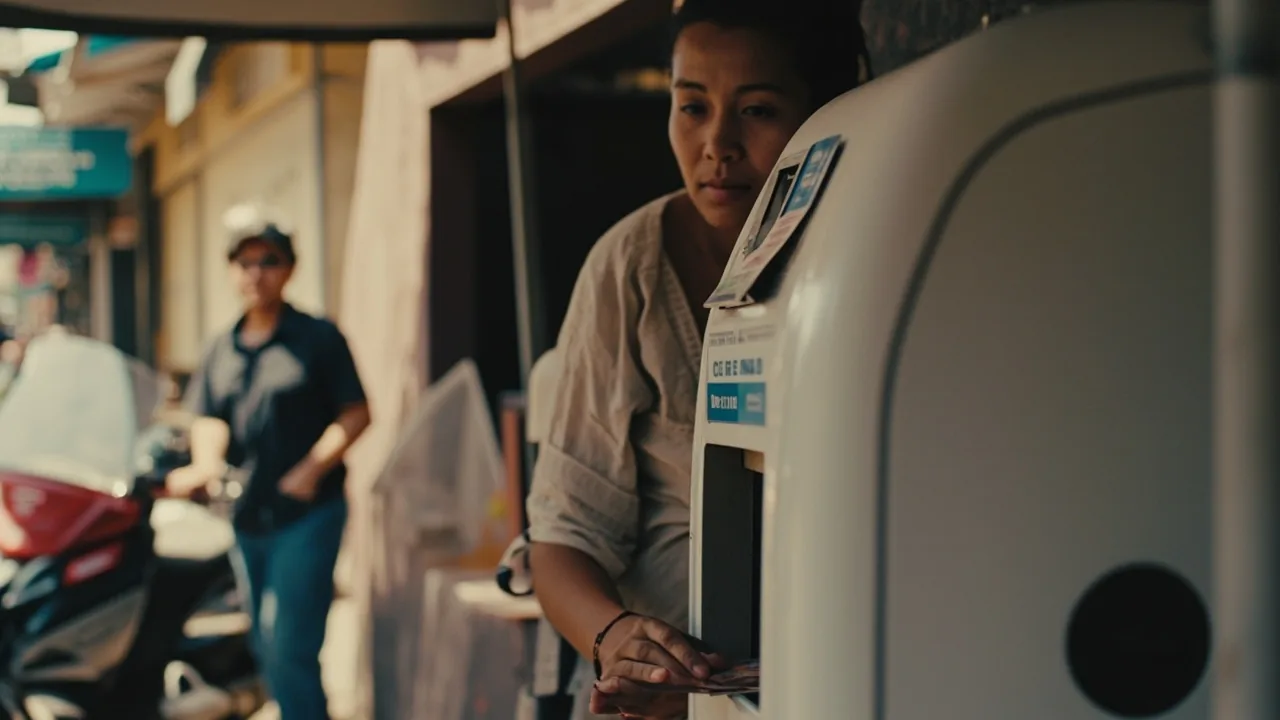
ATMs in Laos: USD, LAK, Limits, and What Indian Travelers Must Know About atm au laos
Verified 2026-07-17 at 1 USD = ₹96.3294 (ExchangeRate-API) and 1 LAK ≈ ₹0.0043, so 10,000 LAK ≈ ₹43 and 22,300 LAK ≈ ₹96 (~$1). The figures below use that rate. Planning the wider region? Our Southeast Asia backpacking hub covers the full multi-country route.
ATMs in Laos follow a single rule that decides whether your trip is cheap or expensive: nearly every machine in the country dispenses Lao Kip (LAK), and the few that dispense USD charge a fat premium and live mostly in Vientiane. If you walk in expecting Thai-style USD withdrawal, you’ll burn through cash on bad rates. The setup that works for Indian travellers is one zero-markup debit card plus a small USD reserve for the visa-on-arrival fee and a few guesthouses.
Verified against the official Banque pour le Commerce Extérieur Lao (BCEL) fee schedule on 2026-07-17 and cross-checked with current traveller reports on r/Laos and the Laos Travel Facebook groups.
Quick Answers
| What | Answer | Price (INR) |
|---|---|---|
| Do ATMs in Laos dispense USD or LAK? | Almost all dispense LAK only. USD-dispensing machines exist in Vientiane and Luang Prabang airports, rarely in Vang Vieng. | ~₹43 (~$0.45) per ₹43 (~10,000 LAK or ~$0.45) |
| Typical withdrawal limit per transaction | ₹4,315-₹8,630 (~1,000,000-2,000,000 LAK or ~$44.76-$89.52) at BCEL (about ₹4,435-₹8,966 (~46-93 USD)) | ~₹4,300-₹8,600 (~$44.60-$89.21) per pull |
| BCEL ATM fee for foreign cards | ₹86 (~20,000 LAK or ~$0.90) flat per transaction | ~₹86 (~$0.89) |
| Your bank’s overseas ATM fee (typical Indian bank) | ₹100-300 + 3.5% currency conversion markup | ~₹100-₹300 per pull |
| Safest card to carry | Zero-markup debit card (Fi or Niyo) | ₹0 markup |
| Worst move | Saying “yes” to DCC (Dynamic Currency Conversion) at the ATM screen | Adds 5-8% silently |
BCEL’s ₹86 (~20,000 LAK or ~$0.90) fee is set by the bank and posted on their English-language fee page; Indian bank charges are your home bank’s own schedule, not BCEL’s, so read both before you fly.
How it Works in Laos
Laos is more cash-heavy than Thailand and Vietnam. Card acceptance exists in Vientiane hotels, Luang Prabang tour operators, and a handful of restaurants, but the daily rhythm (tuk-tuks, night markets, noodle stalls, guesthouse rooms, the bus station) runs on Kip. Plan to withdraw cash two or three times a week, not once.
LAK vs USD ATMs
Two machine types exist, and they behave differently:
LAK-dispensing ATMs (BCEL, JDB, LDB, APB, ICBC):
- Found everywhere: airports, malls, gas stations, bank branches.
- ₹4,315 (~1,000,000 LAK or ~$44.76).
- Bills come out clean (50,000 and 100,000 notes are common).
- BCEL is the most reliable network, with machines in every tourist town and almost every district of Vientiane and Luang Prabang.
USD-dispensing ATMs (mostly in Vientiane, a few in Luang Prabang):
- Marked “USD” on the screen or have a dollar sign.
- Usually dispense ₹9,640 (~100 USD) notes only, which is awkward for small purchases.
- The exchange rate is several percent worse than the official BCEL counter.
- They’re useful only if you specifically need USD for the visa-on-arrival fee, a border crossing, or a guesthouse that quotes in dollars.
Most Indian travellers end up using LAK ATMs for daily spending and carrying ₹9,640-₹19,281 (~100-200 USD) in cash from India as a backup, not relying on USD-dispensing machines.
The DCC trap
Dynamic Currency Conversion is the single most expensive mistake at a Laos ATM. The screen offers to charge your card in INR instead of LAK, with a “convenient” rate. The rate is never convenient. It includes a 5-8% markup on top of the bank’s own conversion fee.
Always tap “No” to DCC. Always let the machine charge in LAK (the local currency). If the screen only offers INR or USD, cancel the transaction and use a different machine.
Fee Breakdown: What You Pay
A single ₹4,315 (~1,000,000 LAK or ~$44.76) withdrawal on a Fi debit card looks like this:
| Layer | Amount | In INR |
|---|---|---|
| Cash received | ₹4,315 (~1,000,000 LAK or ~$44.76) | ~₹4,300 (~$44.60) |
| BCEL ATM fee | ₹86 (~20,000 LAK or ~$0.90) | ~₹86 (~$0.89) |
| Your bank’s overseas ATM fee (Fi) | ₹0 | ₹0 |
| Your bank’s FX markup (Fi) | 0% | ₹0 |
| Total cost of ₹4,300 (~$44.60) in your hand | ~₹4,386 (~$45.50) |
On a traditional Indian debit card (HDFC, SBI, ICICI), the same withdrawal looks like this:
| Layer | Amount | In INR |
|---|---|---|
| Cash received | ₹4,315 (~1,000,000 LAK or ~$44.76) | ~₹4,300 (~$44.60) |
| BCEL ATM fee | ₹86 (~20,000 LAK or ~$0.90) | ~₹86 (~$0.89) |
| Your bank’s overseas ATM fee | ₹100-₹150 (~$1.04-$1.56) | ₹100-₹150 (~$1.04-$1.56) |
| Your bank’s FX markup (3-3.5%) | 3% of ₹4,300 (~$44.60) | ~₹129 (~$1.34) |
| Total cost of ₹4,300 (~$44.60) in your hand | ~₹4,615-₹4,665 (~$47.87-$48.39) |
That difference, ~₹230 (~$2.39) per withdrawal, adds up to ₹1,000-₹1,500 (~$10.37-$15.56) over a 10-day Laos trip. A forex card is worse: 2-3.5% load on every top-up, plus the same BCEL fee on every withdrawal.
Subodh’s Pro Tip: Pull the maximum each time, not the minimum. The ₹86 (~20,000 LAK or ~$0.90) BCEL fee is fixed whether you take 500,000 or 2,000,000. Smaller, more frequent withdrawals mean paying that fee three times instead of once.
Comparison: Cards That Work in Laos
| Card | Markup on FX | Overseas ATM fee | Daily limit | LAK ATM reliability | Verdict |
|---|---|---|---|---|---|
| Fi Zero Forex debit | 0% | ₹0 (charged in INR equivalent) | ~₹1,00,000/day | High (Visa network) | Best primary card |
| Niyo SBM debit | 0% | ₹0-₹100 (~$0-$1.04) | ~₹1,00,000/day | High (Visa/Mastercard) | Strong backup |
| HDFC ForexPlus card | 2-3.5% on load | ₹100-₹200 (~$1.04-$2.07) | Up to loaded balance | High | Avoid if Fi/Niyo available |
| SBI debit card | 3-3.5% FX + ₹100-₹300 (~$1.04-$3.11) ATM | ₹100-₹300 (~$1.04-$3.11) | ₹50,000-₹70,000/day (lower abroad) | High | Worst common option |
| Cash exchanged in India | 5-8% worse than mid-market | n/a | n/a | n/a | Only for ₹9,640-₹19,281 (~100-200 USD) reserve |
| USD-dispensing ATM | 3-6% worse than official rate | ₹482-₹771 (~5-8 USD) flat | $200-$500/transaction | Low (Vientiane only) | Skip unless needed |
| Trip CTA placeholder | Book the trip |
The Niyo vs Fi question is small. Either works. Carry both if you can: if one is blocked by an anti-fraud trigger, the other is immediate fallback. Have your bank’s international customer care number saved offline before you fly.
India-Specific Gotchas: RBI and TCS
Two rules affect every Indian traveller withdrawing abroad, and Laos is no exception.
LRS limit (Liberalised Remittance Scheme): You can spend up to USD 250,000 per financial year on the LRS route. This covers travel, forex cards, and overseas ATM withdrawals combined. A normal backpacking trip stays well under ₹482,018 (~5,000 USD).
TCS (Tax Collected at Source): 20% TCS applies to forex card loads and outward remittances above ₹7,00,000 per financial year. ATM withdrawals on debit cards are tracked separately under your card’s international spend limit and don’t trigger TCS directly, but the bank reports them. Keep the 15G/15H or Form 15CB filed if you cross thresholds. Most Indian backpackers never cross ₹7 lakh in a year, so TCS is a non-issue for a single Laos trip, but the rule is worth knowing if you stack multiple trips.
PAN requirement: If your total forex outflow (cards + cash + remittances) crosses USD 3,000 in a financial year, PAN is mandatory. The forex card provider or bank asks for it. Carry a PAN card photocopy separately from your passport.
Customs cash declaration: Carrying more than USD 3,000 (equivalent) in cash into or out of India requires a customs declaration form at the airport. Laos doesn’t have an equivalent cash-declaration rule at the border, but Thai immigration upstream and Vietnamese immigration downstream do watch for undeclared cash.
For the full list of money moves, see the Laos trip cost breakdown and the Bananarchy Laos budget guide.
What Bananarchy Travellers Use
The setup that holds up across a 21-day Thailand-Vietnam-Laos-Cambodia loop:
- ₹19,281 (~200 USD) in cash from India. For the Laos visa-on-arrival fee, a few guesthouses that quote in dollars, and emergencies on the Thai-Lao border at Chiang Khong / Huay Xai.
- ₹5,000-₹10,000 (~$51.87-$103.73) in Thai Baht. Optional, for arrival in Bangkok and the train to Chiang Rai, but most of the Thai side works on cards in cities.
- One Fi Zero Forex debit card as primary. Withdraw ₹4,315-₹8,630 (~1,000,000-2,000,000 LAK or ~$44.76-$89.52) per pull, max the machine, not the minimum.
- One Niyo SBM debit as backup. Saved offline, kept in a separate bag from the primary.
- No traditional forex card. The load markup (2-3.5%) is dead money on a 10-day Laos segment.
Have your bank’s international customer-care number saved offline before you fly, in case either card is blocked by an anti-fraud trigger on day one. The Niyo card in the same wallet is the immediate fallback.
Luang Prabang ATMs run out of cash more often than Vientiane ones, especially on weekends and the night before the morning alms-giving ceremony, when guesthouses pull large notes for change. Vang Vieng has fewer machines, and the BCEL one near the main strip is the most reliable. If a machine swallows your card, call the bank’s 24-hour international number immediately and have the branch’s address written down to retrieve it before you leave the city.
For tipping and bargaining math on the cash you withdraw, the Laos tipping and bargaining guide is a useful follow-up.
Getting Connected
You need data to check exchange rates, bank fraud alerts, and BCEL’s branch locator on the go. Two options that work in Laos:
- Physical SIM: Unitel and Lao Telecom sell tourist SIMs at Vientiane airport and Luang Prabang airport with 5-15 GB valid 7-30 days. Bring your passport.
- eSIM: Get Nomad eSIM before you fly, activate on landing, and skip the airport SIM counter entirely.
For broader Laos trip logistics, the Laos e-visa application step-by-step for Indians covers the Vientiane and Luang Prabang airport arrivals you’ll land at, and the Laos night market prices guide covers where most of the cash you withdraw goes.
Where to Eat While You Carry All That Kip
Cash rules the food scene, so you’ll be spending LAK within an hour of every ATM pull. Two reliable LAK-only spots to test your new notes on:
- Akhin Restaurant (rating 4.9) is a local Lao spot for grilled river fish, sticky rice, and jeow bong. A plate runs ₹108-₹173 (~25,000-40,000 LAK or ~$1.12-$1.79). Cash only.
- My Kitchen Indian Authentic Food (rating 4.9) is the dal-chawal reset when the local fare gets repetitive. Expect ₹173-₹345 (~40,000-80,000 LAK or ~$1.79-$3.58) per plate, plus a ₹43-₹86 (~10,000-20,000 LAK or ~$0.45-$0.90) chai.
For the broader vegetarian and Indian food scene across Southeast Asia, the vegetarian and Indian food country comparison is worth a read before you fly.
FAQ
Do ATMs in Laos dispense USD or Lao Kip? Almost all dispense LAK. USD-dispensing ATMs exist in Vientiane and Luang Prabang airports but are rare elsewhere and offer a worse exchange rate.
What is the maximum I can withdraw from a BCEL ATM in Laos? Typically ₹4,315-₹8,630 (~1,000,000-2,000,000 LAK or ~$44.76-$89.52) per transaction, depending on the machine and your bank’s daily cap. The ₹4,315 (~1,000,000 LAK or ~$44.76) default is about ₹4,435 (~46 USD) or ₹4,300 (~$44.60).
Will my Indian debit card work in Laos? Yes, if it’s enabled for international use and on the Visa or Mastercard network. ICICI, HDFC, SBI, Axis, Fi, and Niyo all work on BCEL machines. RuPay cards are not widely accepted at Lao ATMs.
What is the BCEL ATM fee for foreign cards? ₹86 (~20,000 LAK or ~$0.90) flat per transaction, which is about ₹86 (~$0.89). This is on top of any fee your own bank charges.
How do I avoid DCC at a Laos ATM? When the screen asks whether to charge in LAK or INR, always choose LAK. If only INR is offered, cancel and find a different machine.
How much cash should I carry into Laos? About ₹9,640-₹19,281 (~100-200 USD) for the visa-on-arrival fee and dollar-quoted guesthouses, plus ₹5,000-₹10,000 (~$51.87-$103.73) in Thai Baht if you’re arriving via Bangkok. Withdraw the rest from BCEL ATMs on arrival.
Is Laos more cash-heavy than Thailand or Vietnam? Yes, meaningfully. Card acceptance is lower than in Bangkok or Hanoi, especially outside Vientiane and Luang Prabang. Plan to withdraw 2-3 times a week on a typical 7-10 day Laos trip.
Subodh’s Take
The single biggest mistake Indian travellers make with money in Laos is treating it like Thailand. Thailand has USD-dispensing ATMs, 7-Eleven card readers, and PromptPay on every street corner. Laos has cash, Kip notes, and a ₹86 (~20,000 LAK or ~$0.90) fee every time you walk up to a BCEL machine. The card that wins in Laos is the same one that wins in Thailand (a zero-markup debit card), but the discipline is different: fewer, larger withdrawals, never accept DCC, and keep a ₹9,640 (~100 USD) bill taped inside your passport for the day a guesthouse doesn’t take card or a border crossing demands dollars on the spot.
Where to Stay
Most Indian travellers in Laos stay in guesthouses and small hotels priced in LAK, with a few boutique options quoting in USD in Luang Prabang and Vientiane. Book the trip with us and we’ll line up the right stay for every stop.
