Singapore Food Guide for Indian Travelers: Must-Try Dishes, Veg Options & Where to Eat Cheap
Looking for singapore food where to eat? Skip the hotel buffet and head straight for a hawker centre. Singapore is one of the easiest food destinations in Southeast Asia for Indian travelers, with a deep Indian restaurant scene, cheap hawker stalls, and vendors willing to answer ingredient questions. For the full SEA trail, check our SEA backpacking hub.
This guide covers what to eat, what to avoid if you are vegetarian or Jain, and exactly where to go in each price bracket.
Subodh’s Pro Tip: Singapore is one of the few Southeast Asian cities where the phrase “I’m vegetarian, no egg, no seafood” produces instant understanding at most hawker stalls, especially in Little India and at Tekka Centre. Outside those zones, expect to ask twice.
Quick Answers
| What | Answer | Price (INR) |
|---|---|---|
| Average hawker meal | Chicken rice, nasi lemak, or laksa at any hawker centre | ₹442 (~4-8 SGD or ~$3.10-$6.20) |
| Signature dish to try first | Hainanese chicken rice from a Michelin-listed stall | ₹374 (~5 SGD or ~$3.88) |
| Cheapest vegetarian meal | Indian veg thali at a Little India hawker stall | ₹299-₹448 (~4-6 SGD or ~$3.10-$4.65) |
| Best upscale Indian splurge | North Indian tandoori dinner at Boat Quay or Orchard | ₹2,242-₹3,736 (~30-50 SGD or ~$23.26-$38.76) |
| Where most locals eat | Hawker centres (Chinatown, Lau Pa Sat, Tekka, Old Airport Road) | ₹442 (~4-8 SGD or ~$3.10-$6.20) per dish |
The Singapore Food Scene: What’s Going On
Singapore’s food identity is built on three things: hawker centres (open-air food courts with 30-100 stalls each, government-regulated, cheap, and historically the only way most Singaporeans ate out), the “zi char” cooked-to-order dinner style at casual Chinese seafood places, and a wildly international fine-dining scene that has produced more Michelin stars per capita than anywhere except Tokyo and Paris.
For an Indian traveler, the practical reality is layered:
- Hawker food is the default meal. Lunch or dinner at a hawker centre for one person typically lands at ₹442 (~4-8 SGD or ~$3.10-$6.20) for a full meal with a drink. Most centres open by 7am and the dinner crowd starts around 6pm.
- Indian food is everywhere, not just Little India. You can find real North Indian (tandoori, dal, naan) and South Indian (dosa, idli, banana leaf) restaurants in Boat Quay, Orchard, City Hall, Bugis, and even some hawker centres.
- Vegetarian and Jain are workable but require asking. Many “vegetarian” Chinese or Malay dishes still contain shrimp paste, oyster sauce, fish sauce, or lard. Indian vegetarian restaurants are the safest bet by a wide margin. Vegan is harder outside of dedicated cafes.
Subodh’s Pro Tip: Most hawker stall owners in Singapore speak some English and are used to dietary questions. Asking “any fish sauce, oyster sauce, or shrimp paste in this?” is a totally normal question, not a weird tourist thing.
Key Phrases for Ordering
Singapore is English-speaking, so phrase cards are less critical here than in Vietnam or Laos. Still, when you hit a hawker stall run by an older Chinese auntie or uncle, a couple of local terms help.
| English Phrase | What it Means | Mandarin/Hokkien | Pronunciation |
|---|---|---|---|
| I’m vegetarian (no meat, no seafood) | The most important sentence | 我吃素 (wǒ chī sù) | “woh chee soo” |
| No egg | For Jains and vegans | 不要蛋 (bù yào dàn) | “boo yow dan” |
| No onion, no garlic | For Jains | 不要洋葱大蒜 | ”boo yow yahng tsahng dahw suahn” |
| Is there shrimp paste / fish sauce? | Sanity check before ordering | 有虾酱吗 / 有鱼露吗 | ”yow hah jiang ma / yow yee loo ma” |
| Less spicy, please | For vindaloo-resistant stomachs | 少辣 (shǎo là) | “show lah” |
| Indian vegetarian, like Jay food | Confusing for non-Indians, but try it | 我吃印度素 | ”woh chee in-doo soo” |
The last one is hit or miss. If you can find an Indian or South Indian stall in the hawker centre, just point at what the Indian auntie ahead of you is eating. Faster than any phrase.
Hawker Centres Worth Knowing
Singapore has dozens of hawker centres. For a deeper dive, see our best hawker centres under 5 SGD guide. The ones that consistently show up on every “best of” list and are easy to reach on the MRT:
- Lau Pa Sat (Downtown Core, Raffles Place MRT): The Victorian cast-iron one in the middle of the financial district. Famous for satay street in the evening when Boon Tat Street closes to traffic and stalls roll out grills. About ₹598-₹897 (~8-12 SGD or ~$6.20-$9.30) for a satay feast.
- Chinatown Complex Food Centre (Chinatown MRT, one stop out): The biggest hawker centre in Singapore, with 260+ stalls. This is where the Michelin-listed Hawker Chan (soy sauce chicken rice) operates. Cheap, authentic, slightly overwhelming.
- Tekka Centre (Little India MRT): The single best hawker centre for Indian vegetarian food. South Indian stalls, North Indian stalls, a few Malay/Indian fusion spots, plus an upstairs wet market if you want to see how locals shop.
- Old Airport Road Food Centre (Mountbatten/Dakota MRT): Local favourite, slightly less touristy. Famous for char kway teow, Hokkien mee, and good bak kut teh.
- Maxwell Food Centre (Chinatown MRT, a 5-min walk from Chinatown Complex): Lighter, easier to navigate, full of social media-famous stalls.
For a quick first day: Lau Pa Sat for satay at night, Tekka for breakfast or lunch on day two, Maxwell for an easy dinner.
What to Eat: The Hawker Hits
1. Hainanese Chicken Rice (₹299-₹448 (~4-6 SGD or ~$3.10-$4.65), ~₹250-₹380 (~$2.59-$3.94) or ~₹289-₹434 (~3-4.50 USD))
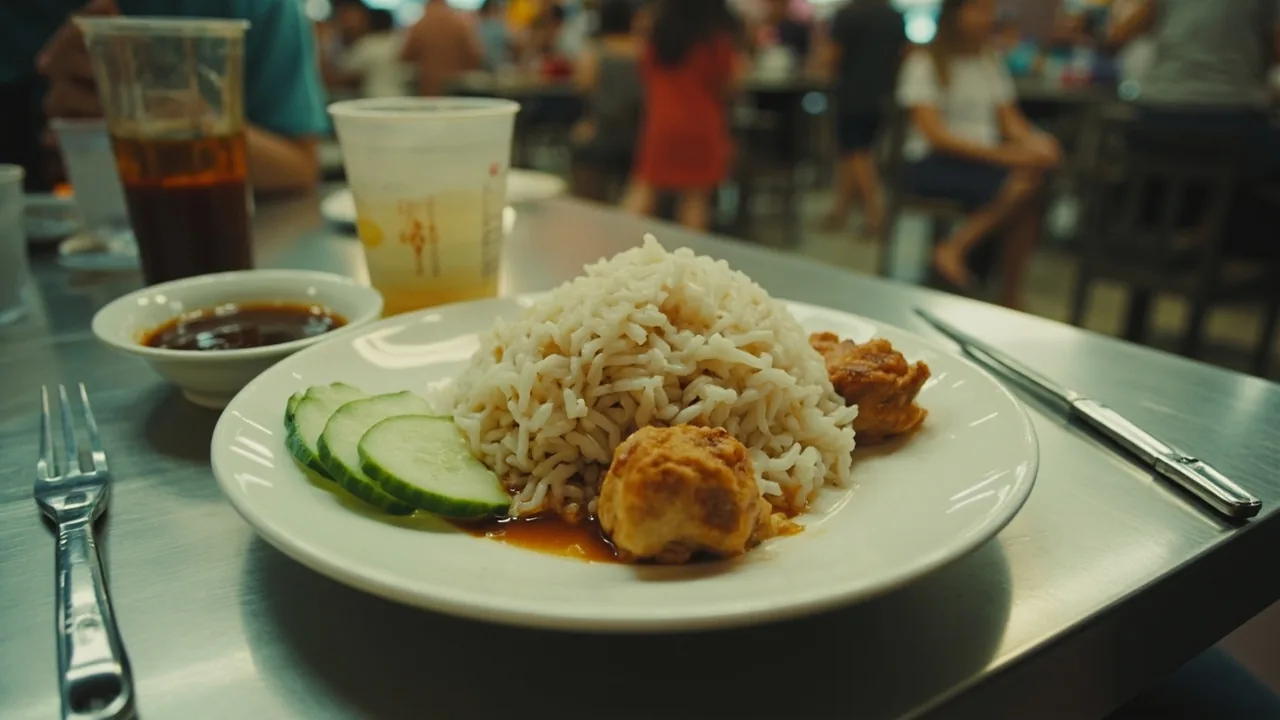
The national dish. Poached chicken on fragrant rice cooked in chicken fat and pandan, served with chilli-garlic sauce, cucumber, and clear soup. The cheapest, fastest, and most universally liked meal in Singapore. People’s Park Food Centre Blk 32 in Chinatown has a couple of well-reviewed chicken rice stalls, and the Chinatown Complex Food Centre has the Michelin-listed option at ₹374 (~5 SGD or ~$3.88).
Veg alternative: ask for the veggie rice version. Some stalls do it, most don’t. If not, switch to the dish below.
2. Laksa (₹374-₹598 (~5-8 SGD or ~$3.88-$6.20), ~₹315-₹500 (~$3.27-$5.19) or ~₹386-₹578 (~4-6 USD))
Spicy coconut curry noodle soup with prawns, cockles, bean sprouts, and a thick broth. The classic is Katong laksa from the east side of the island, with the noodles cut short so you can eat the whole bowl with a spoon. At most hawker centres, you will get a standard bowl with seafood. Strict veg version: order a “vegetarian laksa” at an Indian hawker stall in Tekka, or skip this and try the murtabak instead.
3. Char Kway Teow (₹299-₹523 (~4-7 SGD or ~$3.10-$5.43), ~₹250-₹440 (~$2.59-$4.56) or ~₹289-₹511 (~3-5.30 USD))
Flat rice noodles stir-fried with prawns, Chinese sausage, egg, bean sprouts, and dark sweet soy sauce. The “CKT” you will hear hawker regulars ordering. Comes with shrimp paste by default. Vegetarian version: possible at a few Indian or Chinese-vegetarian stalls, but rare. Skip if strict veg.
4. Nasi Lemak (₹299-₹523 (~4-7 SGD or ~$3.10-$5.43), ~₹250-₹440 (~$2.59-$4.56) or ~₹289-₹511 (~3-5.30 USD))
Coconut rice, fried anchovies, peanuts, cucumber, sambal, an egg, and a small portion of fried chicken or rendang. The Malay national dish and one of the best breakfasts in Singapore. Vegetarian stalls in Tekka and Geylang Serai do a full veg nasi lemak.
5. Satay (₹60-₹90 (~0.80-1.20 SGD or ~$0.62-$0.93) per stick, ~₹50-₹75 (~$0.52-$0.78) or ~₹58-₹87 (~0.60-0.90 USD))
Skewered and grilled meat (chicken, beef, lamb) served with peanut sauce, cucumber, and rice cakes (ketupat). The 10-stick set is the standard order. Satay Street at Lau Pa Sat in the evening is the classic experience.
Subodh’s Pro Tip: At Lau Pa Sat, sit at the central tables. The stall runners will come to you. Do not let anyone “save you a seat” and ask for a tip in advance. That’s a known tourist hustle.
Indian and Vegetarian-Friendly Spots
When you want a guaranteed veg meal, a real North Indian thali, or a proper South Indian banana leaf, these are the reliable names in 2026.
For North Indian (Tandoori, Dal, Naan, Biryani)
- Chola Cafe - Biryani House (4.9 rating). If you want a real Hyderabadi biryani in Singapore, this is the spot most Indians are sent to. Casual setting, focused menu, biryani is the main event. Budget around ₹1,495-₹2,242 (~20-30 SGD or ~$15.50-$23.26) per person.
- Zaffron Tandoori Restaurant @ Boat Quay (4.8 rating). North Indian tandoori with a Boat Quay riverside view. Tandoori chicken, kebabs, naan. Around ₹2,242-₹2,989 (~30-40 SGD or ~$23.26-$31.01) per person with a drink.
- Shahi Maharaja @ Boat Quay (4.8 rating). Authentic North Indian along the riverside. Tandoori chicken is the customer favourite, mains run around ₹2,242 (~30 SGD or ~$23.26) per person.
- Sahebs @ Orchard Road (4.7 rating). Fine-dining North Indian and Punjabi on Orchard. Expect ₹2,989-₹4,484 (~40-60 SGD or ~$31.01-$46.51) per person, but the setting is the cleanest of the bunch.
- Black Pepper Multicuisine (4.8 rating). A modern, upscale spot that does both North and South Indian, good for mixed groups.
For North Indian Street Food & Fusion
- We Desi - Indian Bistro @ City Gate Mall (4.6 rating). North Indian street food and fusion, tandoori momos are the signature. About ₹1,495 (~20 SGD or ~$15.50) per person for a filling meal.
For South Indian & Banana Leaf
Tekka Centre and the stretch of restaurants on Race Course Road in Little India are the densest South Indian zones. Most places in this corridor serve vegetarian thalis, masala dosa, and banana-leaf meals at ₹598-₹1,121 (~8-15 SGD or ~$6.20-$11.63) per person. Walk in, look at what’s fresh, point at what the next table is eating.
Indian Hawker Stalls (Under ₹747 (~10 SGD or ~$7.75))
If you want a real Indian meal at hawker-centre prices, head to Tekka Centre or People’s Park Food Centre Blk 32 in Chinatown, which also runs Indian and Malay stalls alongside the Chinese ones. A full South Indian thali with rice, sambar, rasam, two veggies, curd, and pickle runs ₹374-₹598 (~5-8 SGD or ~$3.88-$6.20). This is the cheapest reliable Indian food in the city.
Non-Hawker Variety
The shortlist also surfaces non-Indian spots worth knowing if you are travelling with non-veg friends or want a break from Indian food:
- Khao Hom by Rung Mama (AMK) (4.7): Thai food in Ang Mo Kio, family-style.
- Sanook Kitchen - Square 2 (4.8): Budget-friendly Thai in a mall setting.
- Yogiyo Korean restaurant (4.7): Korean food, casual, easy.
- KLARA Charcoal Dining @ Thomson (4.7): Charcoal-grilled dishes, local twist.
- Ying Chinese Restaurant @ SICC Bukit (4.7): Chinese with golf course views, upscale.
- Joya Onsen Cafe (4.4): Japanese onsen-style cafe experience if you want a slow afternoon.
- Les Climats (4.9): French fine dining for a special occasion.
- Ming’s Cafe & Pub (4.2): Casual bites and drinks.
For a structured food experience, you can book a guided Singapore food tour on GetYourGuide, which usually covers Chinatown, Little India, and a hawker centre in three to four hours.
How to Eat Cheap in Singapore
Singapore has a reputation for being expensive. Food is the one place that reputation is wrong if you know where to go. For the full trip cost picture, see our Singapore budget breakdown for Indian travelers.
- Eat at hawker centres, not food courts in malls. Mall food courts in Singapore are 30-50% more expensive than hawker centres for the same stall, because of the air-con premium. Hawker centres are the real local food scene.
- Lunch sets over dinner. Many Chinese and Indian restaurants offer a cheaper set lunch (around ₹897-₹1,495 (~12-20 SGD or ~$9.30-$15.50)) that disappears at dinner.
- Skip the drink at restaurants. Service charge (10%) and GST (9%) apply. A ₹1,121 (~15 SGD or ~$11.63) meal becomes ₹1,345 (~18 SGD or ~$13.95) after charges, plus another ₹374-₹448 (~5-6 SGD or ~$3.88-$4.65) for a Coke. Drink water from the bottle you carry.
- 7-Eleven and Cheers for breakfast. Kaya toast sets, instant noodles, and onigiri at ₹224-₹374 (~3-5 SGD or ~$2.33-$3.88) are fine in a pinch, but for actual meals, eat at a hawker centre.
- Use the MRT, not Grab, to reach the hawker centre. A ₹747 (~10 SGD or ~$7.75) Grab to Lau Pa Sat when the MRT is ₹112 (~1.50 SGD or ~$1.16) is money you could have spent on three more dishes.
A realistic daily food budget for a budget-conscious Indian traveller in Singapore: ₹1,495-₹1,868 (~20-25 SGD or ~$15.50-$19.38) covers three meals with a drink at each from hawker centres.
Food Safety and Hygiene
Singapore has some of the strictest food hygiene regulations in the world. Hawker stalls are graded A/B/C, licenses are posted, and stall closures for violations are public. Traveller’s stomach in Singapore is rare compared to other Southeast Asian cities.
A few practical rules:
- Eat at busy stalls. A stall that serves 200 portions of chicken rice at lunch is safer than one that has been sitting for four hours.
- Look for the hygiene grade card. Most stalls display an A/B/C sticker from the Singapore Food Agency. A-grade is the safest; C-grade is technically legal but I’d skip.
- Bottled water is overkill in Singapore. Tap water is drinkable. A ₹112 (~1.50 SGD or ~$1.16) bottled water is a tourist tax, not a safety requirement. Carry a refillable bottle.
- Chilli crab warnings are real. Not hygiene, but worth knowing: chilli crab (₹2,616 (~35 SGD or ~$27.13) / ~₹2,603 (~27 USD) for a small portion at a restaurant) is messy. Wear the apron, or order the sauce on the side.
- For Jain travellers: stick to Indian restaurants, ask specifically about onion and garlic (most North Indian places can do a Jain version, but call ahead), and avoid the sambar at South Indian stalls unless you’ve confirmed it’s onion-free.
Getting Connected
You will want Google Maps, a translation app as backup, and Grab for the late-night return from Boat Quay. The fastest way to get online on arrival is a Nomad eSIM, which activates before you land and avoids the Sim Lim Square queue. A physical Singtel or StarHub SIM is the alternative at ₹747-₹1,121 (~10-15 SGD or ~$7.75-$11.63) for 7 days with data.
Common Food Mistakes Indians Make in Singapore
- Eating only at Indian restaurants. The hawker centres are the point of Singapore. You can come to Little India at home. You cannot get a proper char kway teow at home.
- Assuming “vegetarian” Chinese food is safe. It often isn’t. Oyster sauce, fish sauce, lard, and shrimp paste are common in dishes that look vegetarian. Ask.
- Sitting at a tourist-trap restaurant on Orchard with a guy outside waving you in. The “come in, special menu, free drink” pitch is the oldest Singapore hustle. Walk two streets down to a hawker centre instead.
- Ordering a ₹3,736 (~50 SGD or ~$38.76) crab and being shocked by the bill. Service charge (10%) and GST (9%) are added at most sit-down restaurants. The displayed price is not the final price.
- Skipping breakfast because hotel breakfast is included. Hotel breakfasts in Singapore are usually mediocre. A ₹374 (~5 SGD or ~$3.88) kopi and kaya toast at a local chain cafe is faster, cheaper, and better.
Safety and General Context
Singapore is one of the safest major cities in the world for Indian travelers, including for solo women. Street harassment is rare, public transport is clean and reliable, and the Indian community is large enough that you will never be the only brown face on the MRT. Standard urban awareness applies: watch your phone at Orchard MRT, use Grab instead of unmarked taxis, and keep an eye on bags in crowded hawker centres.
For current advisories before you fly, check the MEA travel advisory page at mea.gov.in and the Singapore Police Force advisories. Both are updated regularly and worth a 5-minute read.
For general food-by-neighborhood context, see our Singapore Indian food by neighborhood guide and the Little India food safety breakdown.
Where to Stay: See our Singapore accommodation guide for hostels and mid-range hotels near the hawker centres covered in this article.
FAQ
Is Singapore food safe for vegetarians? Yes, especially at Indian restaurants and at Tekka Centre. Outside those zones, ask about oyster sauce, fish sauce, and shrimp paste at every Chinese or Malay stall. Most stalls will know what you mean.
Can I find Jain food in Singapore? Yes, but not at hawker centres. Call ahead at North Indian restaurants like Sahebs or Shahi Maharaja and ask for a Jain version (no onion, no garlic, no root vegetables). They will usually accommodate with a day’s notice.
How much should I budget per day for food in Singapore? A realistic budget for a budget-conscious traveler eating mostly at hawker centres: ₹1,868-₹2,616 (~25-35 SGD or ~$19.38-$27.13) per day. Add ₹1,495-₹2,242 (~20-30 SGD or ~$15.50-$23.26) if you want one sit-down Indian meal per day.
Is chilli crab worth it? Yes, but split it with a friend. A whole crab runs ₹4,484-₹6,726 (~60-90 SGD or ~$46.51-$69.77) at most seafood restaurants. Book ahead.
Where do locals eat? Hawker centres, mostly. Lau Pa Sat, Maxwell, Chinatown Complex, Old Airport Road, and Tekka. The “famous” restaurants that show up in travel magazines are mostly where tourists eat.
Is Singapore expensive for Indian travelers? Compared to Bangkok, Hanoi, or Bali, yes. But food specifically is the cheap exception. You can eat a real three-meal day for ₹1,868-₹2,616 (~25-35 SGD or ~$19.38-$27.13) if you eat at hawker centres. Hotels and attractions are where the cost adds up.
Can I use Indian payment apps in Singapore? UPI does not work in Singapore. Carry an international debit card (HDFC, ICICI, Axis all work), some cash in SGD, and one credit card for backup. Most hawker stalls are cash-only, while malls and restaurants take cards.
Subodh’s Take
Singapore is the easiest food city in Southeast Asia for an Indian traveler. The hawker centres are clean, the Indian restaurant scene is deep and authentic, and the language barrier is almost zero. Eat two meals a day at hawker centres, one meal at a proper Indian restaurant, and a ₹374 (~5 SGD or ~$3.88) kopi for breakfast, and you will eat like a king for under ₹2,616 (~35 SGD or ~$27.13) a day. Don’t waste your trip on tourist-trap Orchard restaurants when the real food is in a hawker centre two MRT stops away.
