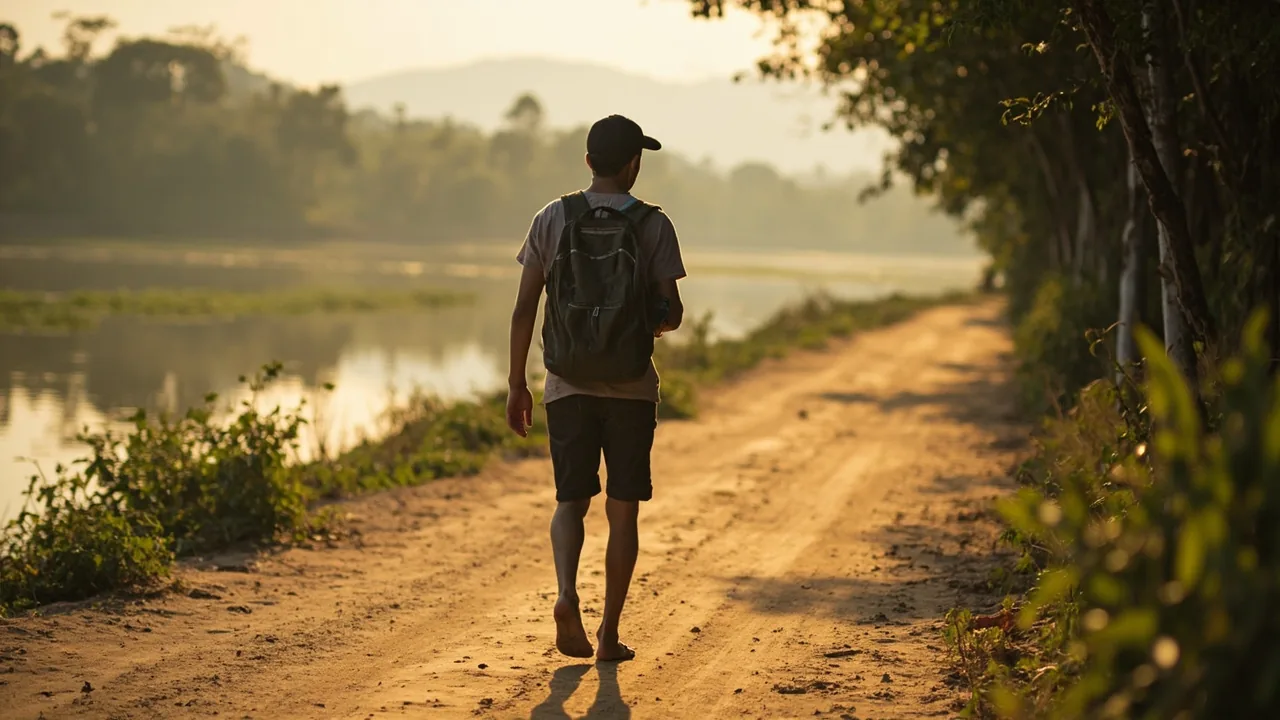
Solo Slow Travel in Southeast Asia: The Complete Backpacker’s Guide
Solo slow travel in Southeast Asia means moving through Thailand, Vietnam, Laos, Cambodia, and Indonesia at the speed of buses and boats, not flights. It is built for the person travelling on a solo slow travel itinerary with three months, one bag, and zero interest in rushing. Planning the wider region? Our Southeast Asia backpacking hub covers the multi-country route.
Quick Answers
| What | Answer | Price (INR) |
|---|---|---|
| Average daily budget (slow pace) | ₹1,700-₹5,164 (~$17.62-$53.52) per day, dorm included | ₹3,500 (~$36.28) to ₹5,000 (~$51.82) |
| Average dorm bed (regional) | ₹717-₹1,291 (~250-450 THB or ~$7.45-$13.40) in Thailand, ₹331-₹662 (~90,000-180,000 VND or ~$3.44-$6.88) in Vietnam | ₹700 (~$7.26) to ₹1,300 (~$13.47) |
| Best countries for first solo slow trip | Thailand, Vietnam, then Laos or Cambodia | , |
| Best transport for slow travel | Night buses, sleeper trains, slow boats (Huay Xai to Luang Prabang, Mekong crossings) | , |
| SIM and data for 30 days | Thailand ₹858 (~299 THB or ~$8.91), Vietnam ₹736 (~200,000 VND or ~$7.64), Cambodia ₹482 (~5 USD) to ₹771 (~8 USD) | ₹860 (~$8.91) to ₹770 (~$7.98) |
The Slow Travel Vibe
The Banana Pancake Trail is the informal name for the main backpacker circuit through Thailand, Laos, Vietnam, and Cambodia. It earned the name because almost every hostel in the region serves some version of banana pancakes for breakfast. The trail exists because the region’s transport and visa rules happen to line up neatly: Chiang Mai connects by slow boat to Laos, Laos connects by overnight bus to Vietnam, Vietnam connects by land border to Cambodia, and Cambodia loops back into Bangkok by bus.
Slow travel works here because Southeast Asia is one of the cheapest regions in the world for the daily basics. A dorm bed runs ₹717-₹1,291 (~250-450 THB or ~$7.45-$13.40) in Thailand or ₹331-₹662 (~90,000-180,000 VND or ~$3.44-$6.88) in Vietnam, a bowl of pho or pad thai is ₹115-₹172 (~40-60 THB or ~$1.19-$1.79) or ₹92-₹147 (~25,000-40,000 VND or ~$0.96-$1.53), and a local beer is ₹172-₹258 (~60-90 THB or ~$1.79-$2.68) or ₹55-₹92 (~15,000-25,000 VND or ~$0.57-$0.96). You can stay a week in one town on what a week in Goa costs you in a private room.
The other reason slow travel works is the social infrastructure. Hostel lobbies here are designed to meet people. Free walking tours run every morning in Chiang Mai, Hanoi, and Phnom Penh. Communal dinners happen three nights a week at most social hostels. You will rarely eat alone unless you actively want to. The backpacker culture is built around shared meals, shared taxis, and shared day-trips, which means solo travellers are absorbed into groups within a day or two of arriving anywhere.
How to Plan a Solo Slow Travel Itinerary
A solo slow travel itinerary is built backwards from your time budget, not forwards from a must-see list. The standard Indian backpacker has 30 to 90 days and a budget of ₹1.5 lakh to ₹4 lakh. The route below is the most popular slow-travel shape and works for any of those windows.
Phase 1: Thailand (10 to 14 days). Land in Bangkok, take the night bus to Chiang Mai, stay a week, then move south through Pai and the Mae Hong Son loop if you have time. Bangkok itself is two nights maximum; Chiang Mai is the slow-travel capital of Southeast Asia and a place most travellers stay longer than planned. For what to expect on the overnight ride, see this Bangkok to Chiang Mai night bus review.
Phase 2: Laos (7 to 10 days). From Chiang Mai, take the two-day slow boat from Chiang Khong to Luang Prabang, then a sleeper bus or minivan to Vang Vieng, then a bus to Vientiane. Laos is the quietest of the four countries and rewards slow travellers specifically. The slow boat itself is a multi-day experience, not just transport.
Phase 3: Vietnam (14 to 21 days). Cross into Vietnam at the Nam Phao / Cau Treo border, then travel north to south or south to north. The north (Hanoi, Sapa, Ha Giang loop) is mountains and rice terraces, and cheap accommodation in Sapa, Vietnam is widely available for slow travellers. The centre (Hue, Hoi An, Da Nang) is the slow-travel sweet spot. The south (Ho Chi Minh City, Mekong Delta) is busy and worth three to four nights. Vietnam has the strongest street food culture in the region and is the cheapest country for daily food costs.
Phase 4: Cambodia (5 to 7 days). From Ho Chi Minh City, cross into Phnom Penh by bus, stay two nights, then bus to Siem Reap for three or four nights. The temples at Angkor take at least two full days and most slow travellers stay a week.
Phase 5: Indonesia, optional (14 to 30 days). From Cambodia, most slow travellers fly back to Bangkok and home. If you have more time, Bali and the Gili Islands are the standard add-on. Solo slow travel in Bali and Java covers the route.
Subodh’s Pro Tip: Book the first three nights of your trip, then wing the rest. Planning more than a week ahead kills the slow part of slow travel.
How to Meet Other Backpackers
The fastest way to meet people on a solo trip is to pick a social hostel and stay a minimum of three nights. Social hostels run free walking tours, communal dinners, and bar crawls that put you in a group within an hour of arriving. Anti-social hostels (quiet, no common area, no events) are where solo travellers get lonely.
Beyond the hostel, four patterns work across Southeast Asia:
- Free walking tours in Chiang Mai, Hanoi, Hoi An, and Phnom Penh. These run every morning and are the single best way to meet other travellers on day one of any city.
- Group day-trips: cooking classes in Chiang Mai, motorbike loops in northern Vietnam, Angkor temple tours, and island boat trips in Thailand all run as group bookings through hostels.
- Travel community groups: the r/solotravel and r/backpacking subreddits, the Backpacker Dealz Facebook group, and WhatsApp groups run by hostels are how many travellers coordinate before they even meet.
- Couchsurfing meetups still happen in Hanoi, Bangkok, and Bali, mostly in the form of weekly language exchanges and drink-ups.
For more on the social mechanics of travelling alone, making friends while solo travelling goes deeper.
Safety for Solo Travellers
Southeast Asia is one of the safest regions in the world for solo travel, but “safe” is not the same as “no precautions.” Two things bite solo travellers more than any crime: road accidents and single-supplement scams.
Road safety. Motorbike accidents are widely reported by backpackers in Thailand, Vietnam, and Bali as one of the most common causes of serious injury; treat that risk accordingly. If you ride, wear a helmet, get an international driving permit before you leave India (the digital one the RTO issues is not accepted in most SEA countries, the physical one from the Automobile Association of India is), and never ride at night in the rain. The cheapest travel insurance in the region covers motorbike accidents up to 125cc with a valid license; without a license, most policies refuse claims.
Scams. The most common solo-traveller scam is the closed-tuk-tuk, where a driver tells you the landmark you want is closed for a holiday and offers to take you somewhere else (a shop that pays him commission). The fix is simple: check Google Maps yourself before getting in any vehicle. The second most common is the bar girl drink scam, mostly in Bangkok and Pattaya: a friendly local buys you a drink, the bill arrives at 2,000-4,000 THB, and the friend disappears with the bar’s commission. Solo male travellers are the main target. The fix is to refuse drinks from strangers in bars that don’t show a menu.
Solo female safety. Travelling solo as a woman in Southeast Asia is mostly fine, with two real notes. One: dress codes at temples in Thailand, Cambodia, and Bali require shoulders and knees covered, and most religious sites lend sarongs at the gate. Two: walking alone at 2 a.m. In Bangkok’s red-light districts or in Hanoi’s Old Quarter attracts attention. Use Grab or Bolt instead of street taxis after dark.
For current safety context, check the Indian Ministry of External Affairs travel advisory at mea.gov.in before departure, and the destination country’s own government travel page.
Budgeting for Solo Travellers
Solo travellers pay more per person than couples or groups on almost everything. A private room costs the same whether one person or two sleep in it. A tuk-tuk to Angkor Wat costs the same whether one person or four ride. The single-supplement is real. Three rules offset it:
- Stay in dorms. A ₹861 (~300 THB or ~$8.94) dorm in Bangkok costs ₹860 (~$8.91); a ₹3,443 (~1,200 THB or ~$35.74) private room costs ₹3,440 (~$35.65). The 2,580-rupee gap is half a week’s food.
- Share transport. Every sleeper bus and slow boat lets you book a group ticket. Ask in the hostel lobby an hour before departure; someone is always going the same way.
- Eat at markets. Street food at night markets costs ₹115-₹172 (~40-60 THB or ~$1.19-$1.79) per dish in Thailand, ₹92-₹147 (~25,000-40,000 VND or ~$0.96-$1.53) in Vietnam. A restaurant meal for one is ₹430-₹717 (~150-250 THB or ~$4.47-$7.45) or ₹221-₹368 (~60,000-100,000 VND or ~$2.29-$3.82). Same flavours, a quarter of the price.
Daily budget at a slow pace, by country:
| Country | Daily range (local) | What that gets you |
|---|---|---|
| Thailand | 1,200-1,800 THB | Dorm, three meals at markets, one coffee, one local transport ride |
| Vietnam | ₹1,288-₹2,024 (~350,000-550,000 VND or ~$13.37-$21.01) | Dorm, three meals of pho/bun/com ga, one coffee, one Grab ride |
| Laos | ₹861-₹1,507 (~200,000-350,000 LAK or ~$8.94-$15.65) | Dorm, three meals, one local beer, slow boat or tuk-tuk |
| Cambodia | ₹1,927 (~20 USD) to ₹2,890 (~30 USD) | Dorm, three meals at markets, one Angkor day-pass worth of food and beer |
| Indonesia (Bali) | ₹1,865-₹2,665 (~350,000-500,000 IDR or ~$19.37-$27.67) | Dorm, three meals, one scooter rental share, one Bintang |
For a deeper breakdown, solo budget travel in Southeast Asia covers the regional numbers.
Getting Connected
Solo travel depends on Google Maps, Grab, Bolt, and WhatsApp groups with your hostel. Reliable data is not optional. Buy a local SIM on arrival (AIS or TrueMove in Thailand, Viettel or Mobifone in Vietnam, Cellcard in Cambodia) for ₹574-₹861 (~200-300 THB or ~$5.96-$8.94) to ₹771 (~8 USD) per 30 days. Each country’s main airport has a SIM counter before the taxi queue; the price is fixed and the SIM is activated in ten minutes.
If you’d rather skip the airport counter, Nomad eSIM ships regional SEA data plans you can install before you fly. On supported phone models, an eSIM avoids swapping your Indian SIM.
Common Solo Mistakes Indians Make
Mistake 1: Booking private hotels instead of dorms. First-time solo travellers default to private rooms because the per-night price looks similar to a dorm. The result is isolation. A dorm at ₹861 (~300 THB or ~$8.94) is not just cheaper, it’s where you meet the people you end up travelling with for the next two weeks.
Mistake 2: Clinging to other Indians. There’s nothing wrong with bonding with fellow Indian travellers, but if your entire social circle is a Hindi-speaking bubble, you’ve paid for a hostel dorm and used it as a hotel. Stay in mixed dorms (6- or 8-bed), join the communal dinner, take the walking tour.
Mistake 3: Over-planning. A solo slow travel itinerary with every night booked for 60 days is not slow travel, it’s a chain of one-night stays. Book three nights, wander, extend or move on. The plan that lives in your phone is the plan that ruins the trip.
Mistake 4: Carrying a 70-litre backpack. Heavy bags are the single biggest reason Indian solo travellers skip day-trips and meet fewer people. A 40- to 50-litre bag with a detachable daypack is the standard.
Mistake 5: Skipping insurance. The most common reason Indian travellers skip travel insurance is cost. The cheapest SafetyWing plan is around ₹5,972 (~62 USD) a month (about ₹5,900 (~$61.15)). A single motorbike accident in Pai with no insurance is a five-lakh-rupee hospital bill. The math is not close.
Subodh’s Take
Slow travel is the only way Southeast Asia makes sense. The first week feels slow; the second week feels normal; by week three you’ll wonder why anyone takes four flights to see four countries. You will meet people in the hostel lobby, travel with them for ten days, split up, meet new people, and repeat. You’ll leave India alone and arrive home with twenty new phone numbers and a stack of photos you didn’t take by yourself. Just take the flight.
FAQ
What is solo slow travel in Southeast Asia, exactly? Slow travel means staying in fewer places for longer (usually a week per town minimum) and using ground transport over flights. Solo means you don’t have a pre-arranged travel partner. Combined, it’s the cheapest, most social, and most flexible way to backpack the region.
Is Southeast Asia safe for solo female travellers? Yes. The region’s main cities have low violent crime rates, and the backpacker infrastructure is built around solo women. Dress codes apply at temples, Grab or Bolt is safer than street taxis at night, and most hostels have female-only dorm options if you prefer them.
How much money do I need for a 60-day solo slow trip? ₹1.8 lakh to ₹3 lakh covers dorms, three meals a day at markets, ground transport, and visa fees for Thailand, Vietnam, Laos, and Cambodia. Add ₹30,000 (~$310.94) to ₹50,000 (~$518.23) for flights and insurance.
Do I need to book accommodation in advance? Book the first three nights of any town. After that, walk-ins at hostels and Booking.com same-day reservations are fine. Booking weeks ahead kills the slow part of slow travel.
What is the best country for a first solo slow trip? Thailand is the easiest start: tourist infrastructure, English widely spoken, the slow boat into Laos is a rite of passage, and Chiang Mai is the backpacker capital of the region.
Will I get bored travelling alone? Solo travellers rarely report boredom in Southeast Asia because hostels and group day-trips fill the social gap. If anything, the risk is over-socialising, not under-socialising.
