Southeast Asia Health Guide: Vaccines, Insurance & Travel Safety Tips for Indians (2026)
Indian backpackers do not need exotic shots to cross into Southeast Asia. This sea health care guide covers the standard pre-trip checklist of four vaccines, one insurance policy, and a few food rules. This complete health guide walks through every one of them, with current prices, real hospital names, and the mistakes that send travellers home early.
For a single starting point across all four countries, see the Southeast Asia backpacking hub. Double-check entry requirements against your government’s travel advisory at MEA’s advisories page before you fly.
What Does “SEA Health Care” Cover for Indian Travellers?
For Indian backpackers doing a multi-country loop through Thailand, Vietnam, Laos, and Cambodia, “health care” covers five things: pre-trip vaccines, travel insurance with medical evacuation, food and water discipline, access to pharmacies and clinics on the road, and a clear plan if something goes wrong. Private hospitals in Bangkok, Ho Chi Minh City, and Phnom Penh are good. Rural Laos and border clinics are not. The job is to avoid needing the latter.
Quick Answers
| What | Answer | Price (INR) |
|---|---|---|
| Standard pre-trip vaccines (4 jabs) | Hepatitis A, Hepatitis B, Typhoid, Tetanus booster | ₹3,500 (~$36.28) to ₹6,500 (~$67.37) |
| Optional but recommended | Japanese Encephalitis, Rabies pre-exposure | ₹2,500 (~$25.91) to ₹4,500 (~$46.64) |
| Travel insurance (1 month, Indian citizen) | SafetyWing Nomad | ₹5,982 (~62 USD) |
| Travel insurance (full year, frequent travellers) | SafetyWing annual upgrade | ~₹144,722 (~1,500 USD) |
| GP consultation, private hospital Bangkok | Bumrungrad International | ₹2,294-₹7,169 (~800-2,500 THB or ~$23.78-$74.30) |
| GP consultation, public clinic Hanoi | Family Medical Practice | ₹4,416-₹7,360 (~1,200,000-2,000,000 VND or ~$45.77-$76.28) |
| Emergency room visit, Bangkok | Private hospital average | ₹14,338-₹43,012 (~5,000-15,000 THB or ~$148.60-$445.81) |
| Hospital bed, private room per night | Bangkok / HCMC standard | ₹22,940-₹71,688 (~8,000-25,000 THB or ~$237.77-$743.02) |
| Evacuation Bangkok to Singapore (worst case) | International SOS tier | ₹4,824,075 (~50,000 USD) to ₹11,577,780 (~120,000 USD) |
The Vaccines You Need
Most Indian backpackers arrive already protected against half of these. A booster or two is usually all you need. The full list for a 3-month Thailand-Vietnam-Laos-Cambodia loop:
1. Hepatitis A (recommended for everyone)
Hep A spreads through contaminated food and water. Rural street food and iced drinks in Laos are the highest-risk scenarios. Two-shot series, 6 months apart. Most Indians over 25 are unvaccinated and need the full series. Two doses from a Delhi clinic cost ₹1,500 (~$15.55) to ₹2,200 (~$22.80).
2. Hepatitis B (recommended)
Three-shot series over 6 months. If you’re flying out within 2 weeks, ask for the accelerated 0-1-2 month schedule plus a 12-month booster. Cost: ₹800 (~$8.29) to ₹1,500 (~$15.55) for adults. Many Indian travellers got this as children through school programmes. Check your vaccination record before paying again.
3. Typhoid (recommended)
Single injection, valid 3 years. Useful if you’ll be eating at markets and roadside stalls in Cambodia, Laos, or rural Vietnam. Cost: ₹400 (~$4.15) to ₹800 (~$8.29). The oral vaccine is also fine.
4. Tetanus-diphtheria booster (recommended)
If your last booster was more than 10 years ago, get one. Free at most Indian government hospitals, ₹200 (~$2.07) to ₹500 (~$5.18) at private clinics. Skip this and a cut from coral or a scooter scrape can turn into a real problem.
5. Japanese Encephalitis (consider)
Two-shot series. Recommended if you’re spending 30+ days in rural rice-growing areas (Cambodian or Laotian countryside, northern Vietnam, Mekong Delta). Optional for beach-and-city itineraries. Cost: ₹2,500 (~$25.91) to ₹3,500 (~$36.28) per dose.
6. Rabies pre-exposure (consider)
Two doses, day 0 and day 7. Worth it for anyone who’ll be around stray dogs (common in Bangkok, Vientiane, Phnom Penh, Hoi An) or rural areas. Post-bite treatment without pre-exposure costs ₹144,722 (~1,500 USD)+ and is not available everywhere. Cost: ₹300 (~$3.11) to ₹500 (~$5.18) per dose.
7. Yellow Fever (only if transiting Africa first)
Not relevant for direct India-to-Southeast-Asia flights. Only required if your itinerary includes a yellow fever risk country in the 6 days before arrival.
Subodh’s Pro Tip: Book a vaccination appointment at a Delhi clinic like Fortis Healthcare or Apollo Hospitals 4 weeks before departure. The accelerated Hepatitis B schedule saves you a third trip.
Travel Insurance: The Non-Negotiable
No vaccine prevents a scooter accident in Pai or a dengue fever spike in Hanoi. Insurance does.
What Indian travellers should buy
Get SafetyWing travel insurance, covers Indian travelers from ~$62/month (~₹5,900). Includes COVID, trip interruption, and medical evacuation across Southeast Asia.
Key features to confirm before buying:
- Medical coverage: minimum ₹24,120,375 (~250,000 USD). Anything below ₹9,648,150 (~100,000 USD) is a problem in Singapore or Bangkok private hospitals.
- Medical evacuation: covered to a “centre of excellence.” Confirm this means Singapore, Bangkok, or Mumbai, not “the nearest facility,” which can be a rural Cambodian clinic.
- Adventure sports: scooter riding, motorbike, scuba, zip-lining. Standard policies exclude these. SafetyWing’s Nomad plan covers some; read the exclusions.
- Pre-existing conditions: most policies exclude them. Declare everything on the application.
- Trip length: monthly renewable for backpackers. Annual for frequent flyers.
If you have a pre-existing condition or you want stronger coverage for scooters, look at World Nomads as a backup quote. They specifically cover motorbikes under 250cc.
What is NOT covered by Indian domestic insurance
Your Star Health or HDFC ERGO policy from India almost does not cover you outside India except for emergency medical evacuation in a narrow set of countries. Check before relying on it. The premium for an Indian traveller under 35 is low enough that skipping dedicated travel insurance to save ₹4,824 (~50 USD) makes no financial sense.
Food and Water: What the Rules Are
Traveller reports are consistent: most Indian backpackers who get sick in Southeast Asia got sick from ice, salad, or undercooked seafood, not from street food per se.
Safe to eat
- Hot, freshly cooked street food: pad thai fried to order, banh mi from a busy stall, grilled skewers from a vendor with turnover. Heat kills most pathogens.
- Cooked vegetables: stir-fried morning glory, curry, tom yum soup.
- Fruit you peel yourself: bananas, mangoes, dragon fruit, rambutan, pineapple.
- Bottled water: check the seal. Real bottled water in Thailand, Vietnam, Cambodia, Laos costs ₹18-₹55 (~5,000-15,000 VND or ~$0.19-$0.57).
- Hot coffee and tea: boiled water by default.
- Beer and spirits: alcohol kills most bugs. Mixed drinks with ice are the wildcard.
Avoid or be careful with
- Tap water: never drink it. Even in 5-star hotels in Hanoi.
- Ice in drinks: large commercial ice from factories (the hollow tube kind) is usually safe; small cloudy cubes from a roadside vendor are not. Rule of thumb: ice that sits in a glass and is melting fast is riskier than ice from a bag pulled out of a freezer at a chain café.
- Raw vegetables: salads, fresh herbs in cold dishes, raw cabbage in larb.
- Raw seafood: ceviche-style preparations, oysters, sashimi at coastal markets. Vibrio and hepatitis A both ride in here.
- Unpasteurized dairy: rare in SEA but check in Cambodia.
- Buffets at low-end hotels: food sitting under warming lamps for hours is the highest-risk setting. Avoid.
Safety Alert: Most cases of traveller’s diarrhoea in Vietnam and Cambodia come from a bacteria called ETEC (Enterotoxigenic E. Coli), not from “exotic” parasites. The treatment is hydration and loperamide (Imodium), not antibiotics. Pack oral rehydration salts from India (₹50 (~$0.52) for a strip of 10 sachets) and you’re covered for the most common outcome.
Pharmacies and Over-the-Counter Meds in SEA
Pharmacies are everywhere in tourist areas. The Thai and Vietnamese pharmacy chains are trustworthy and well-stocked. You’ll find most things you’d buy in India at Indian-made or local generic prices.
| What to pack from India | What to buy locally | What you don’t need to pack |
|---|---|---|
| Oral rehydration salts (ORS) | Paracetamol (500 mg) | Sleeping pills (cheap locally) |
| Loperamide (Imodium) | Ibuprofen | Antihistamines |
| Domperidone (for nausea) | ORS (unbranded, cheap) | Broad-spectrum antibiotics (prescription needed) |
| Broad sunscreen (Indian SPF 50+) | Local-brand sunscreen | Tampons (more variety in SEA) |
| Mosquito repellent with DEET 30%+ | DEET repellent locally | Most first-aid supplies |
Carry your prescription if you bring prescription meds. Codeine-containing cough syrups and some anti-anxiety meds are illegal in Thailand, Singapore, and Malaysia even with a prescription. Check the destination’s controlled-substance list at the embassy site before flying with anything unfamiliar.
When You Need a Hospital
Private hospitals in Bangkok, Chiang Mai, Ho Chi Minh City, Hanoi, Phnom Penh, and Vientiane accept walk-ins and often have translators. Public hospitals are cheaper but the queue is longer and English is patchier.
Trusted clinics across the region
- Bangkok: Bumrungrad International Hospital (the gold standard), Bangkok Hospital, Samitivej Sukhumvit.
- Chiang Mai: Chiang Mai Ram Hospital, Bangkok Hospital Chiang Mai.
- Hanoi: Family Medical Practice, Hanoi’s French Hospital.
- Ho Chi Minh City: Family Medical Practice, Vinmec Central Park.
- Phnom Penh: Royal Phnom Penh Hospital (the only fully-equipped international private hospital).
- Vientiane: Alliance International Medical Center.
- Luang Prabang: Lao Friends Hospital for Children (paediatrics only); serious cases get evacuated to Bangkok or Vientiane.
Hospital admission in a private room in Bangkok or HCMC costs ₹22,940-₹71,688 (~8,000-25,000 THB or ~$237.77-$743.02) per night before treatment. Insurance covers it. Cash up front without insurance is a different conversation.
Mosquito-Borne Illnesses: The Real Risk in SEA
Dengue, malaria, and chikungunya are the three to think about. Most Indian travellers skip anti-malarials because the major tourist areas are low-risk, but check your exact itinerary.
Dengue (widespread, no preventive med)
- All four SEA countries see dengue every year, with spikes May to October in Thailand and Vietnam.
- Symptoms: high fever, severe headache, body pain, rash.
- No vaccine recommended for Indian travellers (the available vaccine, Dengvaxia, is only for those with prior dengue infection).
- Prevention: DEET 30%+ repellent, long sleeves at dawn and dusk, mosquito net where screens are absent.
Malaria (rural and border zones)
- Most of SEA, including Bangkok, Hanoi, HCMC, Siem Reap, Phuket, and Bali, is malaria-free.
- Risk areas: rural Cambodia (especially forested provinces), rural Laos, parts of the Mekong Delta, eastern Myanmar.
- Prevention: atovaquone-proguanil (Malarone) or doxycycline. Prescribed by a doctor in India before you fly.
Chikungunya (sporadic, painful)
- Outbreaks occur across the region. Symptoms mimic dengue but the joint pain is more severe and lingers.
- No vaccine. Same prevention as dengue.
Step-by-Step: Pre-Departure Health Checklist
Six weeks before your flight:
- Book a pre-travel consultation. At any Apollo or Fortis Travel Health clinic, or a Manipal Hospital travel medicine department. Cost: ₹500 (~$5.18) to ₹1,500 (~$15.55) for the consultation.
- Get the four core vaccines. Hep A, Hep B (accelerated if needed), Typhoid, Tetanus booster. Plan ₹3,500 (~$36.28) to ₹6,500 (~$67.37) total.
- Decide on Japanese Encephalitis and Rabies. Adds ₹2,500 (~$25.91) to ₹4,500 (~$46.64) if yes.
- Buy travel insurance. SafetyWing for monthly, World Nomads for adventure sports.
- Fill prescriptions for 3 months’ supply of personal meds plus ORS, Imodium, domperidone, paracetamol, ibuprofen, antihistamine. Cost: ₹500 (~$5.18) to ₹1,500 (~$15.55).
- See your dentist. A toothache in rural Laos is not where you want to be solving a problem. ₹500 (~$5.18) to ₹1,500 (~$15.55) for a check-up.
Two weeks before:
- Confirm your insurance details offline. Screenshot the policy, the 24-hour emergency number, and the evacuation procedure. Hotel Wi-Fi and hospital reception both fail at the worst times.
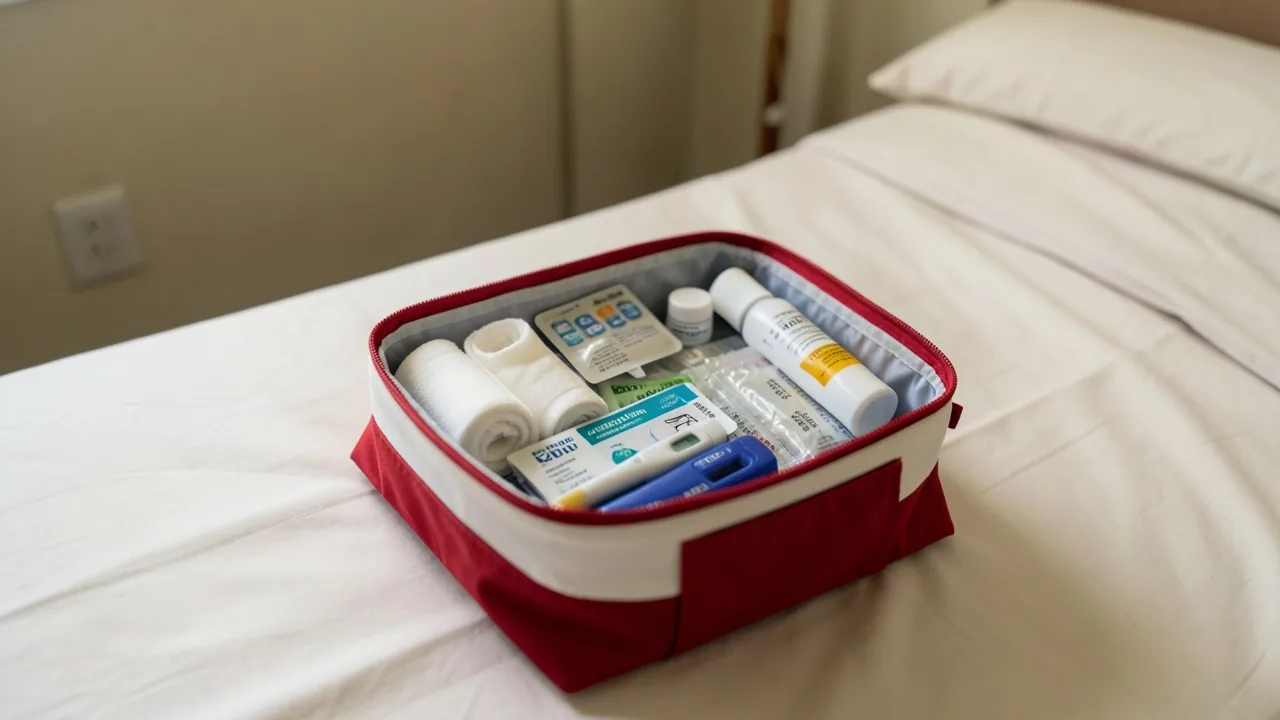
- Pack a basic first-aid kit. Band-aids, antiseptic, gauze, tape, thermometer, electrolyte sachets, SPF 50+, DEET repellent.
- Check government advisories. MEA’s travel advisories and the destination country’s foreign affairs site. Border regions can see periodic tension; some airports have had reports of taxi cartels blocking ride-hailing pickups. Read the advisory the week before you fly.
Staying Connected for Emergencies
A local SIM makes everything easier. Buy at the airport on arrival or order an eSIM before you fly.
For physical SIMs, pick up a local prepaid SIM at the airport kiosk or a 7-Eleven on day one. AIS in Thailand, Viettel in Vietnam, Unitel in Laos, Cellcard or Smart in Cambodia. Cost: ₹574-₹1,434 (~200-500 THB or ~$5.94-$14.86) for a 30-day tourist package with 30 to 50 GB.
For eSIM, Get Nomad eSIM regional plans start from ₹868 (~9 USD) for 1 GB / 7 days, scaling up to ₹3,763 (~39 USD) for 30 GB / 30 days. No physical swap, instant activation when you land, and works across all four SEA countries on one plan.
Save these numbers before you board:
- India emergency line from abroad: +91-11-23012111 (MEA control room).
- Local equivalents: Thailand 191 (police), 1669 (ambulance). Vietnam 113 (police), 115 (ambulance). Laos 191 (police), 195 (ambulance). Cambodia 117 (police), 119 (ambulance).
- Your insurance company’s 24-hour line: in your screenshot folder.
Common Mistakes Indian Travellers Make
- Skipping travel insurance to save ₹5,900 (~$61.15). One dengue hospitalisation in Bangkok costs 200,000+ THB (~₹5,73,800). Insurance pays for itself the day something goes wrong. Also see our guide on travel insurance from India.
- Drinking the “free” water in hotels. Most budget hotels have a water dispenser in the hallway. Use it. The tap in the bathroom is not potable.
- Taking unprescribed antibiotics for traveller’s diarrhoea. Most cases are viral or self-limiting bacterial. Antibiotics delay recovery and wreck your gut for the next two weeks. Rehydration and loperamide are the right move. See the Southeast Asia packing list for what to bring.
- Scooter riding without a licence. Insurance companies exclude scooter accidents if you don’t have a valid International Driving Permit (IDP). Get one in India before flying. An IDP costs ₹1,000 (~$10.36) and is required by Thai and Vietnamese law.
- Exchanging INR at the airport. Airport counters give bad rates. Better to use a forex card. See the best forex cards from India for current recommendations.
- Trekking without altitude or acclimatisation plan. Sapa, northern Thailand, and parts of northern Laos are above 1,500 m. AMS hits some travellers even there.
What Most Guides Don’t Tell You
- The “3-6-3” rule for hospital bills in Thailand: most tourist visa-related private hospital bills get settled 3-6-3 months later, after the insurance company reviews them. Your upfront cash outlay is real. Carry an emergency buffer.
- Rabies immunoglobulin (RIG) is not available in Laos or rural Cambodia. If you get bitten by a stray dog in Vientiane, you’ll need evacuation. This is why the pre-exposure rabies series matters.
- Most public Thai hospitals refuse to bill foreign insurers directly. Bangkok Hospital and Bumrungrad bill insurers. Rural government hospitals do not. Plan to pay cash and claim later.
- Indian embassy contact info is patchy in Laos and Cambodia. Save the Bangkok embassy’s number as your fallback. MEA’s embassy directory lists the current Thai embassy for India-assistance-in-region coordination.
Safety on the Ground: Generic Categories
Petty theft, taxi scams, and bar scams are common across the region. Solo female travellers should read the solo female travel guide for specific patterns. The two universal rules: register your trip with the Indian embassy on arrival, and check the MEA advisory the day before you fly for any changes.
Safety Alert: Borders and remote regions can see periodic security tension. Always check your government’s travel advisory (MEA advisories) and the destination country’s official advisory site within 24 hours of departure.
FAQ
Do I need vaccines to enter Thailand, Vietnam, Laos, or Cambodia as an Indian citizen?
No vaccine is required for entry from India. Yellow fever is only required if you’re transiting an infected country. The vaccines in this guide are about protecting you, not about satisfying immigration.
Is tap water safe in Southeast Asia?
No. Drink bottled water with the seal intact, use the hotel water dispenser, and avoid ice from small roadside vendors. Pack ORS sachets from India.
What is the cheapest reliable travel insurance for Indians going to Southeast Asia?
Get SafetyWing travel insurance, covers Indian travelers from ~$62/month (~₹5,900). Includes COVID, trip interruption, and medical evacuation across Southeast Asia.
Can I use my Indian debit card in a SEA hospital?
Yes for paying the bill. No for direct billing with insurers. Most insurers pay you back after you submit receipts. Carry an emergency ₹50,000 (~$518.23) buffer or set up a forex card from Niyo or Fi.
What if I get sick on the slow boat on the Mekong?
The slow boat from Huay Xai to Lu Pak Beng has no medical kit. Travel insurance includes emergency evacuation. The boat crew radio for help at Pak Beng or Houayxay. Carry your own ORS, Imodium, paracetamol, and an antibiotic prescription (azithromycin) if your doctor agrees.
Are Indian pharmacies and medicines available in SEA cities?
Indian brands are uncommon in pharmacies, but local generics of paracetamol, ibuprofen, cetirizine, omeprazole, and metformin are cheap and good quality. Buy from large chains (Watsons in Thailand, Pharmacity in Vietnam, UCare in Cambodia).
Do I need a yellow fever vaccine if I’m flying through Singapore?
No. Singapore is not a yellow fever risk country. Transit through Singapore does not trigger the requirement.
Subodh’s Take
The five-figure hospital bills you hear about from tourists who skipped insurance are not urban legends. Spend ₹6,000 (~$62.19) on insurance and a few thousand on vaccines before you fly. Spend the rest of your trip on pad thai and sleeper trains.
