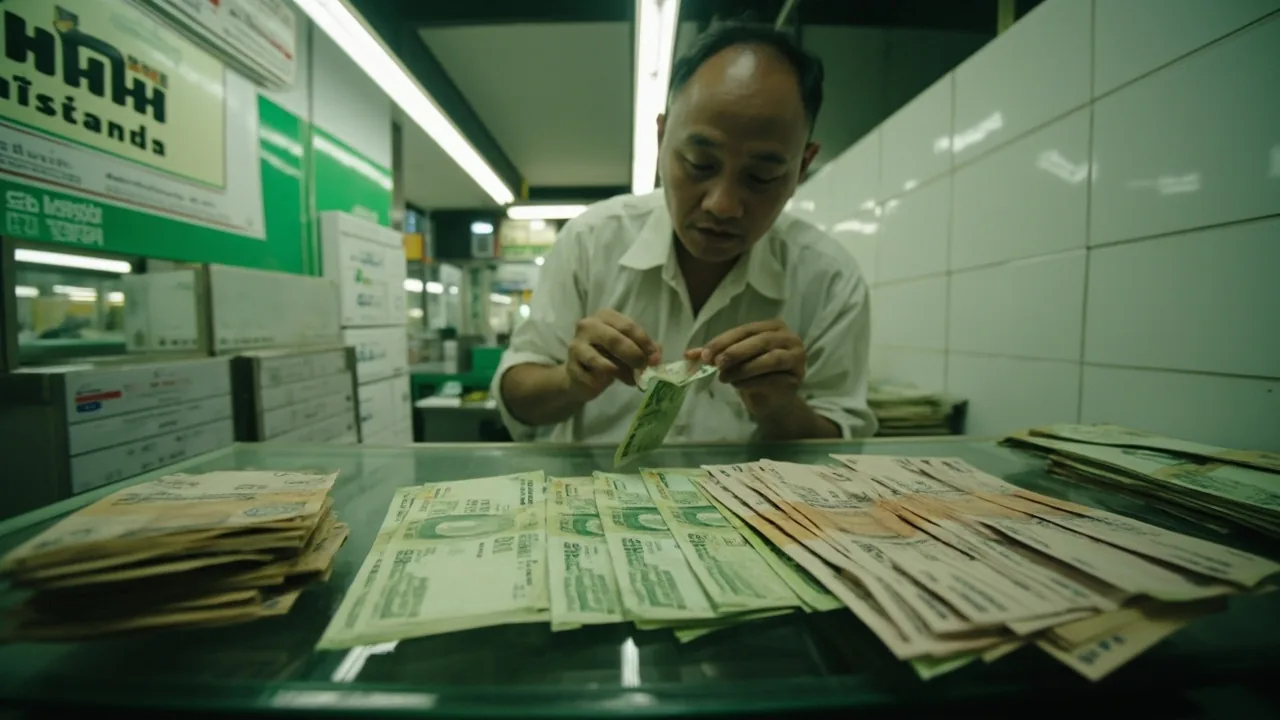
Thailand Currency Exchange Rate Today: Where to Get the Best Deal in 2026
The best Thailand currency exchange rate today for Indians comes from SuperRich or Twelve Victory counters in central Bangkok. Avoid airport counters. This guide covers forex cards, ATMs, SuperRich, Twelve Victory, and when to pay by UPI. See also Sea Backpacking Hub and 7 Days Thailand Tour Package Price.
What Is the Thai Baht to INR Exchange Rate Right Now?
Planning a longer trip? Our average daily spend in Thailand guide breaks it down by region.
The Thai Baht (THB) is the only legal tender in Thailand. Right now, 1 INR = roughly 0.349 THB, or put the other way, 1 THB ≈ ₹2.87 (~$0.08). That rate moves by 1-2% over weeks, sometimes 3-4% if the rupee or Thai baht has a bad week. The mid-market rate (the one Google shows) is what you should anchor to, and any deal you get should be within 1-2% of it. If a counter offers you less than ₹8 (~2.65 THB or ~$0.08) per rupee, walk away. If your Indian bank card is converting at 2.65 or below, you’re paying a hidden 7-8% markup and switching to cash or a forex card will save you serious money across a 10-day trip. You may also find How Much Money Do I Need for 5 Days in Thailand useful for this trip.
Quick Answers
| What | Answer | Price (INR) |
|---|---|---|
| Today’s rate (mid-market) | 1 THB = ₹2.87 (~$0.08) | ₹2.87/THB |
| Best in-person rate | SuperRich / Twelve Victory branches in central Bangkok | ₹100 (~$1.04) → up to 287 THB |
| Airport exchange rate | Always worse, ₹100 (~$1.04) → 255-270 THB | Avoid |
| Indian debit card markup | 3-5% over mid-market | Hidden cost |
| Forex card (HDFC/ICICI/Axis) | 1-2% markup on load + ₹100-₹200 (~$1.04-$2.08) ATM fee | Best card option |
| ATM withdrawal fee (Thailand side) | ₹629 (~220 THB or ~$6.53) per transaction | Built into most ATMs |
| Best SIM in Thailand | AIS/TrueMove tourist SIM, 15 days, 15GB data | ₹1,141 (~399 THB or ~$11.84) |
| UPI in Thailand | Works at major malls, 7-Eleven, McDonald’s via QR | Zero FX fee |
Step-by-Step: Getting the Best Exchange Rate in Thailand
Step 1: Decide What Currency to Carry from India
You have three choices for what to bring from India: Thai Baht (impossible to source in India at a decent rate), USD, or INR cash. Bring USD. Specifically, ₹9,634 (~100 USD) and ₹4,817 (~50 USD) notes in clean, untorn condition. Carrying INR cash to Thailand is a bad idea for two reasons: most Thai exchange counters will not accept rupees at all, and the ones that do give an abysmal rate (often ₹5-₹5 (~1.60-1.80 THB or ~$0.05-$0.05) per rupee). USD is the lingua franca of currency exchange across Southeast Asia, and Thai counters compete hard for clean USD notes. Torn, marked, or pre-2006 series USD bills get rejected or discounted at the counter. If your USD bills have even a small tear, exchange them at the airport in India before you fly. See also: What to Do in Thailand for 7 Days.
Step 2: Get a Forex Card Before You Fly
Forex cards (HDFC, ICICI, Axis, SBI) load once from your Indian bank account at a rate locked at the time of loading, then you spend abroad at near-wholesale rates with no per-transaction markup. For Thai baht, this means loading at roughly ₹8-₹8 (~2.80-2.83 THB or ~$0.08-$0.08) per ₹100 (~$1.04) versus the 2.65-2.70 you’d get swiping a regular debit card. On a ₹50,000 (~$519) trip, that’s ₹1,000-₹2,000 (~$10.38-$20.76) saved. Order the card at least 7-10 days before departure. Load it in USD or THB. THB is better because there is zero conversion when you spend, but not every bank lets you load THB directly. Verify with your specific bank before flying on which currencies your card supports and whether direct THB loading is available, because reloading mid-trip requires an Indian SIM and net banking access.
Step 3: Exchange Your First ₹19,268 (~200 USD) at SuperRich on Arrival
The two best exchange chains in Bangkok are SuperRich (the green-and-yellow logo, “SuperRich 1965” is the original) and Twelve Victory. Both have multiple branches in central Bangkok, near BTS stations, and their rates are within 0.3-0.5% of mid-market. The catch: airport branches of these chains still exist, and they mark up 1-2% over their city branches. So skip the airport. Get to your hotel, drop bags, then find the nearest SuperRich or Twelve Victory branch. Use Google Maps: search “SuperRich” or “Twelve Victory” and the map shows current branches. The rate on the door will say something like “₹8 (~2.84 THB or ~$0.08) per ₹100 (~$1.04)” or, if you’re exchanging USD, “₹96 (~1 USD) = ₹100 (~35 THB or ~$1.04).X”. Check the rate inside before handing over cash. As a rule of thumb, anything within 1.5% of the mid-market is fair.
Step 4: Top Up with ATM Withdrawals During the Trip
For the rest of your trip, use ATMs to draw Thai baht from your forex card or Indian debit card. Every ATM in Thailand charges a ₹629 (~220 THB or ~$6.53) flat fee per transaction (this is built into most Thai bank ATMs, including the orange Bangkok Bank and blue Krungthai ATMs you’ll see on every street corner). To minimize that fee, withdraw the maximum amount your card allows per transaction. Standard Indian bank ATM limits are ₹15,000-₹25,000 (~$155.70-$259.50) per day (which is roughly ₹14,866-₹24,872 (~5,200-8,700 THB or ~$154.21-$258.00)). Forex cards typically allow ₹48,170-₹96,339 (~500-1,000 USD) per day. Withdraw the daily maximum in one go, not in five small withdrawals. Travellers report losing ₹3,145 (~1,100 THB or ~$32.64) over a week just from making small withdrawals at the 7-Eleven ATM. Don’t be that person.
Step 5: Use UPI Where It’s Accepted
UPI now works in Thailand at most major malls (Terminal 21, Siam Paragon, MBK, Central), 7-Eleven, McDonald’s, Burger King, and a growing number of mid-range restaurants and cafes. The conversion rate you get through UPI is generally within 0.5% of mid-market, and there is no FX fee. For Indian travellers, this is the single best payment method when available. The catch: small street-food stalls, local markets, tuk-tuks, songthaews, and most Thai-run shops still don’t accept UPI. Have THB cash for those.
Step 6: Skip the Hotel and Airport Counters
Hotels offer exchange rates 5-8% worse than SuperRich. Airport counters (Bangkok Suvarnabhumi, Phuket, Chiang Mai) are 3-5% worse than city SuperRich. If you land at 11 PM with no Thai baht and need a taxi, use the ATM at the airport (yes, the ₹629 (~220 THB or ~$6.53) fee hurts, but it’s still better than the airport exchange rate). For early-morning arrivals, the difference between the airport counter and a city SuperRich is often 5-10 THB per USD 100 exchanged. On USD 200, that’s 10-20 THB, or roughly ₹30-₹60 (~$0.31-$0.62), not huge. The bigger trap is exchanging your entire ₹50,000 (~$519) trip budget at the airport and losing 5%, which is ₹2,500 (~$25.95).
Common Mistakes Indians Make with Thailand Currency Exchange
Mistake 1: Exchanging INR at the airport. Most Thai airport counters don’t even display a rupee rate, but the few that do will quote you something like ₹5 (~1.60 THB or ~$0.05) per ₹1 (~$0.01). Travellers who didn’t do their homework walk away thinking they got a deal, when in reality they just gave away 40% of their money’s value. Always carry USD as your bridge currency.
Mistake 2: Using a regular Indian debit card without checking the FX markup. HDFC, ICICI, Axis, and SBI all charge a 3-3.5% markup on international transactions plus a cross-currency fee. If you swipe your regular debit card at a Thai restaurant, you’ll see ₹2,750 (~$28.55) charged for every ₹2,650 (~$27.51) worth of baht. That 3.5% adds up to ₹1,750 (~$18.17) on a ₹50,000 (~$519) trip. Get a forex card instead, or use UPI when possible.
Mistake 3: Making small ATM withdrawals. That ₹629 (~220 THB or ~$6.53) fee is the same whether you withdraw a small amount or the daily maximum. Travellers who withdraw ₹5,718 (~2,000 THB or ~$59.35) at a time to “be safe” pay the fee five times over a week when they could’ve paid it once. Withdraw the daily maximum in one shot.
Mistake 4: Carrying torn or old USD notes. Any USD bill with writing, stamps, tears, or from a series older than 2006 gets rejected or discounted. Travellers report losing 5-15% on “damaged” USD bills at Thai counters. If your notes look rough, exchange them at an Indian bank or airport counter before flying.
Mistake 5: Trusting the hotel front desk. Hotel exchange rates are the worst in town, often 5-8% below mid-market. The convenience of exchanging at reception costs real money. Walk to the nearest SuperRich or Twelve Victory branch instead.
Mistake 6: Not enabling international transactions on the card before flying. This one is painfully common. Travellers land in Bangkok, try to use their forex card, and it gets declined because international usage is disabled by default. Enable it via your bank’s app or call the customer-care number before you fly.
What Most Guides Don’t Tell You
Your forex card rate isn’t zero-markup. Banks like HDFC and ICICI advertise “zero forex markup” cards, but they make money on the load rate. When you load ₹50,000 (~$519) onto an HDFC ForexPlus card, you get roughly ₹8-₹8 (~2.78-2.80 THB or ~$0.08-$0.08) per ₹100 (~$1.04), not the mid-market 2.87. That 2-3% spread on loading is their real margin. It is still better than the 3-5% on a regular debit card, but it isn’t free. Compare your specific bank’s load rate on the day you load, and time it when the rupee is strong if you have flexibility.
Some Thai ATMs give better rates than others. Not all ATMs charge the 220 THB fee, and not all give the same conversion rate. AEON ATMs (purple, found in 7-Eleven) sometimes charge only ₹429 (~150 THB or ~$4.45). Bangkok Bank and Krungthai ATMs are reliable but always charge ₹629 (~220 THB or ~$6.53). Your bank might also apply a separate fee on top of the local ATM fee, so check the small print. Travellers report that withdrawing from an HSBC or Citibank ATM in Thailand (rare, but some exist) sometimes waives the local fee.
UPI works at 7-Eleven via the QR code on the counter. The “PromptPay” QR codes that Thai merchants display are increasingly accepted by Indian UPI apps (Google Pay, PhonePe, Paytm). When you scan, you see the conversion in INR before confirming. This is the closest thing to the mid-market rate you’ll get in real-world Thailand spending. If the merchant shows a PromptPay QR, use it.
Big malls and supermarkets often accept credit cards with no foreign-transaction fee. If your Indian credit card (HDFC Millennia, ICICI Amazon Pay, Axis Atlas) has zero forex markup, paying at supermarkets and malls can give you a rate close to mid-market. But these zero-markup cards are the exception, not the rule. Most Indian credit cards charge 3-3.5% on international transactions, just like debit cards.
Some Thai merchants offer “DCC” (Dynamic Currency Conversion) at the payment terminal. This means the terminal offers to charge you in INR instead of THB. The conversion rate on this offer is always 3-5% worse than paying in THB. Always choose THB at the terminal. Even if your home bank’s rate is bad, DCC is worse.
Quick Reference: What to Carry and How Much
For a 7-day Thailand trip on a typical backpacker budget:
| Item | How much | Method |
|---|---|---|
| Cash in USD (for first exchange) | ₹19,268-₹28,902 (~200-300 USD) | Carry in hand luggage |
| Forex card | ₹30,000-₹40,000 (~$311.40-$415.20) loaded | HDFC ForexPlus / ICICI Travel / Axis Forex |
| Backup debit card | Regular Indian debit card | For emergencies only |
| UPI access | Google Pay / PhonePe | Linked to Indian bank account |
| Credit card (optional) | HDFC Millennia / ICICI Amazon Pay (zero forex markup) | Malls and supermarkets only |
For longer trips or those visiting rural areas, increase the USD cash reserve. SuperRich branches cluster in Bangkok, Chiang Mai, Phuket, and Pattaya, but vanish in smaller towns. If you’re heading to Pai, Koh Lipe, or the eastern islands, carry enough baht cash to cover 3-4 days before relying on finding a counter.
Connectivity and SIMs in Thailand
Money matters, but so does having data to find SuperRich branches and use UPI. The AIS and TrueMove tourist SIMs at 7-Eleven cost ₹1,141 (~399 THB or ~$11.84) for 15 days with around 15GB of data. The airport counter charges the same. If your phone supports eSIM, Get Nomad eSIM works before you fly and activates on landing in Bangkok, which means you’ll have data the moment the plane doors open. Critical for finding an ATM at the airport, hailing a Grab, or scanning a UPI QR.
FAQ
Q: What is the best Thailand currency exchange rate today for Indian travellers?
The mid-market rate today is 1 THB ≈ ₹2.87 (~$0.08). The best deal in person is from SuperRich or Twelve Victory branches in central Bangkok, where you’ll get within 0.5-1% of mid-market. Avoid airport counters and hotel front desks, which mark up 3-8%.
Q: Should I carry Indian rupees or USD to Thailand?
Carry USD, in clean, untorn ₹4,817 (~50 USD) and ₹9,634 (~100 USD) notes. Most Thai exchange counters do not accept INR at all, and the ones that do give an awful rate. Carrying INR is the single most expensive mistake Indian travellers make at the Bangkok airport.
Q: Which is better in Thailand: forex card or cash?
Use both. Carry ₹19,268-₹28,902 (~200-300 USD) in cash for the first exchange at SuperRich, then use a forex card (HDFC, ICICI, Axis) for ATM withdrawals during the trip. The forex card rate is better than a regular Indian debit card by 1.5-2%.
Q: Are ATM withdrawals in Thailand safe?
Yes, but always use bank-affiliated ATMs inside bank branches, mall lobbies, or 7-Eleven. Avoid standalone ATMs in dark alleys. Cover the PIN pad with your hand when entering your PIN (skimmers exist). Withdraw the daily maximum to minimize the ₹629 (~220 THB or ~$6.53) per-transaction fee.
Q: Does UPI work in Thailand?
Yes, at major malls (Terminal 21, Siam Paragon, MBK), 7-Eleven, McDonald’s, Burger King, and a growing list of mid-range restaurants. Scan the PromptPay QR code with Google Pay or PhonePe. Conversion is within 0.5% of mid-market with zero fees.
Q: What is the ATM withdrawal limit for Indian cards in Thailand?
Most Indian banks allow ₹15,000-₹25,000 (~$155.70-$259.50) per day (roughly ₹14,866-₹24,872 (~5,200-8,700 THB or ~$154.31-$258.18)). HDFC ForexPlus and ICICI Travel cards allow ₹48,170-₹96,339 (~500-1,000 USD) per day. Some banks offer up to ₹50,000 (~$519) with prior intimation. Check with your bank before flying.
Q: Can I use my Indian debit card directly in Thailand without a forex card?
Yes, but you’ll pay a 3-3.5% markup plus a cross-currency fee. On a ₹50,000 (~$519) spend, that’s ₹1,500-₹1,750 (~$15.57-$18.17) lost to bank margins. A forex card or UPI saves this cost.
Subodh’s Take
Currency exchange in Thailand is one of those things that looks complicated until you’ve done it once, then it becomes the easiest part of the trip. The short version: bring ₹19,268-₹28,902 (~200-300 USD) in your hand luggage, exchange it at a SuperRich branch in central Bangkok on day one, load a forex card before you fly, and use UPI wherever you see a PromptPay QR. That’s it. Skip the airport counter, skip the hotel front desk, skip small ATM withdrawals, and you’ll keep an extra ₹2,000-₹3,000 (~$20.76-$31.14) in your pocket for actual Thailand experiences (like eating at one of Chiang Mai’s legendary vegetarian restaurants).