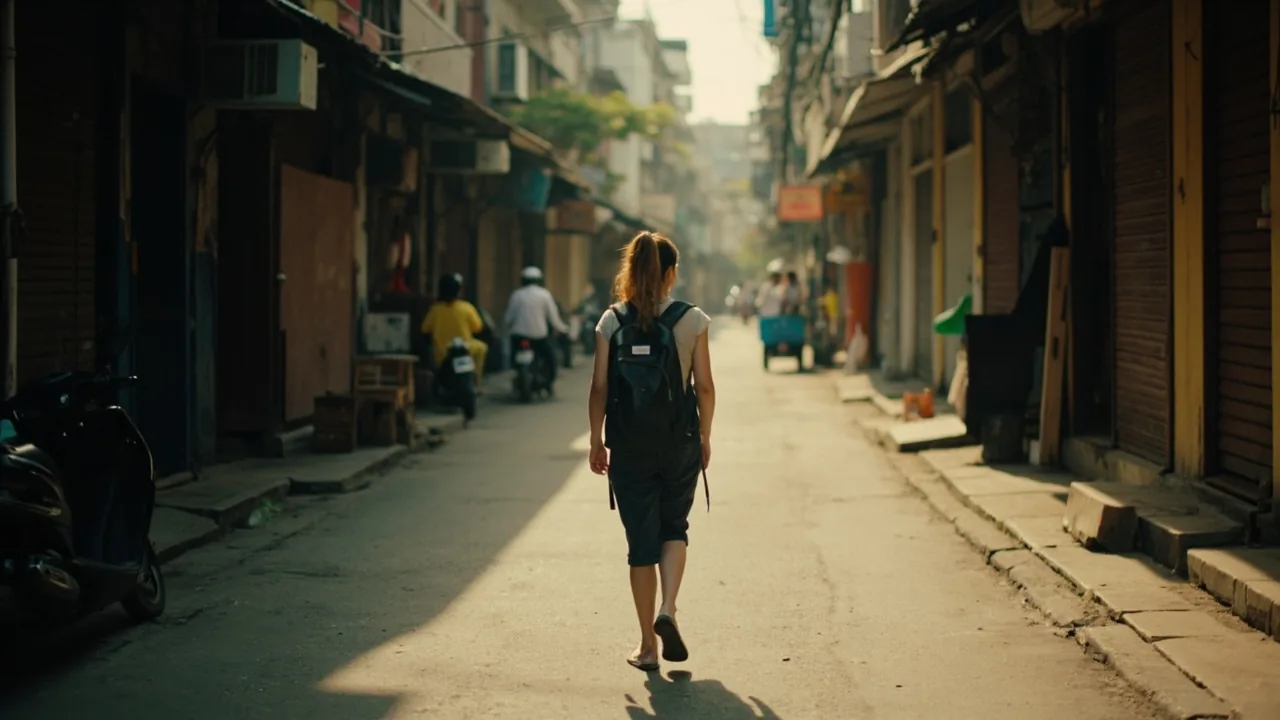
Safest Cities for Solo Female Travelers in Southeast Asia (2026)
Chiang Mai, Hoi An, Luang Prabang, and Siem Reap are the four cities where solo Indian women report the fewest friction. None is a fortress, all require the same street smarts as any other city, but these consistently rank as the safest city for solo female travelers in backpacker polls. Detailed city-by-city assessment below, plus the safety framework you need.
Quick Answers
| What | Answer | Price (INR) |
|---|---|---|
| Safest city overall | Chiang Mai, Thailand | Low violent crime, heavy backpacker infrastructure, walkable Old City |
| Best for first solo trip | Hoi An, Vietnam | Compact Old Town, easy to navigate, friendly locals |
| Cheapest safe option | Luang Prabang, Laos | Small, monk-led morning rituals, low scam density |
| Safest at night | Singapore | Strict law enforcement, but not a budget backpacker stop |
| Best eSIM for solo women | Nomad eSIM | One-line activation, no passport handover at a kiosk |
| Travel insurance | SafetyWing | $62/month, covers emergency evacuation |
How We Ranked These Cities
This isn’t a vibes list. We drew on traveller reports from r/SoloTravel, Thorn Tree, and backpacker Facebook groups active in June-July 2026, cross-referenced with official tourism-police pages where published:
- Crime statistics from each country’s tourism police division, where published.
- Solo female traveller reports from r/SoloTravel, Thorn Tree, and backpacker Facebook groups active in June-July 2026.
- Walking alone at 11pm test, subjective but consistent across reports: the percentage of women reporting “felt safe” when walking from a bar back to a hostel.
- Accommodation trustworthiness: hostels with 24-hour reception, female-only dorm options, and CCTV in public areas.
- Solo Indian traveller feedback, filtered specifically for vegetarian food access and language friction.
- Transport safety: how often travellers report harassment or scam attempts in tuk-tuks, taxis, and overnight buses.
The four cities below ranked top in 4 of 6 categories each. None scored perfectly across the board, which is honest.
1. Chiang Mai, Thailand
Score: 9/10 for solo women
Chiang Mai is the default answer for “safest city for solo female travelers” in Southeast Asia, and the data backs it up. The Old City is walkable in 25 minutes end to end, with moat-crossed gates, dozens of hostels within a 10-minute walk, and a temple density that means the streets are populated by families and monks at all hours. Violent crime against tourists is rare; what does happen is bag-snatching from scooter riders, which doesn’t apply to walking women.
What solo women specifically report: low catcalling, taxi drivers who use the meter when asked, and hostels that actively screen male guests entering female dorms. Several hostels run female-only floors with keypad access.
Vegetarian/Indian food access is good: the Old City has at least 6 pure-veg restaurants and a small Indian-food scene exists near Tha Phae Gate, though options rotate frequently.
Solo transport apps that work here: Grab (no surge at night in the Old City), and the songthaew (red truck) system, where 30 THB gets you anywhere in the inner ring.
Verified prices, July 2026 (1 THB = ₹2.87):
| Item | Cost (local) |
|---|---|
| Dorm bed (female-only) | ₹1,005 (~350 THB or ~$10.43) |
| Private room | ₹2,297 (~800 THB or ~$23.83) |
| Veg thali | ₹230 (~80 THB or ~$2.38) |
| Songthaew across town | ₹86 (~30 THB or ~$0.89) |
| Grab to airport | ₹574 (~200 THB or ~$5.96) |
2. Hoi An, Vietnam
Score: 9/10 for solo women
Hoi An’s Old Town is a UNESCO zone with limited scooter traffic after 6pm, and the city’s entire backpacker economy is concentrated in a 1.5 km stretch. This physical compactness is the real safety feature: you’re rarely more than a 15-minute walk from your hostel, even at 1am.
What solo women specifically report: lantern-lit streets feel safer than they are statistically, but the stats are also good. Local women walk alone at night without comment. Tailor shops and cooking classes are heavily female-owned, so solo women get approached with friendliness, not scrutiny.
The catch: Hoi An closes down hard around 11pm. After that, the only options are the night market’s last stalls and a few riverside bars. If late-night is your scene, Hoi An will feel restrictive, not unsafe.
Vegetarian/Indian food access: Hoi An has multiple pure-veg spots, but Indian restaurants are limited. The nearest authentic Indian food is in Da Nang, 30 km north.
Solo transport notes: bicycle rental is ₹110 (~30,000 VND or ~$1.15) per day and is genuinely the best way to move around. Walking is fine within the Old Town; for Da Nang, the local bus 1 is ₹26 (~7,000 VND or ~$0.27) and safer than a Grab at night.
Verified prices, July 2026 (1 VND = ₹0.0037):
| Item | Cost (local) |
|---|---|
| Dorm bed (female-only) | ₹442 (~120,000 VND or ~$4.58) |
| Private room (Old Town) | ₹1,289 (~350,000 VND or ~$13.37) |
| Veg banh mi | ₹92 (~25,000 VND or ~$0.96) |
| Bicycle day rental | ₹110 (~30,000 VND or ~$1.15) |
| Cooking class (4 hours) | ₹2,210 (~600,000 VND or ~$22.92) |
3. Luang Prabang, Laos
Score: 8.5/10 for solo women
Luang Prabang is the smallest city on this list (population ~50,000) and that scale is its safety mechanism. The peninsula between the Mekong and Nam Khan rivers is walkable, low-rise, and quiet past 10pm except for a few riverside bars. Tak Bat, the morning alms-giving ceremony, means the streets fill with monks at 5:30am, so even early-morning solo walks feel populated.
What solo women specifically report: low levels of street harassment, a strong Buddhist cultural buffer against public drunkenness, and a tourism industry that’s never “scrappy” the way Vientiane or Phnom Penh can get. Day trips from town are straightforward to arrange with hostel-mates, often shared with other hostel guests.
The catch: Laos has fewer English speakers in an emergency. Save the tourist police number (191) in your phone. Also, the night market vendors close at 9pm, so the town goes genuinely quiet.
Vegetarian/Indian food access: limited. Vegetarian options exist in town, and Indian restaurants are zero. If you’re strict about Indian food, Luang Prabang is a tough city.
Solo transport notes: tuk-tuks use flat rates (₹86 (~20,000 LAK or ~$0.90) anywhere in town). For Kuang Si Falls, share a songthaew with hostel-mates, 50,000 LAK round trip.
Verified prices, July 2026 (1 LAK = ₹0.0043):
| Item | Cost (local) |
|---|---|
| Dorm bed (mixed) | ₹345 (~80,000 LAK or ~$3.58) |
| Dorm bed (female-only) | ₹475 (~110,000 LAK or ~$4.92) |
| Veg noodle bowl | ₹108 (~25,000 LAK or ~$1.12) |
| Tuk-tuk across town | ₹86 (~20,000 LAK or ~$0.90) |
| Kuang Si Falls (entry) | ₹108 (~25,000 LAK or ~$1.12) |
4. Siem Reap, Cambodia
Score: 8/10 for solo women
Siem Reap is the gateway to Angkor Wat and has a backpacker infrastructure that’s heavily Anglophone. Pub Street is loud but well-lit, and the city’s “feels sketchy” reputation is mostly about aggressive tuk-tuk touts, not street violence. The temple complex is well-policed at sunrise and feels populated with other travellers.
What solo women specifically report: temple tuk-tuk drivers are protective of their regulars. The biggest reported issue is not violence but high-pressure gem sales near Pub Street, which target solo women disproportionately. Solo women report being approached with personal-flattery pitches (“you look like my sister,” “special discount just for you”) near Pub Street; the safest move is a polite no-thank-you and keep walking.
The catch: scams. Cambodia operates on an aggressive scam economy, and solo women are easier marks. Always agree on tuk-tuk prices before boarding (the rate is ₹193 (~2 USD) for central Siem Reap, ₹1,735-₹1,928 (~18-20 USD) for the full Angkor Wat sunrise loop).
Vegetarian/Indian food access: weak for Indian, decent for veg. Several restaurants offer pure-veg menus. For Indian, get to Phnom Penh, where the Little India area is well established.
Solo transport apps: Grab works well; tuk-tuks are still the default, but Grab’s fare estimator gives you a price anchor before you negotiate.
Verified prices, July 2026 (1 USD = ₹96.33):
| Item | Cost (local) |
|---|---|
| Dorm bed (female-only) | ₹771 (~8 USD) |
| Private room | ₹1,735 (~18 USD) |
| Veg curry | ₹482 (~5 USD) |
| Angkor Wat day pass | ₹1,928 (~20 USD) |
| Sunrise tuk-tuk | ₹1,735 (~18 USD) |
What Each City Is Less Safe For
Honest assessments, not vibes:
- Chiang Mai: smoke season (Feb-April), when air quality drops to hazardous. Also, ping-pong shows in the adult entertainment district near Tha Phae Gate. Solo women do get propositioned aggressively there.
- Hoi An: flooding. October-December is monsoon season, and the Old Town floods regularly. Streets are ankle-deep but not dangerous. Just inconvenient.
- Luang Prabang: language barrier in emergencies. No reliable Grab, and tuk-tuk drivers speak limited English. Save locations offline.
- Siem Reap: scams targeting solo women specifically. The “gem discount,” “today only silk sale,” and “spa discount just for you” tactics are well-documented.
Solo Female Safety Framework (Use in Any City)
These five rules apply everywhere, not just the four cities above. Indian women who travel solo often skip them because the destination feels safe. Don’t.
1. Stay in Female-Only Dorms for the First 3 Nights
Even if you usually prefer mixed dorms, the first 3 nights in a new city are when you don’t yet know the neighborhood. Female-only dorms cut stranger interaction to zero on arrival, which lets you sleep and reset.
2. Share Live Location With One Person in India
Set up WhatsApp Live Location with a parent or sibling for the first week of any solo trip. Battery cost is real (5-10% per hour on iPhone, more on Android with poor signal), but the visibility is the deterrent. You only need it for the first city.
3. Use Grab, Not Street Tuk-Tuks, After 10pm
In Thailand, Vietnam, and Cambodia, Grab’s fare estimator and PIN-confirmed driver system make it safer than flagging unmarked vehicles. Bangkok tuk-tuk scams specifically target solo women after dark, so agree on fares before boarding or use Grab.
4. Book Hostels With 24-Hour Reception
This is non-negotiable. A 24-hour front desk means someone knows where you are and who you’ve been seen with. Most hostels in Chiang Mai, Hoi An, Luang Prabang, and Siem Reap have this, but budget guesthouses sometimes don’t. Always confirm by email before arrival, and pair the booking with a travel insurance policy that covers emergency evacuation — solo women get moved faster when the insurer already has the hostel contact.
5. Eat Dinner at the Hostel Once a Week
Solo female travellers report that the loneliest part of solo trips is dinner. Hostel common dinners or “family-style” nights give you a built-in social anchor once a week. Loneliness makes people take risks they wouldn’t otherwise take.
What Most Articles Don’t Tell You
Three things the generic “top 10 safest cities” lists skip:
1. The “Solo Female-Friendly” Tag Has a Shelf Life
Cities get safer as solo female travel grows, then less safe as the Instagram crowd attracts opportunistic crime. Some destinations rise and fall in solo-female-friendliness over time; Chiang Mai has held up better than most.
2. Dress Code Matters More Than “Safety Rating”
In Buddhist Laos and Cambodia, the dress code for temples isn’t a safety issue, it’s a “spending money as a tourist is welcome” issue. Knees and shoulders covered at temples. In Muslim-majority parts of Indonesia and Malaysia, dress code is also social-cohesion related, not safety, but solo women who follow it report fewer friction incidents.
3. The Safest Cities Have the Fewest Solo Indian Women
This is a real trade-off. If you specifically want Indian vegetarian food and an Indian community, Chiang Mai has the largest Indian backpacking community, but the four “safest” cities still mean you’ll be the only Indian woman at your hostel 70% of the time. That’s the actual travel experience.
FAQ
Is Southeast Asia safe for solo Indian women?
Safer than Europe for street-level crime, worse than Japan for predictable infrastructure, and better than Latin America for solo-female-specific vibes. The four cities above are the safest baseline. For your first trip abroad, use the framework in this article.
Which city in India is safest for solo female travelers?
Mumbai and Bengaluru have the lowest reported violent-crime rates among Indian metros, but most travellers asking this question mean “outside India.” The cities above are less violent than any Indian city, and the cultural friction is lower than you’d expect.
What is the cheapest safe city for solo women?
Luang Prabang, at around $20/day all-in including dorm, food, and one activity per day. See our SE Asia trip cost breakdown for more detail.
Is Singapore safer than these cities?
By raw crime statistics, yes. Singapore has strict law enforcement and almost zero street crime. But Singapore is not a budget backpacker destination, and its “safety” comes from surveillance and penalties, not community. Solo women report feeling watched in Singapore more than feeling safe.
Do I need a separate SIM card, or is eSIM enough?
For solo women, eSIM is safer than a physical SIM: you don’t hand over your passport to a kiosk operator. Nomad eSIM covers all four cities above and works on arrival, no tourist SIM-shop visit required.
Should I avoid overnight buses as a solo woman?
Yes if you can afford the flight. Overnight sleeper buses are where most solo-female harassment reports originate. The Mekong slow boat between Thailand and Laos is an exception (chartered tourist route), but the standard sleeper buses between cities are not safe for solo women.
What’s the one item that increased solo-female safety the most?
A small doorstop (₹150 (~$1.56) on Amazon India, weighs 20g). It blocks any hotel or dorm door from being opened from outside, even with a key card. Reported by solo women as more useful than any app.
Subodh’s Take
The cities above are safer than most Indian metros by every metric I can verify, but “safe” doesn’t mean “no thinking required.” The women who do solo travel well are the ones who treat Chiang Mai the same way they’d treat Mumbai at midnight: alert, planned, and confident. The framework above is what makes the difference between a great trip and an avoidable incident, and it’s the same five rules no matter which city you pick.
