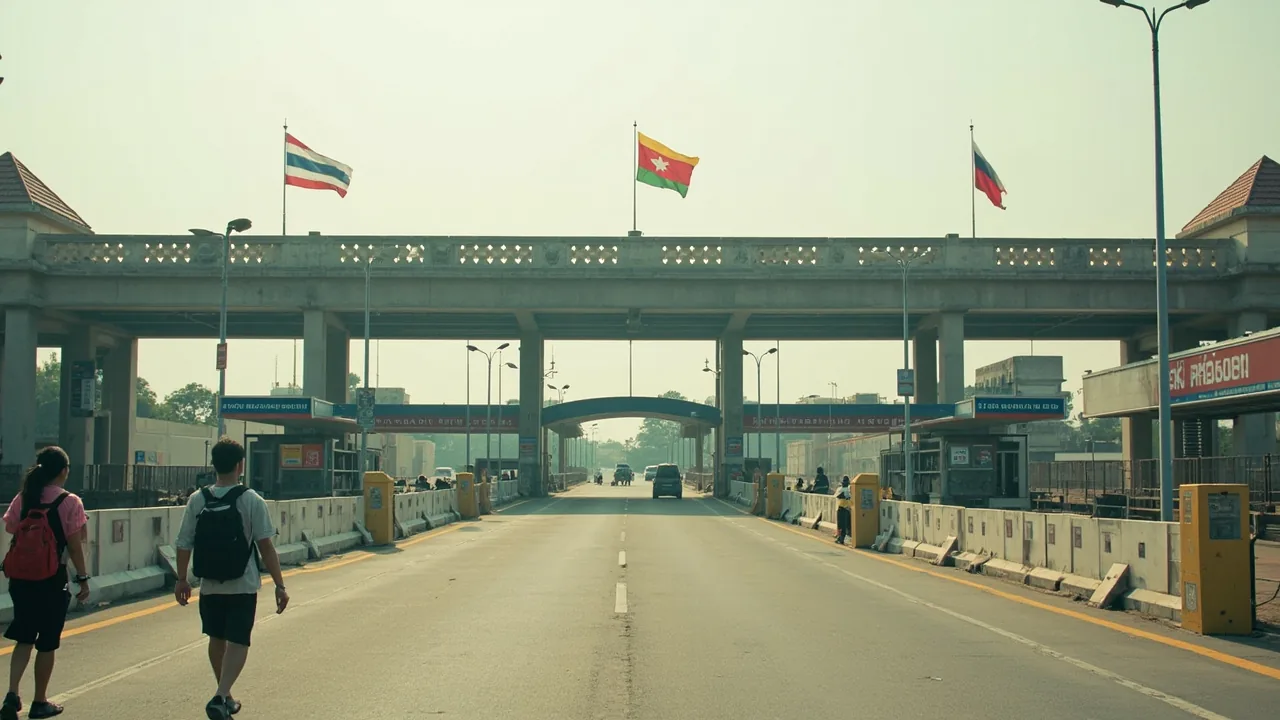
Thailand to Myanmar Overland Border Crossing: Safety Guide for Indian Backpackers
Crossing from Thailand to Myanmar overland border safe travel in 2026 is technically possible, but it is not the casual border hop it was a decade ago. For related planning, see our guide on Sea Backpacking Hub.
The Mae Sot / Myawaddy crossing on the Thai side, the main land gate from western Thailand, has seen repeated closures tied to fighting in Kayin State, and the situation can change week to week. Before you buy a bus ticket out of Bangkok or Chiang Mai, you need to know which border posts are open, what the Myanmar e-visa requires of Indian passport holders right now, and where the military restrictions will block you from going once you are on the other side.
This guide is written for Indian backpackers already in Thailand who are weighing whether to cross, and for those who have friends doing the loop through Chiang Mai and are wondering if the detour through Myanmar is worth the risk.
Subodh’s Pro Tip: The border situation changes faster than any blog post can be updated. The single most useful thing you can do before paying for a bus is to check the Indian Ministry of External Affairs travel advisory for Myanmar on mea.gov.in, then cross-check with the Myanmar Ministry of Immigration’s own e-visa portal at evisa.moip.gov.mm. If the official e-visa portal is not issuing permits for the border post you intend to use, that border post is not safe to plan around.
Quick Answers
| What | Answer | Price (INR) |
|---|---|---|
| Current border status (Mae Sot / Myawaddy) | Periodically closed; check MEA advisory | 0 |
| Myanmar e-visa fee (Indian passport) | ₹4,817 (~50 USD), single entry, 28 days max | ₹4,817 (~50 USD) |
| Cheapest onward bus from Yangon to Bagan | Local bus, 9 to 11 hours | ₹771-₹1,445 (~8-15 USD) |
| Cheapest onward bus from Yangon to Mandalay | Overnight bus, 8 to 10 hours | ₹963-₹1,734 (~10-18 USD) |
| Yangon airport taxi to city centre | Fixed rate, 45 to 60 minutes | $8-12 (~₹670-1,000) |
The e-visa fee converts at $1 = ₹96.5289 right now, so $50 USD = ₹4,826. The fee is non-refundable if your application is rejected or the border closes after you pay.
The Real Risks (What to Worry About)
| Risk | Likelihood | Impact | How to Avoid |
|---|---|---|---|
| Border closed with no notice | High | Moderate | Have a Plan B; do not book non-refundable onward travel from Myanmar |
| Onward overland travel blocked by military rules | High | High | Plan a fly-out from Yangon; do not assume you can keep crossing borders |
| Outbreak of fighting near Myawaddy | Moderate | Severe | Avoid the area entirely if the MEA advisory escalates; have embassy contacts saved |
| E-visa rejected or delayed | Moderate | Moderate | Apply at least 2 weeks before travel; do not book flights until approved |
| Scams at the Thai side of the border (Mae Sot) | Moderate | Low | Use the official border crossing bus, not freelance drivers |
| Cell data and app access drop out near the border | High | Moderate | Download offline maps and embassy contact info before crossing |
| Petty theft in crowded Myawaddy market on the Myanmar side | Moderate | Low | Keep passport on you; carry only what you need for the day |
Safety Alert: The single biggest mistake I see Indian travellers make is treating Myanmar like another Thai province. The military conflict is real, the roads you can legally use are restricted, and the embassy response time is hours, not minutes. Cross with your eyes open.
Is the Border Open in 2026
The honest answer is: sometimes, and not all posts.
There are a handful of overland crossings between Thailand and Myanmar. The two that come up most in backpacker conversations are:
- Mae Sot (Thailand) to Myawaddy (Myanmar): The most-used land crossing, on the western side of Thailand near the Karen / Kayin region. It has been closed and reopened repeatedly since the 2021 coup, often with little public notice.
- Ranong (Thailand) to Kawthoung (Myanmar): A southern crossing that has historically been more stable. Travellers on the Surat Thani / Andaman loop sometimes cross here for a few days before re-entering Thailand.
If the official Myanmar e-visa portal at evisa.moip.gov.mm is issuing tourist e-visas and not flagging any border posts as closed, that is your green light. If the portal itself is offline, or if it explicitly says a particular crossing is suspended, take that at face value.
Travellers report that even when Mae Sot is technically open, the actual experience can include long waits, paperwork checks on both sides, and the occasional demand for “facilitation” payments that nobody wants to put on an official receipt. Document everything, and never hand your passport to anyone without a stamped receipt.
Myanmar E-Visa for Indian Passport Holders (2026)
Visa-on-arrival at the Myanmar land border has been suspended for several years. The only reliable option for Indian passport holders is the e-visa.
What you need:
- Fee: ₹4,817 (~50 USD)
- Max stay: 28 days
- Entries: Single entry only. If you cross into Myanmar at Mae Sot and try to come back overland through the same post, that uses your entry.
- Apply at: https://evisa.moip.gov.mm
- Processing time: Usually 3 business days, but allow 2 weeks to be safe
- Documents: Passport scan, photo, accommodation for first night, return flight or bus ticket out
The e-visa is the only entry permit you can count on. If a hotel in Mae Sot or a freelance “visa agent” offers you something cheaper or faster, walk away. The official portal is the only site that issues a real e-visa.
For a step-by-step breakdown of the application, screenshots of the portal, and common rejection reasons, see the dedicated Myanmar visa guide for Indians.
The Shan State Problem (Read This Before You Cross)
This is the part most travel blogs skip, and it is the part that decides whether a Myanmar crossing is worth doing.
Myanmar’s central government, the military administration that took power in 2021, has had shaky control over the country’s border regions for years. As of 2026, large parts of Shan State, Kachin State, and Chin State are either under the control of ethnic armed organisations, contested between those groups and the Tatmadaw (Myanmar’s military), or off-limits to foreign tourists by explicit decree.
What this means for an Indian backpacker who crosses at Mae Sot is brutal: you can enter at Myawaddy, you can travel to Hpa-An and probably to Yangon, Mandalay, Bagan, and Inle Lake. But the moment you try to continue overland from one of those hubs into the rest of the country, you hit a wall. The overland routes that backpackers used to love, Mandalay to Hsipaw to Lashio and out to the Chinese border, or Inle to Kengtung and into Laos, are either closed, dangerous, or both.
The practical takeaway is that if you cross into Myanmar at Mae Sot or Ranong, you are committing to flying out from Yangon or Mandalay. Buses within central Myanmar work, and the Yangon to Bagan (₹771-₹1,445 (~8-15 USD)) and Yangon to Mandalay (₹963-₹1,734 (~10-18 USD)) routes are running. But the “overland loop through Myanmar” that older guidebooks describe does not exist in 2026.
If you want a full picture of the conflict zones and where tourists can and cannot go, the Myanmar safety guide lays out the regional map in detail.
What to Expect at the Border (Mae Sot to Myawaddy)
If the border is open and your e-visa is approved, here is roughly how the day goes.
- Mae Sot bus station to the Thai immigration post: A tuk-tuk or motorbike taxi from central Mae Sot to the bridge. Cheap, around 50 to. Have your e-visa printout ready.
- Thai exit stamp: Standard. Sometimes slow if there is a queue, but generally smooth.
- Walk across the Friendship Bridge: About 10 minutes. Photos are usually restricted.
- Myanmar immigration on the Myawaddy side: This is where the e-visa gets scanned, your photo gets taken, and you get your entry stamp. Lines can be long.
- Transport onward to Hpa-An or Yangon: Buses from Myawaddy to Yangon are infrequent and slow. Most travellers either stop overnight in Myawaddy or Hpa-An, or pre-book a shared minivan through a guesthouse.
Subodh’s Pro Tip: Download offline Google Maps for Mae Sot and Myawaddy before you cross. Cell data often switches networks right at the bridge, and you do not want to be standing in the no-man’s-land between the two checkpoints with no map and no working app.
Prevention and Preparation Before You Cross
The boring checklist before a Myanmar border crossing is more important than the exciting one.
Documents:
- Passport with at least 6 months validity
- Printed e-visa approval (carry two copies)
- Printed return flight or onward bus ticket from Myanmar
- Printed hotel booking for your first night in Myanmar
- Photocopies of all of the above, stored separately
Health:
- Routine vaccines up to date: typhoid, hepatitis A and B, tetanus
- Consider Japanese encephalitis if you are going to rural areas
- Malaria prophylaxis is worth discussing with a travel doctor, particularly for the border regions
- A full vaccination checklist for Indian backpackers heading to Myanmar is in Myanmar travel vaccinations and health kit
Insurance:
- Travel insurance that explicitly covers Myanmar. Most generic policies exclude countries under active conflict or travel advisory level 4. SafetyWing’s Nomad Insurance covers Indian travellers from ~$62/month (~₹5,900) and includes medical evacuation, which is the specific thing you need if something goes wrong in a smaller Myanmar city.
- See the Myanmar travel insurance guide for conflict and medical evacuation for what to look for.
Money:
- Carry clean, unmarked USD bills in small denominations (₹96 (~1 USD)). Larger bills often get rejected. Torn or marked bills get rejected harder.
- Thai baht is sometimes accepted on the Myanmar side near the border, but the rate is poor.
- ATMs in Yangon and Mandalay work for some foreign cards. Do not count on them.
City-by-City Scams and Gotchas
Mae Sot (Thai side):
- Freelance drivers offering “visa help” or “faster border crossing” for an extra fee. They are not faster and the visa is online.
- Money changers at the bus station offering poor rates for Thai baht to USD. Get your USD before you cross, in Chiang Mai or Bangkok, where the rates are better.
Myawaddy (Myanmar side):
- “Facilitation” requests from unofficial “helpers” who want to speed up your immigration. Politely refuse.
- Money changers offering poor rates. Use the official counters inside the immigration hall.
- Motorbike taxi drivers quoting inflated prices to the bus station. The bus station is a fixed short ride away; agree on a price before you get on.
Yangon (once you get there):
- Taxi drivers at the airport quoting ₹1,927-₹2,890 (~20-30 USD) for the city centre when the fixed rate is ₹771-₹1,156 (~8-12 USD). Walk to the official taxi counter and book there.
- “Closed today” claims about the Shwedagon Pagoda or Sule Pagoda. They are not closed. The tout is trying to steer you to a gem shop.
Mandalay:
- “Free tour” offers from people at the bus station. The tour is free, the gem shop stop at the end costs you.
- Motorbike rental shops asking for your passport as “deposit.” Leave the passport at the hotel, give them a photocopy.
What to Do If It Happens
If the border closes while you are mid-crossing or stuck on one side:
- Stay calm. The Thai side (Mae Sot) has plenty of guesthouses and is safe to wait in.
- Contact the Indian Embassy in Yangon if you have a working SIM or eSIM. The embassy contact details are in the emergency and embassy guide.
- Check the official Myanmar immigration portal and the MEA advisory daily. Do not panic-buy a ₹28,902 (~300 USD) flight out until the situation is confirmed.
If your passport is stolen on the Myanmar side:
- File a police report at the nearest police station. Get the report in writing.
- Take the report to the Indian Embassy in Yangon for an emergency travel document. The embassy in Yangon is the only one; there are no Indian consulates in Mandalay or elsewhere.
- Your eSIM data link (see below) will be your lifeline for contacting family and the embassy.
If you have a scooter or motorbike accident:
- Get to a hospital first, negotiate second. The hospitals in Yangon and Mandalay are decent for cash-paying foreigners.
- Insurance that does not cover medical evacuation can leave you paying ₹481,695-₹963,390 (~5,000-10,000 USD) out of pocket. This is exactly what SafetyWing insurance covers.
Indian-Specific Considerations
Medicines and pharmacies:
- ORS: Available everywhere as “ORS” sachets, no brand translation needed.
- Paracetamol: Local brand “Paracetamol” or “Tylol.” No translation issues.
- Antacids: Pantocid works. Local equivalent is “Pantoprazole” generic, sold at any pharmacy.
- Antibiotics for travel diarrhoea (Metrogyl / norfloxacin): Sold over the counter in Yangon pharmacies but at inflated prices. Bring a course from India.
Embassy contact:
- The Indian Embassy in Yangon is the only Indian mission in Myanmar. Address: 545-547, Merchant Street, Yangon.
- Save the embassy number, your travel insurance emergency line, and your bank’s international card-issuance number in your phone and on a printed sheet in your bag. Two copies, two locations.
Hospital deposits:
- Cash deposit upfront is standard. International hospitals in Yangon (Pun Hlaing, International SOS Yangon) often accept travel insurance direct billing. Smaller clinics do not.
- For a city-by-city breakdown of clinics, hospital deposit ranges, and 24-hour pharmacies, see the emergency hospitals and embassy guide for foreigners in Myanmar.
Food and water:
- Eat at busy places with high turnover. On the Myanmar side, the established Burmese restaurants in Yangon and Mandalay are safe. Skip anything that has been sitting out.
- Bottled water only. Tap water is not potable anywhere in Myanmar.
- A practical guide to eating and drinking safely is in Myanmar street food and tap water safety for Indian tourists.
Getting Connected
Buy a local SIM at Yangon airport (MPT or Ooredoo are the main operators). If you want data the moment you cross, an eSIM you activate before you fly is the easier option: Get Nomad eSIM. Either way, working data is the fastest way to call for help or pull up an embassy number.
FAQ
Is the Thailand to Myanmar border open for Indian tourists in 2026?
The Mae Sot to Myawaddy crossing is open intermittently. The Ranong to Kawthoung crossing has been more stable. Check the official Myanmar e-visa portal at evisa.moip.gov.mm and the Indian MEA travel advisory on mea.gov.in within 48 hours of your planned crossing.
Do I need a visa in advance, or can I get one on arrival at the border?
You need the e-visa in advance. Visa-on-arrival at the Myanmar land border has been suspended for several years and there is no sign of it returning in 2026. The e-visa costs ₹4,817 (~50 USD) and is the only legal option.
Can I cross from Myanmar into China or Laos overland after entering at Mae Sot?
No. The overland routes out of Myanmar into China (Muse / Ruili) and into Laos (Tachileik / Chiang Rai side) are restricted or closed for foreign tourists in 2026. Plan to fly out of Yangon or Mandalay. The overland loop is not a current option.
Is it safe to cross into Myanmar given the military situation?
“Safe” is the wrong word. Travellers report that the tourist areas (Yangon, Mandalay, Bagan, Inle Lake, Hpa-An) are calm and stable, but the situation can change without warning. Check the MEA advisory before you book anything, and have a backup plan to fly back to Bangkok.
What is the cheapest way to get from Yangon to Bagan after crossing the border?
The cheapest is the local bus, around ₹771-₹1,445 (~8-15 USD), taking 9 to 11 hours. Most Indian backpackers either take the overnight bus (save on a hotel night) or pay ₹3,372-₹4,817 (~35-50 USD) for a shared minivan that takes 7 to 8 hours.
Can I use UPI in Myanmar?
No. UPI does not work in Myanmar. Carry clean USD bills in small denominations, plus a backup Visa or Mastercard. ATMs in Yangon and Mandalay work for some foreign cards but not all.
Subodh’s Take
The Thailand to Myanmar overland crossing in 2026 is a trip for travellers who go in with a clear plan, the right insurance, and a backup exit flight already booked. The border can be open on a Tuesday and shut on a Wednesday. The Shan State restriction means you cannot keep looping overland once you are in, no matter what your 2018 Lonely Planet says. If you cross, cross knowing it is a one-way-in, fly-out affair. And if you have any family back home who would not handle a phone call from a Yangon hospital well, this is probably not the year to do it.
