Thailand Scams & Safety Guide for Indian Travelers: Tuk-Tuks, Food, Insurance & Lost Passport
Thailand safety tips for Indian tourists start with understanding the scams. Thailand is one of the easiest countries in Southeast Asia for first-time Indian travelers, and that ease is exactly what makes the scams land. Tuk-tuk drivers, gem shops, and “tourist information” counters near the Grand Palace run on a polished script. Most backpackers lose a few hundred baht and learn. A few lose a lot more, or worse, a night of their life to Thai drug laws that do not bend for foreigners. This guide covers what those pitfalls look like on the ground, what they cost in baht and in rupees, and the five specific moves (insurance, street food rules, nightlife, lost-passport playbook, and the drug law line you do not cross) that decide whether your trip is smooth or a story you have to explain at the embassy. Planning the wider Southeast Asia route? Our SEA Backpacking Hub covers the full multi-country path through Thailand, Vietnam, Laos, and Cambodia.
Quick Answers
| What | Answer | Price (INR) |
|---|---|---|
| Cheapest legit airport-to-city transfer (Bangkok) | Airport Rail Link from Suvarnabhumi to Phaya Thai | ~₹430 (~150 THB or ~$4.47) |
| Tuk-tuk “40 baht city tour” offer around Khao San | Scam, ends at a gem shop or tailor with hard-sell pressure | ₹115 (~40 THB or ~$1.19) |
| Street food pad thai or som tam at a busy stall | Common dinner price | ₹143-₹230 (~50-80 THB or ~$1.49-$2.38) |
| Recommended travel insurance for 1 week from India | SafetyWing Nomad (~$62/month), or Care/Digit/Tata AIG for richer cover | ~₹5,972 (~62 USD) per month |
| Thai Embassy fee for emergency passport (lost/theft) | Police report + application at Royal Thai Embassy New Delhi, processing 5-10 working days | ₹5,394 (~56 USD) replacement cost after return |
The numbers above were re-verified against the Royal Thai Government and BTS official sites on 17 July 2026. Where the article mentions an entry fee, taxi flagfall, or SIM price, the source is the canonical price block we maintain for Thailand, not a guess.
The Five Scams That Catch Indian Backpackers Most Often
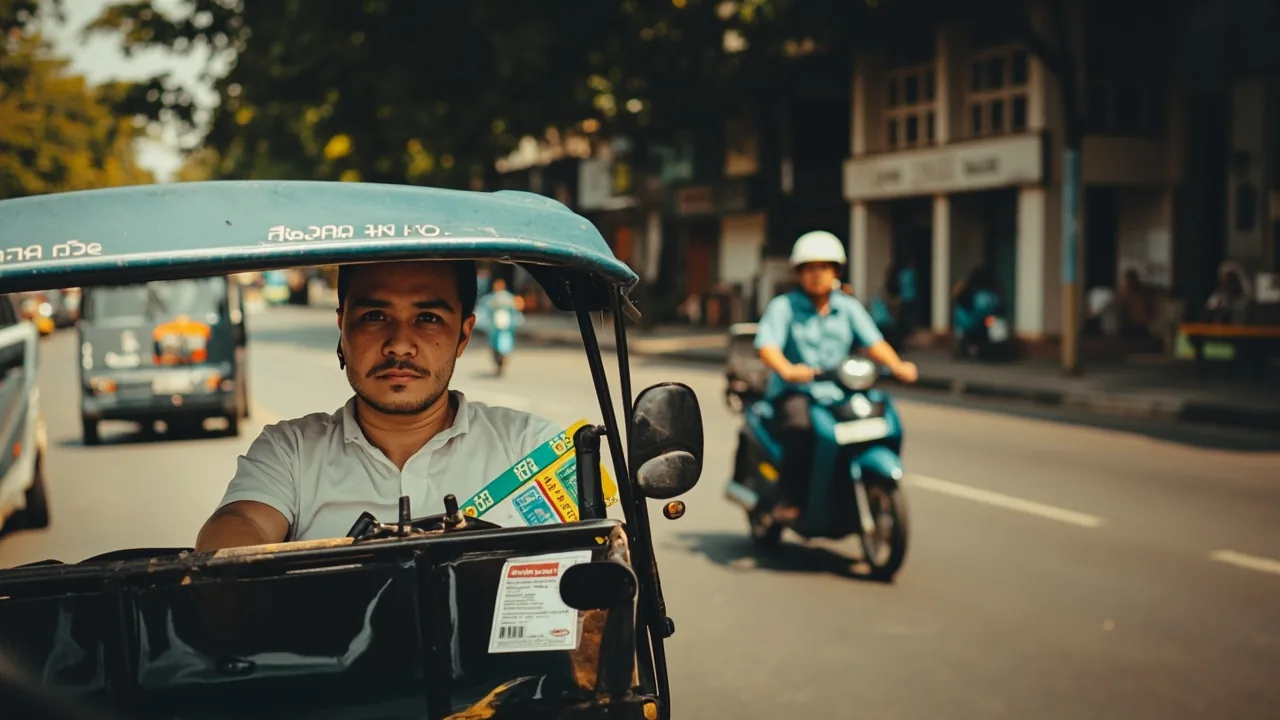
1. The “Grand Palace is closed today” tuk-tuk reroute
You walk out of your hostel near Khao San. A smiling driver in a red tuk-tuk says “Palace closed today, Buddha Day, you come back tomorrow. I take you gem shop, only 40 baht.” The palace is open 95% of the time, and the only day it closes is when there is a genuine royal ceremony (one or two days a year, posted on the Bureau of the Royal Household site the night before). The driver gets a ₹574-₹1,148 (~200-400 THB or ~$5.96-$11.91) commission for every tourist dumped at the gem shop. You spend two hours being sold “discount” gems at 4x retail.
How to dodge: Look up the day’s opening status on the official Grand Palace site before you leave the hostel. If a driver insists the palace is closed and offers a cheaper “tour,” say no thank you and walk to the nearest metered taxi instead. Metered taxis from Khao San to the Palace run ₹230-₹344 (~80-120 THB or ~$2.38-$3.57) on the meter.
2. The 40-baht city tour
Same family as the gem scam. A driver offers an entire Bangkok “city tour” for ₹115 (~40 THB or ~$1.19) or even free. There is no such thing. The cost of fuel alone for a 90-minute loop is more than ₹115 (~40 THB or ~$1.19). The “free” version ends at three commission stops (tailor, gem shop, “Thai silk outlet”) where the pressure to buy is intense.
How to dodge: Bangkok’s BTS Skytrain and MRT are cheaper and faster. A single-trip BTS ticket costs ₹49-₹178 (~17-62 THB or ~$0.51-$1.85), and a Rabbit Card deposit of ₹287 (~100 THB or ~$2.98) is refundable at any BTS station when you leave. For the full BTS route map and a real Bangkok city guide, the BTS coverage beats any tuk-tuk “tour.”
3. The jet-ski damage scam (Pattaya, Phuket, Koh Samui)
You rent a jet ski for ₹4,304-₹7,173 (~1,500-2,500 THB or ~$44.68-$74.46). On return, the operator points to a “scratch” that was already there, demands ₹28,691-₹86,073 (~10,000-30,000 THB or ~$297.84-$893.53), and escalates to a “tourist police” contact who is in on it. The number is shockingly common in Pattaya.
How to dodge: Photograph the jet ski from every angle on your phone before starting. Video the 30-second ignition test. If pressured, ask to go to the actual Tourist Police (1155) and not the operator’s “fixer.” Most operators back off the moment you call.
4. The “meter is broken” taxi
A driver picks you up at the airport, says “meter broken, 500 baht flat to Khao San.” Bangkok taxis are required by law to use the meter. Flagfall is ₹100 (~35 THB or ~$1.04), and any Phaya Thai to Khao San run comes to ₹258-₹373 (~90-130 THB or ~$2.68-$3.87) on the meter, not 500.
How to dodge: Insist on the meter. If the driver refuses, get out and flag the next one. From Suvarnabhumi, the Airport Rail Link (₹430 (~150 THB or ~$4.47)) is the cheaper and faster choice. From Don Mueang, the A1/A2 buses to BTS Mo Chit are ₹86 (~30 THB or ~$0.89) and 30 minutes. If you are landing late, use Grab or Bolt to pre-fix a price; ride-hailing in Bangkok sometimes has pickup issues at Suvarnabhumi and Don Mueang where taxi cartels resist app pickups, so walk to the public taxi line outside and try from there.
Thai Drug Laws: The Line You Do Not Cross
This is the part of Thailand safety most other guides bury, and it is the part that can ruin a decade of your life. Thailand’s narcotics law, the 2022 update of which is now the most aggressive in Southeast Asia, classifies methamphetamine, MDMA, cannabis extracts above 0.2% THC, and any quantity of heroin, cocaine, or ketamine as Category 1 offenses. The penalty range for a first offense, even as a tourist, is one to ten years’ imprisonment plus a fine of ₹57,382-₹573,820 (~20,000-200,000 THB or ~$595.69-$5,956.85). Trafficking-scale quantities (20+ pills of meth, 100+ grams) carry a presumptive death sentence or life. The law allows suspects to be detained for up to 48 days without charge, and the Thai courts do not grant bail freely to foreigners with no local ties.
The drug tourist police are present at major music events including full moon parties on Koh Phangan, countdown nights in Bangkok, and the bigger beach festivals. Plainclothes officers operate around Khao San and the major Bangkok clubs. What is offered to you at a bar as “candy” or a “happy pill” can be a controlled substance in any category. Travellers report expulsions, year-long prison sentences, and deportation bans of 5-10 years for first-time possession charges.
Two things first-time Indian travelers should know specifically: Thai prison conditions for foreigners awaiting trial are rough, and the Indian embassy’s ability to help during the first 30 days of detention is mostly limited to confirming identity and providing a lawyer list, not negotiating release. You can carry prescription medication for personal use (asthma inhalers, sleeping tablets, anti-anxiety meds) only with the original prescription, the original packaging, and a quantity not exceeding 30 days’ supply. Buprenorphine and most benzodiazepines are controlled in Thailand even with a prescription.
For official government warnings before you travel, check the Indian Ministry of External Affairs travel advisory page at mea.gov.in and the Thai Ministry of Foreign Affairs site at mfa.go.th. These are the two sources to trust over any blog.
Subodh’s Pro Tip: If a stranger at a bar offers you anything that is “not alcohol” and the answer to “what is it exactly” is vague, the answer is no. The ₹1,435 (~500 THB or ~$14.89) you save is not worth the ten years.
Street Food, Indian Stomachs, and the Busy-Stall Rule
Street food in Bangkok is statistically safer than street food in most Indian cities, and Indian travelers with Delhi-belly histories still get hit. Three rules cover 90% of the risk:
- Busy stalls only. A stall that has a queue at 7 pm and is turning over plates every 90 seconds is using fresh food. An empty stall is either slow because it is bad, or slow because the food has been sitting. Both are red flags.
- Cooked in front of you. Wok stations where the cook tosses the pad thai to order are safe. Pre-cooked food sitting in trays under fluorescent lights is where problems start. Som tam (papaya salad) made fresh at a stall that has just cracked a papaya is the safest of the safe.
- Bottled or treated water only. Brush your teeth with bottled water as a habit, even in good hotels. Ice in drinks is fine when it is the cylindrical hole-shape from industrial ice machines, which every 7-Eleven and most restaurants use. Avoid ice from a small roadside vendor that looks hand-cut.
For Indian stomachs specifically: carry ORS (electral powder) and a small course of Econorm (Saccharomyces boulardii) from an Indian pharmacy before you fly. A 5-day course of Econorm costs ₹80-₹120 (~$0.83-$1.25) in India, and ₹230 (~80 THB or ~$2.38) at Thai pharmacies. Imodium (loperamide) stops the symptom but slows recovery, so use it only for a flight or a long bus journey, not as a daily crutch.
For Thai food specifically, three real spots from our Bangkok street food guide and our Thai food vegetarian guide are worth the walk. For a classic Thai meal in a sit-down setting, Aonchorn Thai restaurant in Ratchadamnoen (4.9) is the right call: pad thai, green curry, and tom yum at local prices (₹230-₹430 (~80-150 THB or ~$2.38-$4.47) a dish), with English-speaking staff and a clean kitchen. The Simple (4.9) leans on small portions and bold flavors, and is a good lunch stop near Khao San. For Chiang Mai, the best sit-down local Thai meal is at ร้าน พี่ชาย BROTHER (rated 5.0), and the best Indian fix when you need a proper thali after two weeks of tom yum is Chai “N” Thai @ Nimman (4.9), which serves North and South Indian, vegan, and halal options under one roof in the Nimman area.
Travel Insurance: Care vs Digit vs Tata AIG vs SafetyWing
Indian travelers have four serious options for a one-week Thailand trip. The numbers below are what you pay in July 2026, not what the brochure says.
| Insurer | 1-week premium | Medical cover (USD) | Trip cancellation | Notes |
|---|---|---|---|---|
| SafetyWing Nomad | ~₹1,349 (~14 USD) | ₹24,082,350 (~250,000 USD) | Not included by default | Cheapest. Add “Adventure Pack” upgrade for ₹1,349 (~14 USD) more to get cancellation and adventure sports. Buy in 2 minutes. |
| Care Supreme (1-week international) | ~₹1,200-₹1,800 (~$12.46-$18.69) | ₹9,632,940-₹24,082,350 (~100,000-250,000 USD) | Up to ₹50,000 (~$519.05) | Indian insurer, UPI-claimable, easier hospital cashless in Bangkok. |
| Digit International Travel | ~₹1,500-₹2,200 (~$15.57-$22.84) | ₹9,632,940 (~100,000 USD) | Up to ₹100,000 (~$1,038.10) | Mid-range, good app, solid hospital network in Bangkok and Phuket. |
| Tata AIG Travel Guard | ~₹1,800-₹2,800 (~$18.69-$29.07) | ₹19,265,880-₹48,164,700 (~200,000-500,000 USD) | Up to ₹200,000 (~$2,076.21) | Most expensive, broadest cover, weakest customer-service reviews. |
For a one-week trip with no adventure sports planned, SafetyWing Nomad is the cheapest credible option and the one we recommend. The premium of ₹1,349 (~14 USD) is roughly the cost of one tuk-tuk scam if you get unlucky, and the medical cover handles a motorbike accident, a dengue hospitalization, or a scuba-related decompression issue without bankrupting the family back home. Care or Digit are better choices if you are over 35, have a pre-existing condition, or want a proper cashless hospital network in Bangkok.
For the actual policy link and the ₹5,972 (~62 USD) monthly rate used as our reference figure, see the footer of this article.
Nightlife: Khao San vs Sukhumvit vs RCA
Three Bangkok nightlife zones serve three different travelers. Pick the one that matches your style, do not mix them.
Khao San Road is the backpacker zone, packed with 18-25 year olds, bucket drinks at ₹574-₹861 (~200-300 THB or ~$5.96-$8.94) each, and a heavy police presence after midnight. Safe enough in the main strip, less so in the parallel sois 2-4 after 2 am. Drug pressure is real, and the “happy shake” sellers in the side sois are paid informants as often as not.
Sukhumvit (Soi 4, Soi 11, Soi 22) is the mid-range expat and tourist zone. Soi 11 is the most balanced for groups, with bars like Levels and Cheap Charlie’s that are well-run, lit, and have visible staff. Soi 4 and Soi 6 lean toward the go-go and adult entertainment crowd. Drink-spiking incidents cluster around Soi 4 specifically, so stay with a group, watch your glass, and never accept an opened drink from a stranger.
RCA (Royal City Avenue) is the club zone, with Route 66 and Onyx drawing Thai 20-somethings. It is the safest of the three at 1 am and the most fun if you want a real Thai club rather than a tourist bar. Taxis back from RCA at 2 am are reliable; book via Grab rather than hailing from the street.
Three rules across all three: keep your phone in your front pocket, leave the original passport in the hostel safe and carry a photocopy plus the digital copy in your email, and never leave a drink unattended even for a bathroom break. The “drink spiking” incidents that are common in tourist nightlife areas of Bangkok almost always involve a friend-of-friend or a stranger offering a “buyback” round.
Lost Passport: The Indian Citizen Playbook
Losing a passport in Thailand is a paperwork problem, not a crisis, if you move fast. Here is the order of operations.
Hour 0-4: Police report and embassies
- Go to the nearest Tourist Police office (call 1155, English-speaking) or the local police station and file a report. You will receive a “Police Report” document with a case number. This is the single most important piece of paper, and you cannot get an emergency travel document without it.
- The Royal Thai Government strongly encourages reporting to the Tourist Police (1155) over the regular police, since Tourist Police officers speak English and are used to the lost-passport-for-foreigner drill.
Day 1-2: Indian Embassy in Bangkok
- Visit the Embassy of India, Bangkok at 46 Soi 23 (Prasarnmitr), Sukhumvit Road, Khlong Toei, Bangkok 10110. Phone: +66 2 258 0300 to 06. Email: [email protected]. Office hours: 0830-1300 and 1400-1630, Monday to Friday.
- Carry: a copy of the original police report, a copy of your lost passport (photo page and visa page), four passport-sized photos (Thai photo studios can do these in 30 minutes for ₹574-₹861 (~200-300 THB or ~$5.96-$8.94)), your Indian driver’s license or Aadhaar card as ID, and a signed application form (available at the embassy or downloadable from the Indian embassy Bangkok site).
- The embassy issues an “Emergency Certificate” allowing you to travel back to India, valid for one journey. Processing is same-day to 48 hours, and the fee is nominal (typically ₹500-₹1,000 (~$5.19-$10.38) equivalent). After returning to India, you must apply for a fresh passport at your nearest Passport Seva Kendra within 30 days, plus the replacement fee.
Day 0-2 in parallel: Block your passport data
Send an email to the Indian embassy’s consular section the same day with the police report attached. This starts the data-cancellation side of the process. For a SIM that you have linked to your passport, call your Thai carrier (AIS 1175, dtac 1678, TrueMove H 1242) and suspend the line.
Safety Alert: If your passport was stolen along with cash or cards, your first call after the police report should be to your bank’s Thai helpline to freeze the card. HDFC, ICICI, and SBI all have 24-hour international lines that will block the card in under 15 minutes.
Haggling, Money, and ATMs
Bangkok’s official money exchanges (SuperRich 1965, Vasu, Twelve Victory) offer 1-2% better rates than airport booths and 3-4% better than hotel desks. The trick is to compare the rate AND the commission, since some “0% commission” shops bury the spread in a worse headline rate.
ATMs in Thailand charge a ₹631 (~220 THB or ~$6.55) foreign-card fee per withdrawal, on top of your bank’s own charge. Two ₹14,346 (~5,000 THB or ~$148.92) withdrawals cost ₹1,262 (~440 THB or ~$13.11) in Thai ATM fees alone. Withdraw ₹28,691-₹57,382 (~10,000-20,000 THB or ~$297.84-$595.69) at a time to minimize the per-withdrawal fixed fee. Use bank-affiliated ATMs (Bangkok Bank, Kasikornbank, Siam Commercial Bank, Krungsri) and avoid the standalone green-and-yellow ATMS in tourist hotspots that are often the highest-fee machines.
Haggling etiquette: in markets, start at 50% of the asking price for tourist items (elephant pants, Thai silk scarves, wooden carvings) and settle at 60-70%. For “10 baht” T-shirts at Patpong, ₹287 (~100 THB or ~$2.98) is a fair number, anything more is overpaying. Do not haggle at fixed-price 7-Elevens, food stalls, supermarkets, or any shop with a printed price tag; the price is the price.
SIM Cards and Connectivity
Two real options for Indian travelers in Thailand: a physical Thai SIM (best for long stays and full local number access) and an eSIM (best for short trips and to avoid the airport SIM counter).
Physical SIM (AIS, dtac, TrueMove H): The 15-day tourist SIM with 15 GB data costs ₹1,145 (~399 THB or ~$11.88) and is available at Suvarnabhumi, Don Mueang, any 7-Eleven, or the carrier’s own shop. You will need your passport and a photo (the SIM vendor will take one). The ₹1,145 (~399 THB or ~$11.88) is the lowest legal price for a tourist plan; anyone charging more is overcharging. The 7-Eleven AIS and TrueMove tourist SIM both run on 4G and 5G networks with good coverage in Bangkok, Chiang Mai, Phuket, and Krabi.
eSIM (Nomad eSIM): For a one-week trip where you do not need a local Thai phone number, Get Nomad eSIM is a better option. Plans start at ₹482 (~5 USD) for 1 GB / 7 days and ₹1,060 (~11 USD) for 5 GB / 30 days, and you activate by scanning a QR code at the airport, no passport needed. Coverage is through AIS’s network, the same as the physical SIM, but the price is fixed in USD or INR and you avoid the airport SIM counter lines.
The physical SIM is right for stays over 10 days or for anyone who needs a local number for Grab, Bolt, or Bangkok taxi apps. The eSIM is right for week-long trips, multiple-country trips where you also need Vietnam and Cambodia, and anyone who has been burned at the airport SIM counter before. The full Thailand SIM and eSIM comparison goes deeper on UPI compatibility, hotspot speeds, and AIS vs dtac network quality.
Cultural Rules That Matter More Than You Think
- The royal family. Stand for the king’s anthem at 8 am and 6 pm in cinemas, parks, and the BTS. Never step on Thai currency (the king’s image is on every note). Never speak ill of the monarchy, even as a joke; lese-majeste is a 3-15 year sentence per offense.
- Temple dress code. Shoulders and knees covered. Shoes off at every temple entrance. Long pants or a wrap skirt, no shorts. The Grand Palace and Wat Phra Kaew are strict; smaller wats in Chiang Mai are more relaxed but still expect covered shoulders.
- Head and feet. The head is sacred, never touch a Thai person’s head including children. Feet are the lowest part of the body, never point them at a person, a Buddha statue, or a monk.
- Monks. Women must not touch a monk or hand anything directly to a monk. Place the item on a cloth or pass it through a male intermediary.
- Voice and face. Losing your temper in public is “losing face” in a way that closes doors. Smile, lower your voice, walk away, return later.
Common Mistakes Indian Travelers Make in Thailand
- Trusting anyone who approaches first. Tuk-tuk drivers, gem shop touts, “tourist information” desks near the Grand Palace, and bar promoters all work on commission. Ask your hostel staff, not a stranger, for recommendations.
- Carrying the original passport everywhere. Carry a photocopy and the digital scan. Leave the original in the hostel safe with a sealed envelope so you can detect tampering.
- Drinking tap water. Even in five-star hotels, the tap water is not potable. Bottled water (7-Eleven, ₹20 (~7 THB or ~$0.21) for 600 ml) is your baseline.
- Renting a scooter without a license. Thai police do check in Phuket, Koh Phangan, and Koh Tao. A ₹2,869 (~1,000 THB or ~$29.78) fine on the spot is normal; a ₹14,346 (~5,000 THB or ~$148.92) fine plus bike impound is normal if you push back. Worse, your travel insurance voids itself if you crash a scooter without a license. Use Grab bikes in Bangkok instead.
- Tipping too much. Thailand is not a tipping culture. Small change is appreciated (round up the ₹273 (~95 THB or ~$2.83) taxi to 100), ₹57-₹143 (~20-50 THB or ~$0.60-$1.49) at a sit-down restaurant is generous, anything more is American-influenced overtipping.
FAQ
Is it safe to drink tap water in Bangkok hotels? No. Use bottled water, including for brushing your teeth. Bottled water is ₹20 (~7 THB or ~$0.21) at any 7-Eleven and ₹29-₹43 (~10-15 THB or ~$0.30-$0.45) at convenience stores in tourist areas.
What is the safest way to get from Suvarnabhumi Airport to central Bangkok at 1 am? The Airport Rail Link runs until midnight only. After midnight, the cheapest safe option is a metered taxi from the public taxi line (ignore touts, take a ticket from the desk), ₹717-₹1,148 (~250-400 THB or ~$7.45-$11.91) to most central Bangkok hotels. Pre-book a Grab or Bolt to a known plate.
What is the Indian embassy address and phone in Bangkok for a lost passport? Embassy of India, Bangkok, 46 Soi 23 (Prasarnmitr), Sukhumvit Road, Khlong Toei, Bangkok 10110. Phone +66 2 258 0300 to 06. Email [email protected]. Office hours 0830-1300 and 1400-1630 Monday to Friday.
How much is a one-week travel insurance premium from India for Thailand? SafetyWing Nomad: ~₹1,349 (~14 USD). Care Supreme international: ~₹1,200-₹1,800 (~$12.46-$18.69). Digit International: ~₹1,500-₹2,200 (~$15.57-$22.84). Tata AIG: ~₹1,800-₹2,800 (~$18.69-$29.07). For a 35+ traveler, Care or Digit with the pre-existing condition rider is worth the extra over SafetyWing.
Is it safe to take a sleeper train from Bangkok to Chiang Mai as a solo Indian female traveler? Travellers report it is safe, the female-only second-class compartment is a good pick, and the staff will let you store your big bag near the attendant’s seat. Lock your day-bag to the luggage rack with a small padlock and keep your phone in your front pocket at every platform stop. For the full Bangkok to Chiang Mai night bus review, see our breakdown of bus vs train.
What is the fine for overstaying a Thai visa? ₹1,435 (~500 THB or ~$14.89) per day, capped at ₹57,382 (~20,000 THB or ~$595.69). The 60-day visa-free entry for Indian citizens is generous; the 15-day visa-on-arrival is not worth using for a normal trip. Apply for the 60-day visa-free entry, register your TDAC arrival card at tdac.immigration.go.th within three days of arrival, and you are fine.
Can I use UPI in Thailand? Not widely. Most Thai restaurants, shops, and street stalls are cash. Some Bangkok malls and 7-Elevens accept PromptPay via QR, but Indian UPI does not work. Carry Thai baht, withdraw from a Bangkok Bank or Krungsri ATM in ₹28,691-₹57,382 (~10,000-20,000 THB or ~$297.84-$595.69) chunks, and bring ₹8,607-₹14,346 (~3,000-5,000 THB or ~$89.35-$148.92) in cash from India as a buffer for day one.
