Chiang Dao Vegetarian Food Guide: Best Restaurants for Plant-Based Travelers
Chiang Dao sits about 70 km north of Chiang Mai, and it pulls a different kind of traveller than the main city. For related planning, see our guide on Sea Backpacking Hub.
The phrase that does all the heavy lifting in Thailand is Jay (เจ), which means vegan and usually signals no meat, no seafood, no egg, no milk, and no onions or garlic. The yellow flag with red lettering you’ll sometimes see outside Thai restaurants is the official Jay symbol, and in Chiang Dao you’ll find it on a few local spots without any English signage. Learn that word, point at it, and you’ve solved most of your problems. You may also find Mango Sticky Rice Phuket useful for this trip.
Subodh’s Pro Tip: Chiang Dao has roughly 3-5 dedicated vegan/veg-friendly spots at any given time, and they rotate seasonally. Before you arrive, screenshot the names below and check Google Maps, since the smaller cafes in particular open and close on the traveller season. See also: 4000 Islands Vegetarian Food Guide Best Meat Free Restaurants Plant Based Eats for Backpackers.
Quick Answers
| What | Answer | Price (INR) |
|---|---|---|
| Average Jay vegan plate in Chiang Dao | ₹172-₹345 (~60-120 THB or ~$1.79-$3.57) at local spots, up to ₹574 (~200 THB or ~$5.96) at cafes | ₹172-₹574 (~60-200 THB or ~$1.79-$5.96) |
| Cheapest veg meal (rice + curry) | ₹115-₹172 (~40-60 THB or ~$1.19-$1.79) at morning market stalls | ₹115-₹172 (~40-60 THB or ~$1.19-$1.79) |
| Smoothie or fresh juice | ₹172-₹258 (~60-90 THB or ~$1.79-$2.68) at farm cafes | ₹172-₹258 (~60-90 THB or ~$1.79-$2.68) |
| Indian thali fallback (in Chiang Mai, day trip) | ₹431-₹718 (~150-250 THB or ~$4.47-$7.45) | ₹431-₹718 (~150-250 THB or ~$4.47-$7.45) |
| Getting to Chiang Dao from Chiang Mai | Minivan, ~90 min, ~₹287 (~100 THB or ~$2.98) | ~₹287 (~100 THB or ~$2.98) |
The Local Culinary Landscape
Northern Thai food is one of the better regional cuisines for vegetarians in Thailand, and Chiang Dao leans into the lighter, herb-heavy style of Lanna cooking. Khao Soi (curry noodle soup), laab (a minced meat salad traditionally), and gaeng hang lay (a Burmese-influenced pork curry) are the famous local dishes, and almost all of them can be made Jay if you find the right kitchen. For related planning, see our guide on Kanchanaburi Vegetarian Food Guide Best Restaurants What to Eat.
The thing to watch out for is invisible animal product. Thai cooks reach for fish sauce (nam pla), shrimp paste (kapi), oyster sauce, chicken broth, and pork lard as default flavour bases, often without thinking about it. A “vegetable stir-fry” at a basic Chiang Dao eatery will almost contain oyster sauce unless you ask. A “mushroom soup” will likely have chicken stock. Even “fried rice” can come pre-loaded with egg and a splash of nam pla. The good news is that this is fixable with a few phrases, which we’ll get to below. You may also find Kanchanaburi Indian Restaurants Guide Where to Find Indian Food in Kanchanaburi useful for this trip.
Local attitudes are friendly. Northern Thais are used to seeing Jay eaters (Theravada Buddhist monks and the laypeople who feed them), and asking for “Jay” food doesn’t get you a strange look the way it sometimes does in non-touristy parts of India. The town’s small yoga and meditation retreat crowd has also pushed several cafes to put vegan and gluten-free options on the menu permanently.
Key Phrases in Local Script
Print this table or screenshot it before you arrive. Chiang Dao is not a town where you can fall back on English menus everywhere.
| English Phrase | What it Means | Local Script | Pronunciation |
|---|---|---|---|
| I am vegetarian (Thai vegan style) | No meat, no seafood, no egg, no milk, no onion, no garlic | กินเจ | gin jay |
| No fish sauce | Excludes the most common hidden ingredient | ไม่ใส่น้ำปลา | mai sai nam pla |
| No shrimp paste | The second-most common hidden ingredient | ไม่ใส่กะปิ | mai sai kapi |
| No meat, no seafood, no egg | Plain-language fallback | ไม่ใส่เนื้อ ไม่ใส่อาหารทะเล ไม่ใส่ไข่ | mai sai nuea, mai sai ahan thale, mai sai khai |
| No oyster sauce | Common in stir-fries | ไม่ใส่น้ำมันหอย | mai sai nam man hoi |
| No chicken broth | Common in soups | ไม่ใส่น้ำซุปไก่ | mai sai nam sup kai |
| Only Jay food | Asking if a dish can be made Jay | ทำเจได้ไหม | tham jay dai mai |
| No spicy | For people who want gentler food | ไม่เผ็ด | mai phet |
If you want Jain food (no onion, no garlic), standard Thai Jay already excludes those, which is a small but real win for Indian travellers who struggle to find Jain-friendly meals in Southeast Asia.
Safe Local Street Food Dishes in Chiang Dao
Chiang Dao is not Bangkok or Chiang Mai when it comes to street food variety. The morning market on the main road and a few evening vendors near the temple serve the bulk of what’s available. Here are the dishes that are reliably vegetarian or can be made Jay with a quick phrase.
Khao Soi Jay (เจ)
Chiang Mai’s signature dish is a coconut curry noodle soup, and Chiang Dao’s version is usually lighter and less oily. A standard Jay khao soi uses tofu, mushrooms, or just vegetables in place of the chicken, and the curry paste is built from scratch without shrimp paste in the vegetarian version. Travellers report that most Chiang Dao kitchens know how to do this. Price: ₹172-₹287 (~60-100 THB or ~$1.79-$2.98) at local spots, up to ₹431 (~150 THB or ~$4.47) at cafes.
How to order: “Khao soi, gin jay, mai sai nam pla” (khao soi, vegan style, no fish sauce).
Pad Pak Jay (ผัดผักเจ)
Stir-fried mixed vegetables, which sounds like the safest thing on earth but, as noted above, usually contains oyster sauce. Specify no oyster sauce and no fish sauce, and you’re fine. Expect morning glory, Chinese broccoli, cabbage, and mushrooms. Price: ₹144-₹230 (~50-80 THB or ~$1.49-$2.38).
How to order: “Pad pak, gin jay, mai sai nam man hoi, mai sai nam pla”.
Som Tam Jay (ส้มตำเจ)
Green papaya salad is everywhere in Thailand, and the northern version uses fermented soybean (tao jiao) instead of the central Thai shrimp paste and fish sauce. Most Chiang Dao som tam vendors know the Jay version already because monks order it. Price: ₹115-₹172 (~40-60 THB or ~$1.19-$1.79).
How to order: “Som tam, gin jay, mai phet” if you want it less spicy.
Khao Niao Mamuang (ข้าวเหนียวมะม่วง)
Mango sticky rice is the default dessert across Thailand and completely vegetarian by default. Coconut milk, sticky rice, salt, and ripe mango. Chiang Dao’s mangoes in March-May are particularly good. Price: ₹144-₹230 (~50-80 THB or ~$1.49-$2.38) depending on portion size.
Khao Man Kai Jay (ข้าวมันไก่เจ)
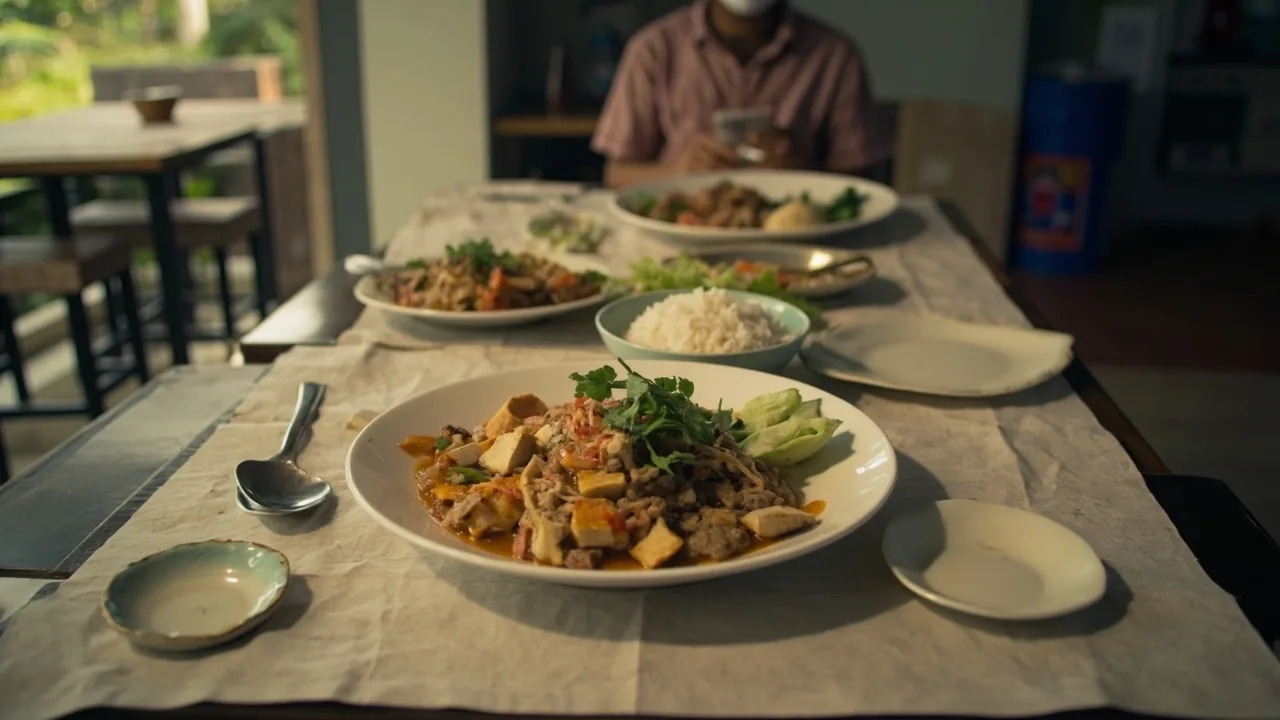
This is exactly the dish the dedicated Chiang Dao vegan spot Kao Man Kai Jay Vegan Food ข้าวมันไก่เจ (4.8) is named after. It’s a vegan take on the classic Hainanese-style chicken rice, with soy-based protein or tofu in place of chicken and seasoned rice on the side. Travellers rate this place 4.8 specifically because they nail the flavour without any of the meat. Expect to pay ₹172-₹258 (~60-90 THB or ~$1.79-$2.68).
Recommended Vegetarian Restaurants and Cafes in Chiang Dao
Chiang Dao’s veg-friendly spots break into two camps: the local/regional kitchens that lean into northern Thai cooking, and the farm-to-table cafes that have grown up with the yoga/retreat crowd. Both are worth your time, and both serve predominantly vegan food.
Local / Regional Spots
Kao Man Kai Jay Vegan Food ข้าวมันไก่เจ (4.8): The standout dedicated vegan Thai kitchen in town. Tiny, no-frills, mostly locals eating here, with a small English menu. The signature is the namesake dish, but they also do Jay versions of standard Thai curries and stir-fries. Budget around ₹172-₹287 (~60-100 THB or ~$1.79-$2.98) for a plate.
TATA Chiang Dao Cafe and Farm (4.6): A farm-to-table cafe set on a working farm, with much of the produce grown on-site. The menu rotates but usually includes Jay versions of northern Thai curries, fresh salads, herbal drinks, and house-made desserts. Plates run ₹345-₹574 (~120-200 THB or ~$3.57-$5.96), smoothies ₹201-₹258 (~70-90 THB or ~$2.09-$2.68). The vibe is relaxed outdoor seating with a view of the fields, and it’s the kind of place where vegetarians, vegans, and omnivores can all order from the same menu confidently.
MonMo Cafe’ @Chiangdao (4.8): A local cafe with consistently high ratings, doing both Thai and Western breakfasts and lunches. Travellers report the kitchen handles vegan requests well, with several marked veg/vegan options on the menu. Good coffee, fresh juices, and a quiet setting. Expect ₹230-₹431 (~80-150 THB or ~$2.38-$4.47) for mains.
El Chiringuito Chiang Dao (4.6): A beach-themed restaurant that leans into the relaxed vibe. The menu leans Mediterranean but has reliable vegetarian plates and several vegan options. Mains around ₹431-₹718 (~150-250 THB or ~$4.47-$7.45), so it’s a bit more expensive than the local spots, but it’s a nice change of pace and good for a long lunch.
Cafes Worth Knowing
There are a handful of smaller cafes around Chiang Dao that come and go with the season. Travellers report that almost every cafe in town has at least one vegan option, and many have oat milk or plant milk for coffee. If you find a place you like, eat there twice; small cafes in Chiang Dao depend on local traffic and can disappear between visits.
When You Need an Indian Food Fix
Chiang Dao does not have a proper Indian restaurant, and it probably won’t have one anytime soon. If you’ve been on the road for a week and need dal-chawal, paneer, or a real masala chai, the fallback is a day trip down to Chiang Mai. The Chiang Mai options are genuinely good and well-priced.
Kanchan Indian Food (Home Made, Pure Veg) (4.8): The clearest answer for strict vegetarians. A family-run kitchen in Chiang Mai doing Punjabi-style pure veg food, home-style cooking, fresh ingredients. Reviewers mention the dal, paneer dishes, and chapati. Expect ₹345-₹574 (~120-200 THB or ~$3.57-$5.96) per plate.
Chada Vegetarian Restaurant Chiang Mai (4.8): A dedicated vegetarian kitchen serving a mix of Thai and Indian dishes, with Jain-friendly options. The yellow Jay flag is sometimes displayed. Plates ₹230-₹431 (~80-150 THB or ~$2.38-$4.47).
INDIAN Bites Cafe & Vegetarian and Vegan Restaurant (4.9): A newer health-focused spot in Chiang Mai doing South Indian vegetarian and vegan dishes. Strong reviews for dosas, idli, and South Indian thalis. Around ₹431-₹632 (~150-220 THB or ~$4.47-$6.55).
Little Indian Kitchen Chiang Mai Night Bazaar (4.9): Halal Indian, vegan-friendly, near the Night Bazaar. Strong ratings from Indian travellers specifically. Good for a dinner after shopping.
Chai “N” Thai @ Nimman (4.9): Right in the Nimman area, with vegan North Indian and South Indian options.
Coconuts N Cocktails Indian Restaurant Night Bazaar (4.9): Casual North Indian with tropical cocktails, more of a vibe than a budget spot, but good for a treat.
For the broader Thailand picture, the Indian restaurants in Thailand guide covers the rest of the country.
Food Safety & Hygiene
Chiang Dao’s water is not safe to drink from the tap. Bottled water is cheap and everywhere: ₹20-₹43 (~7-15 THB or ~$0.21-$0.45) for a 1.5 L bottle. The mountain spring water around Chiang Dao is genuinely good, but don’t drink it untreated just because it looks clean.
A few rules worth following in Thailand:
- Eat where locals eat. If a small Chiang Dao restaurant has six Thai customers at 11:30 AM, the turnover is good and the food is fresh.
- Avoid buffets at room temperature. Rice and curries left out for hours are the most common cause of food poisoning, not street food.
- Skip ice unless it’s from a reputable cafe. Most places in Chiang Dao use commercial ice that’s safe, but if you’re at a remote stall and the ice looks like it’s been sitting in a cooler for a day, skip the drink.
- Wash fruit yourself or peel it. Markets sell pre-cut fruit that’s been sitting out. Whole fruit is safe.
- Carry ORS. Travellers from India usually have it at home; bring a few sachets. Diarrhoea is rarer up here than in Bangkok, but it still happens.
Subodh’s Pro Tip: Thailand pharmacies sell Smecta (diosmectite) and Loperamide over the counter for around ₹86-₹144 (~30-50 THB or ~$0.89-$1.49). If you get hit, you can rehydrate and slow things down while you figure out whether to see a doctor.
Getting Connected
You’ll want a working SIM in Chiang Dao for maps (Google Maps works well for finding the cafes above), translation, and Grab if you need a ride back from the caves at night. Most cafes have Wi-Fi, but it’s not reliable.
Physical SIM: AIS, TrueMove, and dtac all sell tourist SIMs at Chiang Mai airport or any 7-Eleven. A 15-day tourist package with 50-100 GB is typically ₹859-₹1,433 (~299-499 THB or ~$8.91-$14.86). Buy in Chiang Mai before heading up to Chiang Dao since stock is limited at smaller shops.
eSIM option: Get Nomad eSIM before you fly. Same idea, no SIM-swap hassle, and you can activate on landing. India eSIMs and physical Indian SIMs generally don’t roam well in Thailand, so this is worth sorting out before departure.
Common Food Mistakes Indians Make in Chiang Dao
1. Assuming “vegetable stir-fry” is safe. What happens: It comes with oyster sauce and fish sauce already in it. You eat it, then realise it’s not even close to vegetarian. How to avoid: Always say “gin jay, mai sai nam man hoi, mai sai nam pla” when ordering stir-fries and curries.
2. Trusting “no meat” without specifying no fish sauce. What happens: Thai cooks consider fish sauce to be seasoning, not meat, so “no meat” doesn’t mean no nam pla. How to avoid: The phrase you need is “mai sai nam pla” (no fish sauce). It’s the single most important phrase for Indian vegetarians in Thailand.
3. Not asking about chicken broth. What happens: Soup, tom yum, even some noodle broths use chicken stock as the base. A “clear vegetable soup” might be chicken stock. How to avoid: For soups, ask for “nam sup pak, gin jay” (vegetable broth, vegan) or skip soups you didn’t specifically order as Jay.
4. Ordering mango sticky rice from a vendor who’s been sitting in the sun. What happens: The coconut milk and sticky rice ferment in heat, and you get a stomach issue. How to avoid: Buy from a busy stall with high turnover, ideally one preparing it in front of you. Same applies to any coconut-milk-based dessert.
5. Missing the Jay flag. What happens: You walk past a fully Jay kitchen because it has no English sign. How to avoid: Look for the yellow flag with red Thai text. It’s the universal Jay marker across Thailand. Many Chiang Dao cafes also have a small “Vegan” or “Jay” sticker on the door.
Where to Stay
For Chiang Mai vegetarian food options as a base, most travellers stay in the Nimman or Old City area and day-trip up to Chiang Dao.
Getting to Chiang Dao
From Chiang Mai, the easiest route is a minivan from Chang Phueak Bus Terminal (sometimes called the Arcade Terminal). Buses run roughly every hour from 6 AM to 5 PM, take about 90 minutes, and cost around ₹287-₹431 (~100-150 THB or ~$2.98-$4.47). You can book the Chiang Mai to Chiang Dao route on 12go and skip the queue.
Coming from Chiang Rai, take a bus to Chiang Mai and get off at Mae Malai junction, then catch a local songthaew or motorbike taxi the last 25 km into Chiang Dao. The whole route takes 7-8 hours and costs around ₹718-₹1,005 (~250-350 THB or ~$7.45-$10.43).
FAQ
Is Chiang Dao safe for strict vegetarians? Yes, more so than most Thai towns. The presence of dedicated vegan spots like Kao Man Kai Jay and TATA means you don’t have to fight for modifications at every meal. Use the gin jay phrase and you’ll be fine.
Can I get Jain food (no onion, no garlic) here? Thai Jay already excludes onion and garlic, so most Jay-marked spots are accidentally Jain-friendly. The Kanchan Indian Food kitchen in Chiang Mai and Chada Vegetarian Restaurant are also explicitly Jain-aware if you need to drop down to the city.
Is fish sauce used in everything? Closer to “most savoury dishes.” Rice, plain noodles, fresh fruit, smoothies, and most desserts are safe. Curries, stir-fries, soups, and dipping sauces almost always have it unless the kitchen is doing a Jay version.
Is the water safe? No. Drink bottled or filtered water. Ice from cafes and restaurants is usually commercial and safe; ice from small unmarked stalls is a gamble.
Can I find vegan options for trekking lunches? Most Chiang Dao-based trekking operators offer vegetarian lunch on request. If you’re booking through your hostel or guesthouse, ask specifically for gin jay and confirm they’ll skip egg and fish sauce in the onigiri/rice pack.
Are McDonald’s or Burger King safe in Chiang Dao? There’s no McDonald’s or Burger King in Chiang Dao itself. In Chiang Mai, both chains have vegetarian options (McDonald’s has a corn pie and veggie burgers on certain menus, and Burger King has a long-standing veg bean burger). Bring up the specific ingredients at the counter, as sauces vary by country.
Subodh’s Take
Chiang Dao is one of the easiest small Thai towns to eat vegetarian in, mainly because the crowd that comes here specifically asks for plant-based food and the local kitchens have responded. You won’t get Bangkok’s variety or Chiang Mai’s late-night food court energy, but you’ll eat well, you’ll eat cheap, and you might just eat the best Jay khao soi of your trip. Come for the caves and the mountain, stay for the khao soi.
