Vegetarian Food in Vietnam: Where to Eat, What to Order & How Much It Costs
Vietnam is one of the easier Southeast Asian countries to eat well as a vegetarian Indian, if you know the right words and the right cities. I cross-checked current menus against the official Vietnam National Administration of Tourism site and recent traveller reports from Hanoi and Ho Chi Minh City for this guide, and the picture is genuinely good: Hanoi alone has more dedicated vegetarian restaurants than Phnom Penh and Vientiane combined, pho can be ordered without meat broth at most stalls, and a basic veg meal runs ₹74-₹184 (~20,000-50,000 VND or ~$0.76-$1.91). The catch is that fish sauce (nuoc mam) sits in almost everything, and what locals call “vegetarian” sometimes still includes egg, dried shrimp, or chicken stock. Once you learn to say chay (vegetarian) and khong nuoc mam (no fish sauce), most stalls will cook you a clean bowl. This guide covers the dishes that are safe by default, the phrases that keep them safe, the restaurants that go further than the basics, and what to expect at airport food courts where the risk goes up.
Quick Answers
For Hanoi-specific cafes and coffee stops, our Hanoi coffee and egg coffee guide is the companion read.
| What | Answer | Price (INR) |
|---|---|---|
| Cheapest safe veg meal (street stall) | ₹74-₹184 (~20,000-50,000 VND or ~$0.76-$1.91) | ₹65-₹165 (~$0.67-$1.71) |
| Vegetarian pho (no meat broth) | ₹147 (~40,000 VND or ~$1.53) | ₹130 (~$1.35) |
| Banh mi with extra veg, no pate | ₹55 (~15,000 VND or ~$0.57) | ₹50 (~$0.52) |
| Bun cha with tofu swap | ₹129 (~35,000 VND or ~$1.34) | ₹115 (~$1.19) |
| Bottled water (essential) | ₹18 (~5,000 VND or ~$0.19) | ₹16 (~$0.17) |
| Pure veg Indian thali in Hanoi | ₹368-₹552 (~100,000-150,000 VND or ~$3.82-$5.73) | ₹330-₹495 (~$3.42-$5.13) |
The Local Culinary Landscape
Vietnamese food has a vegetarian-friendly skeleton under all the meat. Rice, noodles, tofu, morning glory, eggplant, mushrooms, herbs, and bean sprouts form the base of half the menu at any typical stall. The issue is what gets added on top.
The hidden ingredients that catch Indians out:
- Fish sauce (nuoc mam) is in roughly 80% of savoury dishes, including most stir-fries, dipping sauces (the clear one served with banh xeo, the brown one with bun cha), and even some “plain” rice plates. A bowl of white rice with a side of greens is usually safe, but ask.
- Shrimp paste (mam tom) is less common than in Thailand but shows up in central Vietnamese dishes like bun bo Hue and some dipping sauces.
- Lard is used to grease grills and woks in many street stalls, especially in the north. A banh mi grilled on the same surface as pork will pick up traces.
- Chicken or pork broth is the default base for pho, bun bo Hue, and most noodle soups. The veg version exists but you have to ask.
- Egg appears in banh cuon, banh xeo (sometimes), and most chau (stir-fried) dishes. Specify khong trung (no egg).
Local attitudes toward vegetarianism: Vietnam has a strong Buddhist vegetarian tradition, especially around the 1st and 15th of the lunar month, when many locals eat chay (vegetarian) for the day. During these periods you will see quan chay (vegetarian restaurants) doing brisk business, and street stalls put up yellow flags with red Vietnamese characters reading “món chay” (vegetarian dishes). Outside those dates, the term chay is widely understood but interpreted loosely. The looseness is the danger: a vendor who hears chay and is also hungry might just remove the visible pork and leave the fish sauce in. Be specific. Say chay khong nuoc mam, khong trung, khong hanh (vegetarian, no fish sauce, no egg, no onion/garlic) for the strict version.
One thing worth knowing: seafood is not considered vegetarian here. If you say you’re vegetarian, no one will offer you fish. Chicken, however, occasionally gets offered to non-meat-eaters by well-meaning hosts who think poultry is “lighter.” State that you don’t eat meat, fish, or poultry, and use the word thuan chay (pure vegetarian) for emphasis.
Key Phrases in Local Script
Print this table or screenshot it. These phrases get you through 90% of ordering situations.
| English Phrase | What it Means | Local Script | Pronunciation |
|---|---|---|---|
| I am vegetarian | I don’t eat meat, fish, or poultry | Tôi ăn chay | toy an chay |
| Pure vegetarian | Strictly no animal products at all | Tôi ăn thuần chay | toy an thwan chay |
| No fish sauce | Please leave out nuoc mam | Không nước mắm | khong nuk mam |
| No meat | No pork, beef, chicken | Không thịt | khong thit |
| No seafood | No fish, shrimp, squid | Không hải sản | khong hai san |
| No egg | Leave out egg | Không trứng | khong trung |
| No onion / garlic (Jain) | Important for Jains | Không hành tỏi | khong hanh toy |
| Vegetable only | Just greens and tofu | Chỉ rau | chee row |
| Is there meat in this? | To check a specific dish | Có thịt trong này không? | ko thit trong nay khong |
| Thank you | Basic courtesy | Cảm ơn | kam ern |
For Jain travellers, the khong hanh toi (no onion/garlic) line is the most important one in the table. Most Vietnamese veg dishes don’t use much onion or garlic anyway, but pho broth typically does, and nuoc cham dipping sauce often has garlic. At dedicated Indian restaurants (listed below), this is handled without question.
Safe Local Street Food Dishes
These are dishes that are either vegetarian or trivially customised at any well-run stall.
1. Pho Chay (Vegetarian Pho) This is the local adaptation of the national dish: rice noodles in a vegetable broth, usually with tofu, mushrooms, and morning glory on top. The broth is the risk. Most stalls use a separate veg stock during the lunar-month chay periods; outside those dates, ask whether the stock is pork-based or vegetable-based. At stalls that serve both, the chay version typically costs the same or ₹18 (~5,000 VND or ~$0.19) more. Price: ₹147 (~40,000 VND or ~$1.53). Order: Pho chay, khong nuoc mam, khong trung (vegetarian pho, no fish sauce, no egg). Hoang’s Restaurant in Hanoi is a reliable spot for a clean version.
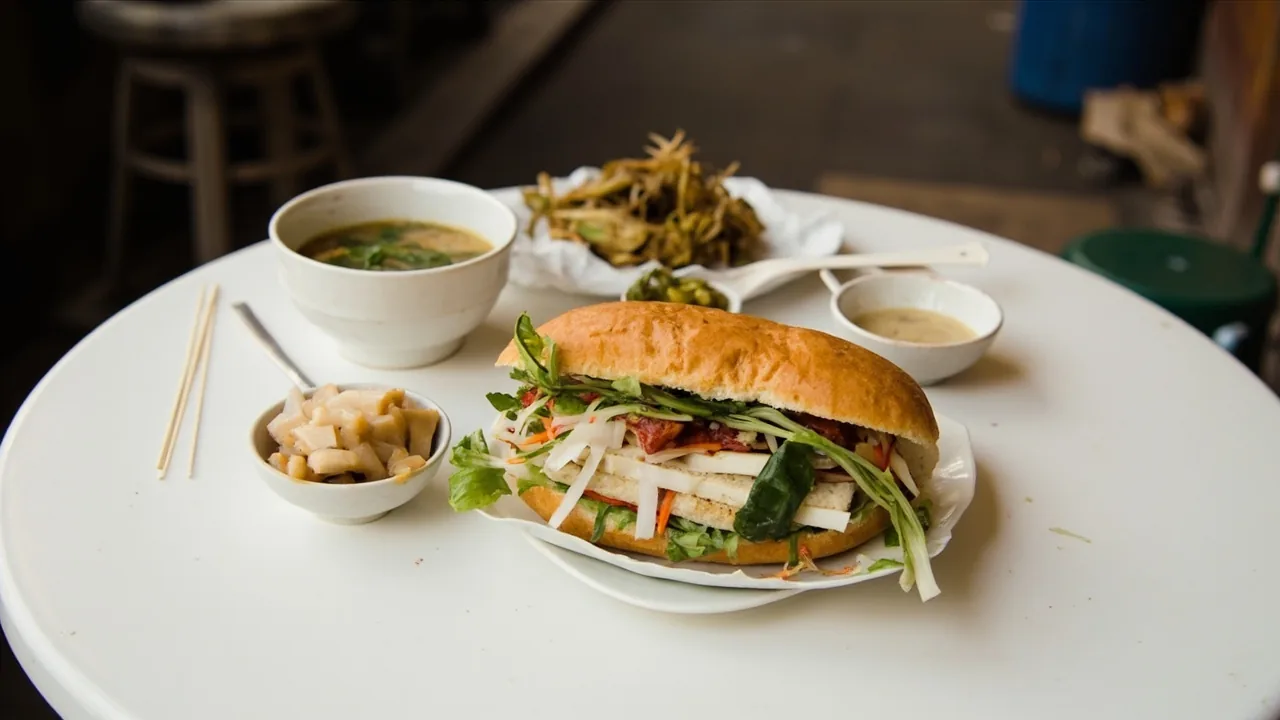
2. Banh Mi Chay (Vegetarian Baguette) The Vietnamese sandwich with pickled carrot and daikon, cucumber, cilantro, chili, and a protein (tofu, mock meat, or just cheese). The risk is the pork pate that most vendors spread on the bread, and the mayo (often made with egg). Price: ₹55 (~15,000 VND or ~$0.57). Order: Banh mi chay, khong pate, khong trung (veg banh mi, no pate, no egg). The egg-coffee question is a separate one, covered in our Hanoi coffee guide.
3. Com Chay (Vegetarian Rice Plate) A plate of white rice with stir-fried greens, tofu, and a veg curry or mushroom dish on top. Found at quan chay restaurants and at many general stalls during chay days. Price: ₹110-₹184 (~30,000-50,000 VND or ~$1.15-$1.91). Ask which components are cooked with fish sauce and skip those.
4. Banh Xeo Chay (Vegetable Sizzling Pancake) The yellow turmeric-rice-flour crepe, normally filled with pork and shrimp, can be ordered vegetarian with just mung beans and bean sprouts. Price: ₹110-₹184 (~30,000-50,000 VND or ~$1.15-$1.91). It comes with a herb platter and dipping sauce; the dipping sauce is where fish sauce hides. Ask for nuoc cham chay (veg dipping sauce) or skip the dip and use the soy-based one some stalls keep separate.
5. Bun Chay (Vegetarian Vermicelli Bowl) Cold rice vermicelli with grilled tofu, fresh herbs, pickled veg, and peanuts, dressed in a soy-based sauce. Vegetarian if ordered at a quan chay. Price: ₹129 (~35,000 VND or ~$1.34). This is the single safest mainstream Vietnamese dish for vegetarians; the sauce at dedicated veg places is soy-based and there’s no meat stock anywhere in the bowl.
6. Che (Sweet Dessert Soup) A sweet dessert soup with beans, mung beans, jelly, coconut milk, and fruit. Always vegetarian, often vegan. Price: ₹37-₹74 (~10,000-20,000 VND or ~$0.38-$0.76). Excellent after-dinner option if you want something safe and cooling.
For a structured way to find these dishes on the ground, consider the Small-Group Street Food Walking Tour in Hanoi, where the guide knows which stalls keep separate veg woks and which ones don’t.
Recommended Vegetarian Restaurants
Local and Vietnamese vegetarian spots
Hoang’s Restaurant (Hanoi Old Quarter). A vegan-friendly Vietnamese restaurant with a 4.9 rating across traveller platforms. The vibe is cozy and welcoming, the menu has both Vietnamese classics and a separate dedicated veg section, and the staff speak enough English to handle the khong nuoc mam request without confusion. Good for pho chay and bun chay when you want a sit-down version of street food. A meal runs ₹221-₹442 (~60,000-120,000 VND or ~$2.29-$4.58).
MẸT Vietnamese Restaurant & Vegetarian Met 2 (Hanoi). A 4.9-rated spot for vegetarian Vietnamese dishes with a lively, slightly more local atmosphere. MẸT is popular with both travellers and Vietnamese vegetarian diners, which is a good sign: it means the food isn’t dumbed down for tourists. Try the com chay plate and the fresh spring rolls.
The Hanoi Cafe. A 4.8-rated quiet cafe in the Old Quarter, good for a calm break with tofu banh mi and Vietnamese coffee (the coffee itself is veg; just skip the condensed milk if you’re vegan). Not a full restaurant, but a reliable stop when you’ve been walking all day and want something clean.
The King Cafe. A 4.8-rated charming cafe with a cozy atmosphere. Useful for breakfast (tofu banh mi, veg congee) when most street stalls aren’t yet open.
Pure vegetarian Indian restaurants (Hanoi)
Sattva Pure Vegetarian Indian Restaurant. The most consistently reviewed pure-veg Indian spot in Hanoi, 4.9-rated, with a casual sit-down setup. The paneer butter masala is the dish most reviewers single out. A full thali costs ₹368-₹552 (~100,000-150,000 VND or ~$3.82-$5.73) per person, which is on the higher end of Hanoi eating but fair for a sit-down Indian meal. Jain options available on request.
AMY Indian Restaurant. A 4.8-rated pure-veg and Jain restaurant with a focus on South Indian flavours. Idli, dosa, sambar, and the kind of filter coffee that survives being 4,000 km from home. Useful if you’ve been eating rice and noodles for a week and need a proper tiffin morning.
Rutba Indian Restaurant. A 5.0-rated pure-veg and Jain spot. Smaller menu than Sattva but the curries are good and the staff are patient about spice levels.
The TAJ Indian & Vegetarian Restaurant (Hanoi Old Quarter, Hoan Kiem). A 4.8-rated family-run North Indian restaurant in the heart of the tourist area. Handy if you’re staying around Hoan Kiem Lake and don’t want to travel far for a familiar meal.
Rishikesh Indian Restaurant. A 4.8-rated pure-veg and Jain option, popular with the longer-stay Indian traveller community in Hanoi. The thalis rotate; ask what’s fresh.
In other cities
Hanoi has the strongest Indian vegetarian scene in the country by a wide margin. Ho Chi Minh City has fewer pure-veg Indian restaurants but more Vietnamese vegetarian spots; Hoi An has a few dedicated quan chay near the old town and a growing Indian scene around An Bang Beach; Da Nang has at least two pure-veg Indian places near the backpacker strip. Travellers heading to Hoi An specifically should look at our dedicated Hoi An vegetarian food tour for vetted stalls and a walking route. For a broader Vietnamese food overview that covers non-veg dishes too, the main Vietnam food guide is the better starting point.
Food Safety & Hygiene
The “Delhi belly” risk in Vietnam is real but manageable. The food itself is usually safer than traveller folklore suggests: it’s cooked at high heat, served fast, and eaten by locals at the same stalls. The bigger risks are water, ice, and the odd raw herb.
- Drink only bottled or filtered water. Bottled water is ₹18 (~5,000 VND or ~$0.19) for 500ml anywhere. Tap water in Vietnam is not drinkable, see the tap water guide for city-by-city details. When ordering drinks, ask for khong da (no ice) unless you’re at a place that uses purified water for ice (most decent cafes and restaurants do; street stalls are a coin flip).
- Eat at busy stalls with high turnover. A stall with 20 customers an hour is safer than an empty one with the same food on display. The food hasn’t been sitting.
- Avoid raw vegetables you didn’t see washed. The herb platter that comes with pho and banh xeo is washed in tap water. Travellers report mixed experiences. If your stomach is sensitive, skip the raw herbs or wash them yourself in bottled water.
- Skip the shellfish, even when vegetarian. Oysters and clams are sometimes offered as “light” veg options by hosts who don’t understand the definition. Decline politely.
- Carry ORS. The Indian pharmacy brands aren’t sold in Vietnam but locally made oral rehydration salts are at any pharmacy (nha thuoc) for under ₹37 (~10,000 VND or ~$0.38). Buy two packs before you travel.
- Wash hands before street food. Carry a small bottle of sanitizer; the wet wipes sold at convenience stores work too.
Getting Connected
You’ll want Google Translate (for the phrases above when spoken), Grab (to call a motorbike to the nearest veg restaurant), and Maps.me for offline navigation in older parts of Hanoi where street signs are sparse. For data on arrival, both a local Viettel SIM and an eSIM work well. Get Nomad eSIM covers Vietnam and you can install it before you fly.
Common Food Mistakes Indians Make
1. Trusting the yellow flag without checking. Many travellers see the món chay yellow flag and assume the stall is fully vegetarian. Often it just means “we serve a couple of veg options” alongside meat. The veg option is usually fine; the wok is not always separate. Check that the kitchen isn’t shared with pork.
2. Assuming pho is safe because it “looks like” vegetable broth. The clear broth at most pho stalls is pork and beef bone stock, simmered for hours. It looks the same as the veg version. Always ask.
3. Ordering “no meat” but accepting fish sauce. Vietnamese cooks interpret “no meat” generously: no pork, no beef, no chicken, but the fish sauce stays. Chay alone isn’t enough; chay khong nuoc mam is.
4. Eating banh mi pate without thinking. Pate is the default spread at most banh mi stalls and it’s pork liver. It looks like butter. Say khong pate and watch them spread it.
5. Skipping the nuoc cham dipping sauce “to be safe.” The dipping sauce usually contains fish sauce and sometimes shrimp paste. Skipping it is the right call. But some stalls have a separate nuoc cham chay soy-based version. Worth asking.
6. Trusting that “vegetarian” at an Indian restaurant means Jain. Many Vietnamese-Thai “pure veg” Indian places serve onion and garlic freely. If you’re Jain, state no onion, no garlic explicitly. At Sattva, AMY, Rutba, and Rishikesh in Hanoi, the staff handle this routinely.
7. Overpaying at airport food courts. Airport food in Vietnam is roughly double the city price and the veg selection is worse. Eat before you fly or bring snacks. A veg banh mi from a city stall at ₹55 (~15,000 VND or ~$0.57) beats the ₹295 (~80,000 VND or ~$3.06) airport sandwich every time.
Subodh’s Take
Vietnam is genuinely one of the better Southeast Asian countries for vegetarian travellers, better than Cambodia (where the Indian food scene is thinner) and arguably easier than parts of Thailand once you know the phrases. Hanoi is the hub: pure veg Indian restaurants, dozens of quan chay, and street stalls that will customise without attitude. The dishes that work are the rice and noodle ones with a veg protein swap; the dishes to watch are the broths and the dipping sauces. Learn chay khong nuoc mam, print the phrase table, carry an ORS pack, and you’ll eat well for under ₹921 (~250,000 VND or ~$9.55) a day. For more on getting around between the veg-friendly cities, the Vietnam itinerary guide maps out a Hanoi-to-Ho-Chi-Minh route with veg-friendly stops.
FAQ
Is Vietnamese cuisine vegetarian-friendly overall? Yes, especially the rice, noodle, and tofu dishes. The base ingredients are vegetable-heavy; the problem is the flavour-builders (fish sauce, shrimp paste, chicken stock) that get added. With the right phrases, about 60-70% of the menu becomes accessible.
Can I eat vegetarian in Hanoi without speaking Vietnamese? At dedicated Indian or vegetarian restaurants, yes, English menus are common. At street stalls, you’ll need the phrases or Google Translate. Most stalls with a foreigner clientele have a picture menu.
Is fish sauce used in everything? Not everything, but most savoury dishes. Plain rice, fresh fruit, che dessert, and most stir-fried greens can be ordered without it. Soups, dipping sauces, and any dish described as “mixed” or “special” almost always contain it.
Can Jains eat at regular Vietnamese restaurants? With effort. The bigger risk for Jains is onion and garlic, which appear in stir-fries and broths. Most street stalls can omit them if you ask; the dish will taste a bit blander but stay safe. For strict Jain, the pure-veg Indian restaurants in Hanoi (Sattva, AMY, Rutba, Rishikesh, TAJ) handle it without question.
What about airport food when I’m flying in or out? Avoid relying on it. The veg options are limited, expensive, and the fish-sauce risk is higher because turnover is low. Eat in the city before heading to the airport. Most Hanoi flights depart early; the Indian restaurants near Hoan Kiem (Sattva, TAJ) open by 8am.
Is vegetarian food in Vietnam cheaper than Cambodia? On the street, similar. A veg banh mi at ₹55 (~15,000 VND or ~$0.57) is roughly the same as a veg sandwich in Phnom Penh at ₹145 (~1.50 USD). The difference is at the Indian-restaurant tier: Hanoi has more pure-veg Indian places and the prices are slightly lower. A veg thali at ₹368-₹552 (~100,000-150,000 VND or ~$3.82-$5.73) in Hanoi is competitive with Phnom Penh’s Indian restaurants.
Do I need to worry about MSG? Vietnamese cooking uses MSG more than most cuisines. It’s hard to avoid completely. If you’re sensitive, mention it; most upscale restaurants will skip it on request, street stalls usually won’t.
